

Designing Tax-Smart Salary Sacrifice Policies for Your Electrical Crew: Super, Laptops And Vehicles Without Surprise FBT
Share this article
Published on July 23, 2026
Designing tax-smart salary sacrifice policies for your electrical crew starts with understanding how salary sacrifice, super, laptops and vehicles are treated for tax purposes. A clear policy can help employees use their pre-tax salary effectively while protecting your electrical business from unexpected Fringe Benefits Tax (FBT), payroll corrections and reporting issues. Salary packaging can support employee retention and provide greater choice over total remuneration. However, the arrangement must be established correctly, reflect any employment or industrial agreement, and explain which benefits may affect an employee’s taxable income, income statement or reportable fringe benefits amount.
Is Salary Sacrifice a Fringe Benefit?
Salary sacrifice is not automatically a fringe benefit. It is an arrangement where an employee agrees to give up part of their future salary or wages in return for benefits of a similar value, such as additional super contributions, a portable electronic device or access to a vehicle. The tax treatment depends on the benefits provided. Benefits generally fall into three groups: fringe benefits, exempt benefits and employer super contributions. Your business may need to pay FBT on certain benefits, while other benefits can be exempt when the required conditions are met, just as GST-registered businesses must carefully manage GST credits and ATO compliance obligations on eligible purchases.
Confused about FBT on employee benefits?
Schedule a complimentary consultation with us today to clarify FBT obligations and avoid unexpected costs.
An Effective Salary Sacrifice Arrangement Starts Before Pay Is Earned
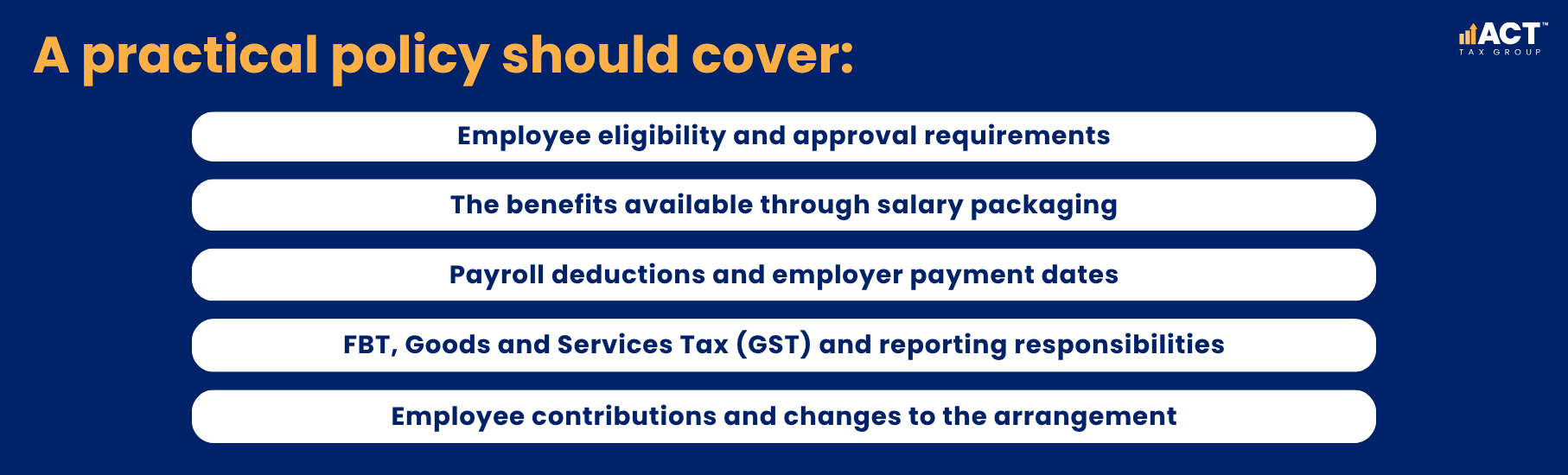
An effective salary sacrifice arrangement must be agreed to before the employee earns the relevant salary. The sacrificed salary is replaced with the agreed benefit, and the employee must not be able to access that sacrificed amount. An arrangement cannot apply to salary, wages or entitlements the employee has already earned or accrued. The agreement should be in writing and should explain the reduced salary, the benefit, associated costs and the period covered. It should also confirm that salary-sacrificed amounts do not reduce the ordinary time earnings used to calculate compulsory Superannuation Guarantee (SG) contributions and do not count towards the employer’s required SG contributions.
Salary-Sacrificed Super Requires Careful Cap Monitoring
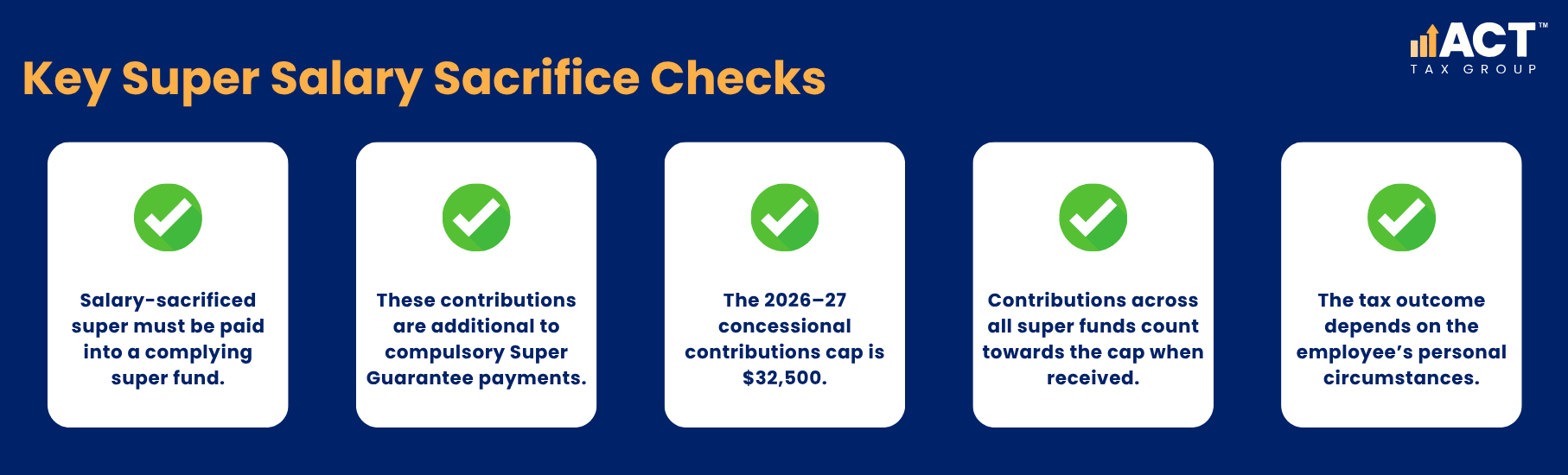
Salary-sacrificed super contributions paid into a complying super fund are treated as employer contributions rather than fringe benefits. These payments are additional to the Super Guarantee contributions your business must make, so they cannot replace your existing employer super obligations. For the 2026–27 financial year, the general concessional contributions cap is $32,500. This cap covers salary-sacrificed super contributions, compulsory employer contributions and personal contributions claimed as a tax deduction across all of the employee’s super funds. Contributions count towards the cap in the financial year the super fund receives them.
Under an effective salary sacrifice arrangement, contributions made to a complying super fund do not form part of the employee’s assessable salary or wages and are treated as employer contributions. However, the outcome will depend on their marginal tax rate, Medicare levy, existing super contributions and personal circumstances, so the arrangement should not be presented as suitable for every employee.
Work Laptops Can Be Exempt Benefits
A laptop or similar portable electronic device can be an exempt benefit when it is provided mainly for work-related use. For an electrical crew, appropriate use may include accessing job plans, recording site information, managing schedules, preparing reports or communicating with clients and supervisors. The exemption generally applies to one item with a substantially similar function during an FBT year. A small business with aggregated turnover of less than $50 million in an income year that starts or ends in the relevant FBT year can provide more than one qualifying portable electronic device, even where the devices have substantially identical functions. The devices must still be mainly used for work.
A policy should distinguish between an employer-provided device and an expense payment that reimburses an employee. It should also explain responsibility for repairs, software, home phone costs, private use and returning equipment when employment ends.

Vehicles Need Strong Private-Use Rules
Company cars and other vehicles are common fringe benefits and can create an obligation to pay Fringe Benefits Tax. FBT may arise when a vehicle is available for private use, including when an employee keeps it at home, even when the vehicle is mainly used for electrical work during business hours. An eligible ute, van or other qualifying vehicle may be exempt from FBT where private use is limited to travel between home and work, travel incidental to employment duties, and other private use that is minor, infrequent and irregular. Your business must be able to demonstrate that these conditions are met.
Eligible battery electric and hydrogen fuel cell cars may be exempt from FBT where the required conditions are met, including the rules for when the car was first held and used and whether Luxury Car Tax applied. Plug-in hybrid electric cars generally stopped qualifying from 1 April 2025 unless transitional conditions apply. The exempt benefit remains reportable where the reporting threshold is exceeded, so calculate its notional taxable value and any employee contributions before including the car in a salary packaging arrangement.
Power up your business with Accounting Built for Electricians
From start-up to expansion, our accounting team supports your tax, payroll, and cash flow at every stage of growth.
How ACT Tax Group Can Help with Salary Sacrifice and FBT Policies
We can review your proposed salary sacrifice arrangement, assess the tax treatment of each benefit and help you establish practical payroll and record-keeping processes. Our IPA-certified team can also help you understand employer contributions, reportable fringe benefits and potential FBT before benefits are provided. Book a consultation with ACT Tax Group to arrange a policy review for your electrical crew. We provide tailored advice that helps you manage compliance, control costs and give employees clear information about their salary packaging options.

Keep Your Crew Benefits Clear and Compliant
A well-designed policy separates super, work devices and vehicles because each benefit has different tax and reporting requirements. Written agreements, accurate payroll records and regular reviews reduce the risk of a benefit unexpectedly becoming taxable or creating an FBT liability, in the same way that timely ASIC lodgements and proactive monitoring help businesses avoid ASIC late fees and penalties. Review each arrangement before the employee earns the sacrificed salary and again when their role, vehicle or benefits change. This gives your electrical business clearer costs while helping your crew make informed decisions about their remuneration.

Lukasz Klekowski
Principal of ACT Tax Group, specialising in tax compliance and financial strategy for Australian small businesses.

Share this article
Disclaimer: All information provided in this publication is of a general nature only and is not personal financial or investment advice. It does not take into account your particular objectives and circumstances. No person should act on the basis of this information without first obtaining and following the advice of a suitably qualified professional. To the fullest extent permitted by law, no person involved in producing, distributing or providing the information in this publication (including ACT TAX GROUP PTY LTD, each of its directors, councilors, employees and contractors and the editors or authors of the information) will be liable in any way for any loss or damage suffered by any person through the use of or access to this information. The Copyright is owned exclusively by ACT TAX GROUP PTY LTD (ABN 31634338088)