


Salary Packaging Explained for Electrician Employers and Employees
Published on March 30, 2026
Salary Packaging Explained for Electrician Employers and Employees is really about sing part of your before-tax salary under an effective salary sacrifice arrangement that is permitted under current tax law and ATO guidance. When you understand how salary packaging works, you can offer a salary package that helps your team reduce taxable income and boost take home pay while you stay on top of tax and payroll.
What Salary Packaging Really Means for Electricians
If you are running an electrical crew, you are dealing with wages, vehicle expenses, tools, and constant credit card payments for materials. On top of that, you and your employees pay income tax on every payday, and any mistake shows up later as a bigger tax bill. Salary packaging gives you a way to swap some pre tax income for specific benefits of similar value, so employees may pay less tax and feel more in control of their home pay.
In simple terms, a salary packaging arrangement is an agreement between an employer and employees to take less income in cash and more value in other benefits. That might be extra superannuation contributions, a motor vehicle, or other benefits that fit the ATO approved rules. When it is set up properly, salary packaging can reduce income tax, but the outcome depends on the benefit chosen, any FBT, reportable fringe benefits, contribution caps, and the employee’s wider circumstances. It does not always increase take-home cash.
Worried your salary packaging could trigger unexpected ATO or FBT problems?
Schedule a complimentary consultation with us today to review your packages so they save tax without breaching ATO rules.
How Salary Packaging Affects Tax and Cash Flow
You might be thinking, “If my sparkies get a pay rise through salary packaging, do we just pay more tax somewhere else?” The key is understanding how pre-tax salary, fringe benefits and after-tax income all fit together so you can see the full picture for both the business and your crew.
Pre Tax Income, Taxable Income, and Take Home Pay
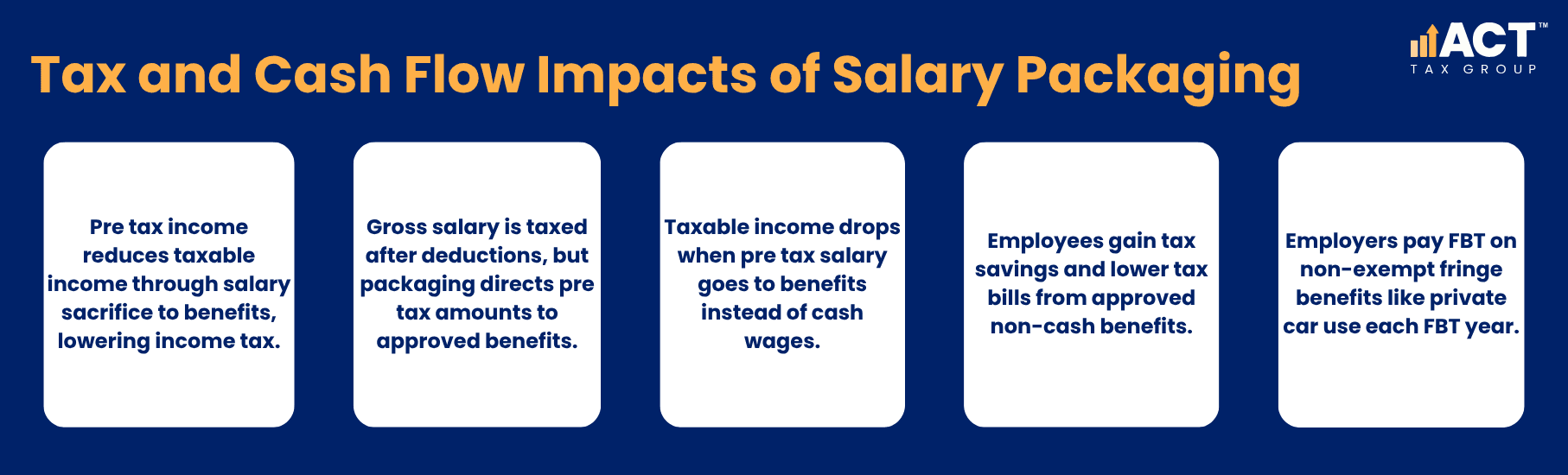
Your gross salary is the amount before you pay income tax or other deductions. Taxable income is what the tax office uses to calculate how much tax you pay each year. When you use salary sacrifice to direct part of your pre tax income into certain benefits, it can reduce your taxable income and lead to less tax being taken out of your wages.
For employees, this can mean tax savings and a lower tax bill at year end, because some of their pay is going into approved benefits instead of being taxed as cash income. For employers, it can make your salary packaging program a useful part of your overall pay strategy, helping you attract and keep good sparkies without simply throwing more money into wages alone.
Fringe Benefits Tax and When You Need to Pay It
Any time you provide fringe benefits instead of just paying wages in cash, you need to think about Fringe Benefits Tax. Fringe benefits can include things like a car for private use, certain expenses paid on behalf of an employee, or other specific benefits that form part of their salary package. As an employer, if those benefits are not exempt benefits, you may need to pay Fringe Benefits Tax each FBT year.
If you provide a motor vehicle as part of a package and the car is used for private trips, you may have to pay FBT on the taxable value of that benefit. In practice, the employer is liable for FBT, but the employee can still feel the impact because employers may ask for after-tax employee contributions to reduce FBT, and reportable fringe benefits can affect adjusted taxable income for some government payments and other income tests. For most for-profit electrical businesses, FBT exemption caps are usually not relevant, so any exemption needs to be checked carefully before assuming FBT will not apply.
Salary Packaging Options That Fit Electrical Businesses
The best salary packaging benefits for a small electrical business are usually the simple ones that you can track easily and explain clearly to your team. You want a salary packaging program that supports your crew’s financial situation without adding more admin than it is worth.
Salary Sacrifice Superannuation Contributions
Extra superannuation contributions are one of the most straightforward salary packaging benefits, and for older workers this can include using options like the Australian Downsizer Scheme to boost super from the sale of a home. Employees agree to salary sacrifice part of their pre tax salary into super instead of taking it as after tax income. This reduces your taxable income as an employee, which can mean less income tax and lower tax on that portion of income.
From the employer’s point of view, you must still pay the minimum super guarantee on the employee’s ordinary time earnings, and from 1 July 2025 that rate is 12%. On top of that, you send the agreed salary sacrifice amount to their super fund from their pre tax income. The result is that your employee may pay less tax overall, and you can offer a more attractive package without increasing wages as much in cash.
Cars, Motor Vehicles, and Novated Leasing
There are important exceptions. Eligible zero or low emissions cars first held and used on or after 1 July 2022 can be exempt from FBT, including under salary packaging, if Luxury Car Tax was never payable on the sale or import. On the other hand, dual-cab utes are not automatically exempt; limited private use rules must actually be satisfied. Some employers use novated leasing, where the employee’s pre-tax salary is used to cover lease payments and certain vehicle expenses, with the lease tied to their employment.
This can deliver tax savings for the employee by reducing their taxable income, and it can mean predictable costs for the business if managed carefully. However, if the vehicle does not qualify as an exempt benefit, you may still need to pay fringe benefits tax on the vehicle expenses or the value of private use. That is why it is important to understand whether your car setup is an ATO approved way of offering motor vehicles or whether you are likely to pay FBT each FBT year.
Everyday Expenses and Other Benefits
These items can be packaged, but for a standard for-profit electrical business they will usually be fringe benefits that create an FBT cost unless a specific exemption or reduction applies. For many electrician employers, especially those that are not not for profit organisations, these types of benefits are more limited and may trigger FBT or fall outside the standard rules.
If your business is a not-for-profit organisation that can access a higher FBT exemption cap, there may be more room to package certain expenses like mortgage, living expenses or other everyday expenses up to a set limit before any FBT applies. For most trade businesses though, it is safer to focus on benefits like super and vehicles where the rules are clearer and the cost is easier to manage.

Common Salary Packaging Mistakes to Avoid
When salary packaging work is rushed or not set up correctly, it can create more problems than it solves. The last thing you want is to think you will pay less tax, only to discover you need to pay FBT or top up unpaid super.
Setting Up Arrangements After Pay Has Been Earned
A salary packaging arrangement must be agreed before the employee has earned the income that will be sacrificed. If you try to re-label past wages as salary sacrifice after the fact, it will not work as expected and can lead to confusion at tax time. Always confirm the arrangement in writing before the first pay where the package applies and make sure both employer and employee understand how the package will affect their pay and other benefits.
Forgetting About Super and Other Obligations
It is easy to assume that because an employee is salary sacrificing into super, you can reduce the compulsory super you pay on their wages. In reality, you still need to calculate super on the right base, and the salary sacrifice amounts are usually on top of that. If the payroll settings are wrong, you might end up with less income going into super than required, and you could face extra costs later to fix it.
Ignoring the Extra Cost of FBT
If you add a car, meal entertainment or other benefits into a package without checking the FBT position, your business might have to pay FBT that wipes out the profit you hoped to keep. Remember that every benefit has a cost, whether that is direct expenses like vehicle running costs or tax on fringe benefits. Before you launch a new package, work through whether it will actually leave you with profit after tax and expenses, or whether it only looks good on paper.

Practical Steps to Set Up Salary Packaging for Your Crew
You do not need a salary packaging provider to get started, although some larger employers use them. What you do need is a clear process, good communication with your employees, and payroll settings that match the agreement.
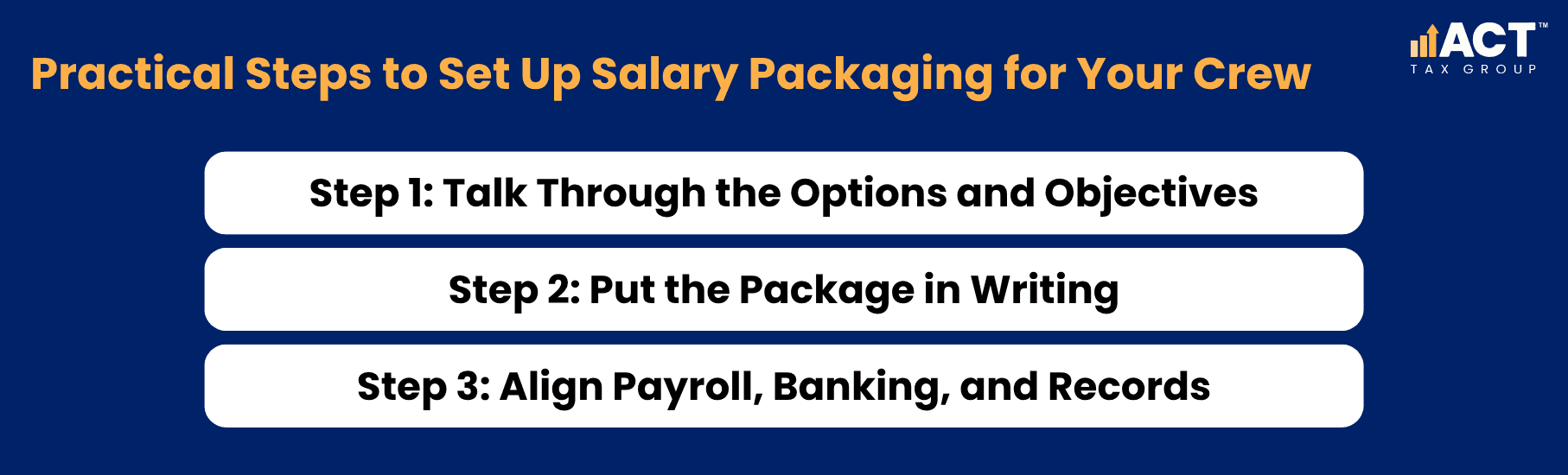
Step 1: Talk Through the Options and Objectives
Start with a clear discussion with each employee about what they are trying to achieve. Are they looking for tax savings, more super, help with vehicle expenses, or a smoother way to manage certain expenses? Every employee’s financial situation and individual circumstances are different, so the salary package depends on what matters most to them and what your electrical business can realistically support.
Make sure they understand the basics: they are swapping part of their pre-tax income for specific benefits, so their home pay may drop even if they end up with more money overall when tax is taken into account. It is important they feel comfortable with the budget impact on their day-to-day living expenses and personal expenses.
Step 2: Put the Package in Writing
Once you agree on the benefits, set up a written salary packaging arrangement that sets out the gross salary, the amount to be sacrificed, and the benefits to be provided. This might include salary sacrifice to superannuation contributions, a car or motor vehicle arrangement, or other benefits you have agreed on. The document should explain how much pre tax salary is being redirected, how it affects their after tax income, and when the arrangement can be reviewed.
Having clear wording helps avoid confusion later about whether certain benefits or expenses are part of the package, and protects both employer and employee if things change in the business or the employee’s role.
Power up your business with Accounting Built for Electricians
From start-up to expansion, our accounting team supports your tax, payroll, and cash flow at every stage of growth.
Step 3: Align Payroll, Banking, and Records
Your payroll and STP setup also needs to report salary sacrifice correctly. Under STP Phase 2, employers report salary sacrifice amounts separately and also include the pre-sacrificed income amounts in the STP report. That might mean:
Sending salary sacrifice amounts straight to the employee’s super fund from their pre-tax salary.
Paying regular vehicle expenses or lease payments on a car as part of a novated leasing arrangement.
Ensuring the balance of income goes into the employee’s bank account as after tax income.
Keep clear records of all payments and benefits so that when you report income, expenses and any fringe benefits at the end of the year, everything lines up. This helps you avoid mistakes in your business accounts, your employees’ income reporting, and any FBT reporting you may need to do.
When to Get Help from ACT Tax Group
Salary packaging can be a powerful tool for electrician employers and employees when it is kept simple and tied closely to your everyday operations. Used well, it can reduce your taxable income, help key staff pay less tax over time, and make your overall package feel like a genuine pay rise without putting your cash flow under too much pressure.
But because salary packaging touches income tax, fringe benefits tax, super, payroll, and sometimes personal expenses like mortgage payments and school fees, it is important not to guess. The rules change, and what is an ATO approved way of packaging certain benefits today may work differently in future years.
If you want to introduce a salary packaging program in your electrical business, or you want your current packages checked so you know whether you may need to pay FBT or adjust your process, ACT Tax Group can walk you through it. That way, your salary packaging work stays practical, your employees understand their benefits, and you keep your focus on running a profitable electrical business rather than worrying about tax surprises.

Lukasz Klekowski
Principal of ACT Tax Group, specialising in tax compliance and financial strategy for Australian small businesses.

Disclaimer: All information provided in this publication is of a general nature only and is not personal financial or investment advice. It does not take into account your particular objectives and circumstances. No person should act on the basis of this information without first obtaining and following the advice of a suitably qualified professional. To the fullest extent permitted by law, no person involved in producing, distributing or providing the information in this publication (including ACT TAX GROUP PTY LTD, each of its directors, councilors, employees and contractors and the editors or authors of the information) will be liable in any way for any loss or damage suffered by any person through the use of or access to this information. The Copyright is owned exclusively by ACT TAX GROUP PTY LTD (ABN 31634338088)