

How Changes to the Medicare Levy Rate Flow Through to an Electrician’s Take‑Home Pay
Published on May 12, 2026
How changes to the Medicare levy rate flow through to an electrician’s take-home pay depends on taxable income, payroll withholding, private health insurance, and personal circumstances. For most Australian taxpayers, the Medicare levy is worked out as part of the tax return and can affect weekly pay, the final income tax position, or the amount payable after lodgement.
Medicare Levy Rate Changes Affect Weekly Cash Flow and Tax Planning
The Medicare levy rate affects take-home pay because employers withhold income tax through payroll during the financial year. When ATO tax tables change, payroll software may adjust the amount withheld, which can change an electrician’s net pay before tax time. However, the ATO does not usually update withholding tax tables solely for Medicare levy threshold changes, and the final Medicare levy is worked out when the tax return is lodged.
For a sole trader electrician, the effect may appear through instalments, a final tax bill, or a smaller refund. The practical issue is cash flow, because a levy, threshold, or withholding change can affect how much money is available for wages, supplier bills, fuel, tools, and family costs, so electricians should consider tax‑savvy strategies to boost profits alongside managing Medicare settings.
Will changes to the Medicare levy rate reduce your weekly take‑home pay more than necessary?
Schedule a complimentary consultation with us today to review your payroll, taxable income, and deductions so your net pay reflects your actual ATO position.
Medicare Levy Calculations on Taxable Income
The Medicare levy is generally calculated on taxable income, not total money received. Taxable income is the amount left after allowable deductions are applied to assessable income, which makes it important to avoid common tax deduction mistakes that could distort the final levy. For example, an electrician with annual income of $95,000 and allowable deductions of $6,000 may have taxable income of $89,000. If they pay the Medicare levy at 2 per cent, the levy would be $1,780 before any Medicare levy reduction or exemption is considered. The Medicare levy surcharge is separate and may apply in addition if the relevant rules are met.
The Limits of Looking Only at the Headline Medicare Levy Rate
The Medicare levy rate is only one part of the calculation. Income thresholds, family income threshold rules, private hospital cover, and Medicare levy surcharge rules can all affect the final position. This is where electricians can get caught out. A single person with higher income may have a different outcome from de facto couples with a dependent child, even if their weekly pay looks similar during the year.
The Medicare Levy Surcharge and Higher Income Earners
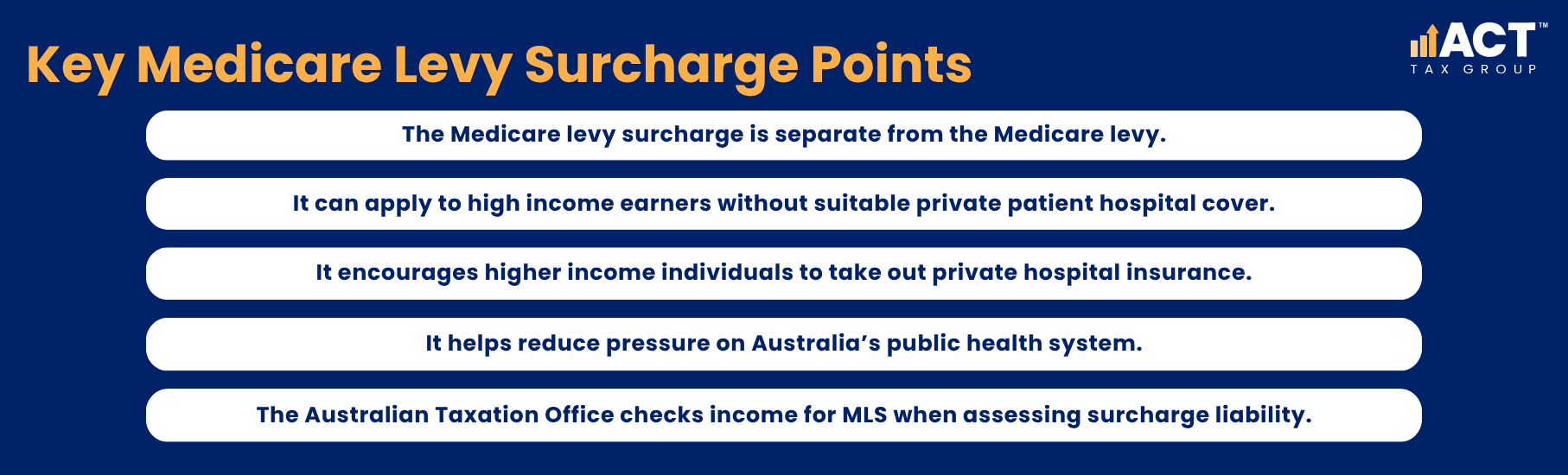
The Medicare levy surcharge is separate from the Medicare levy. The Medicare levy surcharge, or MLS, can apply when income for MLS purposes is above the relevant threshold and the taxpayer, spouse, or dependants do not have an appropriate level of private patient hospital cover.
The surcharge aims to encourage individuals with higher income to take out private hospital insurance and reduce pressure on the public system. For Medicare levy surcharge purposes, the Australian Taxation Office considers income for MLS purposes, which can include taxable income, total reportable fringe benefits, reportable super contributions, net investment losses, foreign income, and exempt foreign employment income.
Private Hospital Cover and the Medicare Levy Surcharge
Private hospital cover can help some electricians avoid paying the Medicare levy surcharge if their income is above the relevant income bracket. The cover generally needs to be an appropriate level of private patient hospital cover from a registered health insurer, with an excess of $750 or less for singles or $1,500 or less for couples or families. This is different from general extras cover or basic health insurance that does not include private patient hospital cover. Electricians should check whether their private health cover is the right type of hospital cover for MLS purposes, rather than assuming any private health insurance is enough.
Family Income Threshold Rules and Surcharge Outcomes
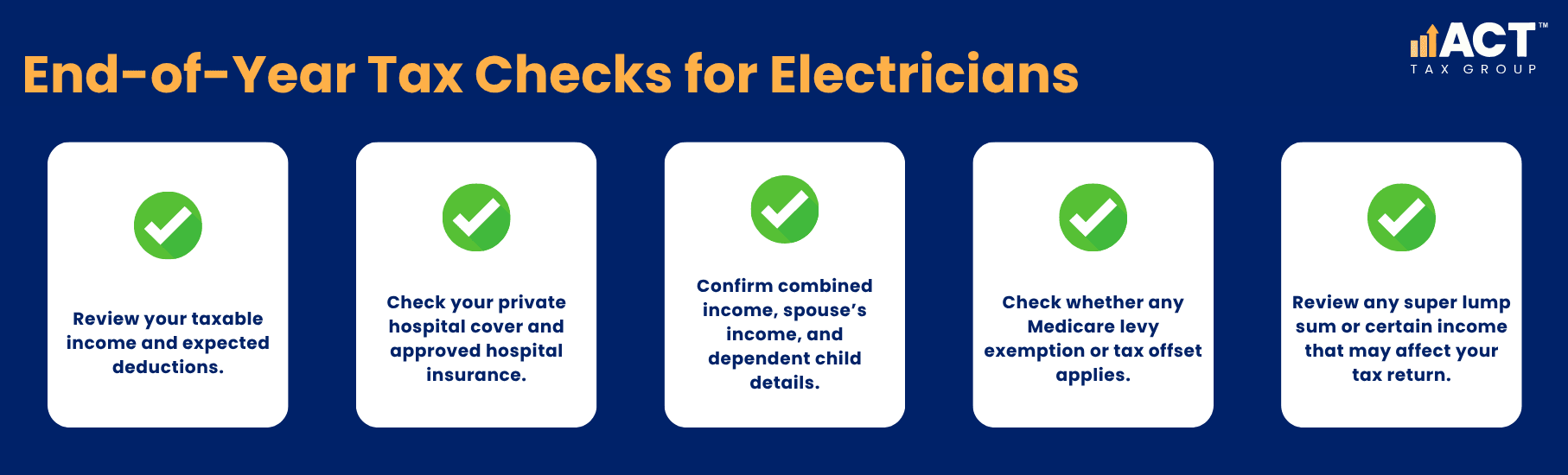
Family income threshold rules can change whether a person pays the Medicare levy surcharge and at what rate. Combined income, spouse’s income, dependent child rules, and family tiers all matter. For families, the MLS income threshold increases by $1,500 for each dependent child after the first. This means a couple’s combined income for MLS purposes should be reviewed together, not just their taxable income, and they may also need to understand Family Tax Benefit Part A entitlements before deciding whether private patient hospital cover is worth considering.

Medicare Levy Exemptions and Special Circumstances
A Medicare levy exemption may apply where a person meets the following criteria, such as being a prescribed person, meeting certain medical requirements, or not being eligible for Medicare for all or part of the income year. The exemption means the person may avoid paying the levy for the relevant period, depending on the facts.
A person who was not entitled to Medicare benefits for all or part of the income year may need a Medicare Entitlement Statement from Services Australia, but having the statement does not automatically mean they are exempt from the Medicare levy. Electricians who have spent time overseas, recently moved to Australia, or had unusual residency circumstances should check this before lodging a tax return and consider using ATO online services for business to keep their records and lodgements organised.
Key Medicare Levy Statistics for Electricians
According to the Australian Taxation Office, the Medicare levy is charged at 2% of taxable income in most cases. This is the starting point for most electricians when estimating the effect on take-home pay.
According to Treasury, the 2024 income tax changes applied to 13.6 million Australian taxpayers. Treasury also stated that the 19 per cent tax rate reduced to 16 per cent from 1 July 2024, which means take-home pay planning should consider both income tax and Medicare settings.
According to the Australian Taxation Office, Medicare levy surcharge rates range from 1 per cent to 1.5 per cent when income for MLS purposes is above the relevant threshold and the taxpayer does not have the required private patient hospital cover. This is why high-income earners should review hospital insurance before the end of the financial year.
Expert Guidance on the Medicare Levy and Take-Home Pay
“The Medicare levy is 2% of your taxable income,” explains the Australian Taxation Office, the federal agency responsible for administering Australia’s tax system. For electricians, that makes taxable income the key number to watch, not just gross wages.
“The Australian Government has legislated cost-of-living tax cuts for all 13.6 million Australian taxpayers,” states the Australian Treasury in its tax guidance. That broader tax context matters because changes to income tax, thresholds, and Medicare settings can all flow through to an electrician’s final pay position.

Practical Examples for Electricians
A licensed employee electrician earning regular wages may see the Medicare levy built into payroll withholding. If overtime increases their annual taxable income, the final levy may also increase, even if their weekly pay feels steady.
A sole trader electrician may feel the effect differently. A strong year with several profitable commercial jobs can lift annual income, increase income tax, and increase the Medicare levy, so setting aside cash during the year is important.
A married electrician, or a person in a de facto relationship, may need to check combined income for MLS purposes, including their spouse’s income and dependant details. If the taxpayer, spouse, or dependants do not hold the required private patient hospital cover and income for MLS purposes is above the relevant threshold, the taxpayer may pay the MLS as well as the standard Medicare levy.
Payroll Issues That Affect Take-Home Pay
Payroll settings can change take-home pay because withholding is an estimate. If payroll software is not updated, allowances are incorrectly treated, or overtime is entered poorly, the weekly net pay may not reflect the final tax position. Electrical businesses should check Pay As You Go withholding, Single Touch Payroll, allowances, apprentices, and superannuation settings. Clear payroll records make it easier to explain changes to employees and reduce pressure when tax return time arrives.
Power up your business with Accounting Built for Electricians
From start-up to expansion, our accounting team supports your tax, payroll, and cash flow at every stage of growth.
Deductions and the Medicare Levy
Deductions can reduce taxable income, and lower taxable income can reduce the Medicare levy where the levy is calculated as a percentage of taxable income. This does not mean every cost is deductible, but it does mean accurate records matter. For electricians, common deduction areas may include eligible tools, protective clothing, licences, training, phone use, vehicle expenses, and equipment, along with working‑from‑home claims using the fixed rate method for work deductions where eligible. The key is to claim what is allowed, keep evidence, and avoid guesses that create Australian Taxation Office risk, especially when claiming input tax credits and aiming to maximise GST credits while staying ATO‑compliant.
End-of-Year Medicare Levy Checks for Electricians
Electricians should review taxable income, deductions, private health cover, and possible MLS exposure before 30 June, and small electrical businesses near the turnover threshold should also consider whether to stay under the GST registration threshold as part of their planning. Waiting until the tax return is prepared can limit the options available.
How ACT Tax Group Can Help with Medicare Levy Rate Changes for Electricians
We help electricians understand how Medicare levy rate changes, taxable income, payroll withholding, private health insurance, and Medicare levy surcharge rules affect real take-home pay. Our team can review your income, deductions, tax return position, hospital cover, and cash flow so you have clearer numbers and stronger compliance confidence.
If you are an employed electrician, contractor, or electrical business owner, we invite you to book a meeting with ACT Tax Group to discuss your tax position. We can help you plan for income tax, Medicare levy, MLS rates, and cash flow in a practical way that supports tax efficiency, asset protection, and business growth.
Key Takeaways for Electricians Managing Take-Home Pay
The Medicare levy may look simply, but it can affect electricians in different ways depending on annual income, taxable income, private hospital cover, family income threshold rules, and personal circumstances. The Medicare levy surcharge can add another cost for higher income earners who do not have the right private patient hospital cover.
The best approach is to review your position before the end of the financial year, keep clear records, and understand how income changes flow through to tax. With early planning, electricians can reduce surprises, avoid paying more than necessary, and make confident decisions about wages, business income, health cover, and cash flow.

Lukasz Klekowski
Principal of ACT Tax Group, specialising in tax compliance and financial strategy for Australian small businesses.

Disclaimer: All information provided in this publication is of a general nature only and is not personal financial or investment advice. It does not take into account your particular objectives and circumstances. No person should act on the basis of this information without first obtaining and following the advice of a suitably qualified professional. To the fullest extent permitted by law, no person involved in producing, distributing or providing the information in this publication (including ACT TAX GROUP PTY LTD, each of its directors, councilors, employees and contractors and the editors or authors of the information) will be liable in any way for any loss or damage suffered by any person through the use of or access to this information. The Copyright is owned exclusively by ACT TAX GROUP PTY LTD (ABN 31634338088)