

Using a Medicare Levy Calculator to Work Out How Much to Set Aside from Each Electrical Invoice
Share this article
Published on May 5, 2026
Using a Medicare Levy Calculator to work out how much to set aside from each electrical invoice helps you avoid the end-of-year shock that catches so many electrical contractors off guard. When you’re running a team of sparkies and apprentices, cash flow is already tight. Missing invoices, delayed payments from builders, and variations that clients won’t sign off on all add to the pressure. The last thing you need is a surprise bill you haven’t planned for, especially when you’re trying to cover payroll, super, and supplier accounts on time.
What Is the Medicare Levy and Why Does It Matter for Electrical Contractors?
The Medicare levy is a compulsory charge that most Australian residents pay to help fund Medicare and Australia’s public health system. For most Australian resident individual taxpayers, the Medicare levy is 2% of taxable income. If you operate as a sole trader and your taxable income is $150,000, your Medicare levy would generally be $3,000 on top of your regular income tax.
Confused about how the 2% Medicare levy and MLS apply to your electrical business income?
Schedule a complimentary consultation with us today to review your taxable income and health cover so you only pay what’s required.
How the Medicare Levy Works for Business Owners
If you’re an employee sparky working for someone else, your employer takes care of the Medicare levy automatically through PAYG withholding. But when you’re running your own electrical contracting business as a sole trader, you’re responsible for paying this levy as part of your individual tax return. If you operate through a company, the Medicare levy applies to your personal taxable income, such as salary, director fees or dividends, not to the company’s taxable income. That’s where the problem starts. You don’t see the Medicare levy being deducted each week, so it’s easy to forget about it until your accountant delivers the bad news at tax time.
Income Thresholds That Affect How Much You Pay
There are low-income thresholds that could reduce or exempt you from the Medicare levy. For the 2024-25 financial year, if you earned less than $27,222, you won’t pay the Medicare levy at all. If you earn between $27,222 and $34,027, the Medicare levy phases in at 10 cents for each dollar above $27,222. Once you earn $34,027 or more, you pay the full 2% Medicare levy. Most electrical contractors earning between $500K and $2.5M in revenue will have a taxable income well above this threshold, so the full 2% levy will apply.
Understanding the Medicare Levy Surcharge
On top of the standard Medicare levy, you might also have to pay the Medicare Levy Surcharge MLS if your income exceeds a certain amount and you don’t hold an appropriate level of hospital cover. The Medicare Levy Surcharge works as an extra tax designed to encourage higher earners to take out private health insurance. For 2025–26, the Medicare Levy Surcharge (MLS) starts once your income for MLS purposes exceeds $101,000 for singles. The MLS is charged at rates between 1% and 1.5%, depending on your annual income tier.
If you’re single, earning $120,000 for MLS purposes in 2025–26, and don’t hold appropriate private patient hospital cover, you’ll generally pay an additional 1.25% MLS on top of the 2% Medicare levy. That means $2,400 in Medicare levy plus $1,500 in MLS, or $3,900 in total. The Medicare Levy Surcharge thresholds are different for families. The family income threshold starts at $202,000, and if you have more than one child, the threshold increases by $1,500 for each additional child after the first. De facto couples are treated the same as married couples for tax purposes when calculating the surcharge.
What Type of Health Cover Helps You Avoid the Surcharge
Note that extras cover, ambulance cover, or other types of health cover don’t help you avoid the MLS. You need to hold an appropriate level of private patient hospital cover with a registered health insurer to avoid paying the Medicare Levy Surcharge. Extras-only cover, ambulance cover and travel insurance do not count as private patient hospital cover for MLS purposes. This is one area where many electrical contractors get caught out, assuming any health insurance will do the job.

How to Use a Medicare Levy Calculator to Work Out What You Owe
A Medicare levy calculator is a simple tool that helps you estimate how much Medicare levy and Medicare Levy Surcharge you’ll owe based on your taxable income and health insurance status. The ATO Medicare levy calculator currently provides estimates for the 2013–14 to 2024–25 income years. For MLS estimates, the ATO directs taxpayers to use the Income tax estimator and the current MLS threshold tables. You can also find a Medicare Levy Surcharge calculator from health insurance providers and accounting websites that incorporate the latest income thresholds and rates for the current tax year.
Working Out Your Taxable Income
To use a calculator effectively, you need to know your estimated taxable annual income for the year. This isn’t your total revenue. It’s your revenue minus all your deductible business expenses like tools, vehicle costs, insurance, materials, subcontractor payments, and wages, including any work-from-home claims you make using methods such as the fixed rate method for home office deductions. If you’re a sole trader electrical contractor earning $800,000 in revenue but spending $500,000 on legitimate business expenses, your taxable income is $300,000. The calculator will then apply the 2% Medicare levy to that $300,000, giving you an estimate of $6,000.
Entering Your Health Insurance Details
You’ll also need to tell the calculator whether you hold private hospital cover that meets the Australian Taxation Office requirements for an appropriate level of private patient hospital cover. If you don’t hold private health insurance and your income is above the Medicare Levy Surcharge thresholds, the calculator will add the relevant MLS percentage. For a single electrical contractor with $150,000 taxable income and no appropriate hospital cover, the estimate may show a 2% Medicare levy of $3,000 plus a 1.25% MLS of $1,875, totalling $4,875.
Factoring in Your Family Situation
Most calculators will also take into account whether you have a spouse or dependent child, as this affects how the family income threshold applies for MLS purposes. If you run your electrical contracting business with your partner handling the admin and bookkeeping, make sure you factor in your combined household income when using the calculator. The calculator will ask about your personal situation, including whether you have families with children, as this affects which family tiers apply and may also interact with benefits like Family Tax Benefit Part A.
Calculating How Much to Set Aside Per Invoice
Once you’ve got your estimated Medicare levy and MLS total from the calculator, you can work backwards to figure out how much to set aside from each invoice. If you estimate you’ll owe $6,000 in Medicare levy for the year and you expect to issue 200 invoices over the year, you need to set aside $30 per invoice. This gives you a starting point for building a cash reserve that covers your obligations as you go.

Setting Up a System to Set Aside Medicare Levy from Each Invoice
Ever had a month where you’re slammed with jobs, invoices are flying out the door, and cash is flowing in, but then tax time hits and you realise you’ve spent it all on payroll, materials, and overheads? That’s the cycle that catches so many electrical contractors. The best way to avoid this is to build a simple system that automatically sets aside a portion of every invoice for your obligations, including the Medicare levy, as part of broader tax‑savvy strategies to boost profits.
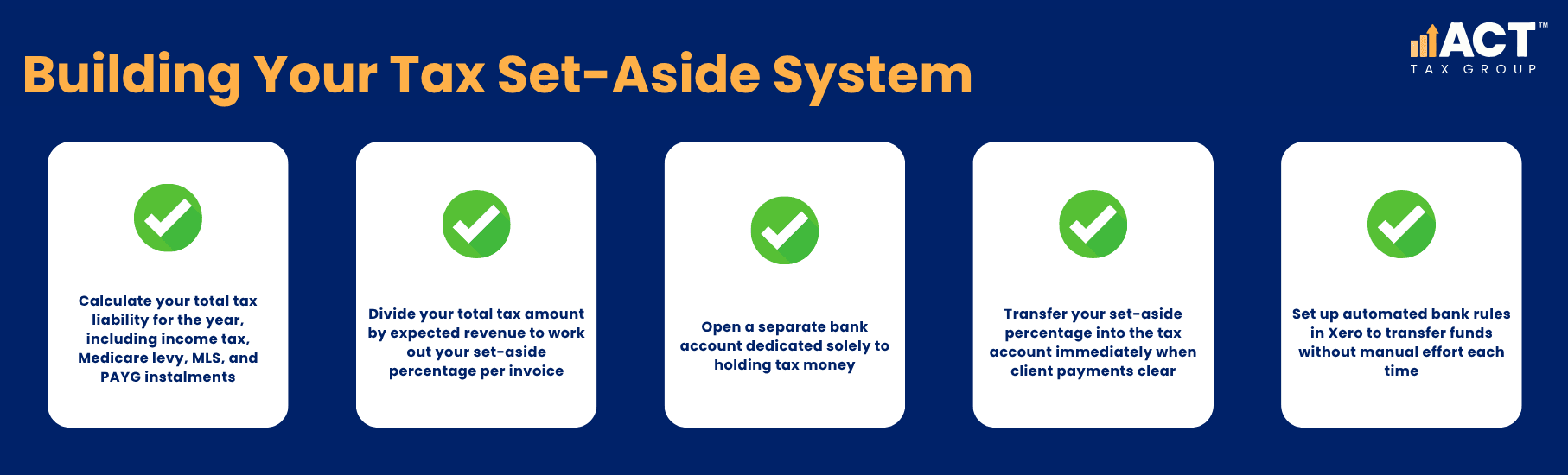
Calculating Your Total Tax Liability for the Year
Start by calculating your total expected amount for the year, not just the Medicare levy. This includes income tax at your marginal rate, the 2% Medicare levy to fund Medicare, any MLS if applicable, and any PAYG instalments you’re required to pay. If you’re an Australian resident sole trader electrical contractor with taxable income of $150,000 in 2024–25, your income tax before Medicare levy is approximately $36,838. Add the 2% Medicare levy of $3,000 and your total becomes approximately $39,838 before any MLS. Add in the MLS if you don’t hold private health insurance, and your total bill could be over $36,000.
Working Out Your Set Aside Percentage
Divide this total amount by your expected number of invoices or total revenue to get a percentage to set aside. If you expect $800,000 in revenue and owe $39,838 in total income tax and Medicare levy, that’s about 5% of every invoice before allowing for any MLS, PAYG instalments or other tax obligations. So, for every $10,000 invoice you send, transfer $450 into a separate bank account earmarked for tax. This way, when your BAS, PAYG instalments or annual tax return obligations fall due, the money is already sitting there waiting. Medicare levy and MLS are generally assessed through your individual tax return.
Creating a Dedicated Tax Account
Many electrical contractors use a dedicated account for this purpose. As soon as payment clears from a client, you transfer the set-aside percentage into this account and don’t touch it until the Australian Taxation Office comes knocking. This discipline is similar to staying ahead of ASIC late fees and penalties, where missing deadlines can quickly escalate costs and stress. This is especially important for electrical contractors dealing with late payments from builders or clients who take 60 to 90 days to pay. By the time the money arrives, you’ve forgotten about the tax component, and it’s already been spent on urgent cash flow needs.
Automating the Process with Accounting Software
If you’re using accounting software like Xero, you can set up automated bank rules that transfer a fixed percentage of incoming payments into your dedicated account. Pairing this with ATO Online Services for Business can streamline how you monitor obligations, lodgements and payments in real time. This takes the guesswork out of the process and ensures you’re consistently setting aside funds, even during busy periods when you’re on the tools and don’t have time to think about planning. The system runs itself once it’s set up, which means less stress and more confidence that you’ll have the cash when the Australian Government sends the bill.
Common Mistakes Electrical Contractors Make with the Medicare Levy
One of the most common mistakes electrical contractors make is confusing the Medicare levy with the Medicare Levy Surcharge. The Medicare levy is the 2% that Australian taxpayers pay to fund Medicare, unless you’re below the low-income threshold. The MLS is the extra tax that higher incomes pay if they don’t hold eligible private hospital cover. Many contractors assume they only pay one or the other, but in reality, you may have to pay both.
Getting Your Taxable Income Wrong
Another mistake is underestimating your taxable annual income when using a calculator. If you are a sole trader, your income for MLS purposes is not your gross invoiced revenue. It generally starts with taxable income and may include specific add-backs such as reportable fringe benefits, reportable super contributions, target foreign income and total net investment losses. This can push you into a higher MLS tier even if your standard taxable income is below the threshold. Always calculate using your income for MLS purposes, not just your basic taxable income, and avoid the sort of common tax deduction mistakes that come from poor records or misunderstanding the rules.
Power up your business with Accounting Built for Electricians
From start-up to expansion, our accounting team supports your tax, payroll, and cash flow at every stage of growth.
Not Updating Your Estimate During the Year
Electrical contractors also often forget to update their estimate as the tax year progresses. If you land a big commercial contract halfway through the year that doubles your expected income, your Medicare levy and MLS obligations will increase accordingly. Using a Medicare Levy Surcharge calculator quarterly, rather than just once at the start of the financial year, helps you adjust your set-aside percentage and avoid a shortfall at tax time.
Missing the Private Health Insurance Opportunity
Some electrical contractors also don’t realise that the cost of private health insurance might be less than the cost of paying the MLS. If you’re earning $150,000 for MLS purposes and facing a 1.25% MLS of $1,875, buying appropriate private patient hospital cover that costs $1,200 for the same period could reduce your direct tax cost by $675, before considering rebates, policy value and your personal health needs. Some Australian residents may also be eligible for the Australian Government Rebate on their health insurance, which reduces the cost of health cover depending on your income and personal circumstances.
Choosing the Wrong Type of Health Cover
Note that to avoid the Medicare Levy Surcharge, you must hold an appropriate level of hospital cover. Extras cover alone, such as dental or optical, won’t help you avoid the MLS. You need either standalone eligible private hospital cover or a combined hospital and extras policy. If you’re unsure whether your health cover meets the requirements, check with your insurer or look at the ATO website for guidance on what counts as eligible hospital cover.

How ACT Tax Group Can Help You Stay on Top of Medicare Levy Planning
Sorting out your Medicare levy obligations and building a system to set aside funds from each invoice doesn’t have to be complicated, but it does require a clear plan and regular check-ins to make sure you’re on track. ACT Tax Group specialises in helping electrical contractors and other trades business owners manage their obligations proactively, so you’re never caught by surprise at tax time.
We can work with you to calculate your total liability for the year, including income tax, Medicare levy, and Medicare Levy Surcharge, and help you set up a simple system to set aside the right percentage from each invoice. We’ll also review your structure, deductions, and health insurance options to make sure you’re not paying more than you need to. Whether you’re a single parent, part of de facto couples, or have families with more than one child, we’ll take into account your personal circumstances to give you an accurate estimate.
If you’ve worked for less than the full financial year or your income has changed significantly, we can help you adjust your calculations so you’re setting aside the right amount. We’ll make sure you’re taking into account any offsets you might be eligible for, such as the pensioners tax offset or other concessions, so you pay what you owe but not a cent more. We can also help you understand whether taking out private health cover makes sense for your personal situation, factoring in the Australian Government Rebate and comparing the cost of health cover against the cost of paying the MLS.

Lukasz Klekowski
Principal of ACT Tax Group, specialising in tax compliance and financial strategy for Australian small businesses.

Share this article
Disclaimer: All information provided in this publication is of a general nature only and is not personal financial or investment advice. It does not take into account your particular objectives and circumstances. No person should act on the basis of this information without first obtaining and following the advice of a suitably qualified professional. To the fullest extent permitted by law, no person involved in producing, distributing or providing the information in this publication (including ACT TAX GROUP PTY LTD, each of its directors, councilors, employees and contractors and the editors or authors of the information) will be liable in any way for any loss or damage suffered by any person through the use of or access to this information. The Copyright is owned exclusively by ACT TAX GROUP PTY LTD (ABN 31634338088)