

Income Splitting and Marginal Tax: When It Actually Helps and When It Doesn’t for Family-Run Electrical Businesses
Share this article
Published on August 25, 2026
Income splitting and marginal tax may reduce the overall tax paid by a family-run electrical business in some circumstances, but income cannot simply be redirected to a family member because they have a lower tax rate. The outcome depends on who earns the income, the work performed, the business structure and whether Personal Services Income (PSI) rules apply. This matters because Australian income tax operates through a progressive tax system, which means the marginal tax rate generally increases as taxable income moves through higher income ranges.
Income Splitting Works When the Arrangement Reflects the Business
Income splitting can be useful where different family members genuinely contribute to the electrical business or have valid rights to business income. A spouse who manages invoicing, payroll, debt collection, customer bookings or supplier accounts may legitimately receive employment income for that work rather than leaving all income taxed in the electrician owner’s hands. The potential benefit comes from differences in marginal tax rates, but tax rates are only part of the calculation. Each person’s total income, eligible deductions, tax offsets, Medicare levy, other income and personal circumstances also influence the final tax payable.
Could Family Payments Trigger ATO Scrutiny?
Schedule a complimentary consultation with us today to set reasonable, well-documented family remuneration.
Marginal Tax Rates Create the Potential Tax Difference
Marginal tax is the tax rate applying to the next portion of taxable income earned, rather than one tax rate applying to the whole income. Australian residents generally have access to a tax-free threshold before income tax begins to apply. From 1 July 2026, the 2026–27 resident individual income tax rates include a 15% rate between taxable income of $18,201 and $45,000, followed by higher marginal tax rates as annual taxable income increases.
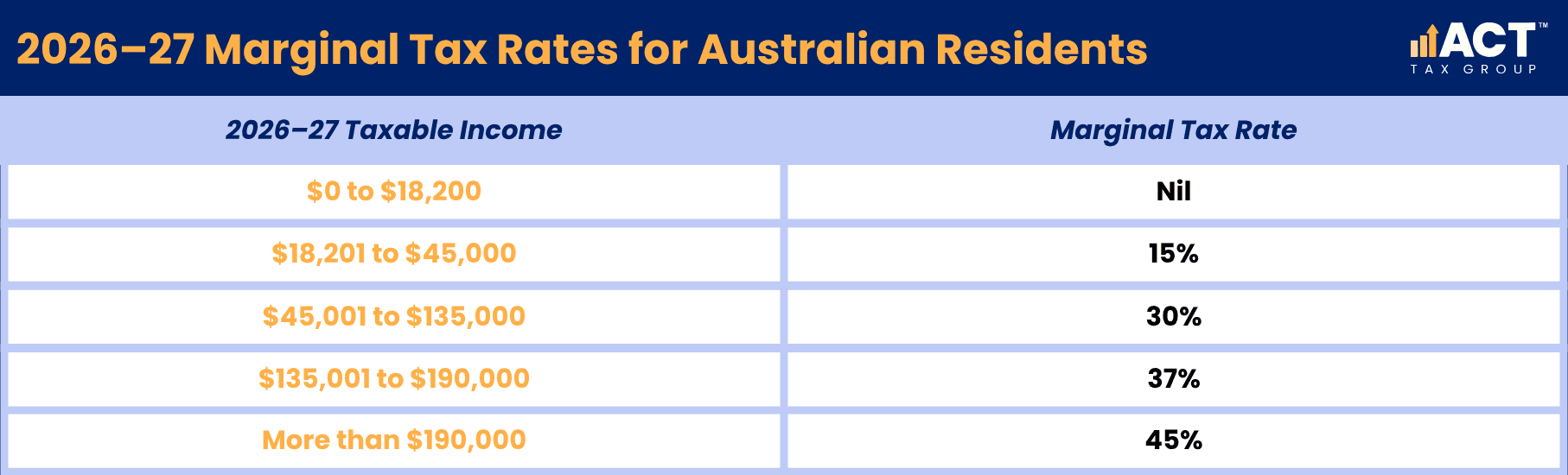
These rates do not mean that moving into a higher tax bracket causes the whole income to be taxed at the higher rate. Only the income falling within that bracket is taxed at the applicable marginal rate, and the final tax bill can also be affected by the Medicare levy, Medicare levy surcharge and available tax offsets.
Taxable Income Matters More Than Business Revenue
Tax planning should focus on taxable income rather than business turnover or the amount of cash collected from customers. Taxable income is generally determined after relevant assessable income and allowable deductions are taken into account, so two electrical businesses with similar revenue can have very different tax positions. Legitimate business expenses and other eligible deductions may reduce taxable income where the tax rules are satisfied. The Low-Income Tax Offset may also affect the tax payable of some lower income earners, which is why comparing gross income alone can give an incomplete picture. For an electrical business, common business expenses may include:
Tools and equipment used to earn assessable income
Employee wages and related employment costs
Work-related vehicle and travel expenses where eligible
Supplier, materials and other operating business expenses
Other eligible deductions supported by appropriate records and receipts
Keeping receipts and maintaining reliable records helps support a tax deduction and makes tax returns easier to prepare accurately.
Genuine Family Employment Can Support Income Splitting
Employing a spouse or another family member can make commercial sense where that person performs genuine work and the amount paid is reasonable for the role. Electrical businesses often rely on family members for bookkeeping, payroll, customer enquiries, scheduling, invoicing and accounts administration while the electrician focuses on field work and managing jobs. The arrangement should be supported in much the same way as employment of an unrelated person. However, if the PSI rules apply, payments to an associate for non-principal work such as bookkeeping, invoicing or administration generally cannot be deducted against that PSI.
Useful records may include:
A clear position description setting out the person’s duties
Records showing hours worked where appropriate
Regular payroll payments at a reasonable commercial rate
Single Touch Payroll (STP) and Pay as You Go Withholding (PAYGW) records
Superannuation records and evidence of the work actually performed
Excessive Family Payments Can Increase Tax Risk
Family involvement does not make every payment automatically deductible. Where a payment to a related family member is otherwise deductible, the deduction is limited to a reasonable amount for the services performed. A practical benchmark is to consider what the business would reasonably pay an unrelated person to perform the same duties. This keeps the focus on the real value of the role rather than choosing a payment amount simply because it produces a lower income tax result. Before setting family remuneration, review:
The duties actually performed
The hours worked during the income year
The person’s skills, experience and responsibilities
Comparable commercial remuneration for the role
Whether business records can support the payment

Personal Services Income Can Restrict Income Splitting
Personal Services Income (PSI) is income that is mainly a reward for an individual’s personal efforts or skills. It can be particularly important for smaller electrical businesses where one electrician personally performs most of the paid work and the income earned depends heavily on that person’s trade skills. Using a company, partnership or trust does not automatically allow Personal Services Income (PSI) to be distributed among family members. Where the PSI rules apply, net PSI received through the entity is generally attributed to the individual whose personal efforts or skills generated it. Even where the business qualifies as a Personal Services Business (PSB), anti-avoidance rules may still apply to arrangements designed mainly to split income and obtain a tax benefit.
Growing Electrical Businesses Can Present a Different Position
A sole trader personally completing almost every job is different from an established electrical business employing tradespeople, apprentices and administration staff. Vehicles, equipment, recurring customers, established systems and business goodwill can also contribute to how the business earns its income. As a business grows, the income may increasingly reflect the activities of the wider operation rather than only the owner’s personal labour. This does not automatically make income splitting appropriate, but it can change the tax and business-structure issues that need to be reviewed.
Family Trusts Need More Than a Lower Tax Bracket
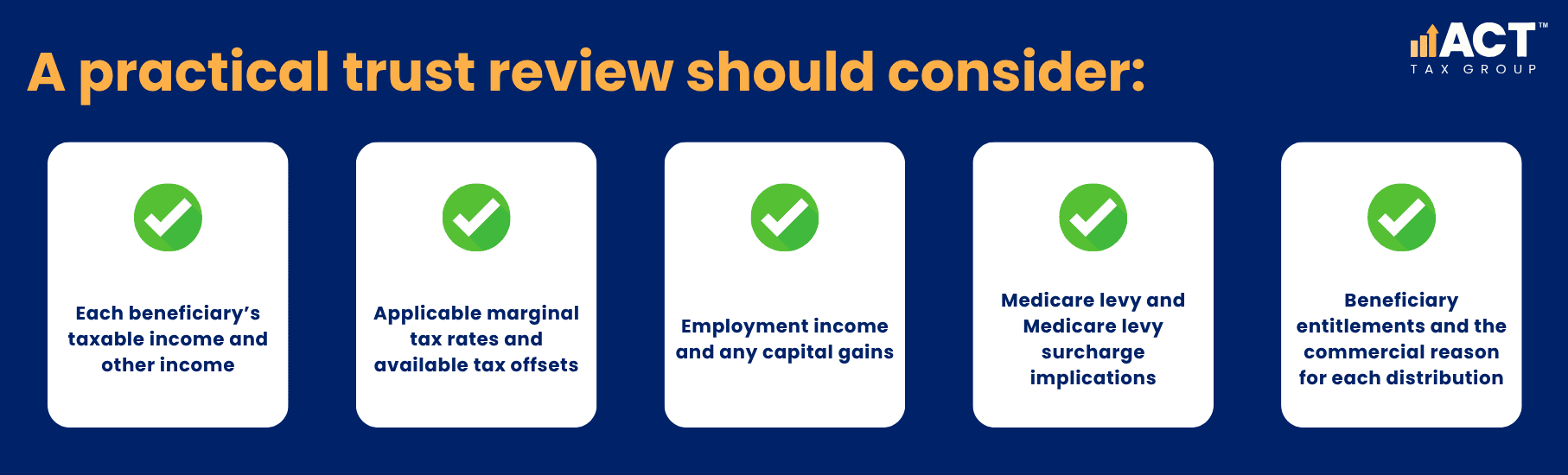
A family trust can offer flexibility in how eligible trust income is distributed, but a lower tax bracket should not be the only factor driving the decision. The trust deed, beneficiary circumstances, type of income, PSI position and actual entitlement to the income all need to be considered. Trust distribution decisions should follow the trust deed and generally need to be made by 30 June, or earlier if the deed requires it. Care is also needed where one beneficiary is taxed on trust income, but another person receives the benefit, because specific trust anti-avoidance rules may apply. A practical trust review should consider:
Each beneficiary’s taxable income and other income
Applicable marginal tax rates and available tax offsets
Employment income and any capital gains
Medicare levy and Medicare levy surcharge implications
Beneficiary entitlements and the commercial reason for each distribution
Medicare Obligations Can Change the Final Result
Marginal income tax is not always the final amount a family needs to consider. The Medicare levy is generally 2% of taxable income, although income thresholds, reductions and exemptions can affect the amount payable. The Medicare levy surcharge may also affect some higher earners who do not hold appropriate private hospital cover. For this reason, an arrangement that appears attractive when comparing income tax rates alone may produce a different result after the family’s broader financial situation is considered.
Tax Offsets Can Affect Lower Income Family Members
Tax offsets can reduce tax payable for eligible taxpayers, and the Low-Income Tax Offset can be relevant for some lower income earners. However, tax offsets do not create a general right to redirect income to a family member or make income automatically tax-free. Some taxpayers may also qualify for other offsets depending on their age, circumstances and income levels. Any offset should therefore be considered as part of the person’s overall tax affairs rather than being used as the starting point for an income-splitting decision.
Fringe Benefits Can Influence the Family Tax Position
Family remuneration is not limited to wages. Electrical businesses may also provide vehicles or other fringe benefits, and some private benefits provided through an employer can fall within the Fringe Benefits Tax (FBT) system. A reportable fringe benefits amount is not included in taxable income, but it can be included in some income tests, including income used to work out the Medicare levy surcharge. Where vehicles or other business assets are used partly for private purposes, the arrangement should be reviewed together with payroll and FBT obligations rather than assuming the benefit is automatically tax-free.
Power up your business with Accounting Built for Electricians
From start-up to expansion, our accounting team supports your tax, payroll, and cash flow at every stage of growth.
The Lowest Tax Bill Is Not Always the Best Business Outcome
Reducing income tax in one financial year does not automatically make a strategy commercially sensible. Extra payroll obligations, superannuation, accounting costs, administration and cash flow pressure can outweigh part of the expected tax saving. Electrical contractors often already manage uneven payments, wages, supplier accounts, vehicles and materials. A tax strategy should therefore support the wider financial situation of the business rather than creating additional pressure simply to reduce tax payable.
Example: An electrician may calculate a potential tax saving from paying an extra $50,000 to a lower-income spouse. If the spouse’s actual work does not support that level of remuneration, a smaller commercially reasonable payment combined with a broader structure review may be more appropriate.
A Structured Review Produces Better Income-Splitting Decisions
The strongest income-splitting strategies start with how the electrical business actually earns its money. The owner’s work, family involvement, employees, assets, customer relationships and current structure should all be reviewed before calculating the potential marginal tax benefit. A structured review also helps identify whether the strategy affects payroll, superannuation, PSI, tax offsets, Medicare obligations or the business’s ability to manage cash flow. A practical review usually involves:
Calculate expected taxable income. Estimate each family member’s income for the financial year, including employment income and other income.
Identify how the income is earned. Determine whether the income mainly comes from one person’s labour or from the wider business.
Review family roles and PSI. Confirm genuine work performed and whether Personal Services Income rules need to be considered.
Model the tax outcome. Compare marginal tax rates, tax offsets, Medicare considerations and expected tax payable.
Document and review the arrangement. Maintain appropriate records and review the position before the end of the income year.
Income Splitting Works Best When Commercial Reality Comes First
For family-run electrical businesses, the strongest arrangements usually follow what is already happening commercially. A spouse who genuinely manages the office, a family member employed in operations or a larger business earning income through employees, systems and assets can create legitimate reasons to review how income is paid or distributed. The goal is not to make assessable income disappear or artificially make income tax-free. Effective planning means applying the Australian tax system correctly while considering legitimate opportunities to manage taxable income, tax liability and the overall family tax bill.

How ACT Tax Group Can Help with Income Splitting and Marginal Tax Planning
We can review how your electrical business earns its income, the work performed by family members, your current structure and each person’s expected taxable income. Our IPA-certified team can also consider PSI, marginal tax rates, tax offsets, payroll, superannuation, trusts, Medicare obligations and other factors that may affect the tax payable. If your spouse works in the business, your electrical operation has grown beyond one person or you are unsure whether your current arrangements still make sense, book a consultation with our team.
Income splitting can help some family-run electrical businesses, but differences in marginal tax rates do not make every arrangement effective. Genuine work, reasonable remuneration, the source of the income, PSI, the business structure and each family member’s taxable income need to be considered together. Tax outcomes depend on individual circumstances, and special rules can apply depending on the type of income and business structure involved. This article provides general advice and information only, not personal financial advice, so seek advice based on your personal circumstances, business structure and financial situation before changing salaries, trust distributions or ownership arrangements.

Lukasz Klekowski
Principal of ACT Tax Group, specialising in tax compliance and financial strategy for Australian small businesses.

Share this article
Disclaimer: All information provided in this publication is of a general nature only and is not personal financial or investment advice. It does not take into account your particular objectives and circumstances. No person should act on the basis of this information without first obtaining and following the advice of a suitably qualified professional. To the fullest extent permitted by law, no person involved in producing, distributing or providing the information in this publication (including ACT TAX GROUP PTY LTD, each of its directors, councilors, employees and contractors and the editors or authors of the information) will be liable in any way for any loss or damage suffered by any person through the use of or access to this information. The Copyright is owned exclusively by ACT TAX GROUP PTY LTD (ABN 31634338088)