

Home Office and CGT: How Much of Your Main Residence Exemption You Might Be Giving Up as an Electrician Working from Home
Share this article
Published on August 11, 2026
Home Office and CGT can affect how much of your main residence exemption remains available if you use part of your family home as a genuine place of business. While your main residence can normally qualify for a full main residence exemption from Capital Gains Tax (CGT), dedicated business use may create a partial exemption and leave part of a future capital gain taxable.
For electricians, this issue can easily be overlooked because quoting, invoicing, scheduling and bookkeeping often happen at home after a day on the tools. According to the Australian Bureau of Statistics’ 2025 Working Arrangements data, 36% of employed Australians usually worked from home, while independent contractors represented 7.6% of employed people, showing how common flexible and independent working arrangements have become.
Dedicated Business Use Can Affect Your CGT Exemption
The CGT main residence exemption generally allows eligible property owners to disregard a capital gain when they sell a property that was their main residence for the entire ownership period and was not used to produce income in a way that affects the exemption. The Australian Taxation Office (ATO) confirms that using part of your home for a business can mean only a partial main residence exemption is available. For tax purposes, there is an important difference between occasionally completing paperwork at home and using part of your home as a genuine place of business. If home loan interest would be deductible for that part under the ATO’s interest deductibility test, your full main residence exemption may be affected, even if you do not actually claim the interest deduction.
Could Your Home Office Reduce Your CGT Exemption?
Schedule a complimentary consultation with us today to assess your business-use area and CGT risk.
Ordinary Home Administration Has Different Consequences
An electrician who sends invoices from the dining table, checks bank statements in the lounge room or prepares quotes from a laptop does not automatically lose the full CGT exemption. What matters is whether the home merely supports your business activities or whether part of the property has become a genuine place of business.
The ATO provides a useful comparison through Rocco, a sole trader plumber who travels to customers and completes bookkeeping at his dining table. He recorded 480 hours of home bookkeeping but had no dedicated business area, so he could claim relevant running expenses but not occupancy expenses. This is a very common scenario for tradespeople and shows why ordinary administration at home should not automatically be treated the same as dedicated business premises.
The Taxable Portion Depends on How the Property Is Used
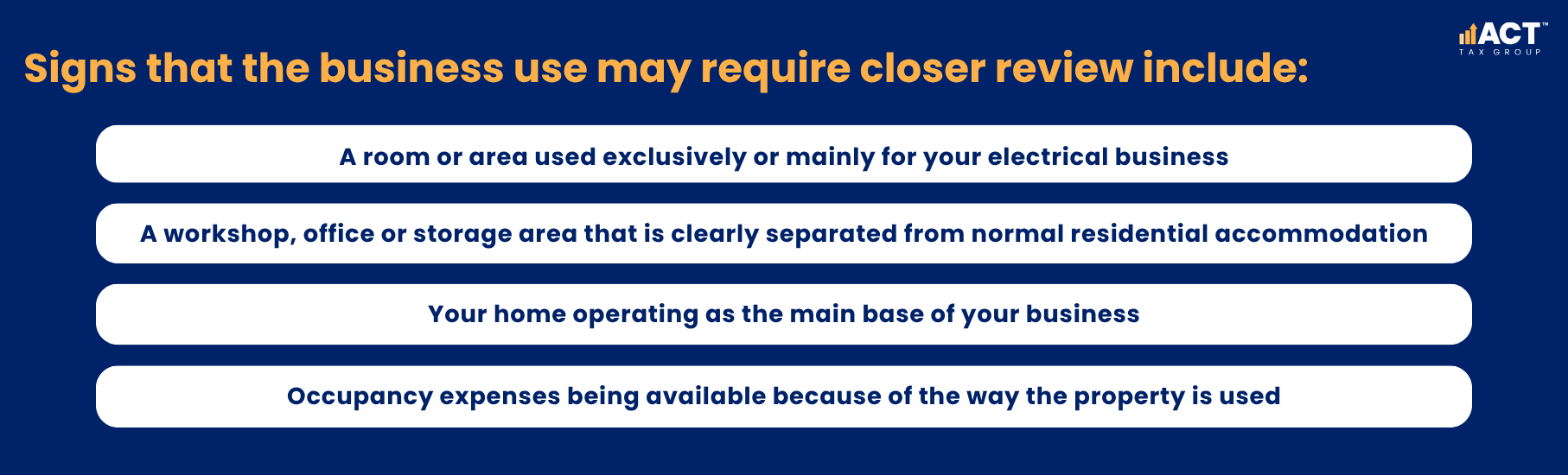
Where the main residence CGT exemption is reduced, property owners do not necessarily pay Capital Gains Tax on the entire gain. In most home-based business situations, the taxable portion reflects the proportion of the home used for business and the relevant period during which that use occurred. For example, if a dedicated business office represents 10% of the home’s floor area, that percentage may become relevant when determining the taxable gain. The actual tax outcome can also depend on the ownership period, the property’s cost base, the exact date business use started, the total capital gain and whether an available CGT discount applies, so a simple percentage calculation should not replace professional advice.
The Produce Income Rule Can Change Your Cost Base
The home first used to produce income rule can apply where your property initially qualified for the full exemption and you later use part of it to produce assessable income. If the ATO conditions are met, including that the home was acquired on or after 20 September 1985 and first used to produce income after 20 August 1996, you must use its market value at that time when calculating the later capital gain. That makes the exact date business use begins important. Where the home first used to produce income rule applies, the market value at that date becomes the starting point for the CGT calculation, with eligible later costs and capital improvements considered under the normal cost base rules.
The Six-Year Rule Does Not Automatically Protect Business Use
The six-year rule is often discussed in connection with a former home that becomes an investment property after the owner moves out. In some circumstances, a former main residence can continue to be treated as the owner’s main residence for up to six years while it produces rental income, provided the relevant conditions are satisfied. There are a few traps for business owners. If part of your home was already used to produce income before you moved out, the six-year rule does not restore the full exemption for that part. The remaining part of the former home may still qualify for the continuing main residence exemption if the relevant conditions are met.

Your Main Residence Status Still Depends on Your Circumstances
Calling a property your home is not the only factor considered when deciding whether the residence exemption applies. Relevant circumstances can include whether you and your family live there, whether your personal belongings are kept there, where your mail is delivered, your address on the electoral roll, connected utility services and your intention in occupying the property. Foreign residents generally cannot claim the main residence exemption when a CGT event happens to Australian residential property unless they meet the ATO’s life events test. If your circumstances involve another property, substantial periods away from the home or a change to income-producing use, professional advice can help determine whether the full CGT exemption or a partial exemption applies.
Meticulous Records Make Future CGT Calculations Easier
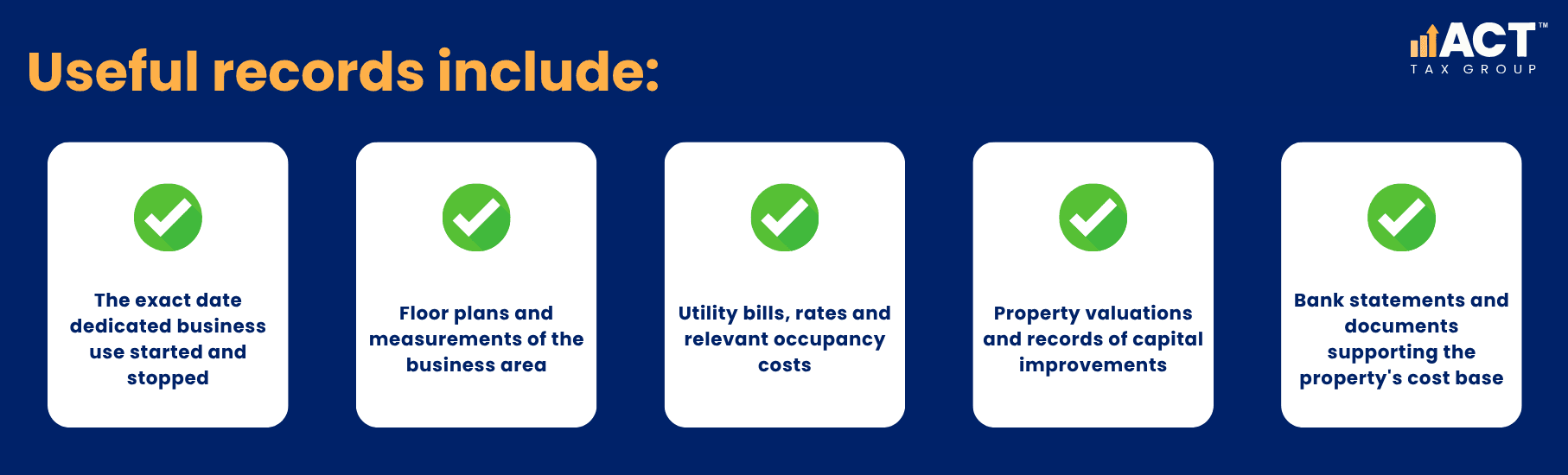
Meticulous record keeping is not just a good idea when your home is also connected with your electrical business. If you sell the property several financial years later, meticulous records can help establish when business use began, how much floor area was involved and which costs form part of the relevant CGT calculation. If the home is first used to produce income after 20 August 1996, the ATO says you need a record of its market value at that time.
Current Deductions Should Be Weighed Against Future CGT
Claiming legitimate business expenses can improve your current financial position, but the immediate deduction is only one part of the decision. Where your home becomes a genuine place of business, reducing today’s assessable income could come with a future taxable capital gain when you eventually sell the property. The aim is not to avoid deductions or assume you will automatically have to pay tax when the property is sold. Strategic planning means understanding the potential tax bill, the total capital gain, any partial exemption and available CGT discount before making informed decisions about how your property will be used.
Power up your business with Accounting Built for Electricians
From start-up to expansion, our accounting team supports your tax, payroll, and cash flow at every stage of growth.
How ACT Tax Group Can Help with Home Office and CGT Planning
We can review how you use your home, your electrical business structure, your current expense claims and your existing property records. Our team can help identify whether a partial exemption may apply, what records should be retained and how the property’s cost base and future taxable capital gain may need to be calculated. If you use a dedicated bedroom, garage, office or workshop for your electrical business, book a consultation with ACT Tax Group. Professional advice before the property is sold can help prevent a future tax headache and give you clearer information for both your current tax return and longer-term financial planning.

Protecting Your Main Residence Exemption Through Clear Planning
Working from home does not automatically remove your main residence exemption or mean you will pay Capital Gains Tax when you sell. The main issue is whether part of your property has become a genuine business area and, if so, how that use affects the CGT exemption, taxable portion and ownership period. For electricians, checking the arrangement early can make future CGT calculations much easier. Keeping meticulous records, understanding the produce income rule and reviewing the potential tax outcome before making long-term decisions can help you protect your position while still claiming legitimate business expenses.

Lukasz Klekowski
Principal of ACT Tax Group, specialising in tax compliance and financial strategy for Australian small businesses.

Share this article
Disclaimer: All information provided in this publication is of a general nature only and is not personal financial or investment advice. It does not take into account your particular objectives and circumstances. No person should act on the basis of this information without first obtaining and following the advice of a suitably qualified professional. To the fullest extent permitted by law, no person involved in producing, distributing or providing the information in this publication (including ACT TAX GROUP PTY LTD, each of its directors, councilors, employees and contractors and the editors or authors of the information) will be liable in any way for any loss or damage suffered by any person through the use of or access to this information. The Copyright is owned exclusively by ACT TAX GROUP PTY LTD (ABN 31634338088)