

Study Loan Repayment Checks for Electricians With Overtime or Allowances
Published on September 8, 2026
Study Loan Repayment Checks for Electricians with Overtime or Allowances can help you work out whether changing weekly or fortnightly earnings could affect your study loan repayments. If overtime, call-outs or allowances regularly increase your pay, checking your expected annual income can help you understand how much Higher Education Loan Program (HELP) debt you may need to repay through the tax system.
Overtime and Allowances Can Increase Your HELP Repayment
How much HECS you pay depends on your annual repayment income rather than your base wage alone. If overtime and taxable allowances increase your income above the minimum repayment threshold, your compulsory repayment amount may increase as well. If you have told your employer that you have a study and training support loan, they must use the current withholding rules when calculating the tax withheld from your pay. The Australian Taxation Office (ATO) works out your final compulsory repayment after you lodge your income tax return.
Could Overtime Push Up Your HELP Repayment?
Schedule a complimentary consultation with us today to estimate your repayment from annual earnings.
Variable Electrical Work Can Change Your Repayment Income
Electricians often have uneven income because overtime and allowances depend on the projects they are working on. A quiet fortnight may include ordinary hours only, while another may include overtime, weekend rates and additional site payments. That variation matters because your annual income determines whether you exceed the relevant repayment threshold. Checking your year-to-date pay instead of relying only on your employment agreement can provide a clearer picture of your likely study loan position.
The 2026–27 Minimum Repayment Threshold Starts At $69,528
For the 2026–27 financial year, the minimum repayment income for applicable study and training loans is $69,528. If your repayment income is $69,528 or less, you do not have a compulsory repayment for that year. The current repayment system uses marginal rates. This means the compulsory repayment calculation applies to income above the relevant threshold rather than applying a flat percentage to your entire repayment income.
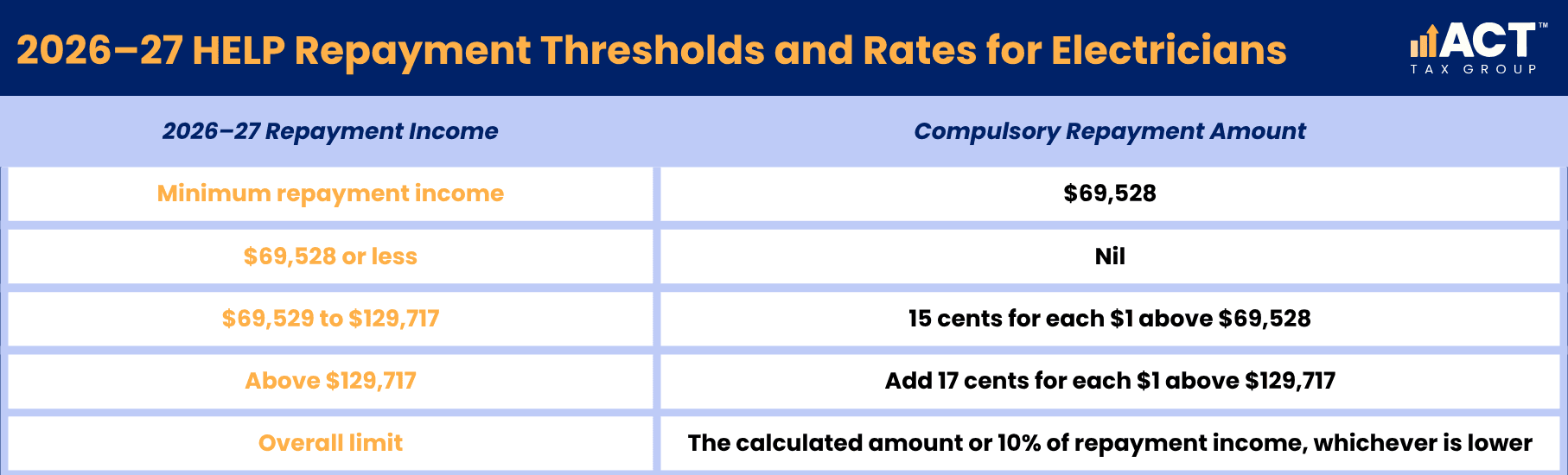
According to the Australian Government’s 2026–27 thresholds and rates, the minimum repayment income is $69,528. The second income threshold begins above $129,717, with the compulsory repayment subject to the applicable calculation and overall limit.
Repayment Income Can Be Higher Than Taxable Income
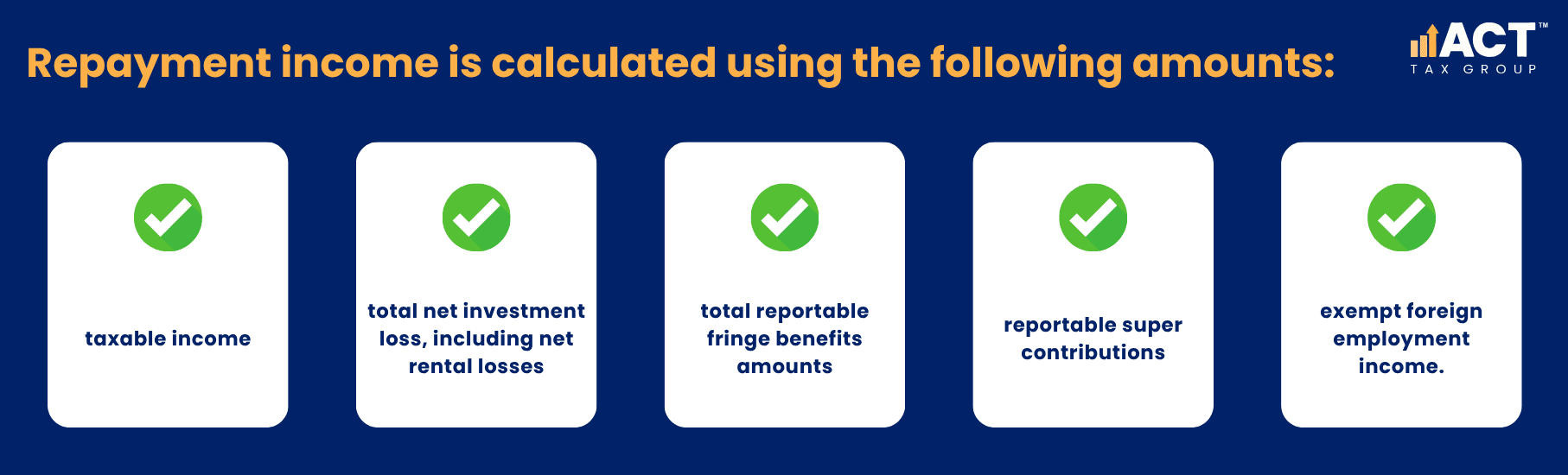
Repayment income can be different from the taxable income shown at the bottom of your tax return. The ATO starts with taxable income and adds certain other amounts when calculating whether you have reached the repayment threshold. Understanding these additional amounts is important if you have investments, salary arrangements or income outside your normal electrical work. Your accountant can calculate your total repayment income using the information in your income tax return.
Several Study and Training Loans Use the Same Repayment System
The compulsory repayment system covers more than traditional HECS debt. Depending on your circumstances, you may have a HELP debt or another eligible study and training loan that is repaid through the taxation system. This can be particularly relevant for electricians who completed university before entering the trade, changed careers, or used an eligible training loan during earlier study. You can generally check your current loan balance through your myGov account linked to the ATO. Study and training loans covered by these repayment rules include:
Higher Education Loan Program (HELP) loans, including HECS-HELP
VET Student Loan debt
Student Financial Supplement Scheme debt
Student Start-up Loan debt, including ABSTUDY SSL debt
Australian Apprenticeship Support Loan debt, formerly called Trade Support Loan debt.

Regular Payslip Checks Can Help Prevent Surprises
Start by checking that your employer has the correct information about your study loan. The information you provide through your employment declarations helps payroll determine the appropriate amount to withhold from your pay. Next, compare your year-to-date income with what you realistically expect to earn for the full financial year. This is especially useful if overtime has increased or you are approaching one of the repayment thresholds and rates.
Taxable Allowances Can Affect Your Compulsory Repayment
Taxable allowances can contribute to your taxable income and may therefore affect your study loan repayment. The result depends on what the allowance is for and how it is treated for tax purposes, so you should not assume every allowance has the same effect. This distinction is important for electricians who receive different payments for travel, tools, working conditions or particular sites. Check your payslip and records carefully so your projected annual income reflects the amounts that actually contribute to your tax position.
Example:
An electrician receives ordinary wages, substantial overtime and several taxable site allowances during a major project. Calculating their expected HELP repayment using base salary alone would understate their likely annual repayment income.
Power up your business with Accounting Built for Electricians
From start-up to expansion, our accounting team supports your tax, payroll, and cash flow at every stage of growth.
Voluntary Repayments Do Not Replace Compulsory Repayments
Voluntary repayments can reduce your outstanding HELP debt, but they are separate from compulsory repayments. Making a voluntary debt repayment does not automatically remove a compulsory repayment calculated when you lodge your tax return. Before making repayments voluntarily, check your loan balance and cash flow. For an electrician running a business or managing irregular income, keeping enough money available for tax, business costs and personal commitments may be just as important as reducing the debt early.
Example:
An electrician makes a voluntary repayment during the year after receiving a large project payment. If their repayment income is still above the minimum repayment threshold, they may also have a compulsory repayment when their tax return is assessed.

How ACT Tax Group Can Help with Study Loan Repayment Checks
If overtime, allowances or other income make your tax position difficult to predict, we can help you calculate your expected repayment income and understand your likely compulsory repayment. Our friendly, IPA-certified team can also review your taxable income, payroll withholding and broader tax position so you have a clearer idea of what may happen when you lodge your tax return. We understand that electricians are often more interested in getting jobs completed than spending evenings working through tax calculations. Book a meeting with ACT Tax Group to arrange a practical review of your HELP debt repayment position and identify any issues that may need attention before the end of the financial year.

Lukasz Klekowski
Principal of ACT Tax Group, specialising in tax compliance and financial strategy for Australian small businesses.

Disclaimer: All information provided in this publication is of a general nature only and is not personal financial or investment advice. It does not take into account your particular objectives and circumstances. No person should act on the basis of this information without first obtaining and following the advice of a suitably qualified professional. To the fullest extent permitted by law, no person involved in producing, distributing or providing the information in this publication (including ACT TAX GROUP PTY LTD, each of its directors, councilors, employees and contractors and the editors or authors of the information) will be liable in any way for any loss or damage suffered by any person through the use of or access to this information. The Copyright is owned exclusively by ACT TAX GROUP PTY LTD (ABN 31634338088)