

Using the Fortnightly Tax Table: Payroll Essentials for Electrical Businesses with Employees
Published on March 19, 2026
Using the fortnightly tax table correctly is one of the simplest ways for electrical businesses with employees to keep payroll running smoothly and avoid unwanted tax surprises. When you are juggling quotes, site work, and employee wages, the last thing you need is confusion about how much to withhold, what to do with allowances, or how training support loans and the Medicare levy fit into your tax calculations on a fortnightly basis.
Why the Fortnightly Tax Table Matters for Electrical Businesses
If your crew is paid on a fortnightly basis, the fortnightly tax table is the main ATO tool you use to calculate how much Pay as You Go (PAYG) withholding to deduct from each employee’s wages. It converts the yearly tax rules into a table that matches normal fortnightly earnings, so you can quickly determine the withholding amount for each pay cycle without doing the full formula yourself every time and avoid knock-on payroll compliance issues, including ATO penalties, interest and reporting problems if withholding is wrong.
Getting this wrong can lead to penalties, ATO letters, or a nasty surprise for employees when they lodge their tax returns and find out that not enough tax was withheld. On the flip side, using the following tax tables correctly can save time, reduce risk, keep your payroll process consistent, and help your business stay on top of compliance without eating into your evenings.
Unsure if you’re using the right fortnightly tax table?
Schedule a complimentary consultation with us today to ensure your PAYG setup matches ATO requirements.
How the Fortnightly Tax Table Works In Practice
At its core, the fortnightly tax table is about matching employee wages to a dollar amount of fortnightly tax you need to withhold. The ATO issues a schedule and a table for each financial year, and you simply refer to the current version on the ATO website when you set up or check your payroll.
When your payroll system is set up to follow the latest tax tables, it will usually calculate the withholding amount for you, especially if you use STP-enabled payroll software and review your lodged reports in ATO Online services for business. Still, it helps to understand what is happening behind the scenes so you can spot when something does not look correct.
Step‑By‑Step: Using the Fortnightly Tax Table for Your Team
This section breaks down the key steps so you can calculate PAYG withholding for your employees on a fortnightly basis, even if payroll is not your favourite job.
1. Confirm Pay Cycle and Use the Right Table
First, confirm that your workers are paid on a true fortnightly schedule, not weekly or monthly. If they are paid every two weeks, you use the fortnightly tax table. If you pay monthly, you must use the monthly tax tables instead, otherwise your tax calculations will be off and the wrong withholding amount will be deducted.
Always refer to the current year’s tax tables on the ATO website and make sure your payroll uses the schedule that matches the financial year you are in. Ignoring this and relying on an old file, or the wrong table frequency, is one of the easiest ways to end up with under‑withholding and extra tax debt.
2. Work Out Employee’s Total Fortnightly Earnings
For each employee, start with the employee’s total fortnightly earnings before tax. This usually includes:
Ordinary wages or salary.
Overtime and shift loadings.
Taxable allowances, such as some travel or site allowances and overtime arrangements.
Bonuses or other regular payments tied to that pay period.
If there are irregular payments, such as certain lump sum payments or some types of termination payments, you may need to treat them differently to normal fortnightly earnings, following the ATO guidance. The idea is to make sure the earnings you use in the table reflect what the worker is actually entitled to for that fortnight.
3. Check Tax Free Threshold and Declarations
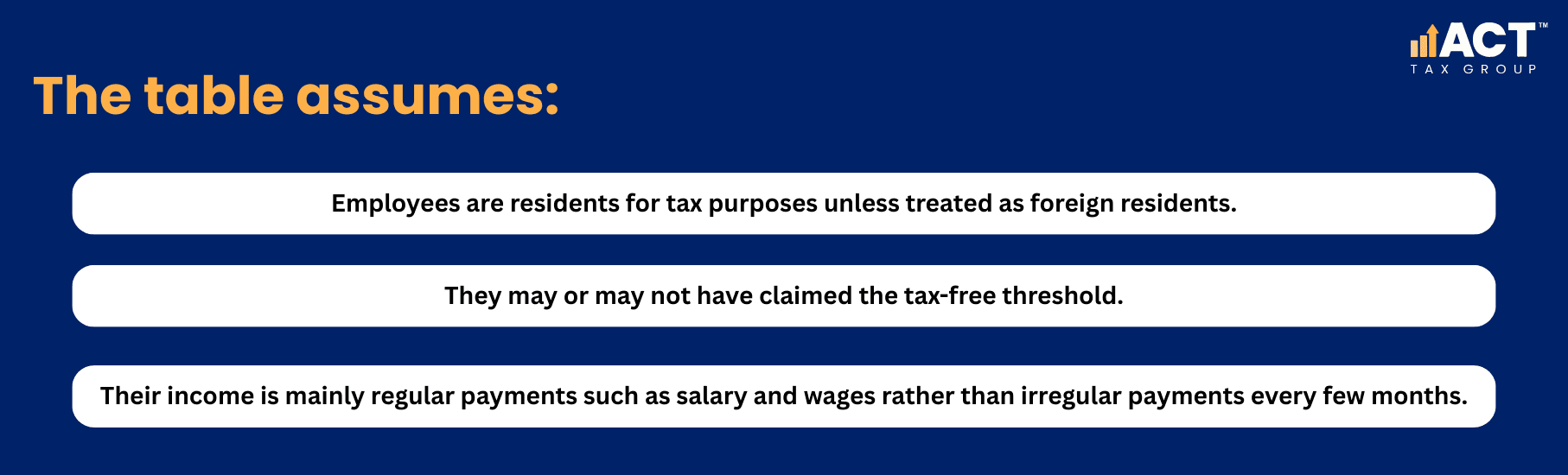
Next, check whether the employee has lodged a Tax File Number declaration or a withholding declaration telling you whether they are claiming the tax free threshold from your business. If they have claimed it and this is their main job, you use the “with tax free threshold” column of the fortnightly tax table. If they have a second job, or they do not want to claim the threshold from you, you use the “no tax free threshold” column.
If an employee hands you a Medicare levy variation declaration or another declaration that affects their tax or Medicare levy position, keep that on file and make sure your payroll settings reflect it. These declarations can affect the correct amount of tax you need to withhold and can trigger a Medicare levy adjustment in the way the table is applied.

4. Look Up the Withholding Amount in the Table
Once you know the employee’s total fortnightly earnings and tax-free threshold status, you go to the fortnightly tax table and find the row that matches their income. If the exact earnings are not shown, use the nearest dollar amount below their pay, not the amount above.
For example, if an electrician has earnings of 1,261 dollars and the table only lists 1,260 and 1,262, you use the 1,260 row. You then read across to the column that matches their situation. For resident employees, use the relevant tax-free threshold column. For foreign resident employees, use the foreign resident rates instead.
5. Allow For Study and Training Support Loans
If an employee has a Study and Training Support Loan (STSL) debt, such as HELP, VSL, FS, SSL or AASL, this can affect how much tax you need to withhold. When their income passes certain thresholds, there may be additional withholding added on top of the standard amount from the fortnightly tax table, so that their loan debt is paid off correctly over time.
In practice, you enter their loan status into your payroll system, and it will use the correct schedule or formula to calculate the extra withholding. This is important because it helps them avoid a surprise bill at tax time and keeps their loan repayments in line with their income.
6. Consider Tax Offsets, Medicare Levy and Adjustments
Some employees may be entitled to tax offsets or may have special Medicare levy situations, such as a Medicare levy exemption, a variation, or a lower rate. They might give you a Medicare levy variation declaration or other form that affects the way tax and the Medicare levy are calculated.
In these cases, you may need to make adjustments to the standard withholding amount shown in the table so that it better reflects their situation. The ATO provides clear guidance on which offsets can be taken into account through payroll, and which ones are handled later when the employee lodges their tax return.
7. Finalise Net Pay and Keep Records
After you calculate the PAYG withholding, you subtract it from the employee’s total fortnightly earnings to arrive at net pay. You also deduct any other agreed items, like salary sacrifice into superannuation, then pay the final amount to the employee.

These records help you stay on top of compliance, support accurate tax documents and record‑keeping for trades, and make it easier to sort out any issues if the ATO asks questions later.
Simple Ways To Make Payroll Less Stressful
Electrical business owners do not need to become tax experts, but you do need a simple system that protects your business and your workers.
Use A Clear Checklist For Each Pay Run
A short, written checklist for each payroll cycle can help you:
Confirm which table applies (fortnightly or monthly).
Check that you are using the current financial year’s version.
Review any new declarations from employees.
Confirm that allowances, bonuses and other earnings are included correctly.
This step‑by‑step process reduces the chance of mistakes and helps you spot when something looks off before you finalise payments.
Power up your business with Accounting Built for Electricians
From start-up to expansion, our accounting team supports your tax, payroll, and cash flow at every stage of growth.
Let Your Payroll Software Do the Heavy Lifting
Good payroll software can automatically calculate the withholding amount using the latest fortnightly tax table and other ATO rules. It can also handle additional withholding for study and training support loans, help you calculate superannuation, support ATO-compliant payroll reporting, and help align your payroll records with your BAS reporting.
The key is to set it up correctly from the start and to review it when something changes, like a new declaration, a new type of allowance, or a change in an employee’s loan or Medicare position.
Link Payroll to Cash Flow and ATO Obligations
Every dollar you withhold from employees is money you are holding on trust until it is passed on to the ATO. Setting aside PAYG withholding and Super in a separate account after each pay run can make it much easier to meet these obligations when they fall due, and makes it simpler to stay on top of Instalment Activity Statements and PAYG reporting without scraping together cash at the last minute.
This habit also reduces stress and helps you see clearly what part of the “money in the bank” is really yours and what belongs to employees and the ATO, which is critical when you are preparing your BAS and GST reporting each period.

When To Reach Out for Help
If you are unsure whether your payroll uses the right table, if your workers have complex situations (such as multiple jobs, support loans, or special Medicare positions), or if you have fallen behind on BAS and PAYG, it makes sense to get professional accounting and tax support.
A good adviser, such as the experienced team at ACT Tax Group, will:
Check your payroll settings against the current fortnightly tax table and related schedules.
Help you correct any under‑ or over‑withholding issues and avoid common tax deduction mistakes that can attract ATO attention.
Guide you through any ATO contact and help reduce the chance of penalties.
Most importantly, they can help you build a simple, repeatable payroll process that reflects the ATO rules without taking over your nights and weekends. That way, you can focus on running jobs, looking after your crew, and growing a strong, steady electrical business.

Lukasz Klekowski
Principal of ACT Tax Group, specialising in tax compliance and financial strategy for Australian small businesses.

Disclaimer: All information provided in this publication is of a general nature only and is not personal financial or investment advice. It does not take into account your particular objectives and circumstances. No person should act on the basis of this information without first obtaining and following the advice of a suitably qualified professional. To the fullest extent permitted by law, no person involved in producing, distributing or providing the information in this publication (including ACT TAX GROUP PTY LTD, each of its directors, councilors, employees and contractors and the editors or authors of the information) will be liable in any way for any loss or damage suffered by any person through the use of or access to this information. The Copyright is owned exclusively by ACT TAX GROUP PTY LTD (ABN 31634338088)