

How Long Should Arborists Keep Tax and Bookkeeping Records? ATO Requirements Explained
Published on May 5, 2026
How long should arborists keep tax and bookkeeping records? ATO requirements explained is often the question that pops up at tax time, usually when you are already under pressure to finish jobs, send invoices and pull together an income tax return.
A Busy Season, a Missing Invoice, and a Record‑Keeping Headache
Picture the end of a financial year. You are finalising your income tax return and your accountant starts asking for bank statements, purchase records, payroll records and other financial records from jobs you did several years ago. You know the work was done and paid for. You remember the big stump grinder repair and the new climbing gear, but some original paper records have faded, a few tax records were accidentally lost in a shed leak, and the only proof you can find is an old credit card statement that does not clearly describe the goods or services date.
In that moment you start asking yourself some simple but important questions. How long do I actually need to keep records? What records do I need to keep for the ATO? Are my current record keeping habits enough if the Australian Taxation Office ever looks more closely at my tax affairs? This is a common situation for sole traders and small arborist companies, and it shows why clear rules around tax record keeping matter. Once you understand those rules, you can set up simple habits and stop guessing.
Unsure which arborist records to keep and for how long?
Schedule a complimentary consultation with us today to map clear ATO timeframes for income, expenses and assets.
The Core Rule for How Long to Keep Tax Records
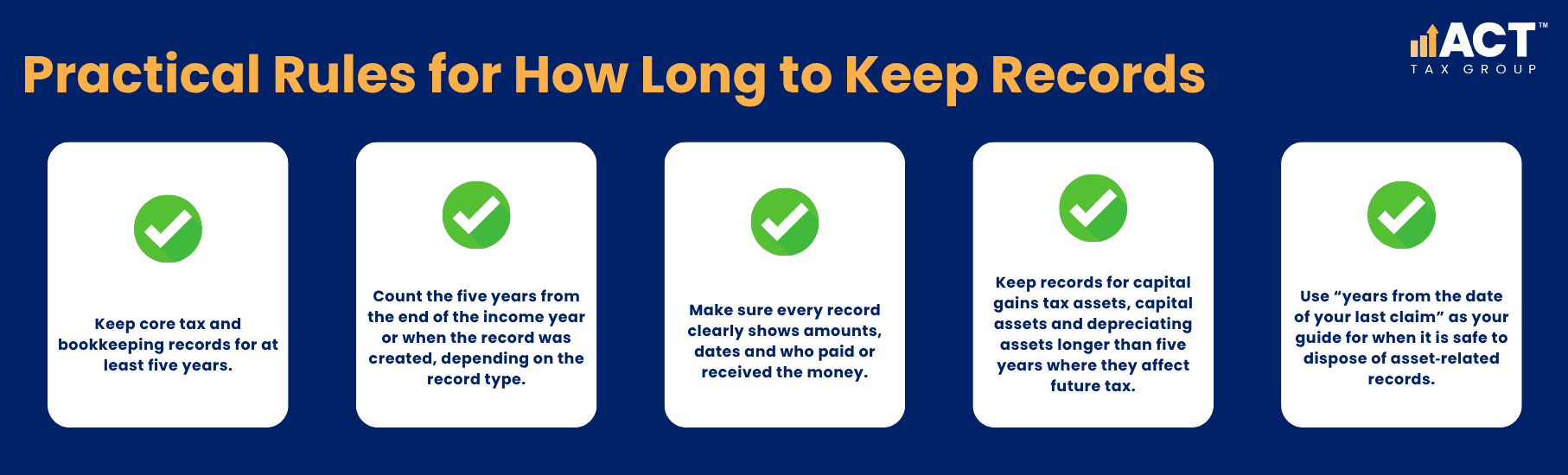
For most arborist businesses, the starting point is that you need to keep records for at least five years. The tricky part is working out five years from which date. In general, you keep records that explain your business income, business expenses and other deductions for at least five years from when the record was prepared or obtained, or when the transaction or related act was completed, whichever is later.
Those records need to be accurate records that clearly show amounts, dates and who paid or received the money. If a record relates to Capital Gains Tax (CGT) assets, capital assets or depreciating assets, you often need to retain records for longer than five years, because the effect on income tax can stretch over many years. This is especially true where there is a capital gain or tax loss linked to that asset or where carried forward tax losses rely on those records to support your position.
For an arborist, a safer rule of thumb is to keep records until the last tax return that relies on those records is outside the relevant review period. If you are still claiming decline in value on a chipper or using records to support a CGT position, then the period of review for those claims is not finished, so you still need to retain records. When that last claim has gone through an income tax return and the review period has passed, you can consider whether it is safe to let those records go.
The Main Records an Arborist Needs to Keep
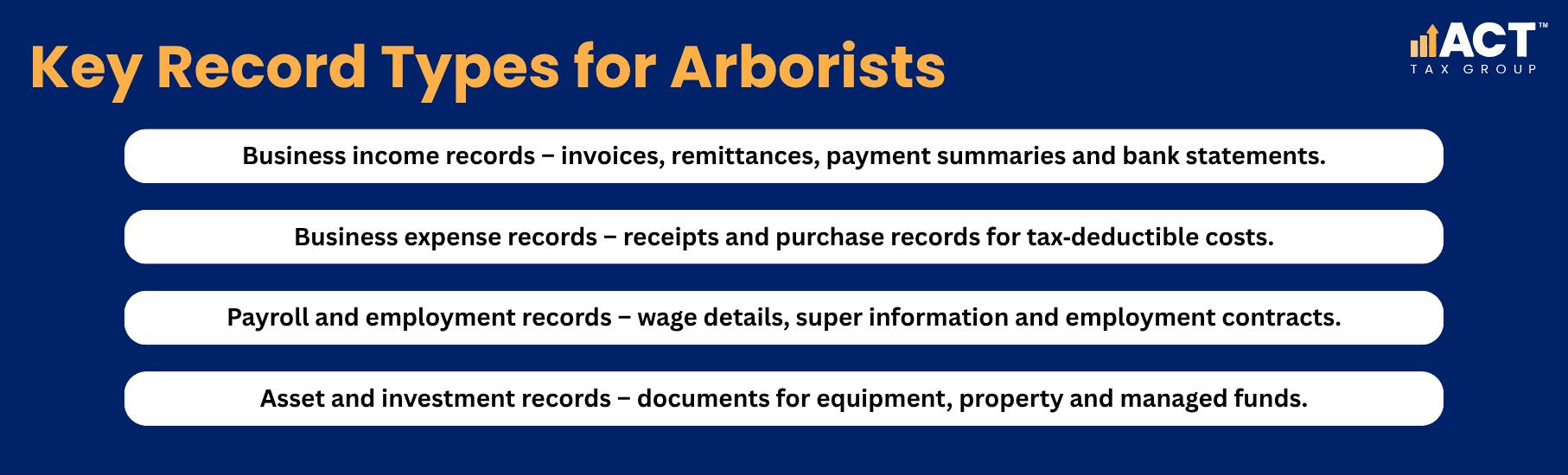
Almost every dollar that comes in and goes out of your business can be traced back to a job, a crew, or a piece of gear. Good record keeping means you can clearly show that story if anyone ever asks. In practice, arborists deal with a few main types of business records.
Business Income
First, there are records for business income. These include invoices issued to customers, remittance advice from larger clients, income statements or other payment records where relevant, and bank statements that show when money for tree removals, pruning, stump grinding, land clearing and other services actually hit your account. If you sometimes take cash payments for jobs, you still need to record that business income properly, so your taxable income is correct.
Business Expenses and Deductions
Second, there are records for business expenses and other deductions. These cover fuel dockets, repair bills, safety gear, dumping fees, insurance, office equipment, record keeping app subscriptions and anything else you treat as a tax deduction. Purchase records and written evidence are important here. A credit card statement alone might not be enough if it does not clearly show what was bought.
Staff and Employment
Third, if you have staff, you need payroll records and employment contracts. These show how much you paid climbers and ground crew, how much super you contributed, and how you calculated their pay. Even if you pay some amounts in cash, you still need clear written evidence of what was paid and when.
Assets and Investments
Finally, there are records for asset purchases and longer‑term investments. For your business this usually means chippers, stump grinders, trucks, trailers, office equipment and sometimes property or managed funds in your personal name. These records matter for CGT, decline in value claims, and any final claim you make once the asset is sold or scrapped. If you also own an investment property or managed funds, you need to keep their records carefully too, because they can affect capital gain calculations years into the future, especially where Capital Gains Tax (CGT) on inherited property may apply.
Paper, Digital and Electronic Records: What Actually Works
Many arborists start with shoeboxes of paper records and then slowly move to digital records as the business grows. The Australian Taxation Office (ATO) accepts both paper records and electronic records as long as they are in English, or readily convertible into English, readable and can be produced if requested. This means you can keep original paper records, electronic copies or a mix, as long as you can show a true and clear reproduction of the details when needed.
In practice, digital record keeping is usually easier once you get used to it. Scanned receipts, scanned employment contracts and emailed invoices can be stored in your accounting software, ATO Online services for business or in cloud folders. As long as the scan is clear and the information is complete, the electronic record is usually just as useful as the original paper records. This is where a simple record keeping app or your accounting software can make a big difference.
A practical approach for a tree services business is to keep day‑to‑day paperwork for a short time, scan or photograph it promptly, then file the electronic copies by financial year and record type. For example, you might have separate folders for business income, business expenses, asset purchases, payroll records, and investment property information. As your system matures, you spend less time hunting for original paper records and more time relying on electronic records that you can search and sort in seconds.
Timeframes for Everyday Income and Expenses
When you look at everyday business income and business expenses, such as job invoices and work-related expenses for fuel, repairs or dumping fees, the five‑year rule is the main guide. In most cases, you keep your tax records for at least five years from when you prepared or obtained the record, or completed the transaction or related act, whichever is later. If your 2024–25 income tax return includes those expenses and income, you keep the supporting tax records for at least five years from when you prepared or obtained the records, or completed the relevant transactions or acts, whichever is later.
This is where good records make life much easier. Clear documentation means you can show that a specific payment in a bank statement matches a particular job or purchase, and you can link the goods or services date to the time of the work. When the Australian Taxation Office looks at your tax affairs, they will expect written evidence that supports the numbers in your return and shows your business transactions in a simple, understandable way.
If some of your expenses relate partly to private use and partly to business use, your records also need to show how you worked out the business portion. That might mean notes, logbooks, or extra detail in your accounting software reports. Keeping this information with your other tax records means you can answer questions quickly if the ATO ever asks for more detail.

Timeframes for Assets, Capital Gains and Tax Losses
Assets and capital items are different to day‑to‑day expenses because they can affect your tax position over a long period. For CGT assets, such as an investment property or certain business premises, you generally need to keep records for at least five years after the relevant CGT event, such as selling or transferring the asset. If those records are used in a later tax return, you may need to keep them for longer. The same idea applies to capital assets used in your business, including chippers, stump grinders and trucks, especially when you make claims for the decline in value over multiple income years or start using a property for short term rental accommodation and CGT purposes.
You also need to think about carried forward tax losses. If your business has a tax loss that you carry into later years, the business records and financial statements that prove that tax loss should generally be kept until the review period has ended for the income year in which that tax loss is fully deducted or applied, particularly if you are also monitoring turnover to stay under the GST registration threshold. That way, if the ATO looks back over several years, you have the records you need to show how the tax loss was created and how it was applied.
A practical way to handle this is to note the year of your last claim or last capital gain event for an asset and then treat that as the starting point for your retention period. If you sell an old stump grinder and declare the final gain or loss in a particular income year, you keep all related records for at least five years from that point, not from when you first bought it.
Employment, Payroll and Super Records
As soon as you employ other people, your record keeping responsibilities expand. Payroll records and employment contracts are not just a tax issue; they also relate to your responsibilities as an employer under workplace laws. These records show what was agreed, what was paid, and when payments were made.
For practical purposes, many arborists choose to keep payroll records, employment contracts and related documents for at least seven years, which aligns with Fair Work time and wages record-keeping requirements. This covers both income tax and wider employment requirements, and it also protects you if a question arises about underpayments, super contributions, or conditions of employment. When records clearly show payment summaries, hours worked, and the services date or period for each pay, disputes are easier to resolve and your position is stronger.
Using payroll features in your accounting software can help. You can store electronic copies of employment contracts, link them to each worker, and generate reports that show payments across an entire financial year. When everything is in one system, you are not trying to match hand‑written notes to bank statements years down the track.
Grow your tree care business with Accounting Built for Arborists
From start-up to expansion, our accounting team supports your tax, payroll, and cash flow — so you can focus on running your business safely and profitably.
What If Your Records Are Lost or Destroyed?
Even with good systems, things go wrong. Records can be destroyed by water, fire or computer failure. They can be misplaced during a move, or accidentally lost when you change devices. If this happens, the key is to act quickly and rebuild as much as you can.
Start by gathering everything still available: bank statements, credit card statements, supplier statements, electronic records in your accounting software and email invoices. Recreate the story of your business transactions as best you can, and keep a clear note explaining how the records were lost and what steps you took to recover them. If needed, ask your suppliers, bank or registered tax agent for copies of older documents.
The ATO understands that accidents happen, but they expect you to take reasonable precautions and show that you tried to rebuild your records. The more you rely on digital records and electronic copies, the easier it is to recover from a problem like this, because you often have multiple backups without realising it.
Building Simple, Low‑Stress Record Keeping Habits
You do not need a complicated system to stay compliant. You need straightforward habits that fit around quoting, scheduling and running your crew. One helpful habit is to capture records on the same day whenever possible. That means sending invoices as soon as the job is finished, taking a photo of receipts before you leave the fuel station, and updating timesheets and payroll information at the end of the week instead of months later.
Another useful habit is to let your accounting software do more of the heavy lifting. When you attach scanned receipts and electronic copies of invoices to each bank transaction, you do not have to hunt for them at tax time. When you group your digital records by financial year, you can respond quickly if the ATO or your accountant asks for particular details, and it becomes much easier to handle accurate BAS and GST reporting for your business.
Over time, these simple routines add up to a strong set of records. You can see your financial position clearly, apply practical cash flow tips for arborists, you can back up every tax deduction you claim, and you can step into a review period with more confidence because you know your business records tell a clear, consistent story.

When to Ask for Help
There comes a point where getting support from a registered tax agent makes sense. This is especially true if your arborist business is growing, you are thinking about a future sale, or you have a mix of business records, investment property and managed funds to juggle.
Professional help is valuable if you are uncertain about how long to retain records for particular CGT assets, if you are managing a tax loss and want to make sure you keep the right records through each income year, or if you have had records destroyed and need to rebuild sufficient evidence for the ATO. A tax adviser who understands trades and tree services can help you set up a simple system for record keeping that fits the way you and your crew actually work.

Lukasz Klekowski
Principal of ACT Tax Group, specialising in tax compliance and financial strategy for Australian small businesses.

Disclaimer: All information provided in this publication is of a general nature only and is not personal financial or investment advice. It does not take into account your particular objectives and circumstances. No person should act on the basis of this information without first obtaining and following the advice of a suitably qualified professional. To the fullest extent permitted by law, no person involved in producing, distributing or providing the information in this publication (including ACT TAX GROUP PTY LTD, each of its directors, councilors, employees and contractors and the editors or authors of the information) will be liable in any way for any loss or damage suffered by any person through the use of or access to this information. The Copyright is owned exclusively by ACT TAX GROUP PTY LTD (ABN 31634338088)