

Arborists: Step‑by‑Step Guide to Negotiating an ATO Payment Plan After a Tough Season
Published on September 8, 2026
An ATO payment plan after a tough season can help an arborist business manage tax debt when seasonal cash flow, late customer payments or unexpected equipment costs make it difficult to pay the Australian Taxation Office (ATO) in full. A payment plan allows an eligible business to repay an outstanding tax debt over time rather than making one large lump sum payment.
Setting Up an ATO Payment Plan Starts with Accurate Information
An arborist should first confirm the entire debt, lodge any outstanding tax returns or activity statements and prepare a realistic cash flow forecast. Depending on the amount owed and the business’s circumstances, an ATO payment plan may be arranged through ATO online services. A business can generally set up a payment plan online if the debt is under $200,000. For payment plans above $200,000, contact the ATO. Base the proposed payment plan on what the business can realistically afford, not on its strongest month of trading. The ATO considers your circumstances when assessing a payment plan, and payments can generally be arranged weekly, fortnightly or monthly, with an upfront payment where required.
Is your ATO payment plan realistic for quieter months?
Schedule a complimentary consultation with us today to set affordable repayments around seasonal cash flow.
Seasonal Cash Flow Should Guide Your Repayment Amount
Cash flow forecasts are particularly important for arborists because income can change substantially throughout the year. A plan based on realistic customer receipts and operating expenses provides a clearer picture of how much the business can pay without creating another cash shortage. Small businesses also need to allow for delayed invoices, equipment repairs and rising operating costs. Recent Australian business data has shown that more than one-quarter of businesses can experience difficulty meeting financial commitments over a short period, highlighting why a payment plan should reflect the actual financial situation rather than optimistic sales expectations. When preparing your forecast, include:
Expected customer payments
Wages and superannuation
Fuel and vehicle costs
Equipment finance and insurance
Upcoming BAS, GST and income tax payments
Example: A tree services business may have $30,000 in completed work awaiting payment from builders and property managers. Those invoices matter when assessing cash flow, but the payment plan should not assume every customer will pay earlier than their agreed terms.

Preparing Financial Information Strengthens Your Position
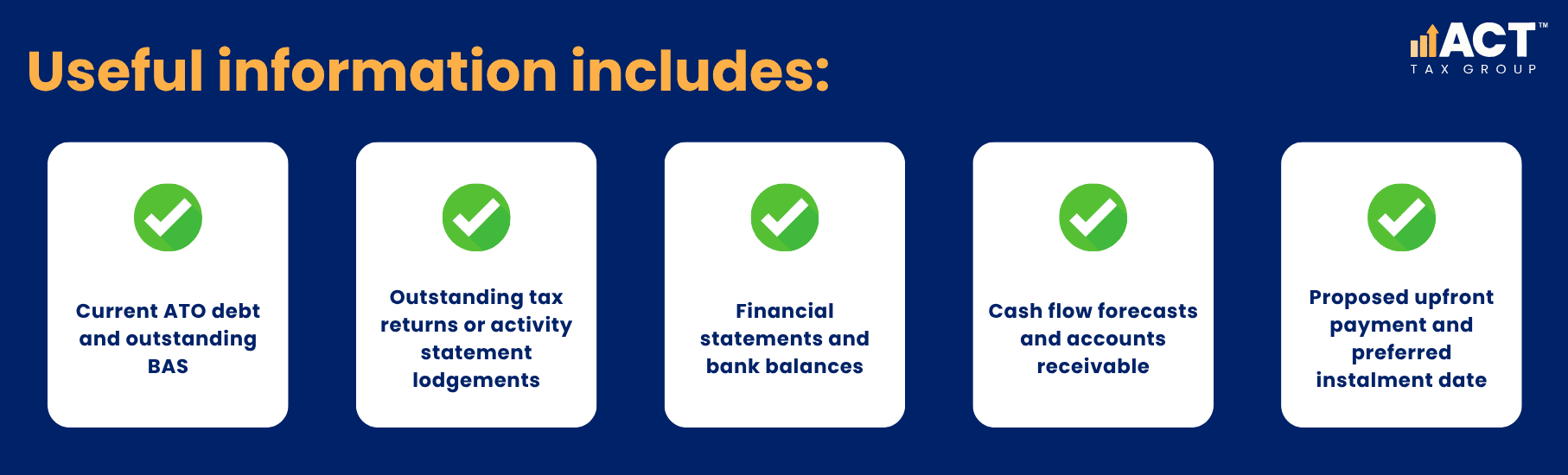
You should have clear financial information ready before discussing an ATO payment plan. This can include bank balances, financial statements, outstanding invoices, liabilities and cash flow forecasts, particularly where the debt is larger or the ATO needs more information about your ability to pay. Your compliance history and personal circumstances may also affect how the situation is considered. Previous defaults, missed payments or outstanding activity statement lodgements can make it especially important to provide accurate information and seek professional advice before agreeing to a new plan.
Example: A sole trader arborist with an overdue BAS and income tax debt may first need to bring lodgements up to date before deciding what repayment amount the business can genuinely maintain.
A Sustainable Repayment Amount Protects Business Cash Flow
The right payment amount depends on the financial situation of the business rather than a standard formula. You should aim to clear the debt as efficiently as possible while leaving enough cash to pay employees, suppliers, operating costs and new tax obligations when they fall due. General Interest Charge (GIC) continues to accrue on tax debt included in an ATO payment plan, so a standard ATO payment plan is not an interest free payment plan. Interest charges can increase the amount ultimately paid, and GIC incurred on or after 1 July 2025 cannot be claimed as an income tax deduction.
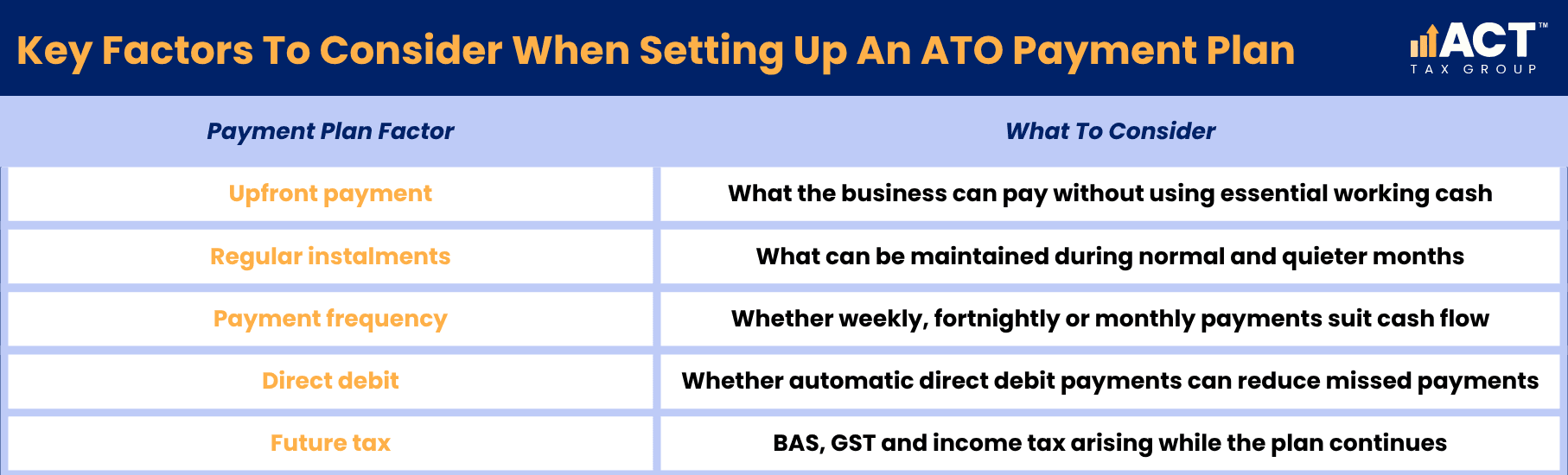
Example: If your monthly payment is affordable during summer but impossible during winter, it may not be a good payment arrangement for a seasonal arborist business.
Staying Current Helps Reduce Payment Plan Defaults
An ATO payment plan only deals with the debt covered by that arrangement. Your business still needs to lodge tax returns and activity statements on time and pay new tax obligations by their due dates or contact the ATO early if payment becomes difficult. Missed payments or unpaid new tax obligations can put the payment plan at risk of default. If you cannot make an instalment by its due date, contact the ATO or your registered tax agent as soon as possible because the plan may be varied or ended.
Example: An arborist paying an older $18,000 tax debt may still collect GST on new jobs. If that GST is used to meet everyday expenses instead of being set aside, another outstanding BAS debt can develop while the first payment plan is still running.
Grow your tree care business with Accounting Built for Arborists
From start-up to expansion, our accounting team supports your tax, payroll, and cash flow — so you can focus on running your business safely and profitably.
Simple Financial Controls Can Keep the Plan on Track
A payment plan works best when the business improves the systems that caused or contributed to the cash shortage. For an arborist, that may mean building tax reserves during the busy season, following up invoices sooner and reviewing cash flow before large equipment purchases. Simple financial controls can reduce the risk of payment plan defaults:
Set aside GST and tax regularly.
Use direct debit payments where appropriate.
Review cash flow forecasts each month.
Follow up overdue invoices quickly.
Make additional voluntary payments when cash flow allows.
A registered tax agent can also help assess whether the proposed arrangement suits your business and explain the effect of interest charges or previous defaults. For larger debts or more complex financial circumstances, professional advice can be particularly valuable before committing to repayments.

How ACT Tax Group Can Help with an ATO Payment Plan for Your Arborist Business
We understand that seasonal income, delayed customer payments, fuel costs and equipment repairs can put pressure on an otherwise sound arborist business. Our team can help you understand your ATO debt, bring outstanding lodgements up to date, prepare cash flow forecasts and work out a payment approach that reflects your actual financial position. As an IPA-certified accounting team, we provide practical support without making the process more complicated than it needs to be. Book a consultation with ACT Tax Group to discuss your tax debt, payment plan options and the steps your arborist business can take to stay on top of future obligations.

Lukasz Klekowski
Principal of ACT Tax Group, specialising in tax compliance and financial strategy for Australian small businesses.

Disclaimer: All information provided in this publication is of a general nature only and is not personal financial or investment advice. It does not take into account your particular objectives and circumstances. No person should act on the basis of this information without first obtaining and following the advice of a suitably qualified professional. To the fullest extent permitted by law, no person involved in producing, distributing or providing the information in this publication (including ACT TAX GROUP PTY LTD, each of its directors, councilors, employees and contractors and the editors or authors of the information) will be liable in any way for any loss or damage suffered by any person through the use of or access to this information. The Copyright is owned exclusively by ACT TAX GROUP PTY LTD (ABN 31634338088)