

Arborist Students and New Climbers: How the Minimum Tax Threshold Affects Your First Year of Work
Published on August 4, 2026
The minimum tax threshold affects how much income tax an arborist student or new climber may pay during their first financial year of work. An Australian resident for tax purposes for the full financial year can generally claim the full $18,200 tax-free threshold. Part-year residents may receive a reduced threshold, while non-residents cannot claim it. Starting an arboriculture career can involve changing hours, casual shifts, allowances and income from other work. Understanding the tax-free threshold, income tax rates and tax deductions can help you protect your take-home pay and avoid an unexpected amount of tax payable when you lodge your tax return.
Understanding the Minimum Tax Threshold for New Arborists
The minimum tax threshold is commonly called the tax-free threshold. For most resident taxpayers, taxable income from $0 to $18,200 is generally free from income tax, while income from $18,201 to $45,000 is taxed at the applicable resident tax rate on the amount over $18,200. Your taxable income is not always the same as your salary. For tax purposes, the Australian Taxation Office (ATO) generally calculates taxable income by subtracting allowable tax deductions from assessable income, which may include salary, allowances, interest, dividends, capital gains and other income.
Working multiple jobs and unsure how tax is calculated?
Schedule a complimentary consultation with us today to manage PAYG withholding across employers.
Your First Employment Forms Affect Your Take-Home Pay
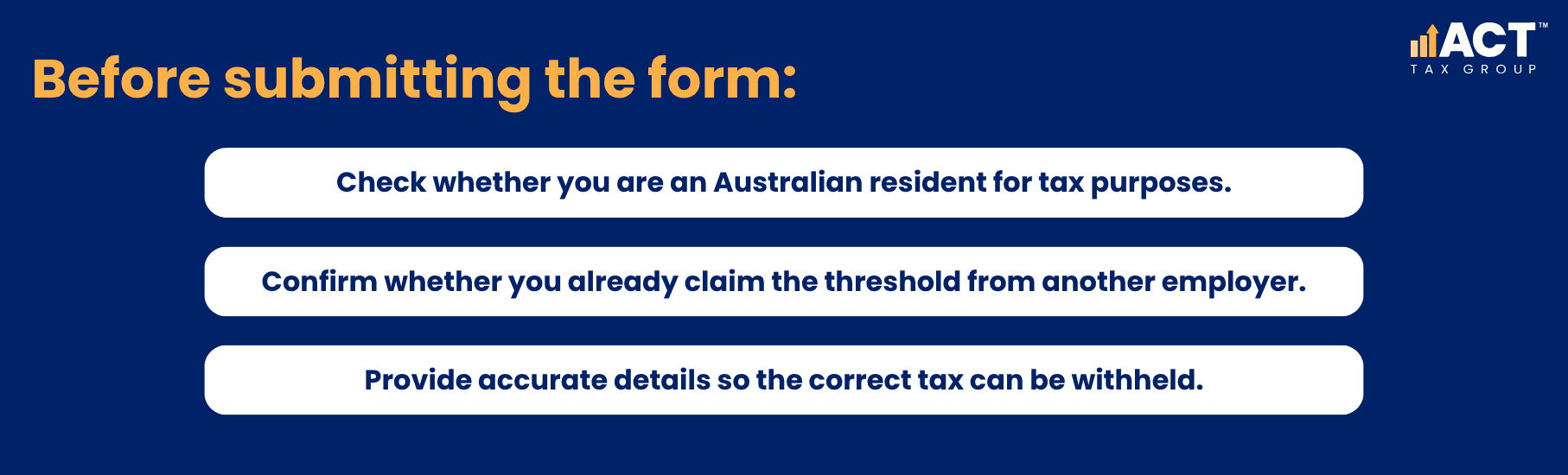
When you begin work, your employer will usually ask you to complete a Tax File Number (TFN) declaration. You can use this form to claim the tax-free threshold if you are eligible, allowing your employer to calculate how much tax to withhold from your pay. When you claim the tax-free threshold, your employer will generally withhold tax once your pay exceeds $363 a week, $726 a fortnight or $1,573 a month. Your employer uses the applicable ATO tax tables, while your final tax payable is worked out when you lodge your tax return.
Multiple Jobs Can Change the Tax You Pay
Arborist students sometimes keep a second job while completing training or building climbing experience. When you receive income from more than one employer at the same time, you generally claim the tax-free threshold from only one employer, usually the employer paying the highest salary or wage. You may claim it from each employer if you are certain your total income for the financial year will be $18,200 or less. Income from every job is combined when your tax return is assessed. Two people with the same income will generally have the same income tax outcome, even when one person earns it from one employer and the other earns it from several employers.

Income Tax Rates Apply to Your Combined Taxable Income
Australian resident tax rates operate through tax brackets, so only the taxable income within each bracket is taxed at that rate. For 2026–27, the rates are nil from $0 to $18,200, 15% from $18,201 to $45,000, 30% from $45,001 to $135,000, 37% from $135,001 to $190,000 and 45% for each $1 over $190,000. These rates do not include the Medicare levy. Most resident taxpayers are generally subject to the Medicare levy, although a reduction or exemption may apply. The Medicare levy surcharge is separate and may apply when your income for surcharge purposes exceeds the applicable threshold and you, your spouse or your dependants do not have an appropriate level of private patient hospital cover.
Work Costs May Reduce Your Taxable Income
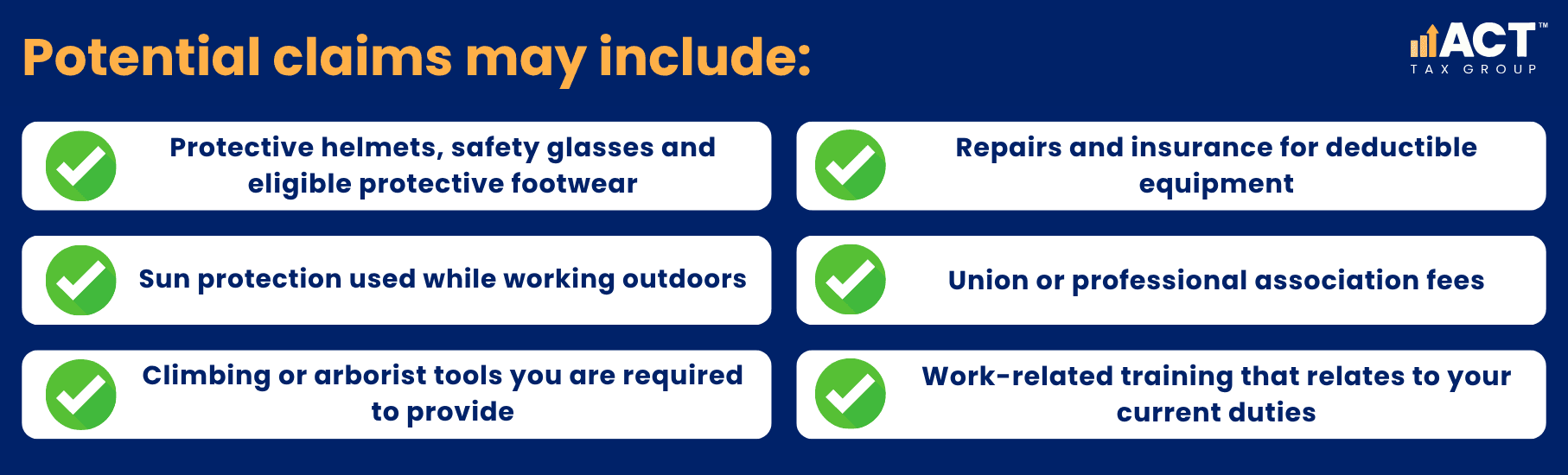
Tax deductions can reduce taxable income when an expense directly relates to earning your employment income. You must pay the cost yourself, keep suitable records and receive no reimbursement from your employer. Applicable expenses may include protective equipment, safety glasses, eligible protective footwear, sunscreen used for outdoor work and tools used in your employee duties. Depending on the item, you may claim its cost or decline in value, but you must exclude private use. Ordinary clothing, private travel, home office running expenses claimed using the fixed rate method and costs paid or reimbursed by your employer are generally not deductible.
Grow your tree care business with Accounting Built for Arborists
From start-up to expansion, our accounting team supports your tax, payroll, and cash flow — so you can focus on running your business safely and profitably.
How ACT Tax Group Can Help with First-Year Arborist Tax
Our friendly, IPA-certified team can explain the tax-free threshold, review income from multiple jobs and help you understand which work costs may qualify for tax deductions. We also help eligible clients understand Family Tax Benefit Part A entitlements alongside their employment income. We provide practical advice based on your employment, residency and personal circumstances without making tax more complicated than it needs to be. You can book a consultation with ACT Tax Group to review your withholding, manage any PAYG instalment obligations and missed payments or prepare your first tax return. We help you organise your records, understand your tax payable and approach the financial year with greater confidence.

Start Your Arborist Career with Clear Tax Records
The tax-free threshold can help low-income earners retain more of their regular pay, but it applies to total taxable income rather than each job separately. Your residency, other income, eligible deductions and Medicare obligations can all affect the final amount payable. Check your first payslip, keep evidence of work costs and review your position when your income changes. Professional advice can help you meet your obligations and avoid mistakes during your first year of work.

Lukasz Klekowski
Principal of ACT Tax Group, specialising in tax compliance and financial strategy for Australian small businesses.

Disclaimer: All information provided in this publication is of a general nature only and is not personal financial or investment advice. It does not take into account your particular objectives and circumstances. No person should act on the basis of this information without first obtaining and following the advice of a suitably qualified professional. To the fullest extent permitted by law, no person involved in producing, distributing or providing the information in this publication (including ACT TAX GROUP PTY LTD, each of its directors, councilors, employees and contractors and the editors or authors of the information) will be liable in any way for any loss or damage suffered by any person through the use of or access to this information. The Copyright is owned exclusively by ACT TAX GROUP PTY LTD (ABN 31634338088)