

Income Splitting and Marginal Tax Rates: When It Helps Family-Run Arborist Businesses and When It Backfires
Published on June 30, 2026
Income Splitting and Marginal Tax: When It Helps Family-Run Arborist Businesses and When It Backfires is an important issue because the right structure can reduce wasted tax, while the wrong arrangement can create problems with the Australian Taxation Office. For family-run arborist businesses, the key question is whether income earned by each family member reflects real work, real ownership, real risk or a genuine entitlement.
What Is Income Splitting in a Family Arborist Business?
Income splitting means allocating income between family members or related entities in a way that may reduce the overall income tax payable. In an arborist business, this may involve wages to family members, trust distributions, company dividends, partnership income or a mix of these options. The main issue is whether the arrangement makes sense for tax purposes and reflects what actually happens in the business. If one person earns most of the income through climbing, quoting and managing jobs, but the income is shifted to someone who does little or no work, the arrangement may backfire.
Are your income splits aligned with ATO rules?
Schedule a complimentary consultation with us today to review compliance and reduce ATO risk.
Marginal Tax Rates Shape the Real Saving
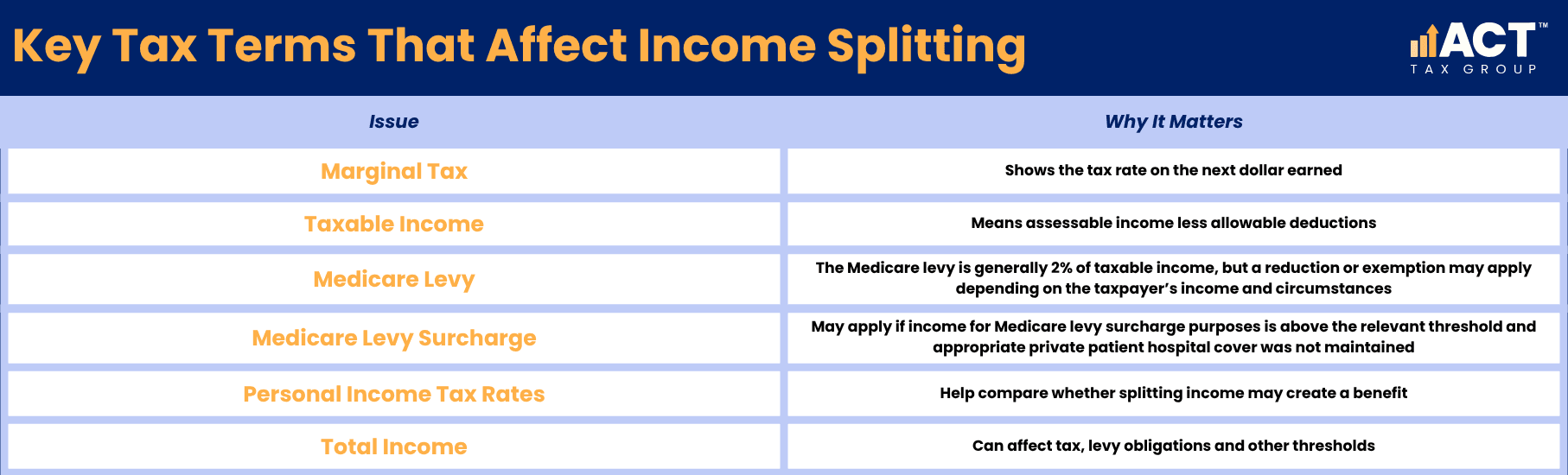
Marginal tax rates affect how much tax a person may pay on the next dollar of taxable income. Income splitting may help when income can legally and commercially move from someone on a higher marginal tax rate to someone on a lower marginal tax rate.
Australian residents pay personal income tax based on the income tax rates that apply to their taxable income for the relevant financial year. For the 2025-26 income year, the resident tax rates include 0 to 18,200, 18,201 to 45,000, 45,001 to 135,000, 135,001 to 190,000, and 190,001 and over, with rates often described as 16c, 30c, 37c or 45c for each $1 over a threshold, plus set amounts such as 4,288 plus 30c, 31,288 plus 37c, or 51,638 plus 45c depending on the income threshold and year, and with the Medicare levy and Medicare levy surcharge considered separately. From 1 July 2026, the 16% rate is reduced to 15%, so business owners should check the applicable ATO rates for the financial year they are reviewing.
When Can Income Splitting Help Arborist Families?
Income splitting can help when family members genuinely work in the business, own part of the structure or are properly entitled to income. For example, a spouse who manages the office, follows up unpaid invoices, maintains records, prepares bookkeeping information and supports payroll may be paid for real work. It may also help where a family trust or company has been set up properly and the income distribution follows the documents, records and commercial reality.
When Does Income Splitting Backfire?
Income splitting can backfire when the arrangement is mainly designed to reduce tax without matching the actual work or ownership. This is especially important where the income is mainly produced by one person’s personal effort, skill, reputation or labour. For arborists, this risk can arise when one owner performs the specialised climbing, quoting and supervision, while profits are directed to another person who does not carry the same responsibility. If the income is mainly a reward for one individual’s personal efforts or skills, the Personal Services Income rules may apply and limit how that income is reported and what deductions can be claimed.
Family Trusts Need More Than a Good Idea
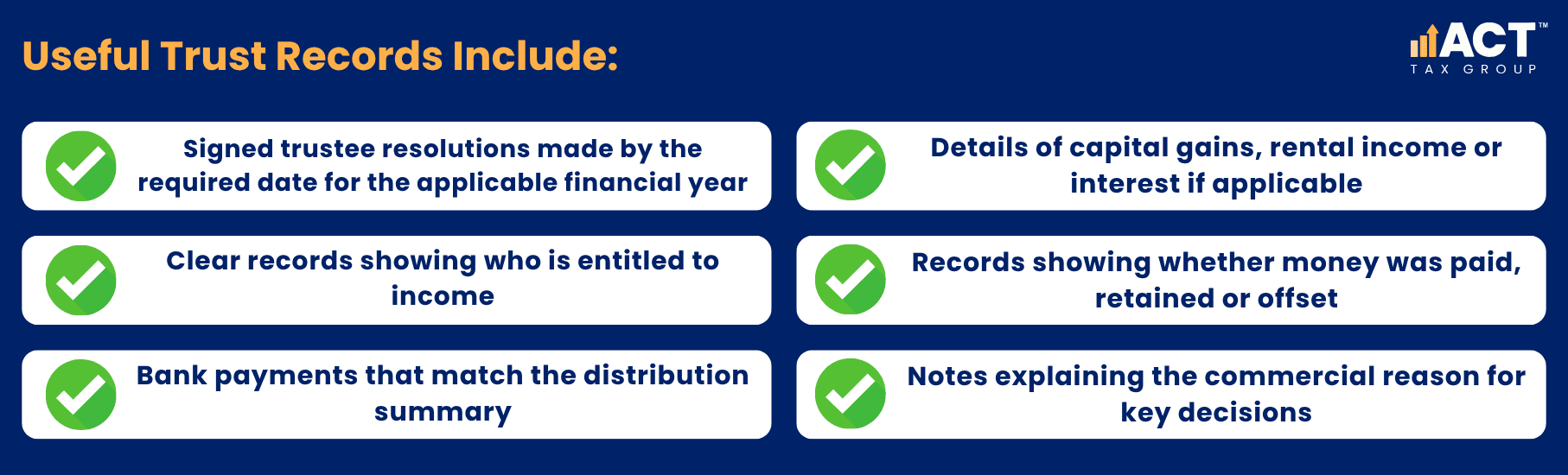
Family trusts can support asset protection, estate planning and flexible income distribution, but they need careful administration. A trust should not be treated as a simple account for moving money around the family without clear records. The trustee must consider the trust deed, beneficiary present entitlement, trustee resolutions, taxable income, Capital Gains, rental income, interest, investments and any payments made to family members.
Paying Family Members Must Reflect Real Work
Paying family members can work well when the payment reflects genuine employment and is reasonable for the duties performed. In an arborist business, family members may help with job bookings, customer calls, quote follow-up, staff records, accounts payable, accounts receivable, payroll, superannuation and equipment records. The risk increases when payments are inflated, undocumented or made for work that was not actually performed. For tax purposes, the business should keep timesheets, role descriptions, employment records, wage summaries, superannuation records and evidence that the family member actually did the work.
Minors and Adult Children Need Different Treatment
Income paid or distributed to children under 18 can be taxed differently from income paid to adult family members, and some income may be taxed at higher rates. This is why a family should seek advice before distributing business profits, trust distributions, dividends, interest or rental income to children. A company structure may help manage business risk and tax timing, but it does not automatically remove personal income tax issues. Company money is not the same as personal money, and owners need to be careful with wages, dividends, loans, reimbursements and drawings.
Adult children may receive income in some circumstances, but the arrangement still needs to be genuine. The family should consider whether the adult child controls the money, receives the benefit, reports the income in their tax return and understands the impact on their total income, deductions, levy obligations and financial situation.

Company Structures Can Help, But Not Always
A company structure may help manage business risk and tax timing, but it does not automatically remove personal income tax issues. Company money is not the same as personal money, and owners need to be careful with wages, dividends, loans, reimbursements and drawings, including whether Division 7A may apply to payments, loans or benefits provided by a private company to shareholders or their associates.
For arborists, a company may be useful where the business owns vehicles, chippers, stump grinders, trailers and climbing equipment, or employs a growing crew. However, the structure should be reviewed alongside Goods and Services Tax (GST) , Business Activity Statement (BAS) obligations, Pay As You Go (PAYG) withholding, superannuation, deductions, payments to owners and any legal or asset protection issues.
Practical Summary for Arborist Business Owners
The benefit of income splitting depends on the family’s full financial situation, not just the above rates on a tax table. A lower taxable income for one family member may reduce tax, but Medicare levy, Medicare levy surcharge, repayment obligations, offsets, deductions and other thresholds may change the result. Before making changes, business owners should review income earned, total income, employment arrangements, investments, rental income, capital gains, business records and future plans. This article provides general information only, so you should seek advice that considers your exact structure, family roles and financial year position.
Grow your tree care business with Accounting Built for Arborists
From start-up to expansion, our accounting team supports your tax, payroll, and cash flow — so you can focus on running your business safely and profitably.
How ACT Tax Group Can Help with Income Splitting and Marginal Tax
We help family-run arborist businesses review their structure, compare tax rates and understand when income splitting may be appropriate. Our ACT-based team can look at taxable income, personal income tax rates, family wages, trust distributions, company profit extraction, superannuation, payroll and the ATO compliance risks. You can book a consultation with ACT Tax Group to review your current structure before the end of the financial year. We provide practical advice so you can make informed decisions, manage tax payable and keep your records clear without relying on guesswork.

Final Thoughts
Income splitting can help a family-run arborist business when it reflects real work, real entitlement, proper records and a sound commercial reason. It can backfire when income is shifted mainly to reduce taxable income tax or change who will pay tax, without respecting the way the business actually operates.
The best next step is to review your structure before wages, trust distributions, dividends or owner payments are finalised. Check the income threshold for each person, the likely marginal tax outcome, the Medicare levy impact, the business records and whether the arrangement makes sense for the family’s wider financial situation.

Lukasz Klekowski
Principal of ACT Tax Group, specialising in tax compliance and financial strategy for Australian small businesses.

Disclaimer: All information provided in this publication is of a general nature only and is not personal financial or investment advice. It does not take into account your particular objectives and circumstances. No person should act on the basis of this information without first obtaining and following the advice of a suitably qualified professional. To the fullest extent permitted by law, no person involved in producing, distributing or providing the information in this publication (including ACT TAX GROUP PTY LTD, each of its directors, councilors, employees and contractors and the editors or authors of the information) will be liable in any way for any loss or damage suffered by any person through the use of or access to this information. The Copyright is owned exclusively by ACT TAX GROUP PTY LTD (ABN 31634338088)