

Using Marginal Tax Rates to Decide Whether to Draw More Wages, More Dividends, or Leave Profits in Your Arborist Company
Published on June 16, 2026
Using Marginal Tax Rates to Decide Whether to Draw More Wages, More Dividends, or Leave Profits in Your Arborist Company can help you choose a more tax-aware way to access business income without creating avoidable cash flow pressure. For arborist business owners, the decision is rarely just about taking more money out today, because wages, dividends, company tax, Medicare levy, and future equipment costs can all affect the actual tax result.
What Are Marginal Tax Rates and Why Do They Matter?
Marginal tax rates show how much income tax applies to the next dollar earned once your taxable income reaches a particular income threshold. Australia uses a progressive tax system, which means your income is taxed in layers rather than all at the same rate.
For Australian residents, the tax-free threshold applies up to $18,200, then different marginal tax rates apply as income rises. If you are reviewing the 2024–25 income year, use the 2024–25 resident tax rates; for current planning, check the latest ATO tax rates for the relevant income year. The Medicare levy of 2% may also apply to taxable income, and the Medicare levy surcharge may apply depending on your total income, private health cover, and family circumstances.
Unsure whether to take wages or dividends?
Schedule a complimentary consultation with us today to compare tax outcomes using your actual income.
Your Arborist Company Needs a Cash Flow Decision, Not Just a Tax Decision
The best option is not always the one with the lowest tax payable in the current income year. Your company may need money for chainsaws, stump grinders, trucks, insurance, payroll, Business Activity Statement (BAS) payments, Goods and Services Tax (GST), and quiet-season reserves, so it helps to follow cash flow management tips for arborists when planning how much profit to leave in the business.
Example: An arborist company with a profitable spring and summer may be tempted to pay extra wages before 30 June. If winter work slows down, leaving some profits in the company may give the business more room to pay staff, maintain equipment, and stay on top of Australian Taxation Office (ATO) obligations, particularly if you use ATO Online Services for Business to track BAS, income tax, and other lodgements in real time.
2024-25 Australian Resident Income Tax Rates
Taxable Income | Income Tax Rates |
|---|---|
$0 to $18,200 | Nil |
$18,201 to $45,000 | 16c for each $1 over $18,200 |
$45,001 to $135,000 | $4,288 plus 30c for each $1 over $45,000 |
$135,001 to $190,000 | $31,288 plus 37c for each $1 over $135,000 |
$190,001 and over | $51,638 plus 45c for each $1 over $190,000 |
More Wages Can Be Useful When You Need Regular Personal Income
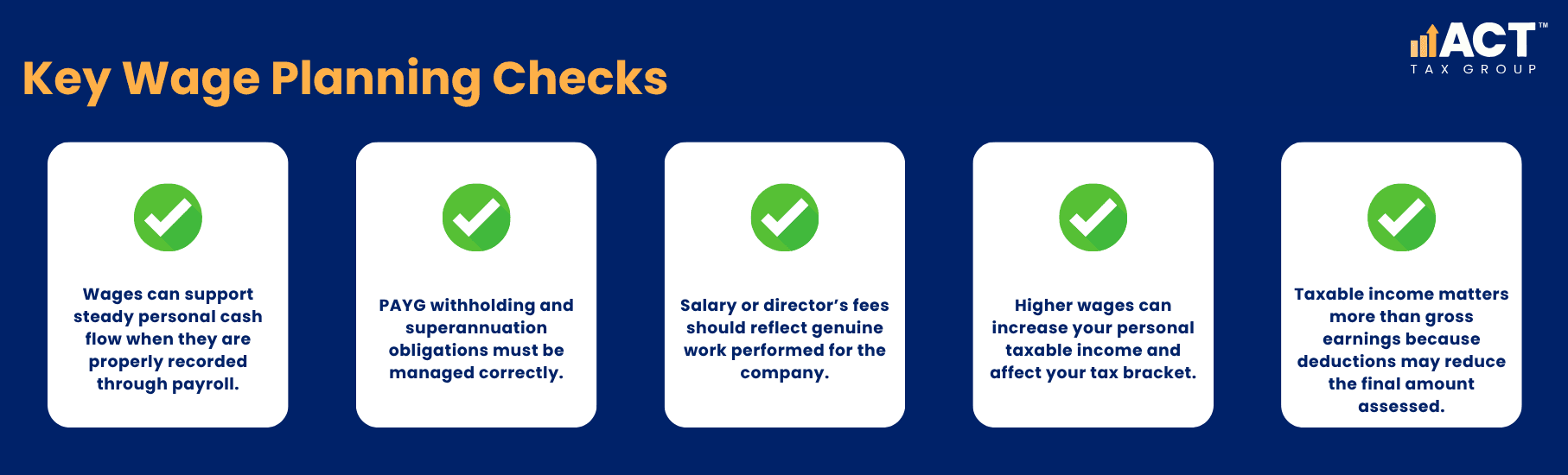
Paying yourself wages can make sense when you need steady personal cash flow, want clear employment income, and need Pay as You Go (PAYG) withholding managed through payroll, especially if you understand what happens if you miss PAYG instalments and want to avoid unnecessary interest and penalties. Wages or director’s fees may be deductible to the company when they are for genuine work, properly authorised, recorded through payroll, and subject to the required PAYG withholding and superannuation obligations, but they increase your personal taxable income. The key is to check which tax bracket your salary moves into after deductions, work related expenses, and other assessable income such as interest, capital gains, or dividends.
More Dividends Can Work When Profits Have Already Been Taxed
Dividends can be useful when your arborist company has after-tax profits available, the company has properly declared the dividend, and you are a shareholder entitled to receive it. If the company pays a franked dividend, the dividend may include franking credits, which are included in the shareholder’s assessable income and may provide a tax offset that reduces their income tax payable, depending on their overall tax position.
Dividends are not the same as wages, and they should not be used casually as a substitute for payroll. For tax purposes, the dividend amount, franking credit, total income, Medicare levy, and any applicable surcharge all need to be calculated before deciding whether dividends are better than salary.

Leaving Profits in the Company Can Protect Working Capital
Leaving profits in the company can be sensible when the business needs cash for upcoming costs, equipment replacement, insurance, debt, or a slower season. For the 2024–25 income year, a company that qualifies as a base rate entity generally pays company tax at 25%, while companies that do not qualify for the lower rate generally pay 30%. A company is a base rate entity only if it meets the relevant aggregated turnover test and has 80% or less of its assessable income as base rate entity passive income.
This does not mean company tax is always the final tax cost. If profits are later paid to you as dividends, your personal income tax position still matters, so the actual tax outcome may be spread across more than one income year.
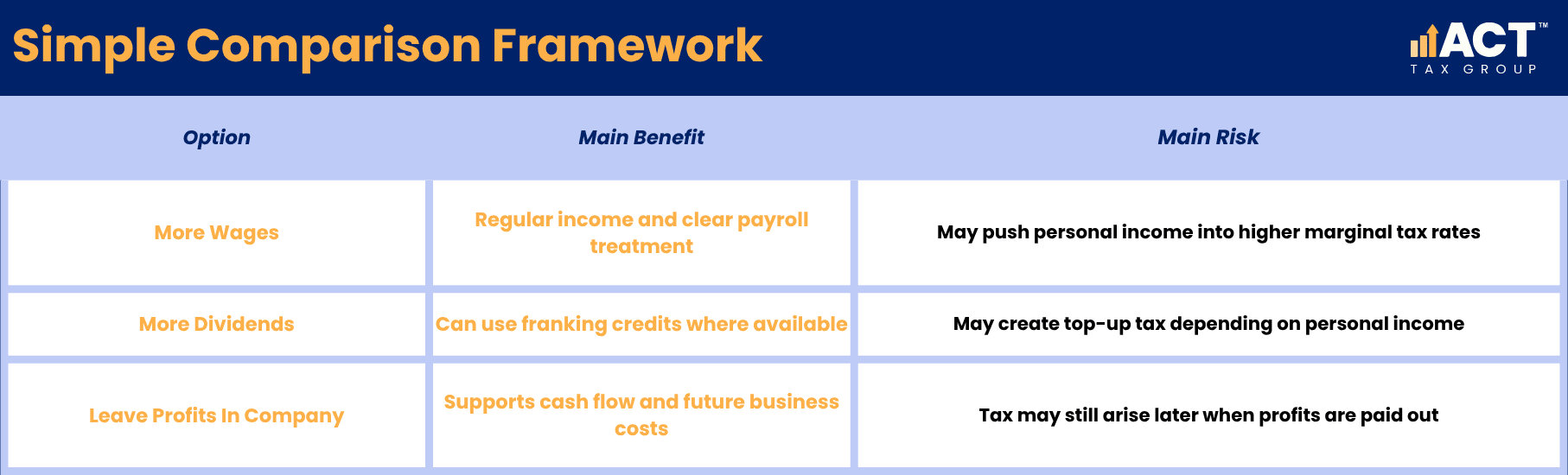
Comparing Wages, Dividends, and Retained Profits
The practical comparison starts with your personal taxable income, the company’s business income, available franking credits, and cash needs. You then model the tax payable under each option rather than guessing based on percentages.
Common Mistakes Arborist Business Owners Can Avoid
A common mistake is looking only at the company tax rate and assuming retained profits are always better. Another mistake is paying income to family members, children, or related parties without checking whether the arrangement reflects genuine work, proper ownership, market-based payment, and the relevant tax integrity rule, especially when those families may also be relying on Family Tax Benefit Part A entitlements that are sensitive to reported income.
Be careful with loans from the company, personal use of business money, and payments that are not properly documented. Private company payments, loans, forgiven debts, private use of company assets, or other benefits provided to shareholders or their associates may trigger Division 7A consequences and be treated as unfranked dividends for tax purposes unless they are properly managed, including monitoring the Division 7A benchmark interest rate on loans. Each payment or benefit should be recorded and reviewed before year end, and you may need to review how Division 7A interest rates impact company loans when planning repayments.
Grow your tree care business with Accounting Built for Arborists
From start-up to expansion, our accounting team supports your tax, payroll, and cash flow — so you can focus on running your business safely and profitably.
How ACT Tax Group Can Help with Arborist Company Tax Planning
ACT Tax Group helps arborist business owners compare wages, dividends, and retained profits using current marginal tax rates, business income, company tax, Medicare levy, and cash flow forecasts. We review your taxable income, assessable income, deductions, payroll records, franking credits, and expected equipment costs so your decision is based on real numbers.
You can arrange a consultation with our friendly, IPA-certified team to review your company structure, tax position, and year-end options, including how to manage ASIC obligations and handle ASIC late fees and penalties if your company has fallen behind. We provide tailored advice to help you stay compliant, reduce stress, and make confident decisions about how and when to take money from your business.

Conclusion
Using marginal rates well means looking at the last dollar of income, not just the total income figure. For an arborist company, the right mix of wages, dividends, and retained profits depends on your cash flow, tax bracket, company tax rate, personal needs, financial plans, and whether you operate through a company or as a sole trader. Before paying extra salary or dividends, check the relevant income year position, expected tax payable, Medicare levy, deductions, loans, business costs, and Division 7A exposure.
Note that the above rates are for Australian resident taxpayers, and foreign residents use different income tax rates, so eligibility and residency should be checked before you rely on the table. Avoid diverting income to another person or entity simply to pay tax at lower income tax rates. A simple year-end review can help you check the actual tax position and keep more control over both your personal finances and company cash flow.

Lukasz Klekowski
Principal of ACT Tax Group, specialising in tax compliance and financial strategy for Australian small businesses.

Disclaimer: All information provided in this publication is of a general nature only and is not personal financial or investment advice. It does not take into account your particular objectives and circumstances. No person should act on the basis of this information without first obtaining and following the advice of a suitably qualified professional. To the fullest extent permitted by law, no person involved in producing, distributing or providing the information in this publication (including ACT TAX GROUP PTY LTD, each of its directors, councilors, employees and contractors and the editors or authors of the information) will be liable in any way for any loss or damage suffered by any person through the use of or access to this information. The Copyright is owned exclusively by ACT TAX GROUP PTY LTD (ABN 31634338088)