

Claiming Home Office Expenses as an Australian Arborist: What You Can and Can’t Deduct
Published on April 7, 2026
Claiming home office expenses as an Australian arborist can feel confusing when you already spend most of your week up trees, not at a desk, but a bit of structure around your home office can make a real difference at tax time.
Why Home Office Deductions Matter for Arborists
If you are like many small business owners running a tree service, your income is strong in the busy months but much tighter when the phone slows down, so every legal home tax deduction helps smooth out the tax bill. On top of rising fuel, gear and insurance costs, missing out on simple work-related expenses like home office running expenses just means you are paying more tax than you need to or missing opportunities to manage cash flow by staying under key thresholds such as the GST registration threshold for small businesses.
You also carry real risk as a business owner: hazardous removals, long days on site, insurance claims that drag on and late payments from builders or property managers. When cash flow is lumpy, making sure you claim home office expenses properly can ease some pressure at tax return time, as long as you keep proper records and only claim the work-related portion of your home expenses, especially if your household also relies on income-tested supports such as Family Tax Benefit Part A.
Struggling to work out what you can really claim for your home office?
Schedule a complimentary consultation with us today to correctly apply ATO fixed rate or actual cost methods.
How the ATO Lets You Claim Home Office Costs
When you work from a home office on quoting, invoicing or running the crew, the Australian Taxation Office (ATO) treats that as working from home, provided you actually incur the cost yourself. Before you think about numbers, remember the basic rules: you must spend the money, it must be directly tied to your arborist income, and you must have detailed records to back it up.
For home office tax deductions, there are two methods you can use on your tax return: the fixed rate method for claiming work-from-home deductions and the actual cost method. Both can work for arborists, but they suit different personal circumstances and different levels of admin time at home.
Method 1 – Fixed Rate Method
Under the fixed rate method, you claim working from home expenses using a cents per hour rate for every actual hour worked in your home office. For the 2024–25 income year, the fixed rate method is 70 cents per hour. Because the rate can change by year, check the ATO rate that applies to the income year you are lodging.
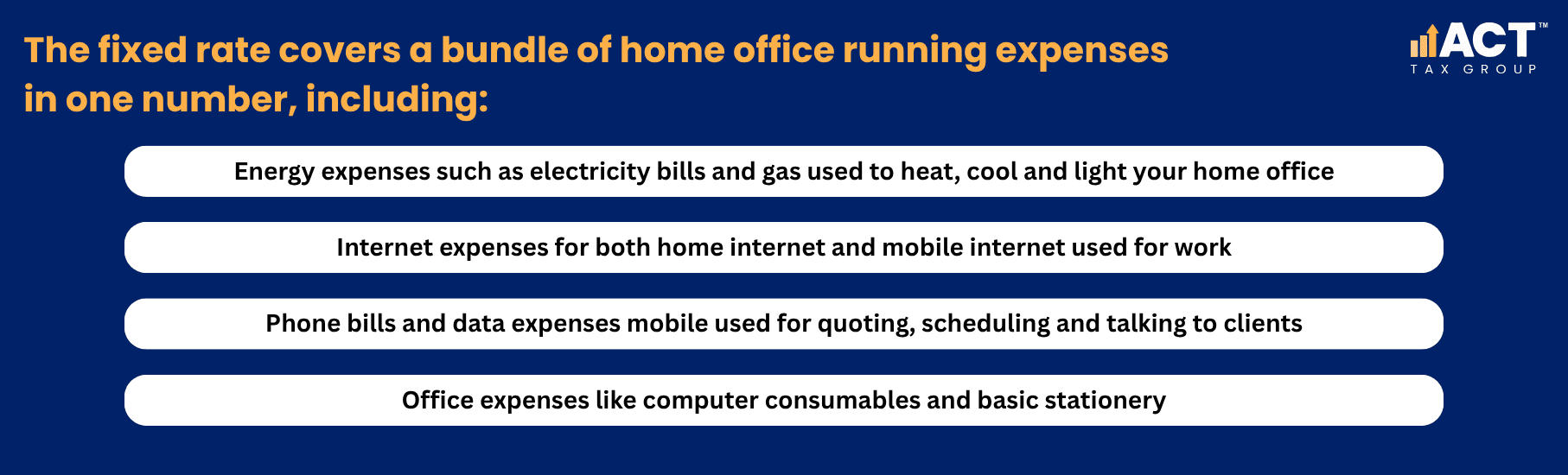
Because these running expenses are built into the cents per hour amount, you do not make separate claims for electricity bills, gas, internet bills, mobile phone expenses or computer consumables under this method. You can, however, separately claim the decline in value of depreciating assets such as a laptop, monitor, printer, desk or office chair, to the extent they are used for work.
The fixed rate method suits arborists who do regular admin nights at home but do not want to spend hours calculating usage percentages for every bill. The key is that you keep track of your actual hours worked from home and have basic proof that you paid the underlying utility bills and phone bills.
Method 2 – Actual Cost Method
The actual cost method is more detailed. Instead of a flat rate, you work out the actual expenses linked to your home office and claim the work-related portion of each cost. This can give a higher tax deduction if you use a dedicated home office heavily, but it asks more of your record keeping.
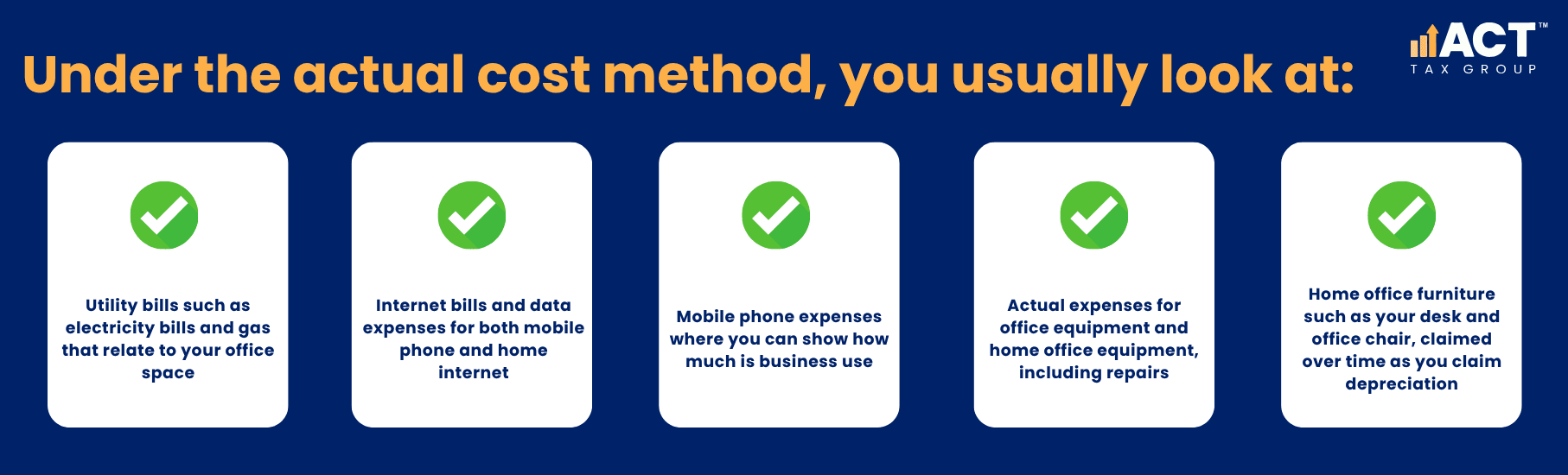
You may use floor area, usage percentages and time spent working to work out the work-related portion. For example, you might apportion utility bills between the home office and the rest of the house, then apply a further split between work and personal use. The actual cost method can suit arborists who do substantial admin from home and can support their claim with detailed records.
If your arborist business operates through a company or trust, different rules can apply, including the need for a genuine market-rate rental agreement with the property owner, and extra attention to ASIC deadlines so you do not get caught by late fees and company compliance penalties.
What You Can Claim as an Arborist’s Home Office
As an arborist, your home office may be where you quote jobs, chase payments, organise the crew and manage business administration. The Australian Tax Office does not mind that the physical work is done on site; what matters is that your home office is genuinely used to earn your income and that you only claim the work-related portion of your home expenses.
Home Office Running Expenses You May Be Able to Claim
Depending on whether you choose the fixed rate or actual cost method, typical home office running expenses that may form part of a valid claim include:
Energy expenses for heating, cooling and lighting your home office during work time
Internet expenses and mobile internet used for quoting, emailing councils, uploading photos, job software and chasing payments
Phone bills and data expenses mobile for your mobile phone when used to manage work, as long as you adjust for personal use
Computer consumables and other office expenses such as paper, ink and small office supplies
Costs to repair or maintain home office equipment like your laptop or printer
If you use the fixed rate method, these home office running expenses are covered by the cents per hour rate, so you do not make separate claims for them. If you use the actual cost method, you work out the work-related portion based on usage percentages and then claim tax deductions for those amounts as work related expenses.
Claiming Depreciation on Home Office Furniture and Equipment
Beyond everyday running expenses, you can also claim depreciation on home office furniture and home office equipment used to run your arborist business. This might include:
A laptop or desktop computer used for quoting and bookkeeping
A monitor, printer and other office equipment
An office chair and desk in your dedicated home office
Simple items like an office plant or shelving, where they form part of your work area
Here, you claim depreciation on the business use share, not the full cost, and keep invoices or bank statements as part of your proper records. For many small business owners, this is a straightforward way to claim tax deductions on larger office purchases over time.

When Occupancy Expenses Come into Play
The next layer is occupancy expenses. These are costs tied to owning or renting the property itself, rather than to additional running expenses. They can include rent or mortgage interest, house insurance premiums, council rates, water rates and land tax.
Dedicated Home Office and Limited Circumstances
You can only claim occupancy expenses in limited circumstances. Generally, this applies where you have a dedicated home office that is clearly a place of business, not just a corner of the lounge room or the kitchen table. For example, you might have a separate room set up only as your office, where you handle all your quoting, staff scheduling and record keeping, and where clients would reasonably expect to find your business if they visited your home.
In those situations, you may be able to claim occupancy expenses such as a share of rent or mortgage interest, house insurance, council rates, water rates and land tax.
You would usually work this out based on the floor area used for business and, where relevant, the time the area is used for business. Because claim occupancy expenses or claim occupancy costs can have long‑term effects, including on the main residence exemption when you sell your home, it is worth getting advice before you put these in your tax return and making sure they fit smoothly with your broader BAS and GST reporting obligations.
The Trade-Off of Claiming Occupancy Costs
Claiming home office in this way can give extra financial benefits now, but it may come with trade‑offs later, especially if your home is your principal place of residence. In short, occupancy costs can be powerful home tax deductions in the right situation, but they are not always the best option for every business owner. You need to weigh up the immediate tax deduction against the possible impact when you sell the property.
Grow your tree care business with Accounting Built for Arborists
From start-up to expansion, our accounting team supports your tax, payroll, and cash flow — so you can focus on running your business safely and profitably.
Common Mistakes When Claiming Home Office Deductions
With home office deductions, the fastest way to attract unwanted attention is to treat every home bill as if it were fully work related. As an arborist already claiming vehicles, gear and other work-related expenses and juggling regular tax payments like PAYG instalments and other ATO obligations, it pays to keep your home deduction clean and reasonable.
Mixing Personal Use and Business Use
One common mistake is forgetting that most home expenses are mixed. Mobile phone, internet expenses and utility bills are usually shared with family members and personal use, so you can only claim the work-related portion. If you treat 100% of your mobile phone or internet bills as work related, without looking at personal use, the claim can look unrealistic.
To avoid this, take a simple sample period, work out usage percentages and apply those percentages across the year. For example, you might find that 60% of your mobile phone calls are to clients, suppliers and staff and 40% are personal. You would then only claim 60% of the relevant mobile phone expenses as work related.
No Records of Actual Hours Worked
Both the fixed rate and actual cost method rely on you having some type of record keeping in place. Many small business owners remember they worked from home a lot but cannot show actual hours worked when they go to lodge their tax return. For an arborist, a simple log of evenings spent quoting, doing safety paperwork or working on your tax return online is often enough to show your pattern of working from home.
You do not need fancy software. A notebook, a simple spreadsheet or entries in your calendar are fine. Note the date, start time, finish time and what you did. These detailed records also help you decide later whether the fixed rate or actual cost method gives you a better outcome.

How ACT Tax Group Can Support Arborists
If you are like most arborist business owners, you did not go into tree work so you could spend your nights sorting out home tax deductions. You want straight answers on what you can and can’t claim, without the noise.
ACT Tax Group works closely with arborists and other trades, helping you set up simple record keeping for working from home expenses, choose between the two methods for claiming home office, and decide whether it makes sense for you to claim occupancy expenses in your current personal circumstances. The goal is to help you claim home office deductions correctly, avoid problems with the Australian Tax Office and free up your time to focus on running a safe, profitable crew.
This article is general in nature, for illustration only and does not constitute financial or personal advice. For ATO‑compliant support that takes into account your actual expenses, personal use and business setup, book a consult with ACT Tax Group before you lodge your next tax return.

Lukasz Klekowski
Principal of ACT Tax Group, specialising in tax compliance and financial strategy for Australian small businesses.

Disclaimer: All information provided in this publication is of a general nature only and is not personal financial or investment advice. It does not take into account your particular objectives and circumstances. No person should act on the basis of this information without first obtaining and following the advice of a suitably qualified professional. To the fullest extent permitted by law, no person involved in producing, distributing or providing the information in this publication (including ACT TAX GROUP PTY LTD, each of its directors, councilors, employees and contractors and the editors or authors of the information) will be liable in any way for any loss or damage suffered by any person through the use of or access to this information. The Copyright is owned exclusively by ACT TAX GROUP PTY LTD (ABN 31634338088)