

Using the Fortnightly Tax Table for Arborist Payroll: Compliance and Best Practices
Published on March 30, 2026
Running a tree services crew is hard enough without stressing over whether you are using the fortnightly tax table for arborist payroll correctly when payday rolls around. When the numbers on your employees’ wages do not match what the Australian Taxation Office expects, you wear the risk of penalties, cash flow headaches, and sleepless nights worrying about how much tax should have been withheld from each fortnight’s pay.
When the Fortnightly Tax Table Goes Wrong in an Arborist Crew
Picture this. It is late June, you have had a big run of storm clean‑ups and hazardous removals, and you are catching up on payroll. You realise your software has not applied the current ATO withholding settings. For payroll paid in 2025–26, the standard Fortnightly tax table still applies from 1 July 2024, while the Study and Training Support Loan (STSL) withholding tables were updated from 24 September 2025.
Now your mind jumps to all the details. Did you use normal fortnightly earnings when you should have treated some amounts as irregular payments or lump sum payments? Did you allow for an employee’s study and training support loans when they ticked the box on their tax file number declaration? Have you missed that one climber who has a second job and was not meant to be claiming the tax-free threshold from your business?
Worried your crew’s PAYG and STSL aren’t lining up with ATO tables?
Schedule a complimentary consultation with us today to check your fortnightly tax tables and fix any under‑ or over‑withholding.
What the ATO Fortnightly Tax Table Actually Does
Before fixing your arborist payroll, it helps to be clear on what the fortnightly tax table does and how it fits with other tax tables. The fortnightly tax table is one of several ATO tax tables used to work out how much tax to withhold from employee payments. It applies when you pay employees on a fortnightly basis, and it works from the employee’s total fortnightly earnings, including salary, allowances and other taxable income for that pay period.
Alongside the fortnightly table, there are weekly and monthly tax tables. Separate schedules apply in some specific cases, such as the horticultural or shearing industry, entertainers, and working holiday makers. However, the standard fortnightly tax table itself can apply to labour-hire workers and to certain compensation, sickness or accident payments when those payments are made on a fortnightly basis. The weekly, fortnightly and monthly tax tables follow the same basic idea: you start from the employee’s earnings for the pay period, apply the rules about the tax-free threshold, study and training support, and Medicare levy, then work out the correct amount of tax to withhold.

How to Use the Fortnightly Tax Table for Arborist Payroll
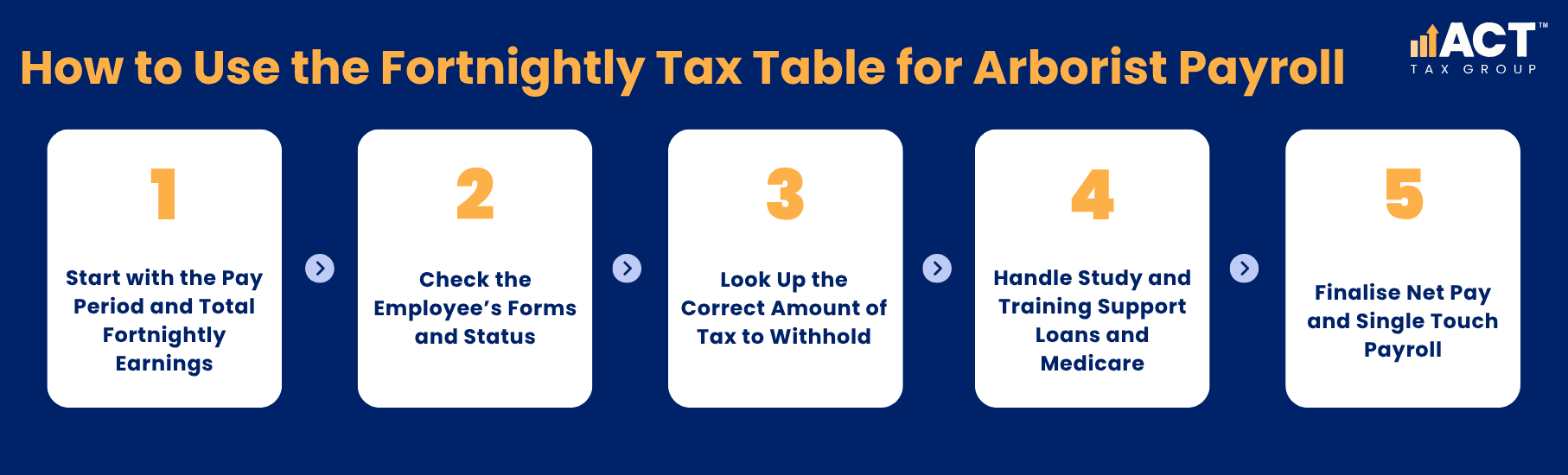
To use the fortnightly tax table properly in an arborist business, you can follow the same steps at every pay run so there are no surprises.
Start with the Pay Period and Total Fortnightly Earnings
Each pay run starts with a clear pay period. Once you know the dates, you work out each employee’s total fortnightly earnings for that period. For most arborist crews, this will include regular payments for ordinary hours worked in the fortnight, overtime that is part of that fortnight’s pay, and any taxable allowances, such as certain travel or tool allowances, that count as taxable income.
Make sure you include all employee payments that the ATO treats as taxable and keep irregular payments and lump sum payments separate so you can check whether they belong under other tax tables instead of the main fortnightly one.
Check the Employee’s Forms and Status
Next, you look at the forms your employees have given you, because they directly affect how much you need to withhold. The key forms are the tax file number declaration, which tells you whether the employee is an Australian resident or a foreign resident for tax purposes, whether they are claiming the tax-free threshold from this job, and whether they have study and training support loans.
There may also be a withholding declaration if the employee wants extra withholding or needs to update earlier details, for example after starting a second job or changes in other taxable income. These forms guide you on which columns in the fortnightly tax table to use, whether to allow for training support loans, and whether any Medicare levy adjustment applies. For foreign resident employees, use the foreign resident rates instead of the resident columns. But if the worker is a working holiday maker on visa subclass 417 or 462, use Schedule 15 for working holiday makers instead of the ordinary foreign resident rates.

Look Up the Correct Amount of Tax to Withhold
Once you know the employee’s total fortnightly earnings and their tax status, you move to the table itself. The process is similar whether you are reading the PDF or letting payroll software automatically calculate the figures.
Find the row that matches the employee’s total fortnightly earnings, using the nearest lower amount if the exact figure is not listed and ignoring cents so you are working in whole dollars. Move across the table to the column that fits the employee’s situation: claiming or not claiming the tax-free threshold, resident or foreign resident, and considering whether study and training support loans apply. Use that figure as the tax to withhold for that pay period, then round to the nearest dollar if required.
If the employee has asked for additional withholding or extra withholding through a withholding declaration, you add that on top of the amount from the table. This helps some employees manage their own situation when they have other taxable income or want to avoid a bill at tax time.
Handle Study and Training Support Loans and Medicare
Study and training support loans affect how much tax you need to withhold. When an employee has a study or training support loan debt and has told you on their TFN declaration or Withholding declaration, use the current STSL withholding tables or updated payroll software settings. The ATO updated the STSL weekly, fortnightly and monthly withholding tables effective 24 September 2025.
For resident employees, Medicare levy settings can affect withholding. If an employee is entitled to a Medicare levy adjustment or exemption, use the Medicare levy variation declaration and the relevant fortnightly Medicare table. Foreign residents generally do not pay the Medicare levy. In some cases, an employee may give you a Medicare levy variation declaration so that the Medicare levy adjustment is reflected in their withholding. While the Medicare levy itself is worked out in their tax return, these forms and the following tax tables help employers work closer to the correct amount across the year instead of leaving everything to be sorted at year end.
Finalise Net Pay and Single Touch Payroll
After you have the tax to withhold, you can finalise net pay. Net pay is generally the employee’s pay after PAYG withholding and after any post-tax deductions, such as union fees. Salary sacrifice should not be grouped with ordinary post-tax deductions because an effective salary sacrifice arrangement reduces pre-tax salary or wages and affects withholding differently.
Once you have finalised the pay run, report it through Single Touch Payroll (STP) on or before payday. STP reporting includes year-to-date gross salary or wages, allowances or other payments, deductions and PAYG withholding for each employee in that pay event. Using ATO Online Services for Business alongside your payroll system keeps the Australian Taxation Office up to date with employee wages and withholding amounts for every payment made, rather than waiting until the end of the financial year.
Best Practice Systems for Fortnightly Arborist Payroll
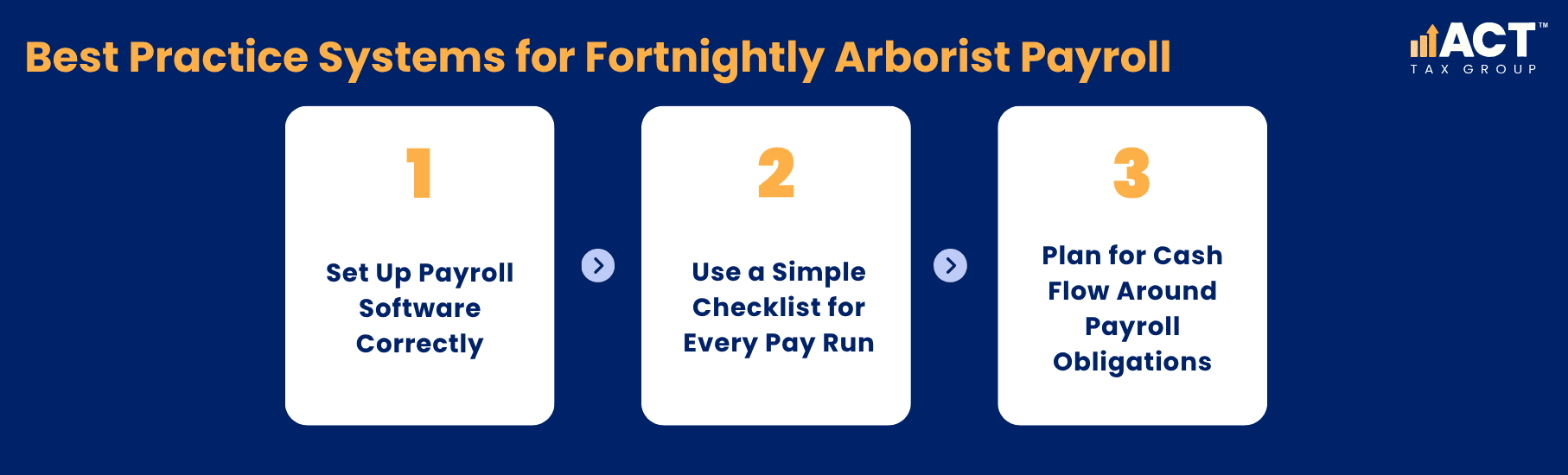
To reduce stress and keep your arborist payroll running smoothly, it helps to build a simple, repeatable system around the fortnightly tax table.
Set Up Payroll Software Correctly
Many arborist businesses rely on payroll software that can automatically calculate tax, super and other amounts. This can make life easier, but only if it is set up the right way. Make sure the software is set to use the correct financial year tax tables and the latest fortnightly tax table rather than old ones.
Employee profiles must match their tax file number declaration, withholding declaration and any medicare levy variation declaration. Options for foreign residents and foreign resident employees are correctly ticked where relevant, so foreign resident rates apply when needed. Once everything is aligned, the software can use the tables in the background and calculate withholding for each pay period while you focus on scheduling work and keeping the crew safe on site.
Use a Simple Checklist for Every Pay Run
A basic checklist can stop small errors turning into big problems. For each pay run, confirm the pay period dates and whether all payments made are regular payments or whether any are irregular payments that need other tax tables.
Check employee wages and total fortnightly earnings for each worker, including taxable allowances and any extra payments. Review each employee’s status: claiming the tax free threshold or not, any study and training support loans, medicare levy forms, and extra withholding requests. Spot check a few employees by comparing the software’s tax to withhold with the figure from the fortnightly tax table, rounding to the nearest dollar and choosing the nearest lower earnings row if needed.
This does not have to be complicated, but it gives you confidence that the correct amount of tax is being handled each fortnight.
Grow your tree care business with Accounting Built for Arborists
From start-up to expansion, our accounting team supports your tax, payroll, and cash flow — so you can focus on running your business safely and profitably.
Plan for Cash Flow Around Payroll Obligations
Because arborist work is seasonal, payroll and PAYG withholding can feel more stressful in quieter months. Building a simple cash flow plan that includes expected fortnightly earnings, tax to withhold and your PAYG withholding payment cycle can reduce pressure. Depending on your annual withholding amount, your payment cycle may be quarterly, monthly, or within 6 to 8 days of the withholding event.
By understanding how much you need to withhold and when these payments are due, you can avoid scrambling to find funds for PAYG withholding or running late on payments made to the ATO, including the risk of missing PAYG instalments and falling behind, even when work slows down over winter.
When To Get Help with The Fortnightly Tax Table
If your gut tells you that your payroll, tax withheld or Single Touch Payroll reports are not lining up with the ATO’s expectations, it is worth getting professional help. A tax or BAS specialist who understands arborist businesses can review your payroll setup, including the tables and rates used to calculate withholding, and help you avoid other compliance issues such as ASIC late fees and penalties on company obligations.
They can check that your handling of employee claims, allowances, support loans and medicare levy adjustments is correct, and help you correct any past pay runs so that payments made to employees and payments made to the ATO are aligned and compliant.
If you are running a tree services business and want help making sure your payroll and PAYG withholding are correct on a fortnightly basis, ACT Tax Group can work with you to put clear systems in place so you can focus on your crew and your clients.

Lukasz Klekowski
Principal of ACT Tax Group, specialising in tax compliance and financial strategy for Australian small businesses.

Disclaimer: All information provided in this publication is of a general nature only and is not personal financial or investment advice. It does not take into account your particular objectives and circumstances. No person should act on the basis of this information without first obtaining and following the advice of a suitably qualified professional. To the fullest extent permitted by law, no person involved in producing, distributing or providing the information in this publication (including ACT TAX GROUP PTY LTD, each of its directors, councilors, employees and contractors and the editors or authors of the information) will be liable in any way for any loss or damage suffered by any person through the use of or access to this information. The Copyright is owned exclusively by ACT TAX GROUP PTY LTD (ABN 31634338088)