

How to Accurately Estimate Your Tax Return as an Australian Arborist
Published on March 24, 2026
How to accurately estimate your tax return as an Australian arborist really comes down to answering one thing: “How much tax will I actually pay on a lumpy year of tree work, and am I getting a refund or a bill?” You want a clear tax estimate before tax time, not a surprise months after a big storm season when the money is already spent.
Start With a Real-World Picture of Your Arborist Income
When your income swings between storm chaos and slow winters, it is easy to underestimate what you have actually earned over the financial year. Before you touch any tax calculator or tax return calculator, you need a clean view of your income.
Struggling to estimate tax on your lumpy storm‑season income?
Schedule a complimentary consultation with us today to set up year‑round tax planning so ATO bills never blindside you again.
Lock In Your Gross Income
Think about every way money comes into your tree business, not just the big jobs that stand out in your memory. Gross income is your full income before tax from all arborist work. That includes tree removal, pruning, stump grinding, land clearing, insurance jobs, council or strata contracts, emergency callouts and any report or consulting work.
Pull figures from your accounting records for the whole income year and include all assessable business income, including cash jobs and any non-cash or barter payments. Do not rely on bank deposits alone. If you picture an online tax calculator, this is the “income” box you would fill in, but here you are grounding it in real numbers so your tax estimate is not built on guesswork.
Sense-Check Your Income Against the Year You Just Had
Once you have a total, pause and sanity‑check it. Does that gross income feel like the year you remember, the busy storm period, the quieter winter, the steady contract work? Are there any big jobs you can remember that are not showing in the numbers because the invoice was late or paid to a different account? Getting these right matters, because every amount of tax and every possible refund flows from this starting point.

Turn Gross Income into Taxable Income You Can Rely On
Income alone does not decide how much tax you pay. What really counts is taxable income. This is where you factor in your real costs of running an arborist crew and stop the estimate from being higher than it needs to be.
Work Out Your Total Deductions
Total deductions include eligible operating costs and the business-use portion of vehicle and equipment expenses. Some assets may need to be depreciated or claimed under simplified depreciation rules rather than deducted in full immediately.
Go back through your bank statements, receipts and accounting software and group these costs. The key is to be consistent and honest: keep work costs in, private expenses out, and apply a fair split where something has both business and personal use so you avoid common tax deduction mistakes. This is the same way a tax return calculator or tax refund calculator uses the “deductions” box, you are just taking the time to build that number properly.
Calculate Your Taxable Income
Once you are confident with your gross income and total deductions, you can work out your taxable income. The formula is straightforward:
Taxable income = gross income – total deductions.
This taxable income figure drives your income tax and usually your Medicare levy. MLS is tested using income for MLS purposes, not taxable income alone, and can also be affected by reportable fringe benefits, family status and private hospital cover. It is the number that every tax calculator, tax estimator and return form is really working off, so spending a bit of time to get it right pays off later.

Use Simple Tax Steps to Estimate How Much Tax You Will Pay
Now you have a clear taxable income, you can move on to your estimated tax. You do not need to be a tax expert; you just need to understand the flow and use the tax rates for the current financial year. For the 2025–26 income year, resident rates are: $0 to $18,200 nil; $18,201 to $45,000 at 16%; $45,001 to $135,000 at 30%; $135,001 to $190,000 at 37%; over $190,000 at 45%, plus Medicare levy where applicable. Add a note to update this section each 1 July.
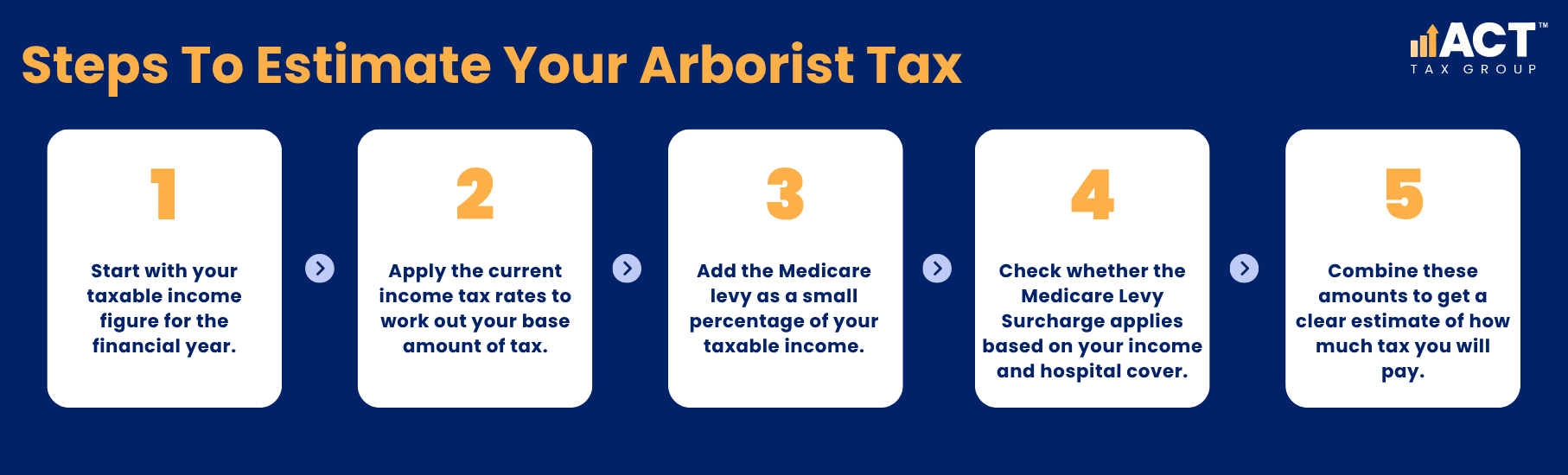
Apply the Income Tax Rates
Australia uses a stepped system of income tax. As your taxable income rises, different slices of it are taxed at different rates. You start with a tax‑free slice, then move through a series of bands where you pay increasing percentages. When you use a tax calculator or tax return calculator, this is exactly what it is doing behind the scenes.
So, at this stage, you take your taxable income and apply the current tax rates for the year. The outcome is a base amount of tax for the year. This is the first part of your tax estimate and gives you a sense of how much tax the system expects you to pay before any other adjustments.
Add Medicare Levy and Check Medicare Levy Surcharge
On top of income tax, most people also pay a Medicare levy, which is a small percentage of taxable income. The rules include some low‑income reductions and exemptions, but in most cases as an arborist‑owner you can expect this to apply. Some higher‑income earners without private hospital cover may also have to pay a Medicare Levy Surcharge.
When you are estimating, it helps to treat these as simple add‑ons: first the main income tax, then the Medicare levy, then any Medicare Levy Surcharge if that fits your situation. Put those together and you now have a solid first view of your estimated tax for the year.
Bring In Tax Deductions, Tax Offsets and Tax Already Paid
A lot of arborist owners stop at the “amount of tax” line and forget the elements that turn that amount into a refund or an extra bill. This is where tax offsets, tax withheld and earlier payments come into play.
Understand How Offsets and Credits Change Your Tax Estimate
Tax offsets are rules that can reduce your income tax after it has been calculated, depending on your circumstances. They are not something you choose at random; they are built into the tax system and into the questions in a tax calculator or tax return calculator. When an offset applies, it lowers your tax payable, sometimes quite noticeably.
Next, look at tax withheld. If you have done some work as an employee during the year alongside your business, the tax that has been withheld from those wages counts as tax already paid. The same applies to any Pay as You Go (PAYG) instalments you have paid during the year as a sole trader or business owner. Missing or underpaying these can have consequences, so it is worth understanding what happens if you miss PAYG instalments. Each dollar of tax withheld and each instalment reduces the amount of tax still owing at the end.
Subtract eligible tax offsets from your income tax first, then subtract PAYG withholding and PAYG instalment credits. Keep in mind that most tax offsets are non-refundable, so they generally cannot reduce tax below zero by themselves. A positive figure generally means tax payable when you lodge your tax. A negative figure usually points to an estimated tax refund.
Factor in Loans, Family and Other Everyday Settings
Your tax obligations are not just shaped by your business. Everyday life choices and family settings can influence your tax estimate, refund and cash flow more than you might think.
Consider Study Debts, Trade Loans and Family Details
If you have a Higher Education Loan Program (HELP) debt or Trade Support Loan, check your repayment income, not just taxable income. For 2025–26, compulsory repayments moved to a marginal repayment system, and the minimum repayment income increased to $67,000. Those repayments might not change your core tax rates, but they do affect how much money actually lands in your bank account as a refund or how much extra you have to pay after you lodge.
Family details such as dependent children, your partner’s income and whether you hold private hospital cover can also change the final picture, especially if you are eligible for Family Tax Benefit Part A. These details are why a tax calculator often asks about your family and cover; the same taxable income can lead to different calculator results once these settings are taken into account.
It is worth writing these on the same page as your income and deductions: loans, dependants, partner income and private health cover. That way, when you use a tax calculator or tax refund calculator, you can plug in all the information at once and know that the tax estimate reflects your real situation.
Grow your tree care business with Accounting Built for Arborists
From start-up to expansion, our accounting team supports your tax, payroll, and cash flow — so you can focus on running your business safely and profitably.
A Repeatable Estimation Process You Can Use Each Tax Time
By this point, you can see that a good tax estimate is not about fancy software. It is about following the same clear steps every financial year. As an arborist, you already rely on checklists for safety and gear; think of this as your tax checklist.
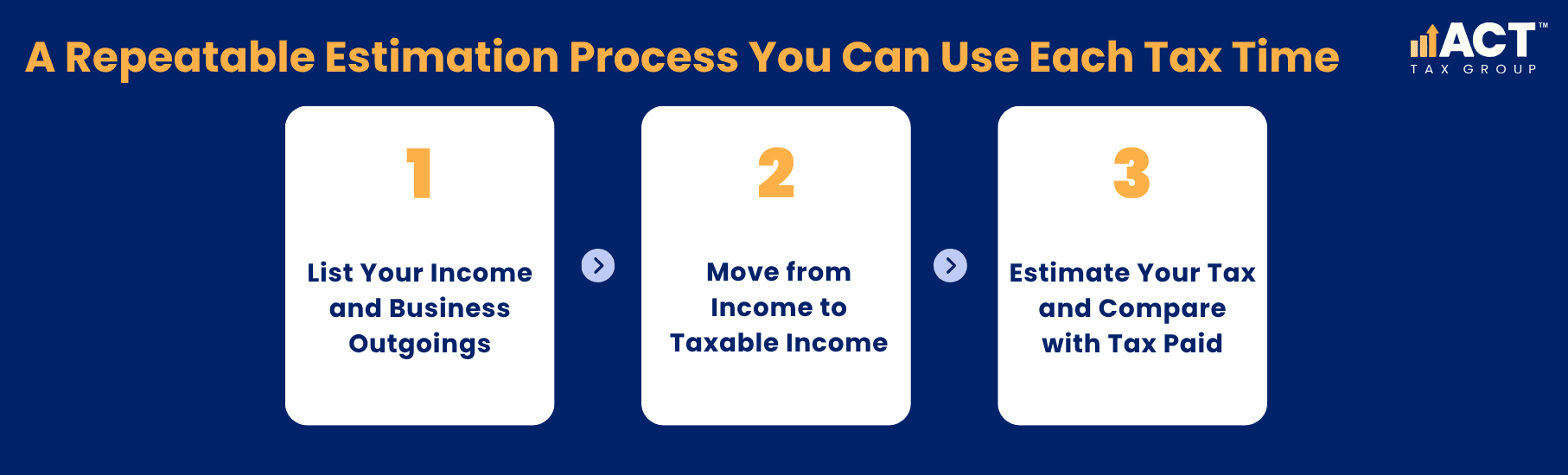
Step 1 – List Your Income and Business Outgoings
Start with your gross income for the year from all tree services. Then list your business outgoings that qualify as deductions and total them. Getting this clear also helps you manage cash flow in your arborist business across busy and quiet seasons. This gives you the two main inputs any tax calculator asks for: income and deductions.
Step 2 – Move from Income to Taxable Income
Subtract your total deductions from your gross income to get taxable income. This is the figure that drives your income tax and Medicare levy. Treat it as your main reference number for the year.
Step 3 – Estimate Your Tax and Compare with Tax Paid
Apply the current income tax rates and add the Medicare levy to work out your estimated tax. Then factor in any offsets you know apply, plus tax withheld and PAYG instalments already paid. If you work from home for part of your admin or quoting, decide whether the fixed rate or actual cost method makes more sense when claiming home office work deductions. Compare the final amount of tax with tax paid to see whether you are heading for a refund or need to put money aside for tax payable.
If you want to double‑check yourself, you can feed the same numbers into a simple tax calculator or follow the standard steps for applying for and lodging your tax return online. When the inputs match, the calculator results should be very close to your own estimate, which builds confidence that you are on the right track.
When It Makes Sense to Get Help with Your Tax Estimate
You did not become an arborist to spend nights wrestling with tax estimates and calculators. You want to know how much tax to set aside, whether an estimated tax refund is realistic and that your tax obligations are under control, without needing to become an accountant on top of running a crew.
Working with an accountant who understands arborist cash flow, seasons and equipment makes this much easier. Together you can set up a straightforward system where gross income, deductions and tax paid are tracked across the year, not just at tax time. That way, a fresh tax estimate is just part of your normal check‑in, and you can focus on the jobs and the people in front of you, not a spreadsheet.

Lukasz Klekowski
Principal of ACT Tax Group, specialising in tax compliance and financial strategy for Australian small businesses.

Disclaimer: All information provided in this publication is of a general nature only and is not personal financial or investment advice. It does not take into account your particular objectives and circumstances. No person should act on the basis of this information without first obtaining and following the advice of a suitably qualified professional. To the fullest extent permitted by law, no person involved in producing, distributing or providing the information in this publication (including ACT TAX GROUP PTY LTD, each of its directors, councilors, employees and contractors and the editors or authors of the information) will be liable in any way for any loss or damage suffered by any person through the use of or access to this information. The Copyright is owned exclusively by ACT TAX GROUP PTY LTD (ABN 31634338088)