

Payroll Compliance Checklist: Employer Responsibilities for Australian Arborists
Published on March 19, 2026
Payroll Compliance Checklist: Employer Responsibilities for Australian Arborists is not just a box-ticking exercise, it is what keeps your crew paid correctly, your work environment safe, and both the ATO and Fair Work off your back. When you are juggling hazardous tree removals, seasonal work, and a tight-knit crew, the last thing you need is a payroll mistake that turns into penalties, backpay, or even a claim that you have failed in your primary duty as an employer or business owner.
Why Payroll Compliance Matters for Arborist Businesses
Running a tree services small business means long days on the job, risky work, and constant pressure to keep jobs moving while cash flow jumps around from summer peaks to quieter winters. If payroll is wrong – even by a little – it can quickly affect workers, lead to money owed, and create legal concerns around your obligations as an employer.
Getting payroll right also supports good workplace health and safety because employees feel respected, understand their pay, and know you are taking your responsibilities seriously. When your systems are up to date and clear, it becomes easier to promote a stable workplace culture where people focus on doing the job safely instead of worrying about pay issues. Clear payroll processes help build trust and reduce disputes and reduces risks from misunderstandings or concerns raised by staff.
Struggling to keep payroll compliant through busy summers and quiet winters?
Schedule a complimentary consultation with us today to map wages, super and BAS so ATO deadlines are always met.
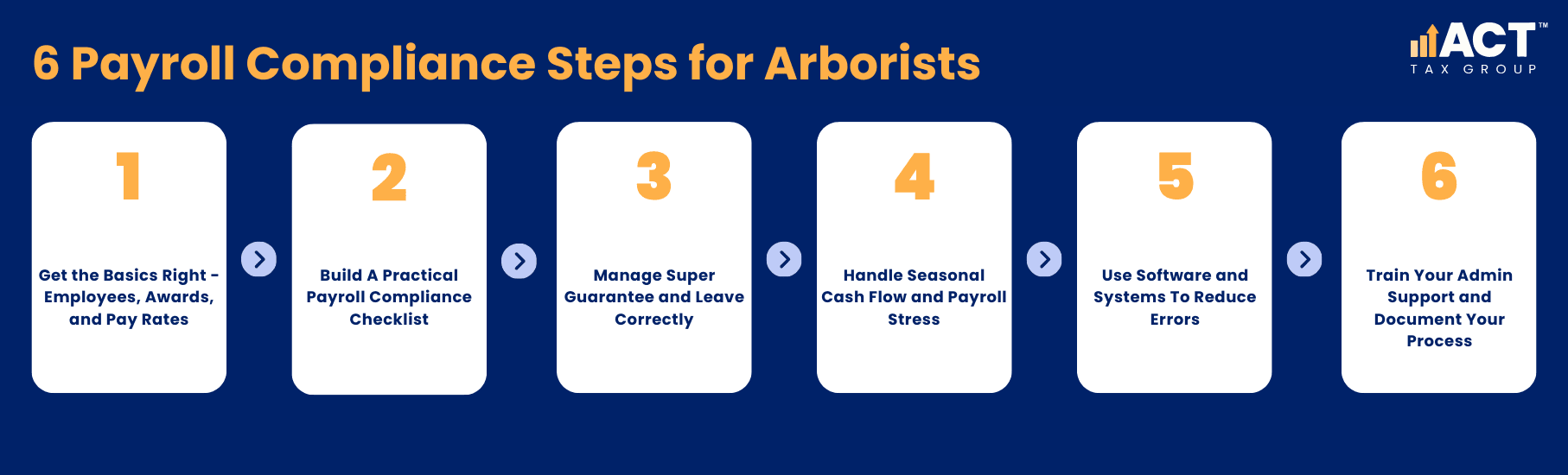
Step 1: Get the Basics Right – Employees, Awards, and Pay Rates
Before diving into checklists and software, start by making sure you are clear on who is an employee, what award or agreement applies, and how their base pay is set. This is part of your responsibility to provide fair and lawful employment conditions, and it sets the foundation for all other payroll responsibilities.
Confirm Who Is An Employee (Not A Contractor)
Many arborist businesses use a mix of full-time crew, casuals, and “contract climbers” or groundies, but some of those self employed workers may actually be employees in the eyes of the law. It is the employer’s responsibility to assess the whole relationship, including the contract and how the work is performed in practice, because from 26 August 2024 constitutionally covered businesses use the whole of relationship test.
If someone operates more like an employee than a contractor, you may have payroll obligations such as tax, super, and leave, even if they send you an invoice in another form. Reviewing this during the hiring process and documenting the arrangement clearly helps avoid surprises later.
Check Minimum Wages and Award Coverage
Many tree services employees are covered by a modern award, but arborist coverage depends on the employer’s industry and the work performed. Common examples include the Gardening and Landscaping Award and, for vegetation clearing near power lines, the Electrical Award. As an employer, you are responsible for making sure pay rates are at least at the award level and kept up to date after each wage decision or date of change.
Confirm which award applies to your arborists, ground crew, and apprentices, and save the current pay guide in your system. Compare your current hourly and daily rates to the minimums and adjust them if needed so that they are not below the lawful level, and record any choices to pay above award so there is no misunderstanding if an employee requests further information.

Step 2: Build A Practical Payroll Compliance Checklist
Once the basics are clear, you can create a simple checklist that covers what must be right each pay run, each quarter, and each year. This checklist becomes part of your workplace procedures and helps anyone who assists with payroll understand what to do, ensuring your systems stay up to date and support good supervision.
Every Pay Run: Hours, Allowances, Overtime, and STP
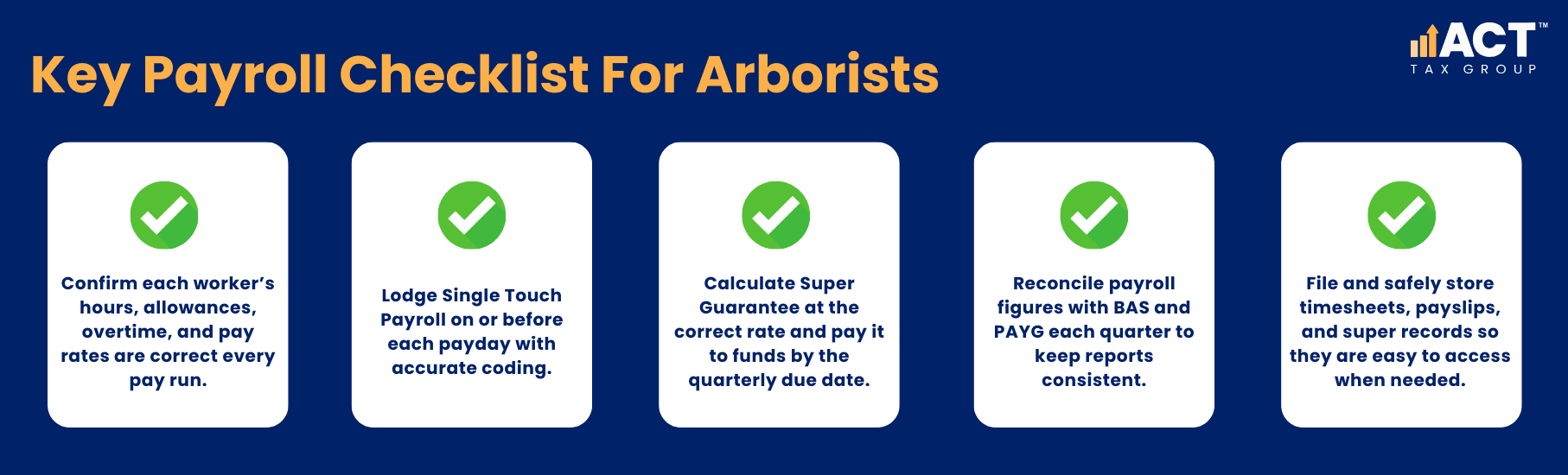
Arborist work rarely fits a neat 9–5 pattern, especially during storm events or emergency jobs, so your payroll process needs to handle variable hours and conditions. Your responsibilities each pay cycle include making sure pay is accurate, allowances like travel or tools are included where required, overtime and weekends are recorded properly, and everything is lodged through Single Touch Payroll on or before payday with correct coding.
This level of detail supports fair employment and makes it easier to respond if an employee requests a review or has questions about their payslip.
Each Quarter: Super, BAS, and Records
Quarterly checks help you stay on track with your obligations for Super Guarantee and tax. Confirm that super has been calculated at the right rate and paid to the fund by the due date, that payroll reports match what you have reported for BAS and PAYG under your BAS and GST reporting obligations, and that records such as timesheets, payslips, and super payments are filed and could be provided if a worker, advisor, or official body asks for them.
Doing this regularly lowers the risk that something goes unnoticed until it has grown into a larger problem for your business.
Step 3: Manage Super Guarantee and Leave Correctly
For arborist businesses, super and leave can get messy when crew hours spike in summer and drop back in winter. Getting these right protects your employees and your business and aligns with your work health responsibilities by supporting them when they are sick, injured, or resting.
Super Guarantee: Rates, Timing, and Responsibility
Super Guarantee is compulsory for most employees, including casuals, regardless of how seasonal the work feels. As the employer, you are responsible for setting your payroll system to the current Super Guarantee rate, paying super at 12% of ordinary time earnings for eligible workers. Until 30 June 2026, contributions are generally due at least quarterly. From 1 July 2026, Payday Super starts, so super must be paid on payday.
If super is not paid correctly or on time, it can be treated as a failure to meet your obligations and you may have to pay extra charges, including those that arise when PAYG instalments are missed or underpaid, which can put extra pressure on your cash flow.
Leave Entitlements for A Seasonal, High-Risk Crew
Even if demand drops in winter, your permanent staff still accrue Annual Leave and Personal Leave based on their regular hours. These entitlements support workplace health by allowing workers to rest, recover from injuries, and manage family responsibilities.
Check that full-time and part-time employees are accruing leave at the correct rate, make sure leave is recorded when taken and balances are available to employees on request. Showing leave balances on payslips is best practice but not strictly required.

Step 4: Handle Seasonal Cash Flow and Payroll Stress
A common comment from arborist business owners is that “cash flow is great in summer, but we are struggling through winter.” Payroll, super, and BAS do not stop when the phone gets quiet, so part of your primary duty is to plan for those quieter periods so you can still meet your obligations, applying cash flow management strategies tailored to arborist businesses to maintain a positive workplace culture.
Forecast Payroll Costs Across the Year
Instead of seeing payroll as a week-to-week problem, map your payroll costs across the next 12 months. This does not have to be complex and can be done in a basic spreadsheet or accounting software, including expected wages for each worker across busy and quiet periods, super, Workers’ Compensation premiums, and other employment-related costs like training and safety gear.
This helps you see where you may face strain and gives you time to adjust pricing, reduce overtime, or look for extra work before you reach a crunch point.
Set Aside Cash for Super and BAS
A simple and effective process is to move a set percentage of every customer payment into a separate account that is only used for tax and super, particularly if you have regular Instalment Activity Statement (IAS) obligations to meet alongside BAS. Agree on a percentage with your accountant or advisor based on your current wage bill and other obligations, including GST credits and BAS reporting requirements, transfer that amount as soon as payments arrive rather than waiting until the end of the month, and review the percentage regularly to keep it aligned with any changes in your crew size, rates, or business model.
This reduces stress and means you are less likely to find yourself unable to pay on time.
Step 5: Use Software and Systems To Reduce Errors
Most arborist owners want to spend more time leading the crew and less time in the office. Using simple, reliable systems helps you manage your responsibilities without getting overwhelmed, and supports consultation and communication across your workplace.
Connect Job Management And Payroll
If you already use job management tools for quoting and scheduling, you can often link them to your payroll and accounting software and make use of ATO Online Services for Business to streamline lodgements and payments. This helps create a single system that supports both operations and compliance, allowing you to use digital timesheets so workers log hours against each job which then feed into payroll, and review labour costs by job so you can see where margins are tight and adjust future prices or processes.
This level of visibility gives you confidence that the numbers reflect reality, reduces the risk of undercharging or unreasonable costs, and helps you avoid issues such as ASIC late fees and penalties that can arise from poor record keeping or missed deadlines.
Keep Data Clean For Reporting
With more detailed reporting now expected from employers, it is important to keep your payroll data clean and consistent. This is part of your duty to provide clear, accurate information about your business, so regularly review your list of pay items to make sure they are named clearly and used in a consistent way, train the person responsible for payroll so they understand why certain codes are used and how they affect reports, and schedule a yearly review with your accountant to check that your system still matches current rules and rates, and consider engaging specialist tax and accounting support for small businesses if you need more tailored guidance.
Grow your tree care business with Accounting Built for Arborists
From start-up to expansion, our accounting team supports your tax, payroll, and cash flow — so you can focus on running your business safely and profitably.
Step 6: Train Your Admin Support and Document Your Process
Many arborist businesses rely on a spouse, partner, or admin person to handle payroll, but if the process is not written down, it can fall apart when that person is away. Clear instruction and training are key parts of good supervision and risk management, helping everyone understand their role in emergencies, discrimination prevention, and daily procedures.
Document A Simple Payroll Procedure
Write down a step-by-step procedure for how payroll runs in your workplace. Keep it short, practical, and easy to follow, including when timesheets are due, who checks them and how corrections are handled, how pay rates, allowances, and leave are checked before each pay run, and how and when STP is lodged, super is paid, and any issues are reported or escalated.
Store this document in a shared place and review it each year so it stays up to date with any changes in law or systems.
Train Key People and Keep Lines Of Communication Open
Training does not have to be formal or expensive. The goal is to make sure the person doing payroll understands the process, the reasons behind it, and what to do if something goes wrong. Sit down and walk through a full pay run together explaining each step and what to check, encourage workers to raise concerns early if they notice anything unusual on their payslip or in their work conditions, and consult your accountant or advisor when you make bigger changes such as hiring more crew, changing software, or starting new services.
This open approach supports a positive workplace culture, improves the quality of your financial records and payroll data so key tax and BAS documentation for your trade business is easier to prepare, and lowers the risk of disputes, grievances, or even unfair dismissal claims.
When To Get Professional Help
Payroll for a small arborist crew might look simple at first, but awards, super, reporting rules, and work health responsibilities all add layers you cannot ignore. If you are not confident that your current setup is fully compliant, it is better to request a review than to wait for a problem to be reported by an employee, visitor, or other party.
A professional who understands both payroll and the arborist industry can review your current payroll process including rates, super, and reporting and show where you may face risks, help you design a simple system that matches your business, your people, and your obligations under current law, and support you in building a workplace where employees are paid fairly, feel safe to speak up, and know that their employer takes responsibilities seriously.

Lukasz Klekowski
Principal of ACT Tax Group, specialising in tax compliance and financial strategy for Australian small businesses.

Disclaimer: All information provided in this publication is of a general nature only and is not personal financial or investment advice. It does not take into account your particular objectives and circumstances. No person should act on the basis of this information without first obtaining and following the advice of a suitably qualified professional. To the fullest extent permitted by law, no person involved in producing, distributing or providing the information in this publication (including ACT TAX GROUP PTY LTD, each of its directors, councilors, employees and contractors and the editors or authors of the information) will be liable in any way for any loss or damage suffered by any person through the use of or access to this information. The Copyright is owned exclusively by ACT TAX GROUP PTY LTD (ABN 31634338088)