

Employee or Contractor? Payroll Compliance for Australian Arborists Explained
Published on March 10, 2026
When you are racing from one hazardous removal to the next, it can feel easier to call everyone a contractor and move on. But the ATO and Fair Work use a relationship test that looks at the true nature of the employment relationship, not just the contract wording or whether a person has an Australian Business Number. They focus on how the work is performed, who controls the hours, who owns the tools and equipment, and who carries the responsibility and costs if something goes wrong.
Why Arborist Payroll Classifications Feel So Confusing
If you are like most arborist business owners, you have probably thought: “Cash flow is tight in winter, so I will just bring in subcontractors for big projects and avoid the extra costs.” On paper that sounds simple, but in practice the working arrangement often looks more like employees work inside someone else’s business than separate companies providing services to each other. That is where employee vs contractor confusion starts.
You might have someone who says they are an independent contractor, but they only work for your business, wear your shirts, use your equipment and perform work only when you tell them. In that case, the real substance of the relationship can be closer to an employment relationship, even if the contract calls them a contractor. Sham contracting provisions exist to deal with situations where a worker is treated as a contractor but, under the test the regulators use, the worker is an employee.
Confused about whether your climbers are employees or contractors?
Schedule a complimentary consultation with us today to review your crew arrangements against ATO and Fair Work tests so you pay the right tax and super.
How The ATO Decides: Employee or Contractor for Arborists
To determine if a worker is an employee or independent contractor, the ATO and Fair Work look at the whole relationship, not one single factor. They consider who has control over how and when the work is done, whether the person can work for more than one client, who owns the major tools and equipment, and who carries legal and financial risk for the work performed. You need to look at the arrangement as a whole and decide where it sits on the employee vs contractor scale.
It is also worth noting that since 26 August 2024, the Fair Work Act includes a new definition of employee under section 15AA. This requires looking at the real substance, practical reality and true nature of the relationship, not just what the written contract says.
Key Factors in Arborist Work
Here are some practical factors that usually matter in tree services when deciding whether a worker is an employee or contractor. These factors show the differences in relation to control, risk and responsibility.
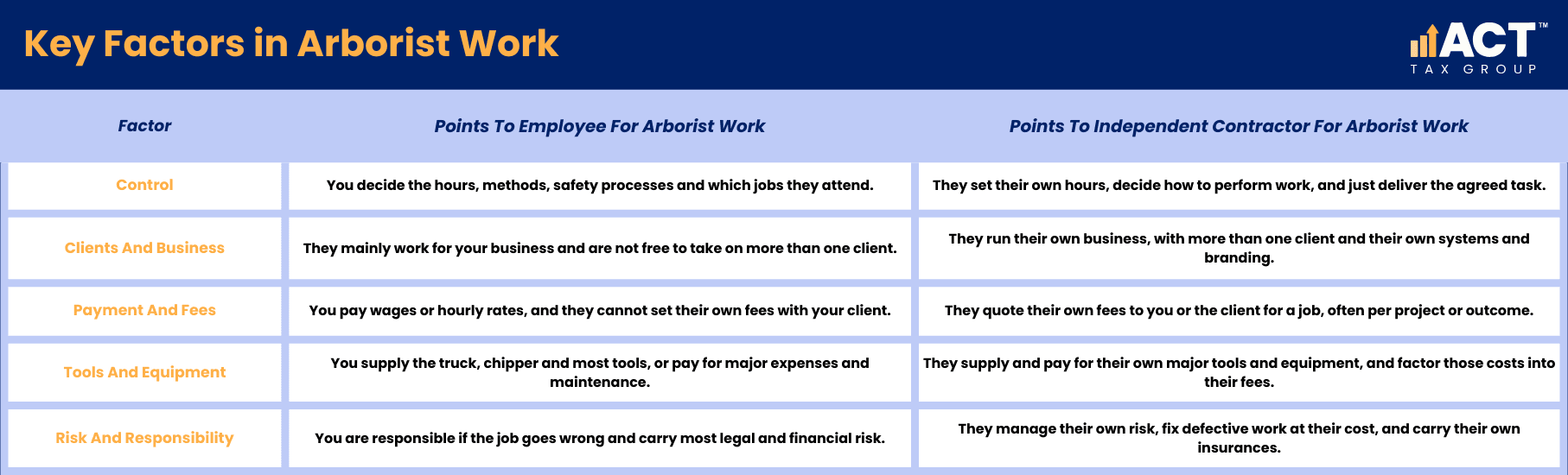
When most of these factors point to you having control and responsibility, it is likely that the worker is an employee, even if the contract calls them a contractor. When most factors show the person running their own business, managing their own risk and setting their own hours, they are generally closer to an independent contractor.
Super Obligations and the Independent Contractor Employee Trap
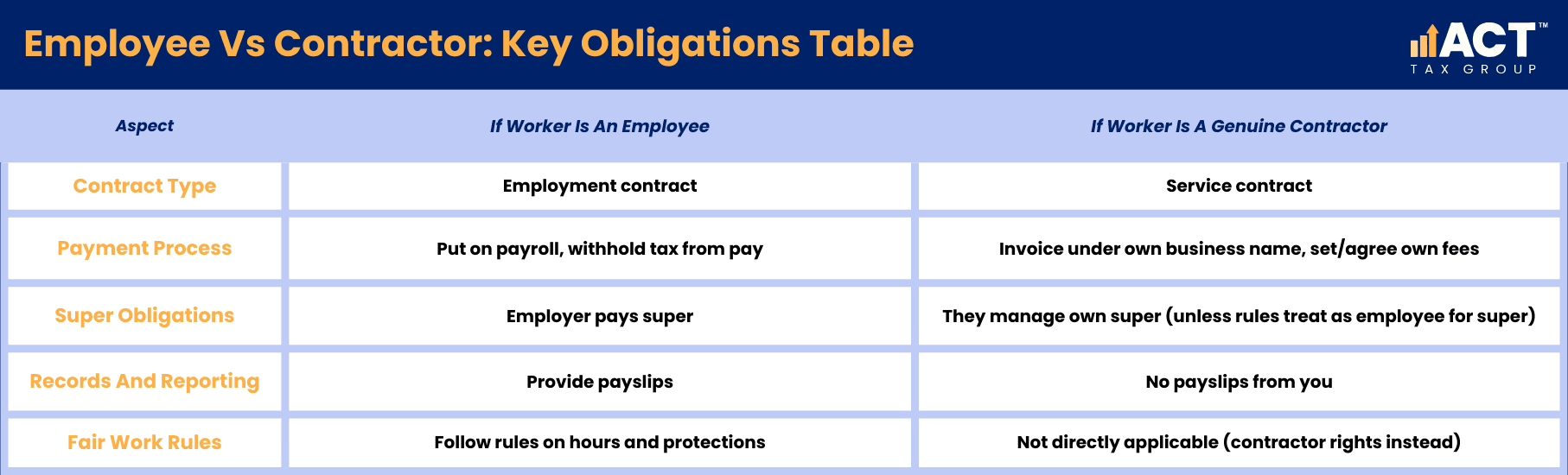
Even if the law treats someone as a contractor in general, you can still have super obligations where the worker is paid mainly for their labour. This is sometimes called the independent contractor employee situation for super. In practice, that can apply where you hire a climber on a day rate, they must personally perform work, and they are not free to send someone else.
From 1 July 2025 the Super Guarantee rate is 12%, and that applies not only to traditional employees but also to workers who meet the test for super as if the worker is an employee. If you ignore that and do not pay super on time, you can end up with extra costs in the form of a charge, interest and administration amounts. It is usually cheaper and less stressful to build super into your pricing from the start rather than trying to catch up later.
From 1 July 2026, Payday Super will require employers to pay super at the same time as wages, with contributions received by the worker’s fund within seven business days of payday. This replaces the current quarterly payment cycle.

Practical Payroll Compliance Steps for Tree Services Businesses
Once you have a handle on the factors that determine worker status for super and other obligations, you can put some simple steps in place. The goal is to manage risk and keep things clear for both parties, so everyone understands the relationship and who is responsible for what.
Use Decision Tools Before You Hire or Renew
Before you hire a new worker or renew an arrangement, take time to run through the official decision tools that compare employee vs contractor status. These tools ask you questions about hours, control, who supplies equipment, whether the worker can take on more than one client, and who carries risk and expenses. At the end you get a clear reference point that helps you decide how you should treat that person for tax and super.
Keeping a copy of those results on your account records gives you a solid example of the consideration you gave to the relationship. If the ATO or Fair Work review your practice later, you can show how you tried to follow the law and apply the test correctly. That does not replace proper legal advice, but it gives you a structured way to think through the relationship.
Align Contracts, Invoices and Daily Practice
Once you decide whether someone is an employee or a contractor, your contract and day‑to‑day practice should match that decision.
Sham contracting is when a business presents an arrangement as a contractor relationship to avoid obligations, but the real nature of the work is closer to an employment relationship. Sham contracting provisions can lead to penalties for the employer, so it is worth checking whether your contracts and actual practice line up.
Courts can impose penalties of up to $19,800 per contravention for individuals, $99,000 for businesses with fewer than 15 employees, and $495,000 for larger businesses.
Build Payroll Costs into Your Pricing
Many arborists worry that if they treat workers as employees, the added costs for super, insurance and leave will blow out project budgets. But those costs exist whether you want them to or not if the worker is an employee in the eyes of the law. The safest practice is to include these labour costs when you price jobs, rather than hoping to save by calling someone a contractor.
For example, when you price a large removal, you would factor in the cost of labour, equipment, fuel, insurances and other expenses. In the same way, if you know that a worker is an employee, you include their super, leave and other obligations in your hourly rate. That way, your quotes reflect the true costs of running your business and you are less likely to be caught out by unpaid obligations later.
Grow your tree care business with Accounting Built for Arborists
From start-up to expansion, our accounting team supports your tax, payroll, and cash flow — so you can focus on running your business safely and profitably.
Keep Records that Reflect the True Nature Of the Relationship
Good records can make or break you if there is a dispute or review later. You should keep copies of contracts, decision tool outcomes, timesheets, payslips, invoices, payment records and any correspondence about the working arrangement. These records show how the parties understood the relationship at the time and how the work was actually performed.
For employees, records help you show that you met your obligations for wages, super and other protections. For contractors, records show how they operated their own business, set their own fees, and supplied their own tools and equipment. In both cases, clear records help you manage risk and keep your business on solid ground.

Getting Help So You Can Focus on the Trees, Not the Paperwork
Most arborists did not start a tree services business so they could spend nights comparing employment law cases or reading about relationship tests. You want straight, practical steps so you can hire people, get jobs done safely, and know that your payroll and contracts match the true nature of the work performed. That is where the right advice and support can make a real difference.
At ACT Tax Group, we work with arborists and other trades who engage both employees and subcontractors, helping them determine when a worker is an employee or contractor, set up clear contracts, and build payroll costs into their pricing. We focus on practical systems that reflect the real substance of the relationship, manage risk and keep you on the right side of the rules while you grow your business.

Lukasz Klekowski
Principal of ACT Tax Group, specialising in tax compliance and financial strategy for Australian small businesses.

Disclaimer: All information provided in this publication is of a general nature only and is not personal financial or investment advice. It does not take into account your particular objectives and circumstances. No person should act on the basis of this information without first obtaining and following the advice of a suitably qualified professional. To the fullest extent permitted by law, no person involved in producing, distributing or providing the information in this publication (including ACT TAX GROUP PTY LTD, each of its directors, councilors, employees and contractors and the editors or authors of the information) will be liable in any way for any loss or damage suffered by any person through the use of or access to this information. The Copyright is owned exclusively by ACT TAX GROUP PTY LTD (ABN 31634338088)