

How Arborist Partners Can Use Separate “Personal” and “Business” Bank Accounts Without Confusion
Published on August 25, 2026
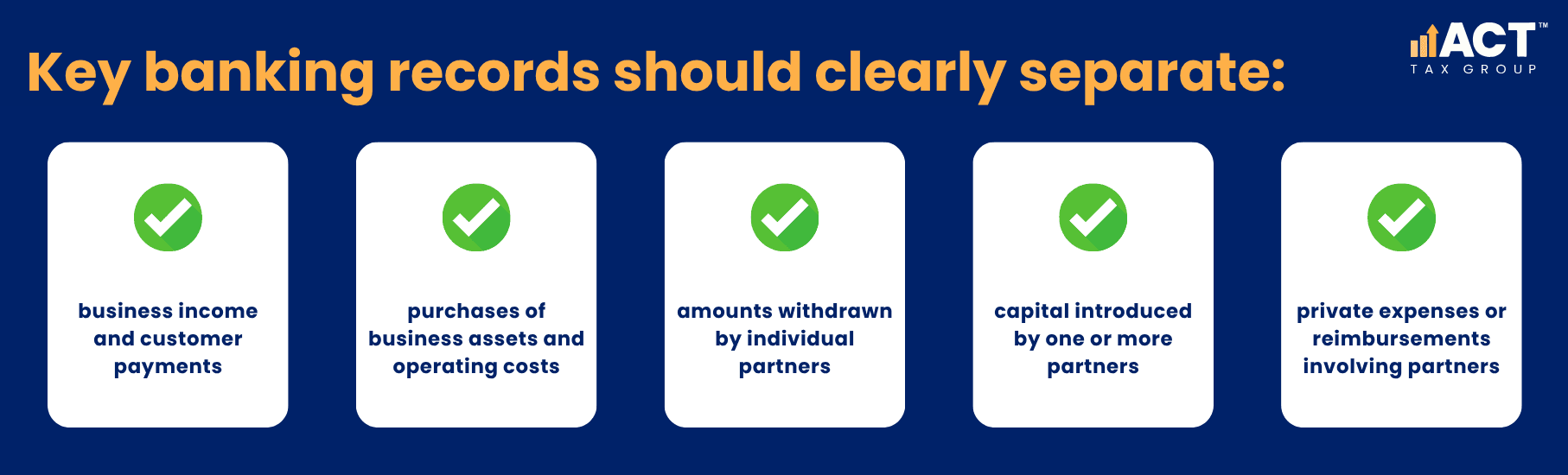
How Arborist Partners Can Use Separate “Personal” and “Business” Bank Accounts Without Confusion starts with giving each account a clear purpose and making sure all the partners understand how money should move between the business and their personal accounts. For an arborist partnership dealing with fuel, equipment, wages, insurance and seasonal income, mixing private spending with business transactions can quickly make bookkeeping harder than it needs to be.
A clear banking system also supports better records for income tax purposes. A business partnership must have a separate bank account for tax purposes and should keep business income, expenses, partner withdrawals and contributions clearly identified.
Separate Banking Creates Clearer Partnership Records
A partnership is a business structure where two or more people run a business together and intend to make a profit. A general law partnership commonly describes parties carrying on a business together under the general law definition, while a tax law partnership can also arise for tax purposes where people receive ordinary or statutory income jointly, even if they are not operating a business in the usual way. For most arborist businesses, the practical focus is a genuine partnership where the partners jointly operate the business and share income. The partnership is generally not a separate legal entity in the same way as a company, although it has separate tax and reporting responsibilities administered by the Australian Taxation Office (ATO).
Need Cleaner Records for Your Partnership Tax Return?
Schedule a complimentary consultation with us today to organise income, expenses and partner contributions.
Clear Account Rules Reduce Day-To-Day Confusion
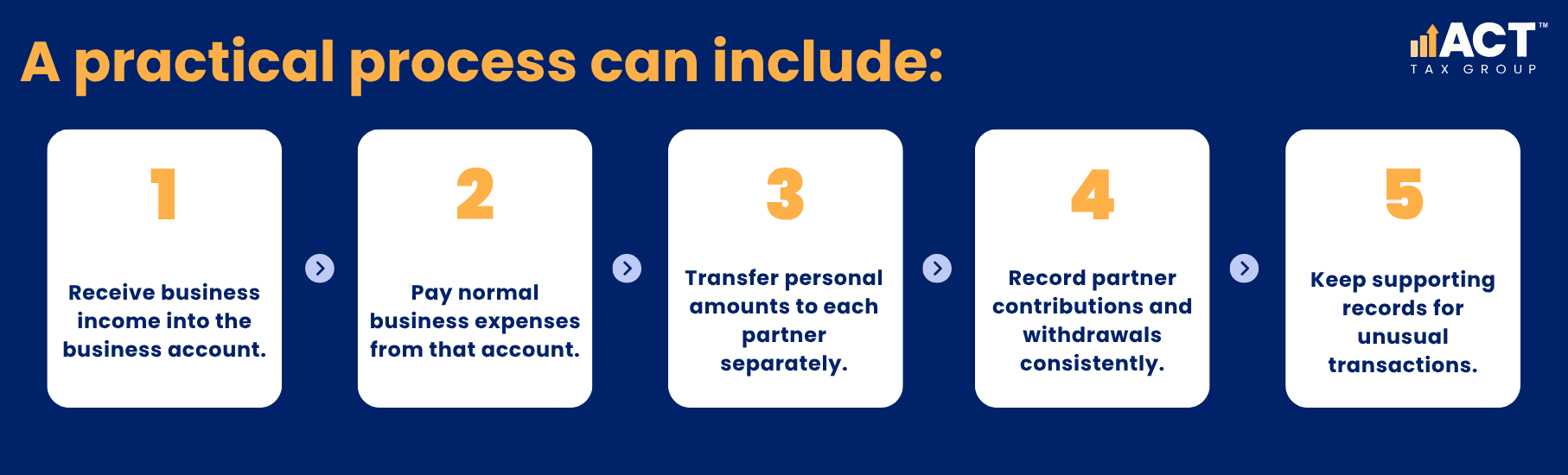
The business account should support the day-to-day operations of the arborist business. Customer payments can be deposited into that account, while fuel, insurance, equipment repairs, subcontractors and other genuine business costs can generally be paid from it. Personal accounts should remain separate. When business partners need money for personal spending, transferring an agreed amount to their own accounts gives the bookkeeping records a clearer distinction between business expenses and money distributed or withdrawn for private use.
Example: Two arborist partners operate under one business name and share ownership of the equipment. Instead of both using the business debit card for personal purchases, they transfer agreed amounts to their own bank accounts. The records then show business costs separately from personal withdrawals.
Partnership Withdrawals Need Consistent Treatment
Money taken from a partnership for private use does not become a business expense simply because it came from the business bank account. Each withdrawal should be recorded according to what actually happened so the partnership income and the position of each partner remain clear. This also helps when the partnership needs to distribute income between partners. Partner withdrawals are not wages or deductible business expenses and may affect each partner’s share of partnership income for tax purposes.
Personal Spending Should Stay Outside the Business Account
If one partner accidentally pays a private expense from the business account, the transaction should still be recorded accurately. It should not be treated as a deductible business cost simply to make the bookkeeping easier. The reverse can also happen when a partner pays a genuine business expense from a personal account. If one partner pays for an urgent chainsaw repair, safety equipment or fuel personally, the receipt should be kept and the payment recorded so the business can recognise the expense correctly.
The Partnership Agreement Supports Clear Financial Boundaries
A written partnership agreement can describe the key features of the relationship between the partners, including ownership, capital, profit sharing, decision-making and banking responsibilities. It can also explain what happens when new partners join, one partner leaves, or disagreements arise. The agreement may also cover partnership debts and the responsibilities of the other partners. In a general partnership, partners can face unlimited liability, which means business debts may affect the partners’ personal assets depending on the circumstances. This is one reason clear records and professional legal advice are important.

Business Structure Changes Financial Responsibility
The form of the business affects how ownership, liability and tax responsibilities work. A sole trader, general partnership, limited partnership, joint venture and company can each operate differently, so the most suitable structure depends on the business activities, ownership arrangements and future plans. A general partnership normally consists of partners who participate in the business and may share responsibility for its debts. A limited partnership can include general partners and limited partners, but the rules differ between states and territories. South Australia and Western Australia, for example, have their own partnership legislation, so legal advice may be appropriate if a business is considering this structure.
Administrative Ease Comes from Consistent Banking
One of the practical benefits of separate banking is administrative ease. Partners can see business income and expenses more clearly, while bookkeepers and accountants spend less time identifying whether transactions were personal or business related. These benefits become more valuable as the arborist business grows. A business with higher annual turnover, more equipment, additional staff and more frequent transactions can quickly lose visibility if personal and business spending are mixed together.
Grow your tree care business with Accounting Built for Arborists
From start-up to expansion, our accounting team supports your tax, payroll, and cash flow — so you can focus on running your business safely and profitably.
Tax and Business Money Should Have a Clear Purpose
A partnership can also use a separate account to set aside money for expected tax and other business obligations. This does not change the tax treatment of the partnership, but it can make it easier to see what money is available for operating costs and what has already been allocated for future payments. For tax purposes, the partnership generally reports its income and expenses, while the partners include their share of partnership income in their own returns. A tax law partnership can also include persons who receive ordinary or statutory income jointly, which is broader than the usual business partnership concept.

How ACT Tax Group Can Help with Arborist Partnership Banking and Tax Records
We can help arborist partners create a practical accounting process that separates business transactions, personal withdrawals, partner contributions and tax obligations. Our team can also review how your business structure, partnership agreement and bookkeeping processes work together so your records remain clear as the business grows.
Frequently Asked Questions
Does An Arborist Partnership Need Its Own Tax File Number?
A partnership has its own Tax File Number (TFN) and must lodge an annual partnership tax return. Each partner reports their share of the partnership’s net income or loss in their own tax return.
Do Partners Pay Income Tax on Money They Withdraw?
A partner’s tax position is generally based on their share of partnership income rather than simply the amount of cash they withdraw. This means taking more or less money from the business during the year does not necessarily change the amount on which they pay income tax.
Can Partnership Assets Be Used Personally?
Partnership assets should be clearly identified and recorded, particularly where equipment such as vehicles, chainsaws, chippers or stump grinders also has private use. Deductions generally need to reflect the extent the asset is used to produce assessable income, so records should show its business and private use.
Are Arborist Partners Personally Responsible for Partnership Debts?
Partners in a general partnership can have personal liability for partnership obligations. Depending on the circumstances, partners may also be jointly and severally liable, meaning one partner could potentially be responsible for more than their expected share of certain debts incurred by the business. Because liability depends on the structure and applicable law, it can be sensible to obtain advice from a lawyer when establishing or changing a partnership.
Can a Partnership Agreement Help Prevent Disputes?
Yes. A clear partnership agreement can reduce uncertainty by setting out responsibilities, profit sharing, banking authority, ownership of partnership assets and how decisions are made.

Lukasz Klekowski
Principal of ACT Tax Group, specialising in tax compliance and financial strategy for Australian small businesses.

Disclaimer: All information provided in this publication is of a general nature only and is not personal financial or investment advice. It does not take into account your particular objectives and circumstances. No person should act on the basis of this information without first obtaining and following the advice of a suitably qualified professional. To the fullest extent permitted by law, no person involved in producing, distributing or providing the information in this publication (including ACT TAX GROUP PTY LTD, each of its directors, councilors, employees and contractors and the editors or authors of the information) will be liable in any way for any loss or damage suffered by any person through the use of or access to this information. The Copyright is owned exclusively by ACT TAX GROUP PTY LTD (ABN 31634338088)