

Medicare Levy Review Steps for Arborists with Multiple Income Sources
Published on October 21, 2026
Medicare Levy Review Steps for Arborists with Multiple Income Sources help Australian tree service operators understand how their combined earnings affect their Medicare levy, income tax, and potential Medicare levy surcharge. When you earn income from employment, subcontracting, and business activities, reviewing your annual taxable income can help prevent unexpected tax bills.
For arborists managing seasonal contracts, changing workloads, and rising equipment costs, keeping track of multiple income sources can be challenging. Understanding Medicare levy rules, private hospital cover requirements, and income thresholds helps you prepare an accurate tax return and maintain better control over your business finances.
Medicare Levy Calculations for Arborists with Multiple Income Sources
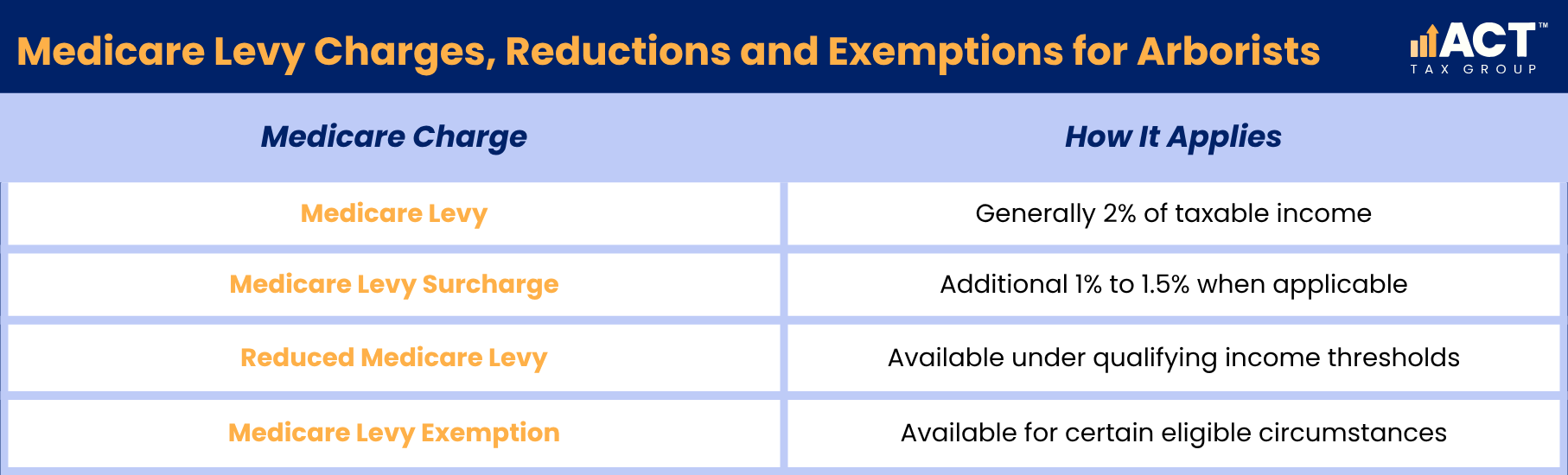
Most Australian taxpayers pay the Medicare levy at 2% of their taxable income, unless a reduction or exemption applies. The Australian Taxation Office (ATO) calculates the levy using your annual taxable income, including relevant earnings from employment, business activities, and investments. The Medicare levy helps fund Medicare, which provides eligible Australians with free or subsidised treatment and other Medicare benefits. Your personal circumstances, deductions, and applicable income thresholds determine how much Medicare levy you pay.
Multiple income sources complicating your Medicare levy?
Schedule a complimentary consultation with us today to review your combined taxable income.
The Impact of Multiple Income Sources on Medicare Levy Calculations
Arborists who work as employees while operating their own tree service businesses must consider their combined taxable income. Even when income comes from separate activities, the total amount generally determines the Medicare levy payable. Seasonal work can make annual income difficult to predict, particularly when storm-damage contracts or commercial projects increase earnings unexpectedly. Reviewing your combined income during the financial year helps you prepare for potential additional tax.
Example: Employment and Contracting Income
Andrew earns $65,000 from employment and $35,000 in taxable business profit from weekend tree removal contracts. His combined taxable income is $100,000, resulting in a standard Medicare levy of $2,000, assuming no reduction or exemption applies.

Essential Medicare Levy Review Steps for Arborists
Reviewing your Medicare levy starts with understanding your income, eligible deductions, and personal circumstances. A structured approach helps identify potential tax obligations before tax time.
The review should also consider private health insurance, family income thresholds, and whether your existing tax payments adequately cover your expected liability.
Follow These Six Medicare Levy Review Steps:
Identify All Income Sources: Gather employment, contracting, business, and investment income records.
Calculate Taxable Income: Combine assessable earnings and subtract eligible deductions.
Check Income Thresholds: Determine whether you qualify for a reduced Medicare levy.
Review Hospital Cover: Confirm whether your private hospital insurance meets surcharge requirements.
Assess Your Family Circumstances: Consider your spouse’s income and any dependant children.
Review Tax Payments: Compare amounts already paid with your estimated annual income tax and Medicare levy obligations.

Medicare Levy Surcharge Requirements for Arborists
The Medicare Levy Surcharge (MLS) is an additional tax you may need to pay if your income exceeds the applicable threshold and you do not have eligible private hospital cover. This calculation includes taxable income and certain additional amounts, such as reportable superannuation contributions and investment losses.
For the 2026–27 financial year, the Medicare levy surcharge may apply if your income exceeds $105,000 as a single person or $210,000 as a family, and you do not have eligible private hospital cover. The family threshold increases by $1,500 for each dependent child after the first. Surcharge rates are 1%, 1.25%, or 1.5%, depending on income.
The Impact of Private Hospital Cover on Medicare Levy Surcharge
Appropriate private patient hospital cover can help eligible higher-income taxpayers avoid paying the Medicare levy surcharge. However, holding private health insurance does not automatically remove the standard Medicare levy.
Your private hospital insurance must come from a registered health insurer and have an excess of no more than $750 for singles or $1,500 for families. Extras-only health cover does not qualify, and periods without eligible cover may attract the surcharge.
When Reviewing Private Hospital Insurance, Check:
Whether your policy includes eligible hospital treatment.
Whether your spouse and dependent children have appropriate cover.
Whether you held eligible cover for the entire financial year.
Whether your policy excess meets surcharge requirements.
Whether the private health insurance rebate affects your insurance costs.
Grow your tree care business with Accounting Built for Arborists
From start-up to expansion, our accounting team supports your tax, payroll, and cash flow — so you can focus on running your business safely and profitably.
Medicare Levy Reductions and Exemptions for Eligible Arborists
You may pay no Medicare levy below the applicable low-income threshold or qualify for a reduced Medicare levy within certain income ranges. Separate Medicare levy exemptions may apply based on medical, residency, or Medicare entitlement conditions.
Eligibility depends on your annual taxable income, family circumstances, and other qualifying conditions. Some seniors may also benefit from different thresholds where the Seniors and Pensioners Tax Offset (SAPTO) applies.
Potential Eligibility Factors Include:
Individual and family income thresholds.
A qualifying dependent child or spouse.
Certain medical requirements.
Relevant Medicare entitlement conditions.
Foreign resident status for tax purposes, subject to exemption eligibility and dependant requirements.
Example: Seasonal Income Changes
An arborist experiences a slow winter and earns less than originally forecast. If their final taxable income falls within an applicable low-income range, they may qualify for a reduced Medicare levy rather than paying the full 2%.
Practical Strategies to Prevent Unexpected Medicare Levy Bills
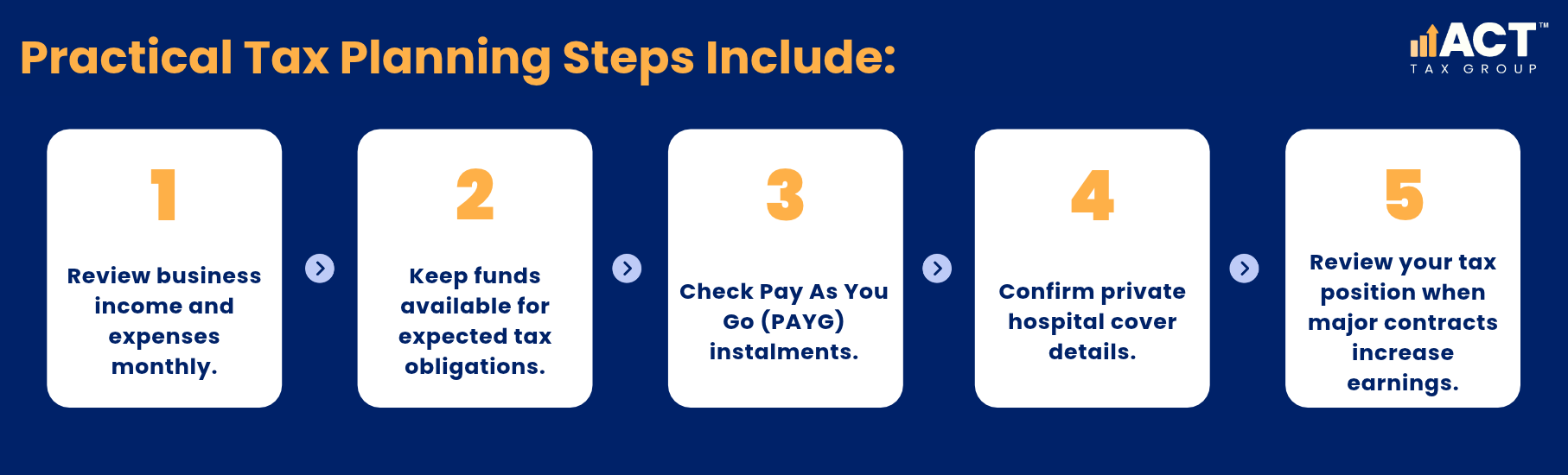
Regular financial reviews help arborists estimate how much tax they may owe when income changes throughout the year. Without sufficient tax withheld from contracting or business payments, additional income can create a larger liability at tax time. The ATO encourages taxpayers to review their financial records and withholding arrangements to reduce unexpected tax assessments.
How ACT Tax Group Can Help with Medicare Levy Reviews for Arborists
At ACT Tax Group, we understand the challenges arborists face when managing seasonal earnings, multiple contracts, and changing tax obligations. Our friendly, IPA-certified team helps you review taxable income, assess Medicare levy requirements, understand private health cover implications, and plan for potential tax liabilities.
We also provide tax accounting, business structuring, and practical financial advice tailored to your circumstances. Book a consultation with ACT Tax Group to discuss your Medicare levy position and develop a clearer approach to managing tax obligations throughout the financial year.
Frequently Asked Questions
How Much Medicare Levy Do I Pay with Multiple Income Sources?
Most Australian taxpayers pay 2% of their taxable income as the Medicare levy, unless a reduction or exemption applies. Your employment earnings, business profits, and other assessable income contribute to the calculation. You may qualify for a reduced Medicare levy based on income or a separate exemption based on your personal circumstances.
Can Holding Private Hospital Cover Help Avoid the Medicare Levy Surcharge?
Holding eligible private hospital cover can help you avoid paying the MLS, but not the standard Medicare levy. You can use a Medicare levy surcharge calculator to estimate your liability based on income for surcharge purposes. Basic hospital cover may qualify if it meets the requirements, while Lifetime Health Cover is a separate insurance cost consideration.

Lukasz Klekowski
Principal of ACT Tax Group, specialising in tax compliance and financial strategy for Australian small businesses.

Disclaimer: All information provided in this publication is of a general nature only and is not personal financial or investment advice. It does not take into account your particular objectives and circumstances. No person should act on the basis of this information without first obtaining and following the advice of a suitably qualified professional. To the fullest extent permitted by law, no person involved in producing, distributing or providing the information in this publication (including ACT TAX GROUP PTY LTD, each of its directors, councilors, employees and contractors and the editors or authors of the information) will be liable in any way for any loss or damage suffered by any person through the use of or access to this information. The Copyright is owned exclusively by ACT TAX GROUP PTY LTD (ABN 31634338088)