

How Electricians Can Estimate Weekly Tax from Wages or Business Income
Published on October 21, 2026
How Electricians Can Estimate Weekly Tax From Wages or Business Income involves calculating annual taxable income, applying Australian income tax rates, and allowing for deductions and the Medicare levy. Whether you receive weekly wages or operate your own electrical contracting business, understanding how much tax to set aside helps you manage your finances and prepare for tax payments.
Weekly Income Tax Estimates for Electricians
The amount of weekly income tax electricians pay depends on their annual income, employment arrangements, and taxable income after eligible deductions. Australian residents are taxed progressively, meaning different tax rates apply to different portions of income rather than one percentage applying to the whole amount. The Australian Taxation Office (ATO) collects income tax using established Australian tax thresholds. For the 2026–27 financial year, the tax-free threshold remains $18,200 for eligible Australian residents.
Unsure how much tax to set aside each week?
Schedule a complimentary consultation with us today to estimate your weekly tax provision.
Understanding Gross Income and Net Income for Electricians
Gross income represents earnings before tax and other deductions, while net income generally refers to the amount remaining after relevant deductions. For employed electricians, gross pay includes ordinary wages, overtime, and taxable allowances, while net pay reflects tax withholding and other payroll adjustments. Self-employed electricians calculate income differently because customer payments must cover business expenses before determining profit. Understanding these distinctions helps contractors avoid treating business revenue as money available for personal spending.
Annual Taxable Income | Personal Income Tax Rates |
|---|---|
$0–$18,200 | 0% |
$18,201–$45,000 | 15% above $18,200 |
$45,001–$135,000 | $4,020 plus 30% above $45,000 |
$135,001–$190,000 | $31,020 plus 37% above $135,000 |
Over $190,000 | $51,370 plus 45% above $190,000 |
These rates exclude the Medicare levy, Medicare levy surcharge, and applicable tax offsets. The lowest non-zero resident income tax rate decreased from 16% to 15% on 1 July 2026, affecting how much income tax many working Australians pay.
Employee Wages and Take-Home Pay
An employee’s gross pay is the amount earned before tax withholding, while take-home pay is the amount received after withholding and authorised payroll deductions.
Business Revenue and Taxable Profit
Business revenue represents earnings from electrical services, while taxable business profit generally reflects assessable income less allowable business deductions. Example: An employed electrician receives $1,600 in gross weekly wages. Their actual net pay depends on income tax withholding, applicable study loan repayments, and other payroll arrangements.
Calculating Weekly Income Tax for Employed Electricians
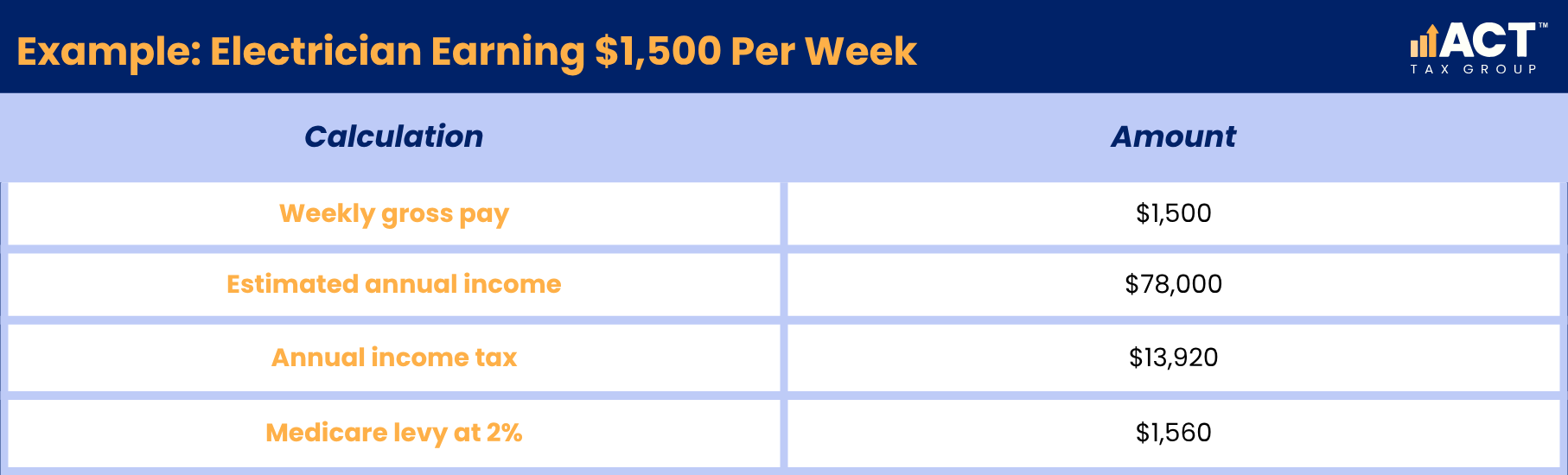
Employed electricians can estimate weekly tax by multiplying gross weekly wages by 52, calculating annual income tax, and dividing the estimated annual liability by 52. An income tax calculator can simplify this process and provide an indication of expected take-home pay. Employers generally deduct tax through Pay As You Go Withholding (PAYGW). Actual withholding may vary depending on tax-free threshold declarations, allowances, tax offsets, and individual circumstances.
The estimated weekly net pay is $1,202.31, assuming no other deductions or withholding adjustments. These figures are for illustrative purposes and do not represent an exact employer withholding calculation. Electricians can use the ATO tax withheld calculator to review withholding based on their circumstances and the calculator’s applicable financial year.
Estimating Weekly Tax for Self-Employed Electricians
Self-employed electricians generally pay income tax based on taxable business profits rather than total customer payments. Sole traders must consider allowable expenses, other taxable income, and applicable tax payments when estimating their weekly obligations. Electrical contractors often experience fluctuating revenue because of delayed invoices, changing projects, and equipment costs. Taxable income must reflect the applicable accounting method, as unpaid invoices may still count as income.
Managing Irregular Business Income
Contractors should review tax provisions whenever work volumes, project expenses, or customer payment patterns change. Money set aside for tax should also account for any instalments already paid to avoid overestimating the remaining liability.
Tax Deductions That Can Reduce an Electrician’s Taxable Income
Eligible work-related expenses can reduce taxable income when they meet the ATO‘s deduction requirements. Electricians may claim qualifying costs connected with earning income, although employee and business deduction rules can differ. Keeping accurate records helps distinguish deductible business expenses from private purchases. Some equipment costs may also require depreciation rather than an immediate deduction, depending on the applicable rules.

Record Keeping and Equipment Purchases
Electricians should retain invoices and receipts, record business use, and identify private expenses where relevant. Proper documentation supports accurate claims and reduces the risk of mistakes. Example: An electrician purchases a $2,200 testing instrument for business use. The deductible amount depends on its business use, GST treatment, and applicable asset deduction rules.
Medicare Levy and Other Payments Affecting Weekly Tax
The Medicare levy is generally 2% of taxable income, although reductions or exemptions may apply depending on individual circumstances. Some electricians may also pay the Medicare Levy Surcharge if their income for surcharge purposes exceeds the relevant threshold and they or their family lack appropriate private hospital cover. Other arrangements, including salary packaging, salary sacrifice, and study loan repayments, may affect tax calculations. Understanding these obligations helps electricians estimate their personal income tax responsibilities more accurately.

Additional Factors Affecting Tax Calculations
Medicare levy reductions or exemptions.
Medicare levy surcharge eligibility.
Available tax offsets.
Compulsory study loan repayments.
Salary sacrifice and certain fringe benefits.
Superannuation and Salary Arrangements
From 1 July 2026, employers generally calculate Superannuation Guarantee (SG) contributions at 12% of qualifying earnings under Payday Super. Contributions must reach employees’ super funds within seven business days of payday, unless an exception applies. Salary sacrifice contributions can affect your concessional contributions cap, while arrangements such as a novated lease may involve additional tax considerations. Seek professional advice before changing these arrangements.
Managing GST and Tax Payments for Electrical Contractors
Electrical contractors registered for Goods and Services Tax (GST) generally charge 10% GST on taxable services and may claim credits on eligible business purchases. GST is separate from income tax and should not be treated as business profit. Businesses generally must register for GST when their current or projected GST turnover reaches $75,000 over the relevant 12-month period, subject to registration rules. Contractors required to make Pay As You Go (PAYG) instalments may report and pay them through a Business Activity Statement (BAS) or Instalment Activity Statement (IAS), depending on their circumstances.
Power up your business with Accounting Built for Electricians
From start-up to expansion, our accounting team supports your tax, payroll, and cash flow at every stage of growth.
Example: Electrical Installation Invoice
An electrician issues a $5,500 invoice, including $500 GST, for a taxable electrical installation. The GST component must be accounted for separately, while eligible GST credits may reduce the net GST payment. Income tax provisions should reflect expected taxable business profits and PAYG instalments already paid. The ATO’s business information explains GST registration, BAS reporting, and payment obligations.
Practical Steps to Calculate Weekly Tax More Accurately
A regular weekly calculation helps electricians understand how much tax to allow for without relying on guesswork. This becomes particularly useful when overtime increases, business invoices remain unpaid, or operating expenses change. Rather than applying one fixed tax percentage to every payment, estimate annual taxable income and update your calculations as your financial situation changes.
Five Steps for Weekly Tax Planning
Calculate gross income: Record weekly wages or business earnings.
Review eligible deductions: Identify allowable work-related expenses and business costs.
Estimate annual taxable income: Consider expected earnings for the financial year.
Calculate tax obligations: Apply current rates and consider the Medicare levy and relevant adjustments.
Review existing payments: Account for tax already withheld or paid through instalments before setting aside further money.
Reviewing Weekly and Monthly Provisions
Electricians with irregular earnings can calculate a monthly amount based on expected annual liability and adjust it as income changes. As Tim Loh, then Assistant Commissioner at the ATO, explained in 2021 when discussing additional earnings, “Generally, when you provide your labour, skills or goods for a fee, you need to report this income in your tax return.”

How ACT Tax Group Can Help with Weekly Tax Estimates for Electricians
At ACT Tax Group, we understand the challenges electricians face when balancing weekly wages, changing contract income, equipment costs, and Australian income tax obligations. Our friendly, IPA-certified team provides practical accounting, taxation advice, and business support tailored to electricians and electrical contractors across the Australian Capital Territory (ACT).
We help you understand taxable income, review eligible deductions, estimate tax provisions, and manage PAYG responsibilities while considering your financial situation. Book a consultation with ACT Tax Group to discuss your weekly tax estimates and receive guidance suited to your employment or business circumstances.

Lukasz Klekowski
Principal of ACT Tax Group, specialising in tax compliance and financial strategy for Australian small businesses.

Disclaimer: All information provided in this publication is of a general nature only and is not personal financial or investment advice. It does not take into account your particular objectives and circumstances. No person should act on the basis of this information without first obtaining and following the advice of a suitably qualified professional. To the fullest extent permitted by law, no person involved in producing, distributing or providing the information in this publication (including ACT TAX GROUP PTY LTD, each of its directors, councilors, employees and contractors and the editors or authors of the information) will be liable in any way for any loss or damage suffered by any person through the use of or access to this information. The Copyright is owned exclusively by ACT TAX GROUP PTY LTD (ABN 31634338088)