

Essential Employer Responsibilities for Plumbers: Tax, Payroll, and Super Explained
Published on January 13, 2026
Essential Employer Responsibilities for Plumbers: Tax, Payroll, and Super Explained start with understanding that as a plumbing business owner in Australia, you have a primary duty to your employees to pay them correctly, look after their superannuation, and create a safe, workable system for day-to-day payroll and compliance. When these employer responsibilities are unclear or left until the last minute, it affects cash flow, increases stress, and can lead to ATO concerns that are much harder to fix later.
When A Busy Week Becomes a Compliance Problem
Imagine this real-world scenario. You have had a huge week of work: urgent hot water jobs, blocked drains, plus a couple of builder jobs that required extra equipment and longer hours. Payroll gets pushed back until late Sunday night, you rush through apprentice hours, miss a travel allowance, and forget to pay superannuation by the due date because a builder took longer than expected to pay your invoice. A few weeks later, you receive a message about late super or missing details in your payroll report, and suddenly the whole work environment feels a lot more stressful.
This is how many plumbing business owners find themselves overwhelmed. The problem is rarely intentional misconduct; it is usually a lack of clear procedures, training, and systems for handling employer responsibilities. When there is no simple way to record hours, check allowances, and ensure payments are made on time, it becomes easy to fall behind. The goal is to build familiar and practical processes so that tax, payroll, and super are handled as part of normal business, instead of a crisis.
Struggling to keep up with PAYG and payroll for your plumbing staff?
Schedule a complimentary consultation with us today to set up simple ATO-compliant PAYG and payroll systems.
Getting Payroll Right Without Losing Your Weekends
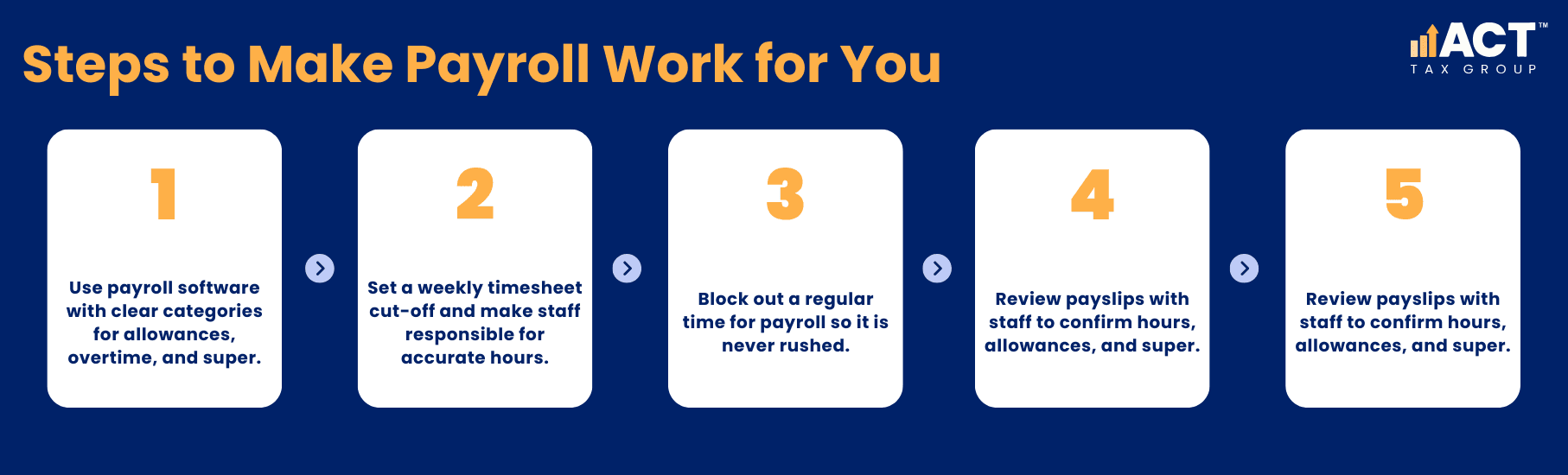
Payroll is often where things first show signs of strain. Once you hire workers and apprentices, you are no longer only responsible for getting the job done on site; you also have a duty to pay correctly, with the right tax withheld and the right information reported.
PAYG Withholding as an Essential Employer Responsibility
When you take on staff, you take on clear responsibilities as an employer to withhold tax from wages and pass that on to the ATO. This is part of your due diligence as a business owner and is required to help employees meet their own tax obligations. In practice, that means using payroll systems or tools that apply the right tax tables so staff are not under-withheld or over-withheld.
As part of this duty, your organisation needs to keep accurate records of wages and tax withheld so that you can report these through your Business Activity Statement and year-end processes. If these records are incomplete, missing, or out of date, it makes it hard to respond to questions from staff, your accountant, or the ATO. Good record-keeping is not just a paperwork exercise; it protects your business and supports your workers by showing exactly what has been paid on each job and each pay cycle.
Single Touch Payroll and Clear Information
Single Touch Payroll (STP) is a system that sends payroll information to the ATO each time you process a pay run. STP Phase 2, which has been mandatory since 1 January 2022, requires more detailed reporting including disaggregated allowances and income types. For a plumbing business, this can feel like another layer of admin at first, but it actually helps keep everything in one form and reduces the risk of errors. Instead of waiting until the end of the year to report wages and tax, you are sending the details as you go.
Using an STP-enabled payroll system means that wages, tax withheld, and superannuation are reported together, which makes it easier to find and fix mistakes early. For example, if an apprentice’s pay suddenly changes without a reason, it shows up quickly. This kind of system also helps staff, because they can see their information in real time through their own online accounts rather than waiting for paper summaries.

Apprentices, Allowances, And Real-World Payroll Complexity
Hiring apprentices and tradespeople is a big step for any plumbing business. It helps grow your organisation and share the workload, but it also increases the number of responsibilities you carry as an employer.
Why Apprentice Payroll Needs Extra Care
Apprentices often have different pay rates depending on how far along they are in their training, and plumbing award conditions can include overtime, weekend rates, and industry allowances. That is a lot to track when you are also quoting jobs, managing equipment, and dealing with customers. Without clear payroll procedures, it becomes easy to underpay allowances or forget to change rates when an apprentice moves to the next year.
This is not just a wage issue; it can become a workplace concern if staff feel their pay does not match what they expect. Being open, providing clear information on payslips, and checking rates regularly all help to maintain trust. It also shows your workers that you take your duty of care seriously, not just on the job site but in the way you handle their pay and entitlements.
Superannuation: Paying It Right And On Time
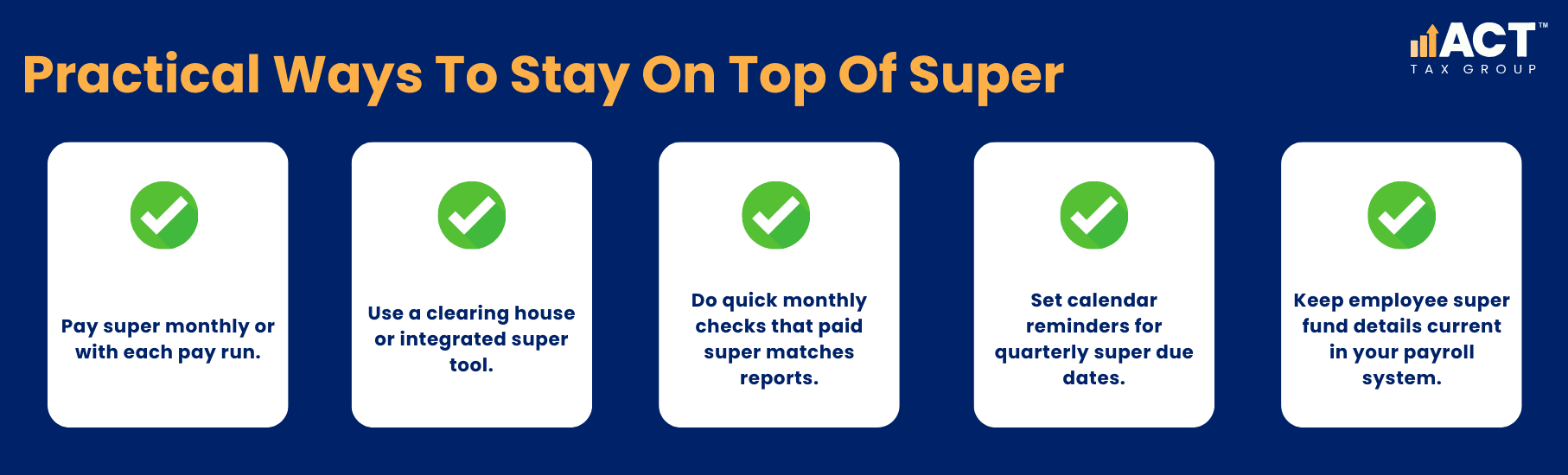
Superannuation is one of the essential employer responsibilities that causes the most stress for plumbers. Super bills often feel out of sync with incoming cash, especially when builders and real estate agents pay late, but the rules around paying super are firm and time-based.
Understanding Your Super Obligations As An Employer
As an employer in Australia, you are required to pay Super Guarantee on eligible employees’ ordinary time earnings at 12 percent, which has been the rate since 1 July 2025. This applies to apprentices and other staff once they meet the standard conditions for super, regardless of whether your business is having a busy or quiet month. Super is calculated on ordinary hours, not just on overtime, and it must be paid to the correct fund rather than kept in your business account.
Super currently has fixed quarterly due dates across the year, 28 October, 28 January, 28 April, and 28 July, and payments need to reach the funds by these dates to be counted as on time. However, from 1 July 2026, super will need to be paid at the same time as wages under new payday super rules. When super is paid late, you may have to complete extra forms and pay additional charges, which takes more time and money than simply paying on schedule. This is where planning becomes critical for a plumbing business that often deals with lumpy cash flow.
From 1 July 2026, new payday super rules will require employers to pay superannuation at the same time as wages, with contributions reaching employees’ funds within seven business days of payday, instead of the current quarterly system. Employers should start preparing their payroll systems now for this change. For the 2025–26 year, the maximum super contribution base is $62,500 per quarter, meaning the maximum Super Guarantee you are required to pay per employee is $7,500 per quarter.
Work Health, Safety, And Workplace Responsibilities For Plumbers
While tax and super are often front of mind, your responsibilities as an employer also extend to workplace health and safety. A plumbing business uses vehicles, heavy equipment, and sometimes machinery in tight or risky spaces, so the way you manage safety is just as important as the way you manage payroll.
Your Primary Duty of Care
As a business owner, you have a primary duty to provide a safe work environment for your workers, visitors, and anyone else who may be affected by the work you do. This includes both physical and mental health. For plumbers, that covers everything from using ladders and power tools correctly to managing long hours, hot roof work, and high-pressure schedules that can increase fatigue.
Meeting this duty means doing more than just having safety policies on paper. You are expected to show diligence by identifying risks, putting practical controls in place, and making sure staff understand and follow these controls. This might include basic procedures for working in confined spaces, handling hot water systems, or using new equipment. It also means making it clear how staff can report hazards, raise concerns, or ask questions without fear of blame.
Training, Procedures, and Everyday Safety Systems
Safety works best when it is part of the way your organisation runs every day, not just something raised in toolbox talks after an incident. Simple ways to improve work health and safety for plumbing staff include:
Providing regular, practical training on how to use new tools, machinery, and vehicles safely, and checking that staff are actually familiar with the instructions.
Keeping safety procedures short and clear so they are easy to follow on site: for example, steps for isolating a job, using protective gear, and packing equipment safely in the ute.
Encouraging staff to consult with you about safety concerns and supporting them when they stop work to prevent injury, rather than pushing them to rush and increase risks.
These actions help prevent injuries, protect your business reputation, and create a workplace where staff feel safe and supported. They also reduce downtime, costly incidents, and the emotional impact that accidents can have on the whole team.

Bringing It Together: Stronger Systems, Less Stress
When you look at all your responsibilities together: payroll, PAYG withholding, superannuation, and workplace health and safety, it can feel like a lot for a small business to carry. But these areas are closely linked. When your systems for pay, super, and safety are clear and consistent, you are better placed to respond to change, support your staff, and grow your business without burning out.
The aim is not to turn you into a full-time administrator, but to build simple, reliable procedures that protect your workers and your business. That includes clear payroll routines, regular super payments, straightforward safety policies, and training that fits the real jobs your team is doing. Over time, these systems help you meet your legal responsibilities, reduce your worry about missing something important, and free you up to focus on the jobs that bring in revenue.
If you feel like you are spending too much time reacting to problems which are fixing late super, redoing pays, or dealing with workplace incidents, it might be time to review your current payroll and safety systems. ACT Tax Group can help you review your employer responsibilities, set up practical processes for tax, payroll, and super, and give you the guidance you need to keep your business compliant and sustainable, all in plain language that makes sense for plumbing work.

Lukasz Klekowski
Principal of ACT Tax Group, specialising in tax compliance and financial strategy for Australian small businesses.

Disclaimer: All information provided in this publication is of a general nature only and is not personal financial or investment advice. It does not take into account your particular objectives and circumstances. No person should act on the basis of this information without first obtaining and following the advice of a suitably qualified professional. To the fullest extent permitted by law, no person involved in producing, distributing or providing the information in this publication (including ACT TAX GROUP PTY LTD, each of its directors, councilors, employees and contractors and the editors or authors of the information) will be liable in any way for any loss or damage suffered by any person through the use of or access to this information. The Copyright is owned exclusively by ACT TAX GROUP PTY LTD (ABN 31634338088)