

Employee or Contractor? Hiring Options for Australian Plumbers Explained
Published on December 22, 2025
Employee Or Contractor? Hiring Options for Australian Plumbers Explained is a decision that affects how you pay people, what obligations you take on, and how much risk sits on your shoulders as a plumbing business owner. Getting the employee vs contractor call wrong can mean surprise tax, super obligations, and Fair Work Act issues later, even if the person has an Australian Business Number and sends you invoices.
Missed Super and a “Contractor” Plumber
Picture this: you are slammed with hot water system callouts and bring in a proposed contractor to perform work on a specific task because you do not feel ready to hire employees. You agree an hourly pay rate, you set the work hours and jobs, and they wear your shirt and drive your ute while you focus on other industrial activities and promotional activity to grow the business.
A couple of financial years later, an ATO review letter raises questions about super obligations and whether this worker is an employee in practical reality, rather than an independent contractor. Suddenly, your work arrangements, contract terms, and full picture of the working relationship are under the microscope. You thought you had a contractor, but the law may see a worker is an employee in someone else’s business instead of truly running their own business.
Unsure if your “contractors” should be paid super?
Schedule a complimentary consultation with us today to check if super or PAYG obligations apply.
Why The Employee Vs Contractor Decision Matters
This decision is not just a box you tick once and forget. It changes what you must do under tax law, workplace law, and superannuation obligations. If the worker is an employee, you usually need to withhold tax from pay, make super contributions, cover workers compensation, and provide employee entitlements such as paid leave and annual leave. If the worker is a genuine contractor running their own business, they generally pay their own tax and cover their own costs. However, regarding super, the rules are stricter. Even genuine contractors may be entitled to super if they are sole traders paid mainly for their labour.
You might prefer contractors because it feels like a cleaner way to hire for a particular task or short burst of work. But Fair Work laws and Superannuation rules often look past what the contract is called to focus on the real substance and true nature of the working relationship. If the full picture shows that the person is working in your business, under your reasonable direction, with you bearing most of the financial risk, the relationship test may point towards employment.

How The Fair Work Act New Definition Works
From 26 August 2024, a new definition of employment applies under the Fair Work Act. Instead of only looking at the written contract, the new test considers the real substance, practical reality, and true nature of the relationship between the person paid and the employer. The Fair Work Commission can look at both the contract and how things operate on site to determine whether someone is an employee or an independent contractor.
Several factors are weighed up under this relationship test. These include who controls work hours, who provides tools and equipment, who the business bears financial risk, whether the person can work for multiple clients, and whether they can genuinely act like their own boss. If the worker mostly does employees’ work in someone else’s business, with little control over work arrangements and pay, the relationship test applies in favour of the worker being treated as an employee.
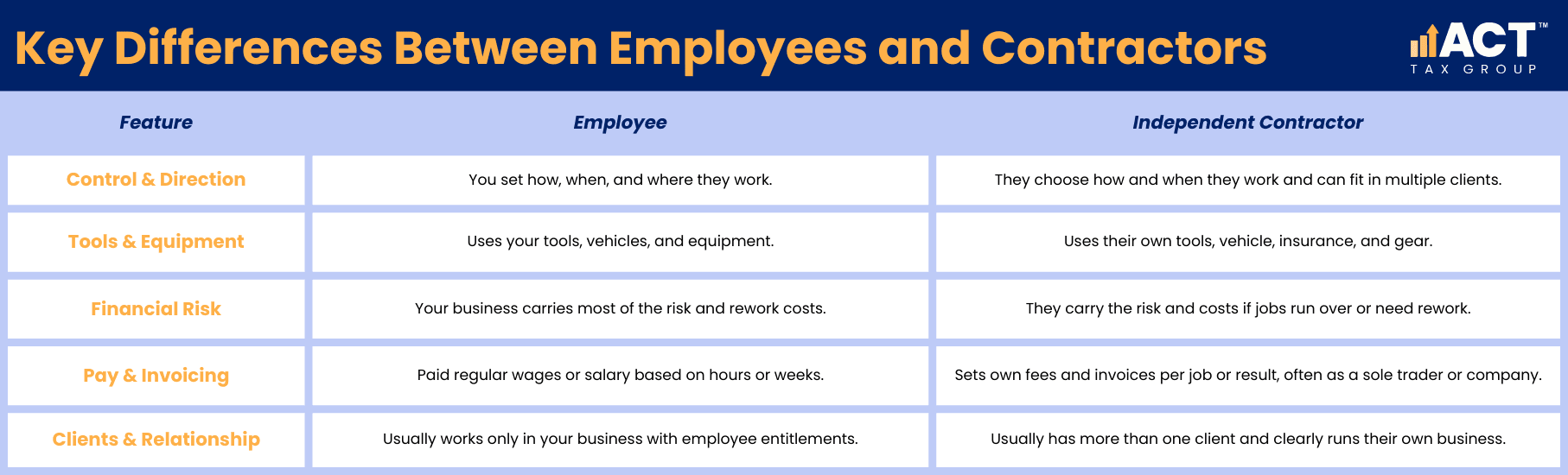
Key Differences Between Employees and Contractors
When you strip out labels and look at the day-to-day, there are some key differences that usually show whether a worker is an employee or an independent contractor. Thinking through these in your plumbing business helps you see whether your current work arrangements line up with how the law views the relationship.
Control, Hours, And Direction
If you can give reasonable direction about how, when, and where the worker must perform work, and you decide their work hours, they start to look more like an employee. They are slotting into your jobs and schedule, often with very little power to turn down work or rearrange their day.
A contractor generally has more say over when they provide services and how they complete a particular task. They may negotiate work hours to fit around multiple clients, rather than being tied to one employer. The more freedom the worker has to plan their time and methods, the stronger the case for them being a contractor rather than an employee.

Tools, Costs, And Financial Risk
Employees typically use the business’ tools, vehicles, and equipment, and the business bears most of the costs arising from the work. If something goes wrong, the business is usually responsible for fixing it and covering any loss. Employees rarely carry much financial risk themselves.
In contrast, a genuine contractor often supplies their own tools, vehicles, and insurance, charges their own fees, and carries more financial risk if a job runs over time or needs rework. They act like sole traders or run a company that can provide services to more than one client and deal with their own tax and super obligations, even if they are on hire through a labour hire agency.
Clients, Pay, And Business Structure
An employee generally works in one business, with pay based on hours, weeks, or a regular pattern. They receive wages or salary from that employer, and their workplace rights and employee entitlements flow from that single employment relationship.
A contractor usually has more than one client over time, even if they are working mainly for you at the moment. They invoice for a specific task or result, set their own fees, and may operate as sole traders with an Australian Business Number or through a company. They may also be engaged through labour hire or on hire arrangements when a labour hire agency supplies workers to your business. The more someone behaves like they run their own business, the more likely they are a contractor.
Super, Workers Compensation, And Other Obligations
If a worker is an employee, you are normally responsible for superannuation obligations, workers compensation cover, and other employee entitlements. That includes super contributions at the required rate, plus support if they suffer injury or illness in the course of employees’ work. Ignoring these obligations can lead to back payments, interest, and penalties.
If the worker is a contractor, the picture is more mixed. You are often still responsible for super obligations if the contractor is a sole trader engaging in labour-hire or is paid wholly or principally for their personal labour. In other cases, the contractor looks after their own super and workers compensation because they are clearly running their own business and bearing more risk. Understanding where your arrangements sit on this line is crucial before you hire or renew a contract.
Sham Contracting and Why It Is Risky
Sham contracting is when a business treats a worker as a contractor on paper when, in everyday terms, the worker is really an employee. This can happen if a business wants to avoid paying super, annual leave, and other employee entitlements, or just does not understand the law. The risk is that the worker later claims their legal rights and the business is found to have misrepresented the employment relationship.
Under workplace law, sham contracting can lead to orders to back-pay employee entitlements, make super contributions, and compensate for losses. There can also be penalties if the business is found to have taken adverse action against a worker for seeking their workplace rights. In a plumbing business, this might arise if someone called a contractor starts asking about super and annual leave and is then given less work or let go.
Labour Hire, On Hire, And Subbies in Plumbing
Many plumbing businesses use subbies through a labour hire agency or on hire arrangements to stay flexible on staffing. These setups can blur the line between who is the employer, who is responsible for super obligations, and who covers workers compensation. It is important to understand who is actually responsible under the contract and under law, not just who is issuing the invoices.
The fact that a worker comes through labour hire does not automatically remove your responsibility. The full picture of who controls the work, who pays the person, and which business bears the main risk will still guide how the relationship test applies. Where in doubt, it is safer to slow down and seek legal advice or professional advice before signing new on hire arrangements.
How To Review Your Current Work Arrangements
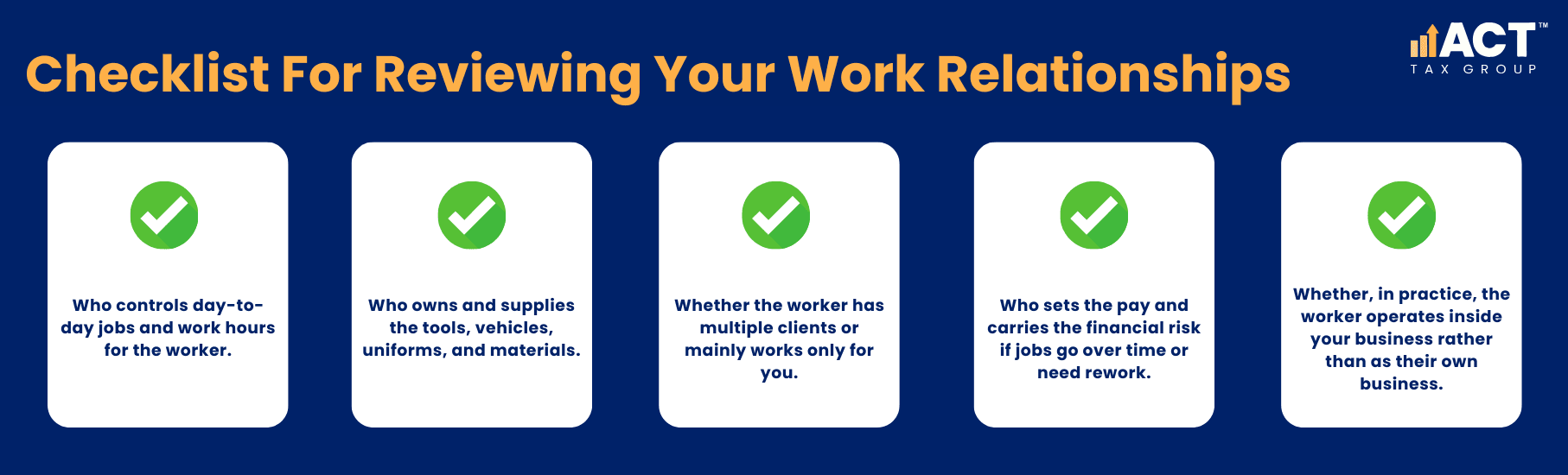
If you already have a mix of employees and contractors in your plumbing business, it can help to step back and review the full picture of each working relationship. Rather than rely only on what the contract says, look at what actually happens on site from day to day.
If the answers point strongly towards you controlling the work and the person mostly working in your business, the Fair Work Act’s “true nature” definition suggests they may be an employee, even if the contract calls them a contractor. That might be the moment to seek legal advice or talk to a trusted advisor so you can determine the right way forward before the Fair Work Commission or the ATO step in.
When To Get Professional Help
Sorting out employee vs contractor status is not just a paperwork exercise; it goes to the heart of how your plumbing business hires, manages risk, and stays on the right side of the law. Once you factor in tax, super, workers compensation, and workplace rights, the rules can be complex and small changes in how you engage people can change the outcome.
If you are unsure about your current mix of employees and contractors, or you are thinking about a new contractor relationship, it is usually better to seek legal advice or professional advice early. A review of your contracts and work arrangements against the law and the new definition in the Fair Work Act can reduce the chance of a worker later claiming they should have been treated as an employee.

Lukasz Klekowski
Principal of ACT Tax Group, specialising in tax compliance and financial strategy for Australian small businesses.

Disclaimer: All information provided in this publication is of a general nature only and is not personal financial or investment advice. It does not take into account your particular objectives and circumstances. No person should act on the basis of this information without first obtaining and following the advice of a suitably qualified professional. To the fullest extent permitted by law, no person involved in producing, distributing or providing the information in this publication (including ACT TAX GROUP PTY LTD, each of its directors, councilors, employees and contractors and the editors or authors of the information) will be liable in any way for any loss or damage suffered by any person through the use of or access to this information. The Copyright is owned exclusively by ACT TAX GROUP PTY LTD (ABN 31634338088)