

Australian Tax Rates 2025: What Plumbers Should Know About Income, GST, and PAYG
Published on October 28, 2025
If you’re a plumber in ACT, there’s a good chance you’ve wondered how the current tax rates will affect your pay. Take-home pay, business cash flow, and keeping up with the rules are constant concerns. This page covers what you need to know for the 2024-25 financial year, including income tax, GST, and PAYG, with clear examples and straightforward help for every plumbing business. The focus here is to keep things practical and relevant, so you can spend less time worrying about tax and more time on your work.
Understanding Income and Taxable Income
As an Australian resident running a plumbing business, the money you earn each year counts as assessable income. For tax purposes, it’s essential to know how much tax will be taken out of your business by understanding resident tax rates and how these apply to your taxable income.
Confused about when you need to register for GST?
Schedule a complimentary consultation with us today to clarify your GST obligations and set up your business properly.
Current Tax Rates
These tables and the rates come straight from the Australian Taxation Office (ATO), making it clear how your assessable income will be taxed by the end of the year. The higher your income, the more you’ll pay in each bracket, and the rates are designed so that each certain amount over a threshold faces a higher tax rate.In the 2024-25 financial year, here are the relevant tax brackets and how the tax is calculated:
Taxable Income | Tax Rate | Tax Payable on Income |
|---|---|---|
$0 – $18,200 | Nil | Nil |
$18,201 – $45,000 | 16% | 16c for every $1 over $18,200 |
$45,001 – $135,000 | 30% | $4,288 + 30c for every $1 over $45,000 |
$135,001 – $190,000 | 37% | $31,288 + 37c for every $1 over $135,000 |
$190,001 and above | 45% | $51,638 + 45c for every $1 over $190,000 |
Alongside income tax, there are a couple of other things plumbers need to keep in mind. Most taxpayers will pay a Medicare levy of 2% on their taxable income, while those with higher earnings may also pay a Medicare Levy Surcharge based on taxable income. Your total tax payable includes these in addition to the standard tax rate.
Making the Most of Deductions for Plumbers
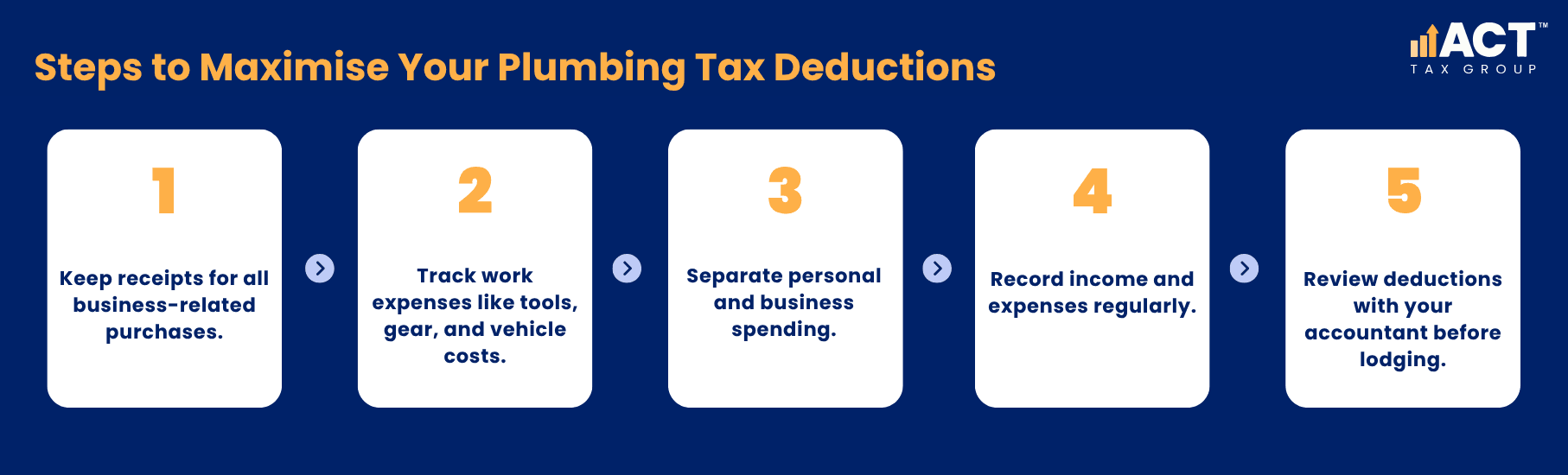
To reduce the amount of tax you pay, it’s essential to claim eligible expenses as tax deductions. For plumbers, this can include tools, equipment, safety gear, work vehicle expenses, and any work-related payments as shown on your records.
Make sure to keep receipts for money paid toward your business. You’re entitled to claim eligible business deductions, which are subtracted from your assessable income, helping reduce how much tax you pay at tax time. Regular, clear record keeping makes your tax return faster and helps you get the right refund or lower your tax bill for the year.
GST: When Plumbers Must Register and What Counts
Plumbing businesses must register for GST as soon as their aggregated turnover will reach $75,000 in a 12-month period. This includes all income, not just payments received for completed jobs. If you expect to pass the $75,000 mark—even if it’s not happened yet—you need to register within 21 days.
GST is charged at a rate of 10% on most goods and services, so you’ll need to add this to your invoices and collect it from customers. Once registered, it’s a requirement to stay registered for at least 12 months, even if business drops later in the year.
GST payments are reported on your Business Activity Statement (BAS), which you typically lodge quarterly or, for larger businesses, monthly. All GST collected from customers is included, while you can claim credits for GST you pay on business purchases. The ATO website provides detailed tables to help calculate what is payable.

PAYG Instalments: Helping Plumbers Stay Ahead
PAYG (Pay As You Go) instalments help plumbers and other small business owners spread their tax payments across the year, so there are fewer surprises when it’s time to lodge a tax return.
The ATO works out your PAYG instalments in one of two ways: you might be required to pay a set dollar figure every month or quarter based on your last tax return, or you could use a PAYG instalment rate and apply it to your actual income for each period, then pay that calculated amount when you lodge your BAS.
If your income jumps up or down during the financial year, you can either update your BAS or contact the ATO to adjust those instalments. That way, you’re only paying tax on what you actually earn, and you’re less likely to get a big bill at tax time. PAYG instalments kick in if you owe tax of more than a certain amount—often $4,000 on your previous return, though it’s best to check the latest on the ATO website.

Other Tax Points for Companies
If you run your plumbing business as a company, different tax rates apply depending on your total business income and setup. For example:
The lower company tax rate for “base rate entities” with aggregated turnover under a certain amount is 25%, which applies to most small businesses in the trade sector.
The full company tax rate for other companies is 30%.
Dividends paid by the company can bring additional personal tax considerations for owners, and it may affect how much you pay and claim at year end.
Businesses need to consider whether they’re entitled to use the lower company tax rate and how their company’s income will be assessed each financial year.
What Happens When You Get It Wrong?
Missing deadlines for BAS, not lodging PAYG instalment statements, or underpaying GST, can all lead to penalties. That’s why it’s helpful to stick to a routine—set a calendar reminder for monthly statements or quarterly BAS, use digital tools to store receipts as you make purchases, and review your records regularly.
ATO support and information are always available—check the ATO website for more help, updates on resident tax rates, deductible business expenses, and guidance on how your payments are calculated.

Conclusion
As an ACT plumber, setting aside a bit of time each month to learn the rules and stay organised can help you avoid excess stress, save money on your tax bill, and let you focus on your work instead of paperwork. If you’re an employer, understanding when to withhold the right amounts for your team is just as important as keeping up with current tax rates, GST rules, PAYG instalments, and company tax arrangements. These basics make your business run better when followed properly. If anything feels unclear, it’s smart to reach out and get easy-to-understand advice using verified information.

Lukasz Klekowski
Principal of ACT Tax Group, specialising in tax compliance and financial strategy for Australian small businesses.

Disclaimer: All information provided in this publication is of a general nature only and is not personal financial or investment advice. It does not take into account your particular objectives and circumstances. No person should act on the basis of this information without first obtaining and following the advice of a suitably qualified professional. To the fullest extent permitted by law, no person involved in producing, distributing or providing the information in this publication (including ACT TAX GROUP PTY LTD, each of its directors, councilors, employees and contractors and the editors or authors of the information) will be liable in any way for any loss or damage suffered by any person through the use of or access to this information. The Copyright is owned exclusively by ACT TAX GROUP PTY LTD (ABN 31634338088)