

Company vs Sole Trader: Choosing the Best Business Structure for Your Plumbing Business in Australia
Published on October 13, 2025
Company vs sole trader structures each offer distinct advantages for your plumbing business, but which one actually makes sense when you’re handling callouts, apprentices, and those ATO letters? One week you’re flat out with emergency hot water systems, the next it’s quiet – this feast-or-famine cycle makes choosing the right business structure crucial for protecting what you’ve worked so hard to build.
Understanding the Two Most Common Business Structures
Ever wonder why some plumbers operate under their own name while others have “Pty Ltd” after their business name? The choice between these business structures affects everything from how much tax you pay to whether your family home is at risk if something goes wrong. For plumbing businesses dealing with public liability, apprentice payroll complexity, and the constant stress of BAS lodgements, understanding these differences can save you thousands and plenty of sleepless nights.
Are BAS lodgements and ATO letters stressing you out?
Schedule a complimentary consultation with us today to simplify compliance and avoid costly penalties.
Sole Trader Business Structure: The Starting Point
As a sole trader, you and your business are essentially the same thing in the eyes of the law. You use your own name or register a business name, get an ABN, and you’re ready to start taking on jobs. There’s no separate legal entity – your business income becomes your personal income, and your business debts become your personal debts.
The simplest business structure appeals to many plumbers starting out because setup costs are minimal. You lodge a single tax return covering both personal and business income, and you’re personally liable for everything the business does. This unlimited liability means if your business can’t pay its debts or faces a lawsuit over property damage, creditors can pursue your personal assets including your family home.
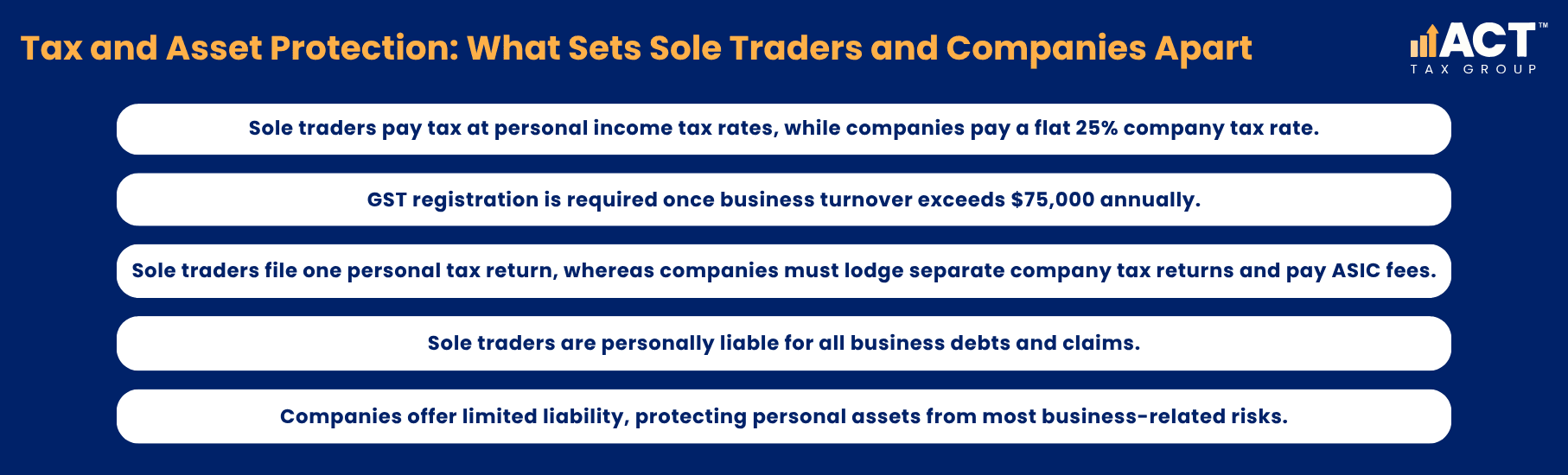
When you operate as a sole trader, you pay personal income tax rates on all the profits your plumbing business generates. For the 2024-25 financial year, you benefit from the tax-free threshold of $18,200, then pay progressive rates from 19% up to 45% plus Medicare levy on higher incomes.
Company Business Structure: The Separate Legal Entity
A proprietary limited company creates a separate legal entity that exists independently from you as the owner. The company owns the business assets, earns the business income, and is responsible for business debts. You become a director and shareholder of this legal structure, which provides limited liability protection for your personal assets.
Setting up a company involves higher setup costs through ASIC registration and ongoing compliance requirements including annual company tax returns, annual review fees, and maintaining proper corporate records. You’ll need at least one shareholder and one or more directors, though the same person can fill both roles.
Companies pay corporation tax at a flat rate rather than personal income tax rates. For eligible companies, the company tax rate is 25% on business profits, potentially providing significant tax savings compared to higher personal income tax rates that sole traders face.

Tax Implications
The tax burden difference between these structures becomes clearer when you look at real numbers from typical plumbing businesses. Understanding how each structure affects your bottom-line helps you make the right choice based on your actual income level.
Personal Income Tax Rates vs Company Tax Rate
As a sole trader, all business profits flow through to your personal tax return. If your plumbing business generates $80,000 in profit after expenses, you’ll pay personal income tax on this amount. The progressive tax system means you pay 19% on income between $18,201 and $45,000, then 32.5% on income from $45,001 to $120,000.
Company structures offer a different approach. That same $80,000 profit gets taxed at the company tax rate of 25%, resulting in $20,000 in tax. However, accessing this money personally involves additional steps – you need to pay yourself a salary or receive dividends, each with their own tax implications.
GST Registration and Business Bank Account Requirements
Both sole trader and company structures must register for GST once annual turnover reaches $75,000. This threshold applies to your total business income before expenses, and registration must occur within 21 days of reaching this amount.
You’ll need separate business bank accounts regardless of structure choice, though companies are legally required to maintain this separation while sole traders do it for practical record-keeping purposes. This separation makes tracking business income and expenses much clearer when preparing your annual company tax return or personal tax return.
Ongoing Costs and Compliance Burden
The administrative load differs significantly between structures. Sole traders handle their tax obligations through a single personal tax return that includes business income and deductions. Companies must lodge separate annual company tax returns, maintain minutes of meetings, and comply with various corporate governance requirements.
Annual review fees through ASIC add several hundred dollars yearly to company costs, while sole traders avoid these ongoing expenses. However, companies may access better financing options and appear more credible to larger commercial clients, potentially offsetting these additional costs through increased revenue opportunities.

Asset Protection
Personal asset protection represents one of the biggest differences between sole trader and company structures. Understanding how each structure affects your exposure to business risks helps you make an informed decision about protecting your family’s financial security.
Personal Assets and Business Liabilities
Operating as a sole trader means you’re personally responsible for all business debts and legal issues. If your plumbing work causes significant property damage and insurance doesn’t cover the full claim, creditors can pursue your personal assets including your family home, savings, and other investments.
This unlimited liability extends to all aspects of your business operations. Late payments to suppliers, ATO debts, employee entitlements, and public liability claims all become personal obligations that can affect your family’s financial security.
Limited Liability Protection Through Companies
Company structures provide limited liability protection by creating a separate legal entity that owns the business and assumes its debts. Your personal assets generally remain protected from business creditors, though this protection has important limitations.
Directors can still be personally liable for certain debts like unpaid superannuation, PAYG withholding, and GST obligations. Additionally, banks typically require personal guarantees from directors when providing business loans, which can reduce the practical benefits of limited liability protection.
The key advantage comes from protection against general business debts and most liability claims. If your company faces financial difficulties or legal action, your family home and personal savings typically remain safe from business creditors.
Making the Right Choice for Your Situation
Choosing between sole trader and company structures depends on your current circumstances and future plans. Consider where your plumbing business stands today and where you want it to be in the coming years.
When Sole Trader Makes Perfect Sense
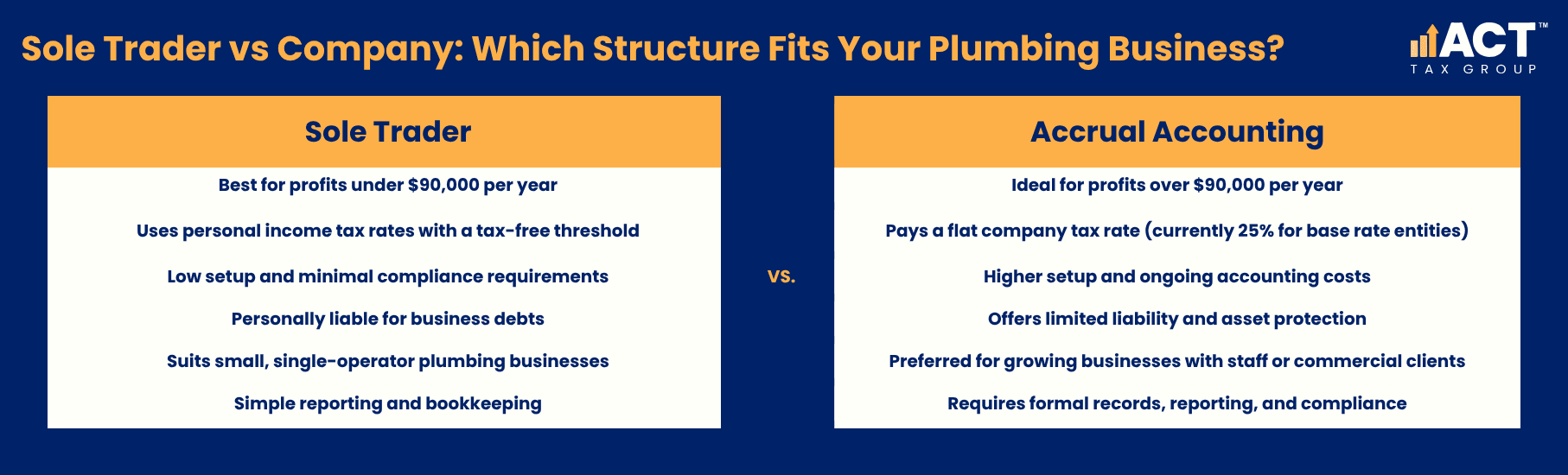
The sole trader structure works well for plumbing businesses in specific situations. If you’re generating less than $90,000 in annual profit, personal income tax rates often result in less tax than company structures, especially when you factor in the tax-free threshold.
Many successful plumbing businesses start as sole traders then transition to companies as they grow. This approach lets you establish your customer base and understand your profit patterns before taking on the additional compliance burden of more complex business structures.
Sole traders also make sense if you want to keep things simple and focus on plumbing work rather than administrative tasks. The straightforward reporting requirements and minimal setup costs appeal to operators who prefer hands-on work over paperwork.
When Company Structure Provides Better Value
Company structures become advantageous when your plumbing business consistently generates profits over $90,000 annually. The flat company tax rate provides significant savings compared to progressive personal income tax rates that can reach 45% plus Medicare levy.
Asset protection considerations also favor companies for plumbing businesses with substantial personal wealth to protect. If you own your family home outright or have significant savings, the limited liability protection justifies the additional compliance costs and complexity.
Companies also provide advantages for businesses planning to employ multiple staff or expand into commercial contracts. Many large builders and commercial clients prefer dealing with incorporated entities, and accessing business finance becomes easier with proper company structures and financial records.
Special Considerations for Plumbing Operations
The plumbing industry presents unique factors that influence your structure choice. Insurance requirements, apprentice payroll obligations, and vehicle deductions all play important roles in determining the best structure for your specific situation.
Professional indemnity and public liability insurance remain important regardless of structure choice, though companies may provide additional protection layers. Vehicle and equipment deductions represent significant tax benefits for plumbing businesses, and both structures can claim these deductions effectively.
Apprentice payroll adds complexity to business operations regardless of structure. Proper management of wages, superannuation, and allowances becomes critical to avoid Fair Work penalties, and companies may provide better systems for managing these obligations.
Transition Strategies and Professional Advice
Changing business structures involves costs and tax implications that require careful planning. Many plumbing businesses successfully transition from sole trader to company once profits consistently exceed certain thresholds.
The transition typically involves transferring business assets to the new company structure, which may trigger capital gains tax on assets that have appreciated since purchase. However, small business concessions may provide relief for eligible businesses.
Getting your business structure right from the start saves money and stress down the track. Whether you choose the simplest business structure or opt for more complex arrangements, the key is matching your choice to your current situation while keeping future growth plans in mind.

Lukasz Klekowski
Principal of ACT Tax Group, specialising in tax compliance and financial strategy for Australian small businesses.

Disclaimer: All information provided in this publication is of a general nature only and is not personal financial or investment advice. It does not take into account your particular objectives and circumstances. No person should act on the basis of this information without first obtaining and following the advice of a suitably qualified professional. To the fullest extent permitted by law, no person involved in producing, distributing or providing the information in this publication (including ACT TAX GROUP PTY LTD, each of its directors, councilors, employees and contractors and the editors or authors of the information) will be liable in any way for any loss or damage suffered by any person through the use of or access to this information. The Copyright is owned exclusively by ACT TAX GROUP PTY LTD (ABN 31634338088)