

Payroll, Super, and Leave: An Electrician’s Guide to Employer Responsibilities in Australia
Share this article
Published on February 26, 2026
Payroll, super, and leave: an electrician’s guide to employer responsibilities in Australia explains the employer obligations you must meet when you hire employees or engage an independent contractor in your electrical business. As an employer and business owner, you are responsible for correct pay, superannuation, and leave entitlements under Australian law. These employer responsibilities apply whether you operate a small business with fewer employees or manage a growing organisation.
How Can Electricians Comply with Payroll, Super Guarantee, and Leave Employer Obligations?
Electricians comply with employer obligations by setting up clear payroll procedures, using compliant software, and exercising due diligence over pay, superannuation, and leave entitlements. A reliable system ensures PAYG Withholding (PAYGW) amounts, super guarantee contributions, and wages are calculated correctly each pay cycle.
As an employer, you must determine correct award rates, allowances, and overtime before completing payroll. Regular reviews help you identify concerns early and raise any issues before they affect other employees or lead to penalties.
When you engage workers, you must assess whether they are an employee or an independent contractor. Fair Work’s contractor/employee definitions changed from 26 August 2024 (Closing Loopholes reforms), and different tests can apply in different legal contexts (for example, Fair Work’s definition does not determine tax and superannuation status). The classification affects tax, superannuation, insurance, and leave entitlements. Getting this wrong can expose your business to unlawful underpayments and compliance action.
Unsure if you’re paying the right Award rates and allowances?
Schedule a complimentary consultation with us today to review wages, penalties, and allowances against Fair Work rules.
What Does Payroll Compliance Mean for an Electrical Business Owner?
Payroll compliance means you pay employees correctly, withhold the right amount of tax, and report through STP each time you process wages. It also means meeting Fair Work record-keeping and payslip rules, such as issuing payslips within one working day of payday and keeping time-and-wages records for 7 years.
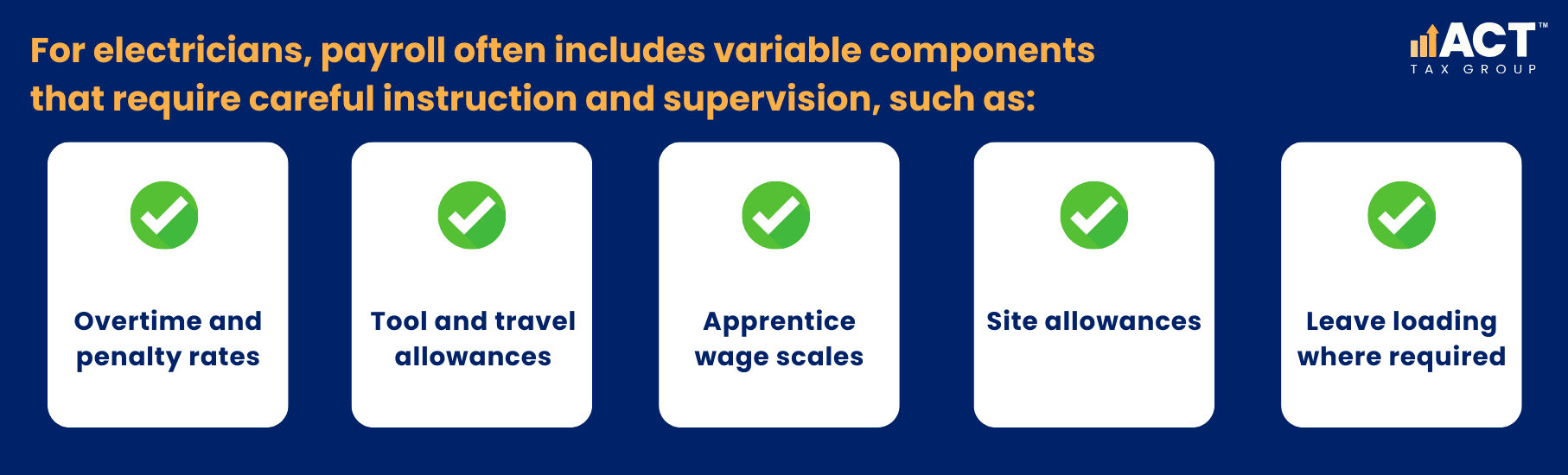
A small business with fewer employees may assume payroll is simple. However, even one incorrect calculation can affect entitlements and expose the employer to penalties. Just as common tax deduction mistakes can trigger ATO scrutiny, payroll errors can quickly escalate; for example, if overtime is not calculated correctly over several months, back payments may be required on behalf of affected workers.
As a responsible employer, you must also provide information to employees about their pay, superannuation fund, and leave balances. Clear communication builds trust and reduces disputes within the workplace.
How Does Super Guarantee Apply to Electricians and their Workers?
Super guarantee requires employers to contribute super for eligible workers, generally calculated on ordinary time earnings (OTE). Until 30 June 2026, contributions must be received by the employee’s super fund by the quarterly due dates. From 1 July 2026 (Payday Super), super will generally need to be paid on payday and received by the fund within 7 business days.
Superannuation is not optional, and paying it late creates financial and administrative consequences for your business. If you don’t pay the right amount of SG on time and to the right fund, you may need to lodge a Super Guarantee Charge (SGC) statement and pay the SGC. The SGC is not tax-deductible and includes extra costs such as nominal interest and an administration fee.
Key super guarantee responsibilities include:
Determining whether workers are eligible for superannuation (including some contractors engaged mainly for their labour).
Calculating contributions correctly on wages
Making payments to the employee’s chosen fund or (where required) their stapled fund, on time.
Keeping records of contributions made on behalf of employees
For example, an electrician who engages a contractor without reviewing the agreement may later discover the worker is eligible for superannuation under super guarantee rules. Without proper due diligence, this can result in unexpected liabilities and added pressure on cash flow.
Superannuation is a core part of your employer responsibilities and forms part of the broader tax and compliance system that applies to every electrical undertaking.
What Leave Entitlements Must Employers Provide in the Workplace?
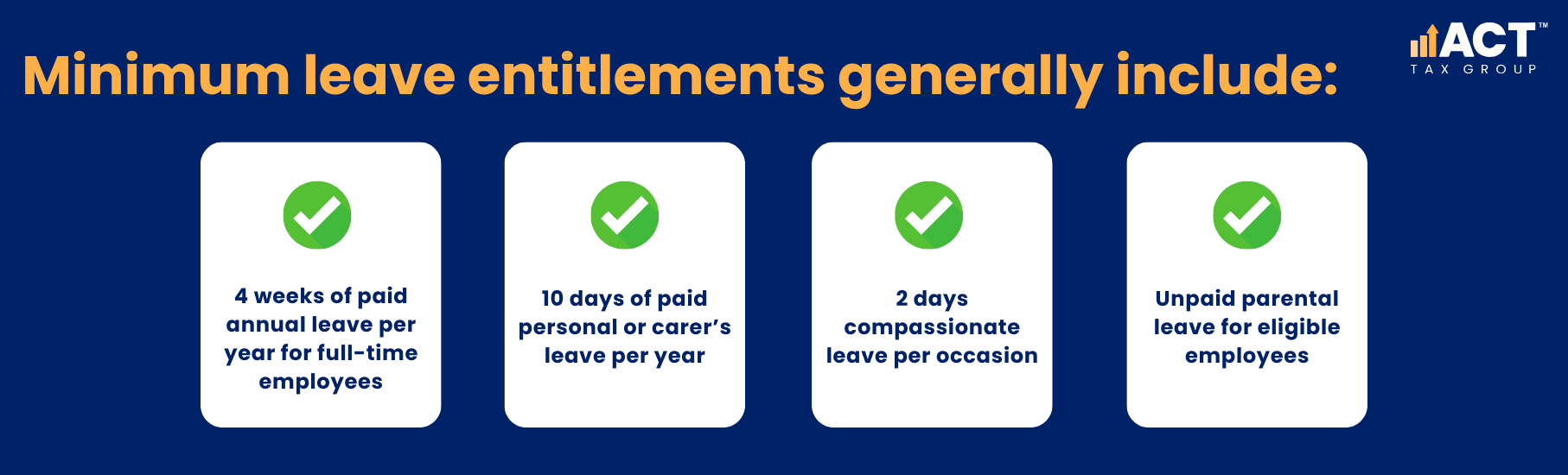
Under the National Employment Standards, employees are entitled to minimum leave entitlements, including annual leave, personal leave, compassionate leave, and parental leave. As an employer, you are responsible for tracking these entitlements accurately and ensuring payments are made when leave is taken.
Leave is more than an administrative formality. It supports employee health, work health balance, and workplace wellbeing. A safe and supportive work environment includes not only physical safety and proper equipment, but also fair access to leave and lawful treatment free from discrimination.
If you do not maintain accurate leave records, the financial impact can build over time. For example, a business owner who fails to track accrued leave may face large lump-sum payments when an employee resigns.
How Does STP Change Payroll Responsibilities for Electricians?
Single Touch Payroll (STP) requires employers to report payroll information to the ATO each pay event, including year-to-date salary and wages, allowances (where relevant), deductions, and PAYG withholding. STP reporting can also include year-to-date superannuation liability/OTE, with additional reporting changes expected from 1 July 2026 under Payday Super. This real-time reporting forms part of your ongoing employer obligations.
STP increases transparency and requires greater diligence in each payroll process. Every pay event must reflect correct wages, allowances, and employment details, including when employees start or finish a job.
To comply with STP, you must:
Use STP-enabled payroll software
Lodge pay event reports on time
Finalise STP income statements by lodging a finalisation declaration by 14 July each year (unless a different deadline applies to certain closely held payees).
Ensure allowances and income types are categorised correctly
If errors occur, you must correct them promptly. Ignoring mistakes may raise compliance concerns and increase the risk of review.

Why Workplace Health, Safety, and Payroll Responsibilities Go Hand-in-Hand
As an employer, your primary duty under work health and safety law is to ensure, so far as reasonably practicable, the health and safety of workers and visitors in your workplace. This includes providing safe machinery, proper training, clear instruction, and appropriate supervision.
While workplace health and payroll may seem separate, they are both core employer responsibilities. A compliant work environment requires safe systems of work and fair pay practices. Workers who feel secure in their wages and entitlements are more likely to raise concerns early and contribute positively to the organisation.
For example, an electrical business that invests in safety training, clear procedures, and compliant payroll systems builds trust with employees and customers. This reduces risks, supports staff retention, and strengthens the overall business.
Power up your business with Accounting Built for Electricians
From start-up to expansion, our accounting team supports your tax, payroll, and cash flow at every stage of growth.
Get Support to Manage Payroll, Super Guarantee, and Leave Obligations
Managing payroll, superannuation, and leave while also overseeing safety, customers, and daily operations can stretch any business owner. We understand that electricians often carry multiple responsibilities, from hiring and supervision to completing complex projects safely and on time.
Our team assists electrical businesses with setting up compliant payroll systems, reviewing super guarantee obligations, and ensuring leave entitlements are tracked correctly. We provide information in clear, practical terms so you can understand your responsibilities and exercise due diligence with confidence.
If you would like further information or want to review your current system, we invite you to consult with us. Together, we can propose practical solutions that support compliance, reduce risks, and give you peace of mind.

Strengthening Your Electrical Business Through Compliance and Diligence
Payroll, super guarantee, and leave are essential employer responsibilities that sit alongside workplace health and safety duties. When you comply with tax, superannuation, and employment law, you protect your business from penalties and unlawful disputes.
By exercising due diligence, maintaining accurate procedures, and ensuring correct payments on behalf of your employees, you create a stable foundation for growth. Strong systems allow you to focus on delivering quality electrical services, supporting your workers, and building a resilient, compliant business for the future.

Lukasz Klekowski
Principal of ACT Tax Group, specialising in tax compliance and financial strategy for Australian small businesses.

Share this article
Disclaimer: All information provided in this publication is of a general nature only and is not personal financial or investment advice. It does not take into account your particular objectives and circumstances. No person should act on the basis of this information without first obtaining and following the advice of a suitably qualified professional. To the fullest extent permitted by law, no person involved in producing, distributing or providing the information in this publication (including ACT TAX GROUP PTY LTD, each of its directors, councilors, employees and contractors and the editors or authors of the information) will be liable in any way for any loss or damage suffered by any person through the use of or access to this information. The Copyright is owned exclusively by ACT TAX GROUP PTY LTD (ABN 31634338088)