

Discretionary Trusts for Electricians: Tax, Asset Protection, and Bookkeeping Implications
Share this article
Published on February 3, 2026
If you are an electrician in the ACT, Discretionary Trusts for Electricians: Tax, Asset Protection, And Bookkeeping Implications can sound like something only big family businesses worry about, but the right setup can help protect personal assets, manage tax obligations, and support business growth. When your business assets, vehicles, and gear are all on the line, it is worth understanding how a discretionary trust structure can support your financial security and reduce business risks over the long term.
What a Discretionary Trust Really Means for Electricians
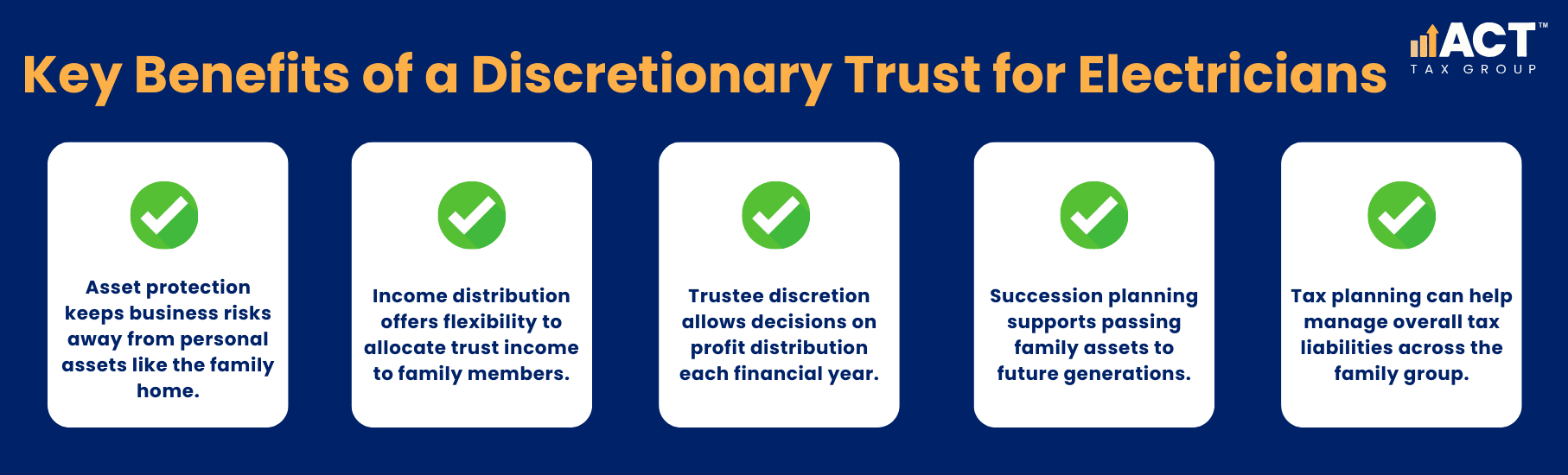
For most electricians, a discretionary trust (often called a family trust) is a legal relationship where a trustee company or individual manages assets and trading activities for the benefit of a group of family members or other eligible beneficiaries. Instead of people holding fixed entitlements like shares, the trustee decides each year how to distribute trust income and capital gains within the trust’s rules, which are set out in the trust deed.
In practice, many electrical businesses operate as a discretionary trading trust with a corporate trustee. In that setup, the discretionary trading trust holds the business assets, such as tools, plant, and sometimes vehicles, while the trustee company signs contracts, runs the trading activities, and manages assets as the legal owner on behalf of the trust. The trust property can also include cash in a dedicated bank account, amounts owed by customers, and other assets held for the benefit of family members and the wider group of eligible beneficiaries.
Struggling to work out if a family trust is right for your electrical business?
Schedule a complimentary consultation with us today to assess tax, asset protection, and ATO implications for your trust setup.
How Trust Income and Tax Work over the Financial Year
From an income tax point of view, a family trust is usually treated as a separate legal entity, but in many situations, it does not pay tax itself. Instead, it calculates net income from its trading activities and investment activities over the financial year and then distributes that net income to beneficiaries. Those beneficiaries then pay tax on their share of the trust income distributions in their own tax returns, based on their own tax rates.
This means that each year, the trustee decides how to allocate income and, in some cases, capital gains, and must record these decisions clearly. If the trustee does not properly distribute trust income or leaves undistributed income without following the trust’s rules, the trustee will be taxed on that income at the highest marginal rate of 47 percent. Because income distribution and profit distribution decisions affect how much tax each person will pay, they need to be checked against the trust deed, the ongoing compliance requirements, and each beneficiary’s personal circumstances.
Why Electricians Consider a Discretionary Trading Trust
Many electricians start as sole traders and only think about a discretionary trust once the business begins to generate income consistently, hires employees, or signs larger contracts. At that stage, the business owner often worries more about legal action, financial loss, and how to protect personal assets such as the family home. They may also be thinking about long-term succession planning and how to keep family assets available for future generations.
A discretionary trust structure, such as the “ABC Family Trust” style arrangement you often hear about, can offer several potential benefits for an electrical business. These include asset protection, flexibility in how income distribution works within the family, and support for longer-term tax planning and succession planning. However, a discretionary trust is not a simple tax savings tool or a quick fix; it is a full legal structure that needs to be set up and managed carefully to work as intended.

Asset Protection: Separating Business and Personal Assets
One major reason electricians look at a discretionary trust is asset protection. When business assets such as tools, plant, vehicles, and goodwill sit inside a discretionary trading trust and not directly in your personal name, it can help protect personal assets if something goes wrong in the business. If legal action is taken against the business, the aim is that trust assets are at risk, not the family home or personal savings, provided guarantees and other agreements are managed carefully.
That said, a discretionary trust structure is not a magic shield. Banks may still ask company directors or business owners for personal guarantees, which can expose family assets even when a trust is in place. If personal and business spending are mixed in the same bank account or the trust is not run according to its trust deed, the protection can also be weakened. Asset protection only works when the trust structure is supported by good records, clear contracts, and proper separation between business property and private spending.

Tax Flexibility without Overcomplicating Things
Another reason electricians look at a discretionary trading trust is the tax flexibility it can offer. Because there are no fixed entitlements like there are in a unit trust or company structure, the trustee can distribute trust income and capital gains each year to different family members or other eligible beneficiaries. This allows income to be allocated to people on lower marginal tax rates where appropriate, which can help manage the overall tax liabilities across the family.
However, the goal should not simply be tax savings. The way you distribute trust income and distribute trust income distributions must still reflect who is genuinely involved, what work they do, and how profits are shared in a fair and commercial way. If the trustee’s discretion is used purely to shift income to people who do not contribute to the business, this can cause problems and may lead to unexpected tax outcomes. This is another area where it is important to seek professional advice before locking in any distribution strategy.
Bookkeeping Implications of Running Through a Trust
Once you move into a discretionary trust structure, your bookkeeping and record-keeping become even more important. The trust needs clear records to show how much net income it has made in a financial year, how that income distribution has been decided, and how much each beneficiary should include in their own income tax return. Clean records also help to show that the trust is a real business structure, not just a name on paper.
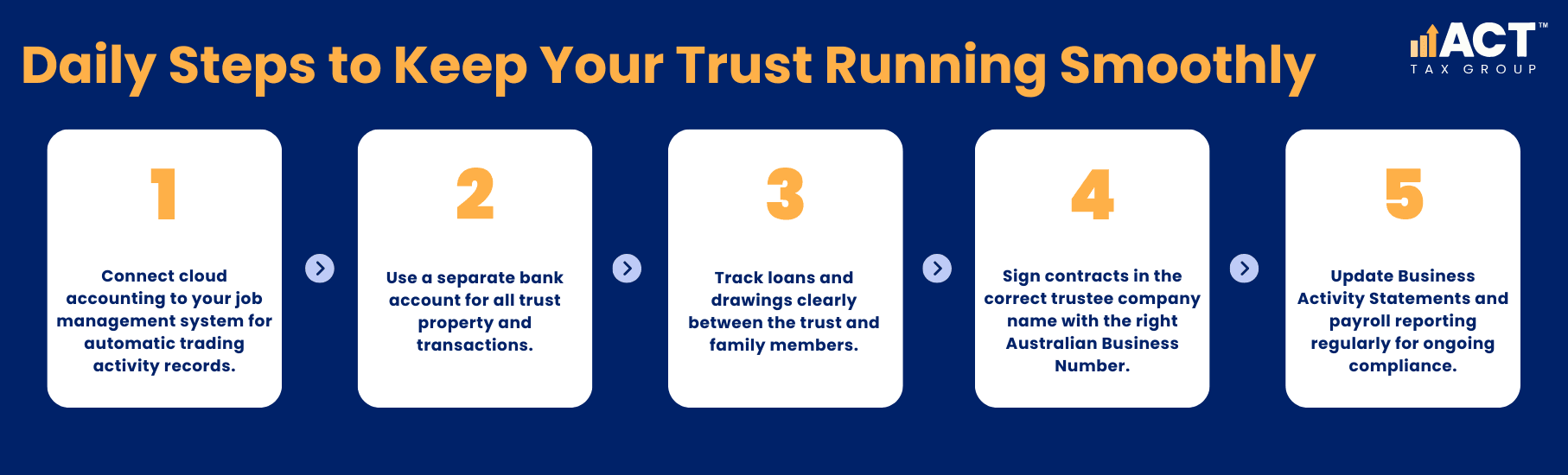
Good bookkeeping for a trading trust should support accurate profit reporting, proper tracking of loans and drawings, and clear separation of trust assets from personal assets. This means the family trust should have its own bank account for trading activities, with all sales, expenses, wages, and other transactions flowing through that account. Personal expenses should not be paid from the trust’s bank account, and if they are, they need to be recorded correctly and adjusted so that the accounts match the legal agreement and the trust deed.
Power up your business with Accounting Built for Electricians
From start-up to expansion, our accounting team supports your tax, payroll, and cash flow at every stage of growth.
Practical Systems That Make a Trust Work Day-To-Day
For a busy electrician, the trust structure must work in the background without causing more stress. A practical setup often includes cloud accounting software connected to your invoicing and job management system so that trading activities are recorded automatically. This helps to keep track of trust property, such as money owed by customers, assets held, and any loans between the trust and family members.
In a discretionary trading trust with a corporate trustee, you also need to keep a clear line between what belongs to the trustee company as the legal owner and what belongs to the trust. Company directors should ensure that contracts are signed in the right name, that the Australian Business Number is used correctly, and that ongoing compliance such as Business Activity Statements and payroll reporting is kept up to date. This approach reduces the risk of financial loss from simple paperwork mistakes and supports a smoother year-end process when distributions are decided.
How a Discretionary Trust Fits into Your Overall Business Structure
For many electricians, a discretionary trading trust with a corporate trustee becomes the core business structure once the business reaches a certain size. In this setup, the trading trust generates income from electrical work, holds the main business assets, and the trustee company signs contracts and manages assets on the trust’s behalf. The business owner may be both a director of the trustee company and a beneficiary of the family trust.
This arrangement can provide limited liability at the company level and flexibility at the trust level, but it also means more moving parts to manage. There may be separate bank accounts for the trust and for the trustee company, clear loan accounts between the trust and family members, and annual resolutions about how to distribute income and deal with any undistributed income. Changing into this structure can trigger capital gains tax and stamp duty costs, so these need to be considered upfront.
Planning For the Long Term with Your Trust
It is also important to understand what happens if a key person dies or becomes unable to work. A well-drafted trust deed will usually set out what happens to trust property on a deceased estate event, including who steps in as trustee, how unit holdings (if any) are treated, and how control passes to the next generation. Thinking about this upfront can support a smoother transition and help protect family assets if something unexpected happens.
When To Seek Professional Advice and What to Ask
Given the number of choices involved in setting up and running a discretionary trust, it is essential to seek professional advice before making changes to your structure. This includes decisions about moving from a sole trader or simple company structure into a family trust, introducing a trustee company, or changing how you distribute income to family members. A trusted adviser can help you weigh tax benefits, asset protection goals, and practical realities like admin capacity and cash flow.
A discretionary trust structure can offer real potential benefits for electricians, but only when it is matched with good records, clear processes, and regular professional advice that takes your personal circumstances into account. Used well, it can help protect personal assets, support more flexible tax planning, and give your family business a stronger foundation for the next stage of growth.

Lukasz Klekowski
Principal of ACT Tax Group, specialising in tax compliance and financial strategy for Australian small businesses.

Share this article
Disclaimer: All information provided in this publication is of a general nature only and is not personal financial or investment advice. It does not take into account your particular objectives and circumstances. No person should act on the basis of this information without first obtaining and following the advice of a suitably qualified professional. To the fullest extent permitted by law, no person involved in producing, distributing or providing the information in this publication (including ACT TAX GROUP PTY LTD, each of its directors, councilors, employees and contractors and the editors or authors of the information) will be liable in any way for any loss or damage suffered by any person through the use of or access to this information. The Copyright is owned exclusively by ACT TAX GROUP PTY LTD (ABN 31634338088)