

What Is a Director ID and Why Is It Required in Australia?
Published on December 2, 2025
A Director Identification Number (director ID) is a unique 15-digit identification number you apply for once and keep for life, regardless of how many companies you direct or change companies across Australia. This identification number is now a legal requirement for company directors in Australia, with regulators actively enforcing compliance.
The director ID system helps prevent fraudulent director identities and illegal phoenix schemes, where companies deliberately shut down to avoid paying creditors or the Australian Taxation Office (ATO). By creating a verified identity system, regulators can trace directors’ relationships across multiple entities and identify patterns of misconduct. For small to medium-sized businesses and family companies, understanding your director ID obligations protects your business reputation and personal interests.
What Is a Director Identification Number in Simple Terms?
A director ID is a permanent government-issued identification number ensuring each own director has one verified identity across all directorships. You apply once through the Australian Business Registry Services (ABRS), and that identification number follows you throughout your career.
The ABRS manages the director ID system and holds all director details securely, separate from your company’s Australian Securities and Investments Commission (ASIC) record. Your director ID is not publicly searchable and does not appear on the ASIC register. Once issued, your director ID remains valid for life.
Unsure if your director ID set-up is fully compliant?
Schedule a complimentary consultation with us today to confirm your director IDs meet ABRS and ATO rules.
Why Is a Director ID Required in Australia?
The director ID requirement prevents people hiding behind false identities when acting as a director. By creating a verified identity system, regulators can trace directors’ relationships across multiple companies and identify those involved in compliance failures.
A key goal is stopping illegal phoenix activity, where companies deliberately close to avoid paying employees or creditors, then restart under new entities with the same controllers. Strengthening director identification protects honest businesses, employees, and creditors from these schemes.
Who Needs to Apply for a Director ID?
You must have a director ID if you are a company director or own director of an Australian registered company, registered Australian body, or registered foreign company operating in Australia. Directors of Aboriginal and Torres Strait Islander corporations also need to apply.
If you’re a director of a corporate trustee, such as a company acting as trustee for a Self-Managed Superannuation Fund (SMSF), you’re required to hold a director ID. Sole traders and partners do not need a director ID unless also directing a registered company.

When Do You Need to Apply?
New company directors must apply for a director ID before appointment, rather than after taking the role. If you’re already a director without a director ID, you are in breach of your regulatory obligations. Apply immediately to avoid enforcement action, as ASIC has been actively pursuing non-compliant directors since the transition period ended.
Original transitional deadlines have passed, and any person currently acting as a company director should already hold a valid identification number. If considering a new directorship, applying in advance ensures you’re ready without delays.
How Do You Apply for Your Director ID?
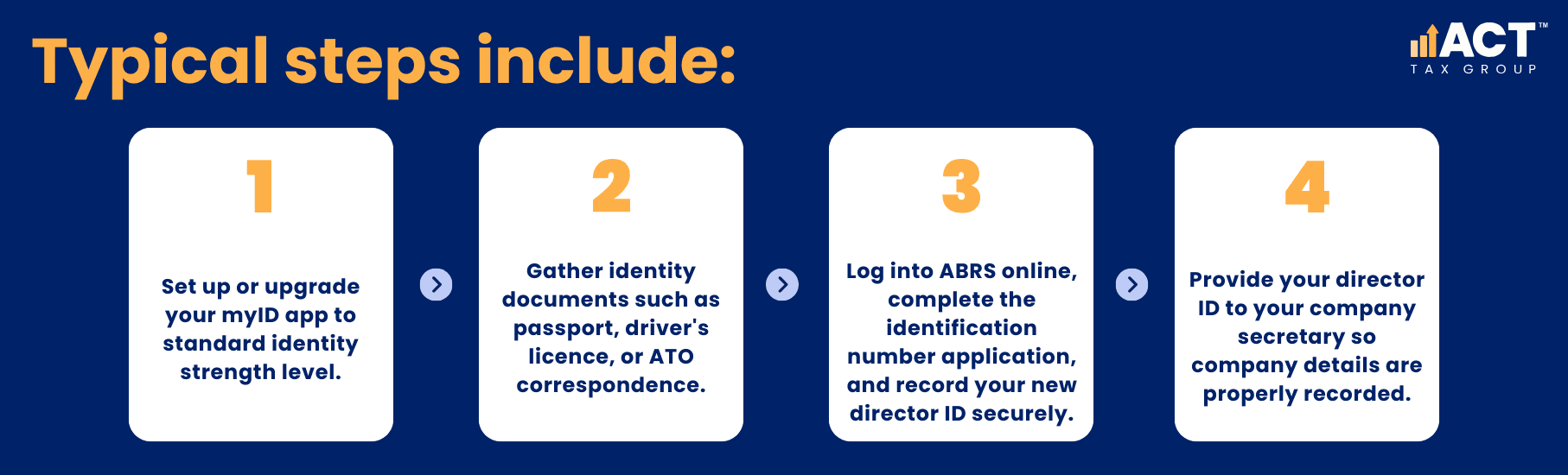
The fastest way is online through ABRS using a Digital ID such as myID app with standard identity strength. Log in, verify your details against ATO records, and your director ID is usually issued instantly if verification succeeds.
If you cannot apply online due to accessibility issues, ABRS accepts phone and paper application forms, though these take longer and require certified copies of identity documents. You must complete the application yourself, your accountant or lawyer cannot apply on your behalf, though they can guide you.
If you’re an overseas director, you can apply online provided you can verify your identity through myID.
What Happens If You Don’t Have a Director ID?
Failing to apply when required is a criminal offence. Regulators have commenced enforcement action, with courts imposing substantial fines against directors who ignored the requirement. Failing to apply when required is a criminal offence. The maximum penalty for individuals is 60 penalty units, which currently equals approximately $13,200–$14,000. However, civil penalties for serious offences such as intentionally applying for multiple director IDs or providing false identity information can reach up to $1.1 million, and potential imprisonment may also apply.
Beyond formal penalties, reputational damage of non-compliance affects your ability to access finance, insurance, and future board opportunities. Your name may be recorded in ASIC enforcement notices, damaging your professional standing permanently.
How Does Director ID Affect Small Business and Family Companies?
For many SMEs and family-owned businesses, the director ID requirement adds one important step to your governance process but is a one-time application. Once each own director holds their identification number, it becomes part of your standard governance toolkit.
The system encourages better internal processes, such as keeping secure records of each director’s identification details and ensuring your company secretary knows where to access this information. For growing businesses, taking director ID seriously signals to lenders that you operate with integrity.

How Can an Adviser Help with Your Director ID?
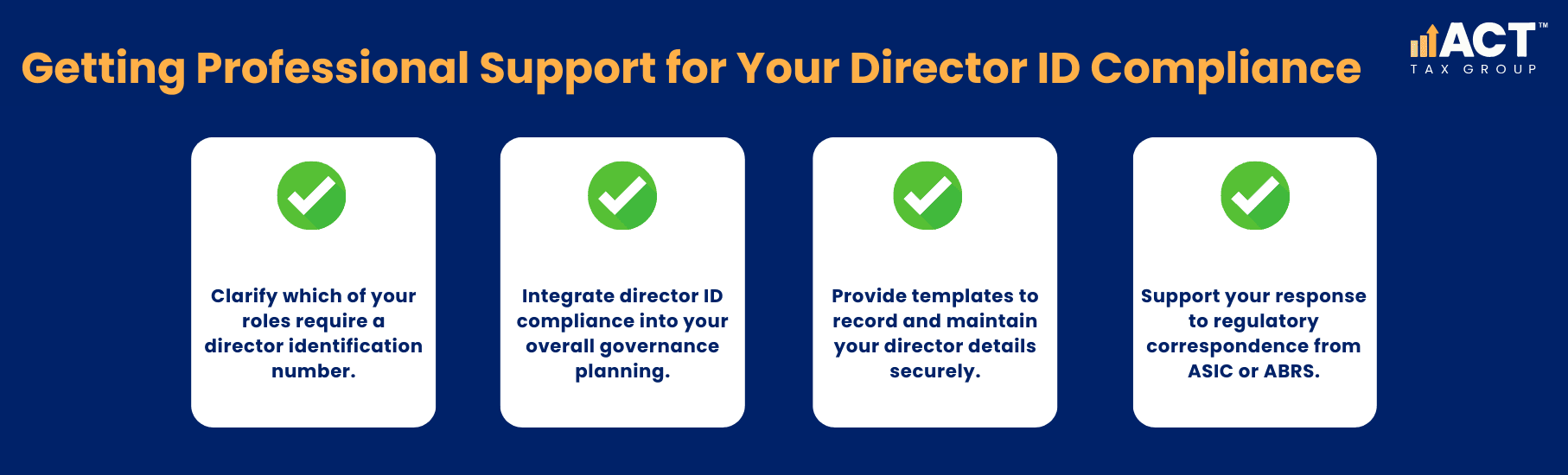
A trusted adviser can make the process straightforward by stepping you through requirements and integrating your director ID obligations into your broader business structure and compliance planning. This is valuable if you hold more than one director appointment or operate family groups with several companies.
A proactive accountant helps you avoid compliance risks by confirming which roles require a director ID, creating a compliance checklist, and supporting you if you need to contact ABRS for clarification or to verify any documentation.
Conclusion
If you’re already a company director or planning to become one, treat your director ID as a non-negotiable governance responsibility. Confirm that every own director in your group holds a valid identification number and that director ID checks are built into your appointment process.
Your next steps should be to confirm your current directorships, apply online through ABRS if you haven’t already, and speak with a professional adviser if anything is unclear. Staying on top of your director ID obligations is a straightforward way to reduce regulatory risk and demonstrate that your business takes governance seriously.

Lukasz Klekowski
Principal of ACT Tax Group, specialising in tax compliance and financial strategy for Australian small businesses.

Disclaimer: All information provided in this publication is of a general nature only and is not personal financial or investment advice. It does not take into account your particular objectives and circumstances. No person should act on the basis of this information without first obtaining and following the advice of a suitably qualified professional. To the fullest extent permitted by law, no person involved in producing, distributing or providing the information in this publication (including ACT TAX GROUP PTY LTD, each of its directors, councilors, employees and contractors and the editors or authors of the information) will be liable in any way for any loss or damage suffered by any person through the use of or access to this information. The Copyright is owned exclusively by ACT TAX GROUP PTY LTD (ABN 31634338088)