

What Is Leave Loading? Understanding Your Entitlements in Australia
Published on December 16, 2025
What is leave loading? Understanding your entitlements in Australia starts with recognising that leave loading is an extra payment employees receive on top of their annual leave pay, commonly 17.5% of the employee’s base rate or, in some awards, the higher of 17.5% or the weekend or shift penalty rates that might have applied.It is often called leave loading, annual leave loading or holiday loading, and it was introduced to compensate workers for lost overtime and penalty rates when they take paid annual leave instead of working. Knowing whether you are entitled to leave loading helps you check that your annual leave pay and final pay are correct when you take time off or when your employment ends.
What Is Leave Loading and Who Is Entitled to It?
What is leave loading in simple terms is that loading is an extra amount added to paid annual leave so that employees receive more than their regular pay while on holidays. This extra payment employees receive is usually 17.5% of the employee’s base rate on top of the same annual leave pay they would normally get, or sometimes the higher amount of weekend penalty or shift loading they might have earned if they worked instead.
Employees covered by a modern award, an enterprise agreement or an employment contract that includes annual leave loading are often entitled to leave loading when they take annual leave. Part time employees and full-time employees can both be entitled to leave loading if their employee’s award, award or enterprise agreement, or legal document such as a contract or agreement, says the extra payment applies. Unlike paid leave that only matches regular pay, holiday leave loading is an extra payment designed to compensate workers for lost overtime, shift penalty rates and extra expenses incurred while on holiday.
Worried your leave loading payouts and final pays might be non‑compliant?
Schedule a complimentary consultation with us today to check unused leave, termination pay and ATO obligations.
How Does Annual Leave Loading Work in Practice?
Annual leave loading usually applies when an employee takes paid annual leave under the national employment standards, which guarantee at least four weeks of annual leave for many employees and sometimes more for shift workers. When annual leave loading applies, the employer pays the same payment for the weeks of annual leave as usual, plus an additional pay amount representing the leave loading payment.
In many cases the annual leave loading rate is clearly stated in the relevant award or enterprise agreement as 17.5% of the minimum hourly rate or the minimum weekly pay for the employee’s classification. In some particular industry awards, especially for shift workers and support workers, the rule instead compares the 17.5% loading with what the employee would have earned in weekend penalty rates or shift penalty rates such as a Saturday pay rate, and then pays whichever is higher. The effect is that employees receive an extra payment on top of annual leave pay that reflects either the standard loading or the likely penalty rates they miss out on.

How Do You Calculate Leave Loading?
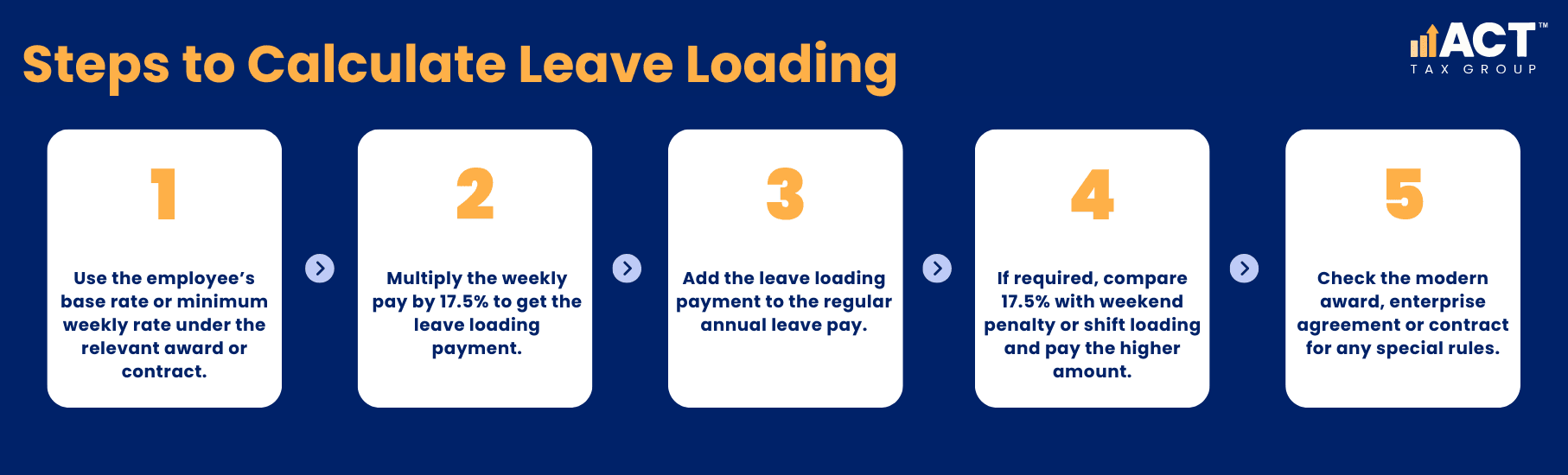
To calculate leave loading, start with the employee’s base rate or the minimum weekly rate that applies under the relevant award or legal document setting their rate of pay. For many employees, you take their normal weekly pay for one week of annual leave and multiply it by 17.5% to find the leave loading payment, then add this extra payment to the annual leave pay they already receive for that week.
For example, if an employee’s award sets a minimum weekly pay of $1,000, the annual leave loading for one week of annual leave at 17.5% would be $175, so leave loading paid for that week is $175 and total pay leave for that week becomes $1,175. In awards that compare 17.5% with weekend penalty or shift loading, you might instead work out what the person would have earned in weekend penalty rates and overtime rates and pay the higher amount as the loading is an extra sum to compensate workers for that lost overtime. The key is that the correct sum depends on the modern award, enterprise agreement or employment contract that applies.
When Is Leave Loading Paid, Including When Employment Ends?
Leave loading is usually paid when an employee actually takes paid annual leave during the year, so they receive their regular pay for the leave period plus the extra payment employees receive as annual leave loading. Some employers also allow employees to request that paid annual leave loading is paid in advance or as part of a planned holiday block, but it still represents loading on the weeks of annual leave covered.
When employment ends, employees must be paid leave loading on unused annual leave in their final pay under the Fair Work Act, even if the award or agreement attempts to exclude it. This means that accrued leave built up over time may attract both the same annual leave pay and an additional pay amount for leave loading, so the final pay should include annual leave loading where the employee’s award or award or enterprise agreement provides for it. Checking the wording of the modern award, enterprise agreement or employment contract is essential to see whether accrued leave attracts holiday leave loading when employment ends.
Is Leave Loading Compulsory Under Australian Law?
Leave loading is not a separate entitlement under the national employment standards, which instead set out minimum weeks of annual leave and other basic leave entitlements. Whether an employee is entitled to leave loading depends on a legal document such as a modern award, an enterprise agreement, or an individual employment contract that mentions annual leave loading specifically. Casual employees can receive leave loading only if their contract or agreement specifically provides for it.
Under the wider Fair Work Act framework, employers must follow the leave entitlements in any award or agreement that covers their employees, which means they must pay leave loading if the applicable award, enterprise agreement or employment contract says so. In many particular industry awards, leave loading is a long‑standing entitlement, while in others it does not apply. Employers who pay above the minimum hourly rate or offer a higher rate of pay need to make sure the legal document clearly states whether that higher regular pay includes annual leave loading or whether leave loading is still a separate extra payment.
How Is Leave Loading Taxed and How Does It Relate to Super?
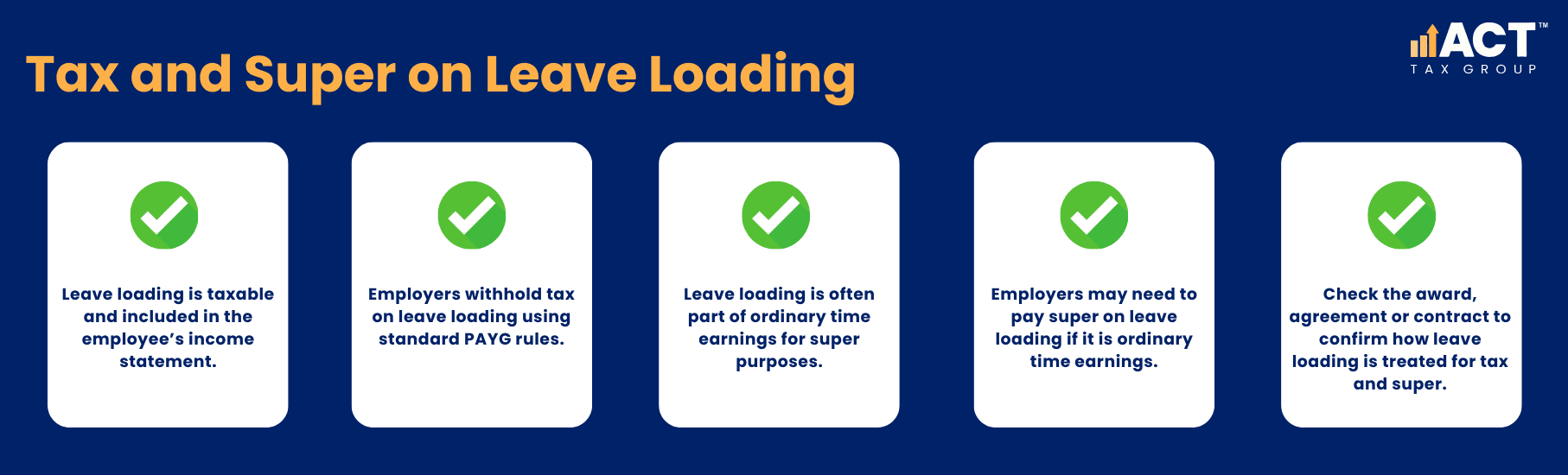
From an employee’s point of view, leave loading taxed is treated in a similar way to other forms of pay leave, because it forms part of their taxable income for the year. When employers pay leave loading, they generally withhold tax using the usual pay as you go rules and include the leave loading payment along with annual leave pay on the employee’s income statement.
For super, leave loading can be treated as part of ordinary time earnings or ordinary time earnings OTE in most cases, which means employers may need to pay super contributions on the loading as well as on regular pay. To exclude leave loading from OTE, employers need written evidence from the award, agreement, or documented policy proving the loading is solely to compensate for lost overtime—not general extra expenses. Because of this, many employers seek advice to check if their award or agreement and their payroll settings treat leave loading correctly for super purposes.
What Are Common Leave Loading Issues for Employees and Employers?
A common issue is that employees do not always realise they are entitled to leave loading, especially in workplaces where the employment contract is brief or the relevant award is not regularly discussed. This can mean employees receive only the same payment as their regular weekly pay when they take annual leave, even though the employee’s award or a modern award in their industry might provide for an extra payment on top.
Employers can also run into problems where their payroll system does not correctly calculate leave loading on accrued leave or final pay, or where the legal document is unclear about whether a higher salary includes annual leave loading. If an award or enterprise agreement says that eligible employees should receive a particular annual leave loading rate, failing to pay leave loading can lead to back payments and stress for both direct employees and business owners. Having clear terms that explain whether regular pay includes annual leave loading and how leave loading entitlements are calculated helps avoid confusion.
How Can ACT Businesses and Workers Review Leave Loading Entitlements?
Employees in the ACT who want to understand their leave loading entitlements can start by checking which modern award or enterprise agreement applies in their job and then reading the sections on annual leave and annual leave loading carefully. It is important to see whether the document states that employees receive leave loading at 17.5%, whether the loading compares with weekend penalty rates or shift loading, and whether unused annual leave gets holiday leave loading when it is paid out.
Employers in Canberra and across the ACT can reduce risk by aligning their payroll systems, contracts and policies with what the Fair Work Ombudsman guidance and the relevant award or agreement require. This includes checking that the minimum weekly rate or minimum weekly pay used to calculate leave loading matches the current rates in the relevant award, and that part time employees and full time employees are treated correctly under the national employment standards and the Fair Work Act framework. Support workers, shift workers and staff in other particular industry awards often have more complex rules because of shift penalty rates and overtime rates, so these need extra care.

What Practical Steps Should You Take Next?
If you are an employee, you can compare your payslips from a period of annual leave with your regular pay to see if an extra payment appears that looks like leave loading. If you do not see any additional pay when you take paid annual leave, and you believe your relevant award or employee’s award includes annual leave loading, you can ask your employer for an explanation and request a copy of the legal document that applies.
If you are a business owner or manager, checking your award or agreement, your contracts and your payroll setup is the best way to confirm you are paying the correct sum for annual leave pay and leave loading. This includes confirming whether your rate of pay or weekly pay arrangements are intended to include annual leave loading or whether leave loading payment is added separately whenever employees take annual leave or receive unused annual leave in a final pay.
Our team at ACT Tax Group helps ACT employers and employees understand what is leave loading, how to calculate leave loading for eligible employees, and how to make sure leave loading paid matches the applicable annual leave loading rules. If you want support to review your legal document setting pay, confirm leave loading entitlements or clean up your payroll for annual leave loading and other leave entitlements, our advisers can work with you so that both you and your team feel confident every time you pay leave or take a holiday.

Lukasz Klekowski
Principal of ACT Tax Group, specialising in tax compliance and financial strategy for Australian small businesses.

Disclaimer: All information provided in this publication is of a general nature only and is not personal financial or investment advice. It does not take into account your particular objectives and circumstances. No person should act on the basis of this information without first obtaining and following the advice of a suitably qualified professional. To the fullest extent permitted by law, no person involved in producing, distributing or providing the information in this publication (including ACT TAX GROUP PTY LTD, each of its directors, councilors, employees and contractors and the editors or authors of the information) will be liable in any way for any loss or damage suffered by any person through the use of or access to this information. The Copyright is owned exclusively by ACT TAX GROUP PTY LTD (ABN 31634338088)