

Beyond Sticker Price: Using LCT, GST and Write-Off Rules to Budget for Your Next Arborist Truck or 4×4
Published on June 9, 2026
From Accounting Profit to Taxable Income: A Simple Bridge Every Arborist Owner Can Walk Through at Year-End helps arborist business owners understand how accounting profit becomes taxable income before income tax is calculated. In simple terms, taxable income is worked out before tax, not after tax, and it helps determine how much tax may be payable for the financial year.
What Should Arborists Check Before Buying a Truck Or 4×4?
Arborists should check the vehicle price, LCT value, GST treatment, expected business use, finance costs and write-off outcome before signing a contract. The cheapest car on paper may not be the best business choice once dealer delivery charges, government fees, transfer fees, accessories and running costs are included.
For the 2025–26 financial year, the Australian Taxation Office (ATO) sets the LCT threshold at $91,387 for fuel efficient vehicles and $80,567 for other vehicles. The luxury car tax rate is 33%, and luxury car tax applies only to the amount above the relevant threshold, not the full value of the car.
Confused about LCT on your new work vehicle?
Schedule a complimentary consultation with us today to clarify LCT thresholds and obligations.
The Sticker Price Is Only One Part of the Budget
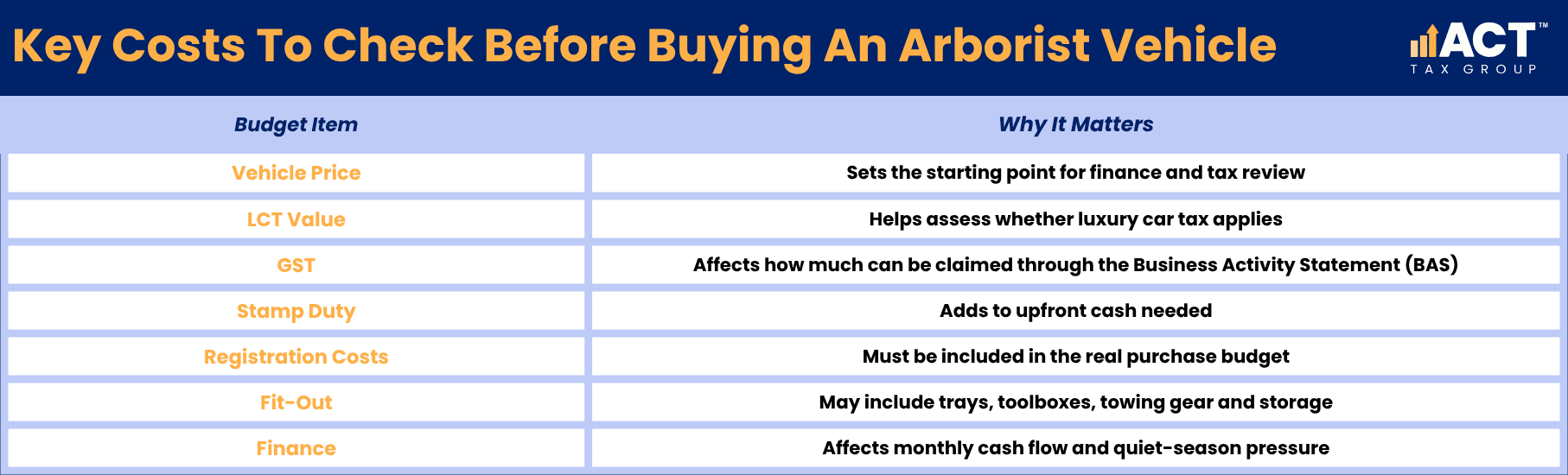
The sticker price rarely shows how much tax and total ownership cost will affect your business. Your budget should include the car’s price, GST, possible luxury car tax LCT, stamp duty, registration costs, compulsory third-party insurance, finance interest, accessories, fit-out, fuel consumption and servicing.
When luxury car tax calculating is required, the LCT value can include more than the base retail price. Dealer delivery charges, some accessories, customs duties for imported vehicles and GST may all affect the value, while some government fees such as stamp duty and registration may be treated differently depending on the purchase.
How Does Luxury Car Tax Affect Arborist Vehicles?
Luxury car tax may apply when luxury vehicles, new and imported vehicles, or certain used car transactions exceed the luxury car tax threshold. In most dealer purchases, LCT is generally built into the vehicle price, while businesses that sell or import luxury cars, and individuals who import luxury cars, may need to report or pay LCT directly if the rules apply.
A vehicle purchase should be reviewed before the business commits, because tax timing and cash flow often matter as much as the vehicle itself. This is especially important where the vehicle sits close to the luxury car threshold or where accessories may push the value above the limit.
Which Vehicles May Be Treated Differently?
Not all vehicles are treated the same under the tax system. Some commercial vehicles are mainly designed to carry goods, not passengers, and this can affect whether car tax rules, LCT rules and deduction limits apply.
LCT does not apply to some vehicles, including commercial vehicles designed mainly for carrying goods and not passengers, and certain emergency vehicles such as ambulances, firefighting vehicles, police vehicles and search and rescue vehicles. Primary producers and tourism operators may be eligible for a partial LCT refund on eligible vehicles, but this is separate from an exemption and depends on meeting the ATO conditions.
How Does GST Change the Real Cost?
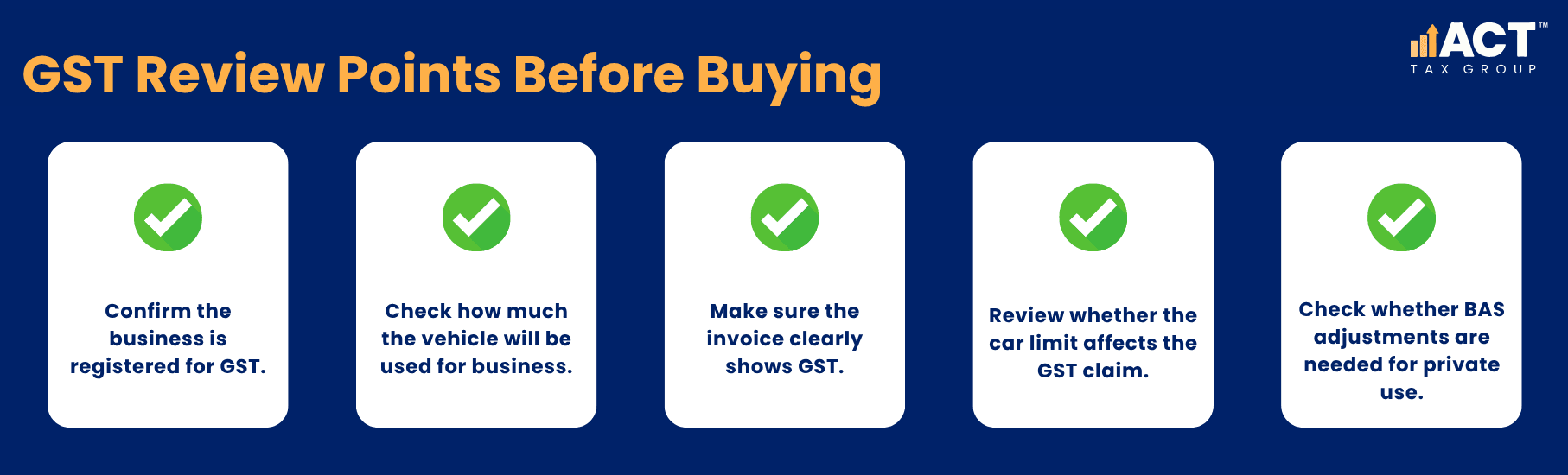
GST can reduce the after-tax cost of a business vehicle if your business is registered for GST, holds a valid tax invoice and uses the vehicle in carrying on the business, especially where you understand how to maximise GST credits and stay ATO-compliant. However, GST credits may be limited by the car limit, private use, luxury car rules or second-hand vehicle rules.
You also cannot claim a GST credit for luxury car tax itself, even where the vehicle is used in the business. That means the business needs to know how much tax is actually recoverable, rather than assuming the full GST amount on the invoice can be claimed.
What Do Write-Off Rules Mean for a New Vehicle?
Write-off rules can help with tax timing, but they do not make an expensive vehicle free. For the 2025–26 income year, eligible small businesses with aggregated turnover of less than $10 million may be able to immediately deduct the business portion of eligible assets costing less than $20,000 per asset, if the asset is first used or installed ready for use during that income year.
If the vehicle costs $20,000 or more and the business uses the simplified depreciation rules, the business portion will generally be placed into the small business pool rather than being fully written off straight away. A car limit may also apply to certain passenger vehicles, so arborists should review the vehicle type before relying on a deduction estimate.

Imported Vehicles and Luxury Cars Need Extra Care
Imported vehicles can create extra issues because customs duties, GST, luxury car tax and transfer costs may all affect the final purchase price. This can apply whether you import luxury cars directly, buy imported vehicles locally, or purchase from a dealer who has already included some costs in the price.
Some buyers search for a luxury car tax calculator to estimate how much tax may apply, which can be useful as a starting point. However, a calculator cannot replace advice because LCT exemptions, credits, refunds, previous LCT paid, vehicle use and the exact LCT value can change the outcome. Primary producers and tourism operators must also meet specific ATO conditions to claim any LCT refund.
Fuel Efficiency Can Change the Threshold
Fuel efficiency matters because fuel efficient vehicles can receive a higher LCT threshold than other vehicles. This is why electric vehicles and low fuel consumption vehicles may have a different LCT result from other cars with a similar retail price.
The higher LCT threshold does not mean every fuel-efficient car avoids paying LCT. It simply means the threshold is higher, so the business still needs to check the value of the car, the financial year, and whether the vehicle meets the required fuel-efficient standard.
Grow your tree care business with Accounting Built for Arborists
From start-up to expansion, our accounting team supports your tax, payroll, and cash flow — so you can focus on running your business safely and profitably.
A Practical Budgeting Checklist for Your Next Vehicle Purchase
A practical budget should show the full vehicle purchase cost, the likely GST claim, possible LCT, finance repayments and the extra revenue needed to justify the asset. It should also allow for fuel, servicing, tyres, insurance and downtime.
Before you buy, consider whether the vehicle is genuinely suitable for arborist work and whether it is mainly built to carry goods or passengers. You should also check whether the LCT threshold applies, whether you need to pay luxury car tax through the purchase price, and how much GST the business can claim.
It is also important to confirm whether stamp duty and government fees are included in the quote, whether any personal use will affect the claim, and whether the write-off rules or pooling rules apply. Finally, review whether the repayments will fit quiet-season cash flow and what records the ATO may expect you to keep.
How ACT Tax Group Can Help with Arborist Truck And 4×4 Tax Planning
We help arborists and trade-based businesses make informed decisions before they commit to a major vehicle purchase. Our team can review luxury car tax, GST, write-off rules, car tax limits, finance timing, BAS treatment, family tax benefit entitlements and record keeping so you can understand the likely tax and cash flow result.
You can book a consultation with ACT Tax Group before you sign the purchase contract or finalise finance. We will help you compare options, understand the tax position and build a practical budget around your next vehicle purchase.

Conclusion
A good arborist vehicle budget looks beyond the advertised price and considers luxury car tax, GST, write-off rules, finance, running costs and business use together. Luxury car tax was originally linked to the Australian car manufacturing industry, and its thresholds are adjusted over time with reference to the consumer price index, so only vehicles above the relevant threshold need closer review.
Before you buy, collect the quote, finance terms, fit-out details and expected business-use information, including whether the vehicle price is shown excluding government fees. With the right review, you can choose a truck or 4×4 that suits your work, supports your margins and keeps your tax position clear.

Lukasz Klekowski
Principal of ACT Tax Group, specialising in tax compliance and financial strategy for Australian small businesses.

Disclaimer: All information provided in this publication is of a general nature only and is not personal financial or investment advice. It does not take into account your particular objectives and circumstances. No person should act on the basis of this information without first obtaining and following the advice of a suitably qualified professional. To the fullest extent permitted by law, no person involved in producing, distributing or providing the information in this publication (including ACT TAX GROUP PTY LTD, each of its directors, councilors, employees and contractors and the editors or authors of the information) will be liable in any way for any loss or damage suffered by any person through the use of or access to this information. The Copyright is owned exclusively by ACT TAX GROUP PTY LTD (ABN 31634338088)