

Designing Tax-Smart Salary Sacrifice Options for Your Arborist Crew: Super, Equipment and Vehicles Without FBT Surprises
Published on May 26, 2026
Designing Tax-Smart Salary Sacrifice Options for Your Arborist Crew: Super, Equipment and Vehicles Without FBT Surprises means setting up salary sacrifice benefits in a way that helps your team without creating unexpected Fringe Benefits Tax (FBT), payroll, or income tax issues. For arborist businesses in ACT and across Australia, the main challenge is offering practical benefits like super contributions, protective clothing, equipment, and vehicles while keeping records clear and compliant.
Is Salary Sacrifice a Fringe Benefit for Arborist Employees?
Salary sacrifice is not always a fringe benefit, but many salary sacrifice benefits can create fringe benefits depending on what is provided. A salary sacrifice arrangement usually means an employee agrees to give up part of their future salary or wages in exchange for benefits that form part of their total remuneration package. For example, salary sacrificed super contributions are usually treated differently from a company car, equipment, or school fees. Salary sacrificed super contributions paid to a complying super fund are generally treated as employer contributions and are not fringe benefits. Other non-cash benefits provided to employees may fall under fringe benefits tax rules.
Are your salary sacrifice benefits triggering unexpected FBT?
Schedule a complimentary consultation with us today to review and reduce your FBT exposure.
Fringe Benefits Tax Needs to Be Considered Before the Package Starts
Fringe Benefits Tax applies to many non-cash benefits provided by an employer to an employee or their associate. If fringe benefits provided are taxable, the employer may need to pay Fringe Benefits Tax, often called FBT, based on the taxable value of those benefits. The FBT year runs from 1 April to 31 March, which does not match the usual income year. This timing matters because an arborist business may need to review vehicles, equipment, and other benefits before 31 March, not just at tax return time, and make sure its BAS and GST reporting obligations reflect those benefits correctly.
Super Salary Sacrifice Should Never Reduce Super Guarantee Contributions
Salary sacrificed super contributions must not reduce an employee’s super guarantee entitlement and cannot be counted towards the employer’s compulsory super guarantee contributions. Employer super contributions made under an effective salary sacrifice arrangement still need to be handled carefully so the employee’s normal income, reduced salary, and super records are correct. According to the Australian Taxation Office (ATO), the Superannuation Guarantee rate is 12% from 1 July 2025, and this rate continues for later years unless the law changes.
The general concessional contributions cap is $30,000 from 1 July 2024 to 30 June 2026 and is scheduled to increase to $32,500 from 1 July 2026. Employees should consider their total employer contributions, salary sacrificed contributions, and any personal deductible contributions before sacrificing too much, and older workers might also weigh up strategies like boosting super using the Downsizer Scheme as part of their broader retirement plan.
Equipment and Protective Clothing Can Be Practical Salary Packaging Options
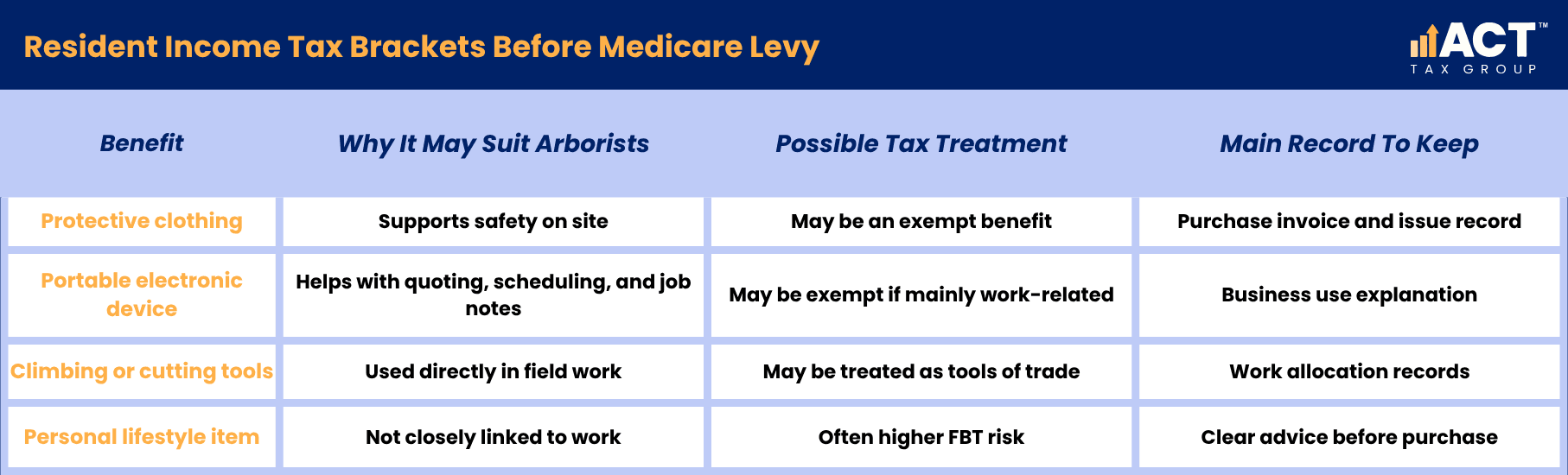
Equipment and protective clothing can be useful salary packaging options for arborist crews because they relate directly to safe, productive work. Items such as approved protective clothing, tools of trade, and a portable electronic device may be exempt benefits if they are primarily used in the employee’s employment and meet the required conditions, including limits on substantially identical items where applicable.
This is where records matter. If the business provides equipment under a salary packaging arrangement, the employer still needs to show the item qualifies as a work-related item, is primarily used in the employee’s employment, and is properly recorded. Good recordkeeping here also supports cash flow planning for arborist businesses because it keeps asset purchases, usage, and tax treatment clearly documented.
Vehicles Are the Main Source of FBT Surprises
Vehicles create FBT risk because a work ute, van, truck, or company car can easily shift between business use and private use. An arborist crew may need vehicles for early starts, chainsaws, climbing gear, stump grinding tools, mulch, and site access, but the employer still needs records showing how the vehicle is used. A common mistake is assuming all dual cab utes are automatically exempt from FBT. Some eligible vehicles may qualify for an FBT exemption where private use is limited to work-related travel and minor, infrequent, and irregular private use. The employer must check the vehicle type, actual use, home garaging, odometer records, and supporting records.
A Salary Packaging Arrangement Should Compare Pre Tax Income and After-Tax Income
An effective salary sacrifice arrangement should show the employee what changes before they agree. This includes the impact on pre-tax income, after tax income, taxable income, reportable fringe benefits amount, reportable employer super contributions, and any benefits reported through payroll or on the employee’s income statement. Some salary sacrifice arrangements may reduce taxable income, but reportable fringe benefits amounts or reportable employer super contributions may still affect other areas of the employee’s financial position, including eligibility for payments such as the Family Tax Benefit Part A.
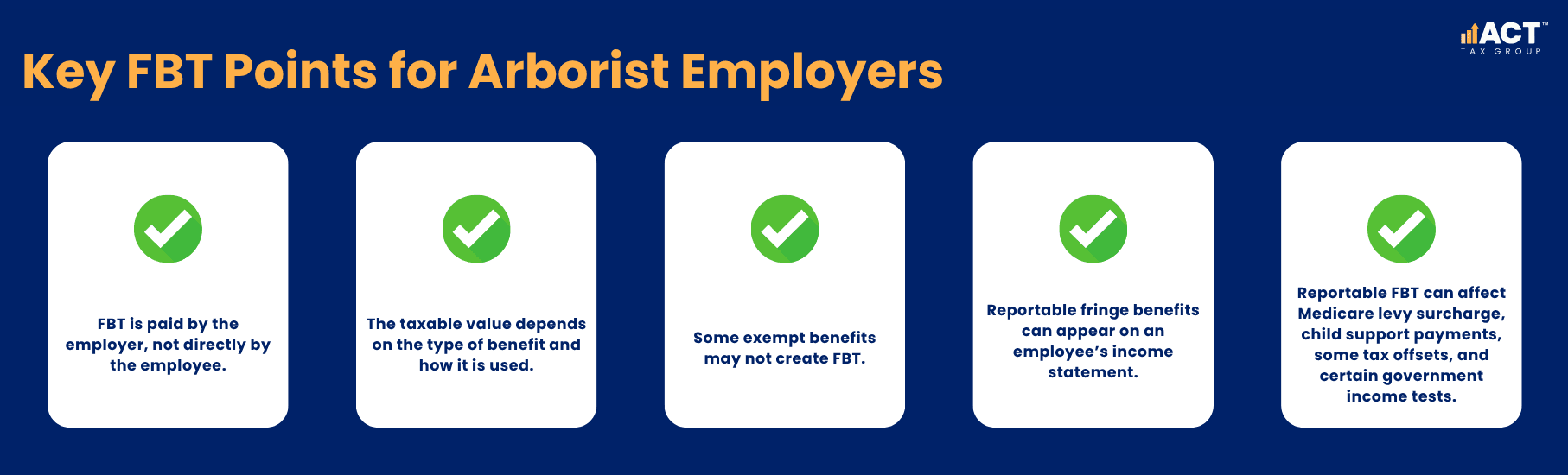
A reportable fringe benefits amount is not included in assessable income and is not directly taxed, but it can affect Medicare levy surcharge, tax offsets, child support payments, and some government income tests.

Common Salary Sacrifice Mistakes Arborist Businesses Should Avoid
The biggest mistake is setting up salary sacrifice without checking whether the benefit creates FBT, GST, payroll, income tax consequences, or even interacts with issues like Division 7A benchmark interest rates on shareholder or associate loans. Another common mistake is copying another employer’s package without checking whether the same rules apply to your business, your vehicles, and your crew. A salary sacrifice arrangement is only effective for ATO purposes when it is entered into before the employee earns the salary or wages being sacrificed. It should not be backdated, used to disguise normal income, or used in a way that conflicts with an employment or industrial agreement.
Mistakes That Can Create Problems
Backdating a salary sacrifice agreement.
Treating salary sacrificed super contributions as employee contributions when they should be treated as employer contributions.
Forgetting to calculate super guarantee contributions correctly.
Offering school fees or loan repayments without FBT modelling.
Assuming all fringe benefits are exempt benefits.
Failing to calculate the total taxable value of benefits.
Forgetting that the employer pays FBT when FBT applies.
Not reviewing the package before the end of the FBT year.
How To Build an Effective Salary Sacrifice Framework
A practical framework starts with the role, not the tax outcome. Climbers, ground crew, estimators, supervisors, and office staff may all need different benefits, so the employer should match the package to the work performed. The business should then check the tax treatment before offering the benefit. This includes whether the benefit is exempt, whether FBT is payable, whether the employee will have a reportable fringe benefits amount or reportable employer super contributions, and whether payroll can manage the arrangement accurately.
Grow your tree care business with Accounting Built for Arborists
From start-up to expansion, our accounting team supports your tax, payroll, and cash flow — so you can focus on running your business safely and profitably.
What Should Be Reported to Employees?
Employees need clear information about their salary packaging arrangement, so they understand what appears in payroll records. Some benefits may need to be included as a reportable fringe benefits amount on the employee’s income statement, while certain excluded or exempt benefits may not be reported in the same way. Older wording often refers to an employee’s payment summary, but most employees now access payroll and tax details through their income statement. Either way, the employer needs accurate records showing the benefits provided, the taxable value, any grossed-up reportable fringe benefits amount, and whether any reporting exclusion applies.
How ACT Tax Group Can Help with Salary Sacrifice for Arborist Crews
We help arborist businesses design salary sacrifice and salary packaging options that are practical, compliant, and easy to manage through payroll. Our team can review super, protective clothing, equipment, vehicles, FBT, taxable value calculations, and reportable fringe benefits so you can make confident decisions before benefits are offered. You can arrange a consultation with ACT Tax Group to review your current crew benefits, vehicle use, payroll setup, and FBT position. We provide tailored advice for Australian small to medium-sized businesses, helping you reduce compliance stress while supporting a crew that relies on safe tools, reliable vehicles, and clear pay arrangements.

Conclusion
Salary sacrifice can help arborist employers offer meaningful benefits without relying only on higher cash wages. Super, equipment, protective clothing, and vehicles can all form part of a tax effective package when the rules are checked early and the paperwork is clear. The next step is to review your current arrangements before the FBT year ends on 31 March. A written salary sacrifice agreement, accurate payroll setup, vehicle records, and practical tax advice can help your business avoid FBT surprises while giving your crew benefits that genuinely support their work.

Lukasz Klekowski
Principal of ACT Tax Group, specialising in tax compliance and financial strategy for Australian small businesses.

Disclaimer: All information provided in this publication is of a general nature only and is not personal financial or investment advice. It does not take into account your particular objectives and circumstances. No person should act on the basis of this information without first obtaining and following the advice of a suitably qualified professional. To the fullest extent permitted by law, no person involved in producing, distributing or providing the information in this publication (including ACT TAX GROUP PTY LTD, each of its directors, councilors, employees and contractors and the editors or authors of the information) will be liable in any way for any loss or damage suffered by any person through the use of or access to this information. The Copyright is owned exclusively by ACT TAX GROUP PTY LTD (ABN 31634338088)