

Electricians: Building Medicare‑Related Tax into Your Weekly “Buckets” So It’s Always Covered
Published on May 19, 2026
Electricians building Medicare-related tax into weekly buckets means setting aside money each week for the Medicare levy and possible Medicare levy surcharge, as part of your broader income tax planning before the cash is spent elsewhere. This helps electrical contractors avoid a year-end tax return shock when taxable income is higher than expected.
Electricians Can Keep Medicare-Related Tax Covered with Weekly Buckets
For many electricians, the challenge is not only earning income, but keeping enough aside when invoices, supplier accounts, wages, private health insurance, and business costs all compete for cash. A weekly bucket system gives you a simple way to protect money for income tax, Medicare, and other tax obligations across the financial year.
Struggling to set aside Medicare levy each week?
Schedule a complimentary consultation with us today to build a clear weekly tax bucket.
Weekly Buckets Give Electricians Better Cash Flow Control
A weekly bucket system works by splitting business income into clear categories as money comes in. Instead of treating the full bank balance as available spending money, you move a practical amount into separate buckets for tax, Goods and Services Tax (GST), wages, superannuation, and future costs.
This approach suits electricians because cash flow often changes from week to week. A large commercial payment may land in one week, but the next week may include materials, apprentice wages, vehicle costs, and unpaid variations from earlier jobs.
Medicare Levy and Medicare Levy Surcharge Affect Year-End Tax
The Medicare levy is an amount many Australian resident taxpayers pay in addition to income tax to help fund Australia’s public health system. The Australian Taxation Office explains that the Medicare system supports access to Medicare benefits, including medical care that many Australians rely on.
The Medicare Levy Surcharge (MLS) is different from the Medicare levy. It may apply if your income for MLS purposes is above the relevant threshold and you, your spouse, or your dependants do not have an appropriate level of private patient hospital cover.
Taxable Income Drives the Medicare Levy Calculation
Your taxable income is the main starting point for calculating the Medicare levy, although reductions or exemptions may apply depending on income and personal circumstances. For most Australian resident taxpayers, the Medicare levy is 2% of taxable income, unless a reduction or exemption applies.
This is why electricians should not wait until lodgement time to think about Medicare. If your income level changes because you win more projects, employ staff, or take larger owner drawings, the amount you need to pay the Medicare levy may also change.
Private Hospital Cover Can Affect the Medicare Levy Surcharge
Medicare levy surcharge works by looking at income thresholds, family income, and whether you hold an appropriate level of private hospital cover. If the Medicare levy surcharge applies, it is additional tax on top of the Medicare levy.
Income for MLS purposes can include taxable income, reportable fringe benefits, total net investment losses, reportable super contributions, certain trust income, and exempt foreign employment income where applicable. For Medicare levy surcharge purposes, the Australian Taxation Office may consider your combined income if you have a spouse or family.
Lumpy Electrical Income Makes Weekly Buckets Practical
Electrical contractors often deal with uneven income because builder payments, residential jobs, insurance work, and commercial contracts do not always arrive on time. A weekly bucket gives you structure before tax money gets mixed with general spending.
A Medicare Tax Bucket Needs a Practical Weekly Amount
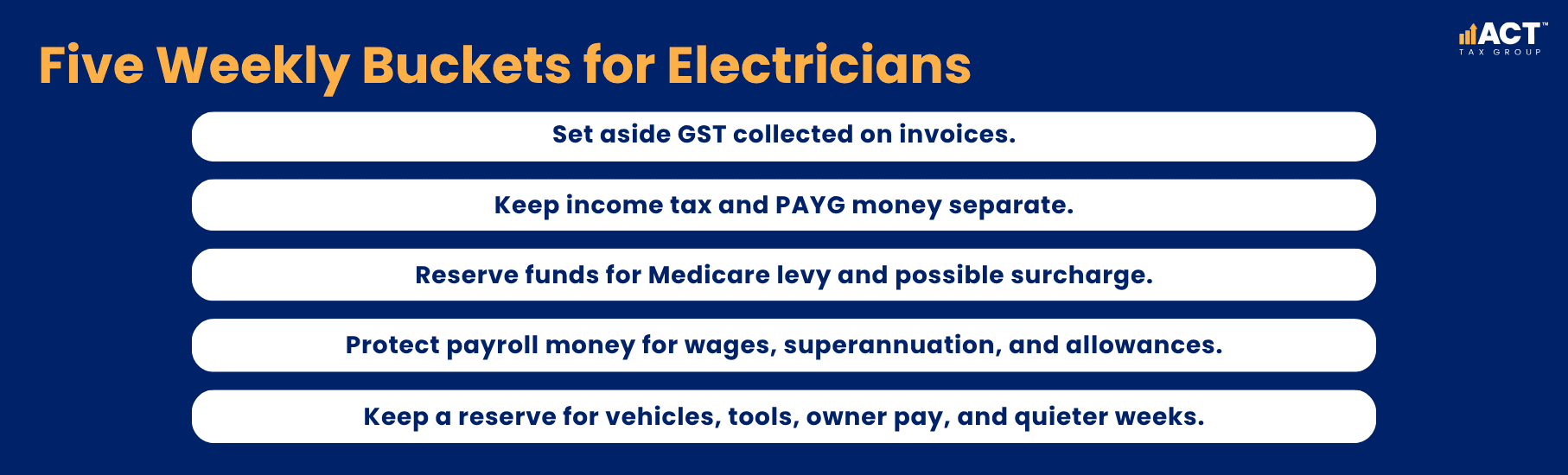
A practical starting point is to estimate the Medicare levy separately from general income tax. If your expected taxable income is $100,000 and no reduction or exemption applies, a 2% Medicare levy estimate would be $2,000 for the income year.
If the Medicare levy surcharge applies, you may need to allow more. The MLS rates are 1%, 1.25%, or 1.5%, depending on your income for MLS purposes and whether you have an appropriate level of private patient hospital cover.
Family Income Thresholds Can Change the Final Amount
Family income can affect whether the Medicare levy surcharge applies, because the ATO uses combined income for MLS purposes where you have a spouse. For 2025–26, the base family threshold is $202,000, plus $1,500 for each dependent child after the first.
This matters for electricians with growing households or changing personal circumstances. If you have a spouse, dependent child, sole care responsibilities, or changing family income, your Medicare-related tax position may be different from a single person with the same business profit.
Medicare Levy Exemption Rules Need Careful Checking
A Medicare levy exemption may apply in limited situations, but exemption means you meet specific rules, not simply that you would prefer to avoid paying. Some taxpayers may qualify for a full or part exemption, while others may qualify for a reduced rate.
Examples can include meeting specific medical exemption rules, being a foreign resident for tax purposes, or not being entitled to Medicare benefits for all or part of the year. Seniors and pensioners tax offset eligibility and certain family circumstances may affect Medicare levy reductions or exemptions for some taxpayers.

Electrical Contractors Face Different Medicare Tax Outcomes
An electrician operating as a sole trader with $90,000 taxable income may put aside a weekly amount for the Medicare levy as part of the broader tax bucket. This keeps the expected levy visible rather than letting it appear as a surprise after the tax return is prepared.
A growing electrical contractor with two vans, apprentices, and a mix of private and commercial work may have higher taxable income and reportable fringe benefits. If that owner’s income for MLS purposes is above the relevant threshold and they do not have an appropriate level of private patient hospital cover, the Medicare levy surcharge may become relevant.
A company director of an electrical business may assume the company tax bucket covers everything. In reality, wages, dividends, trust distributions, or other personal income can still affect the director’s personal tax return and Medicare-related tax outcome, as can home-based work choices and how you claim fixed rate method home office deductions.
Private Health Insurance Decisions Need Early Planning
Private health insurance is a personal and financial decision, and only appropriate private patient hospital cover is relevant for Medicare levy surcharge purposes. However, electricians who are near the MLS income thresholds should understand how private hospital, private patient, and hospital cover rules may affect their final tax position.
Taking out appropriate private patient hospital cover late in the financial year may only reduce MLS exposure for the days the cover is in place. For MLS purposes, the Australian Taxation Office looks at whether appropriate cover applied for the relevant days in the income year.
Quarterly Reviews Keep the Medicare Bucket Accurate
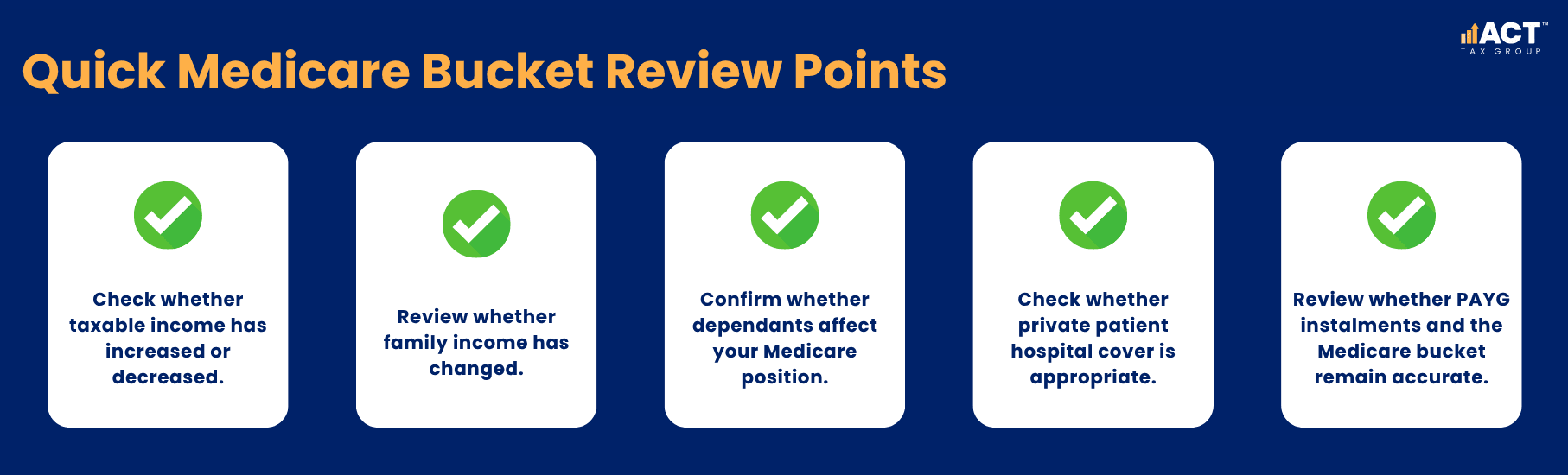
A quarterly review helps keep your weekly bucket accurate. Electricians should compare actual profit, expected taxable income, private hospital cover, family income, and PAYG instalments before each Business Activity Statement (BAS) cycle.
Most Australian Taxpayers Need to Consider the Medicare Levy
Most Australian taxpayers pay the Medicare levy unless they qualify for a reduction or exemption. Low-income earners, some foreign resident taxpayers, and people who meet certain medical or family criteria may be treated differently.
Private health cover does not usually remove the standard Medicare levy. It may help you avoid paying the Medicare levy surcharge if the cover meets the appropriate level and your income places you above the relevant thresholds.
Power up your business with Accounting Built for Electricians
From start-up to expansion, our accounting team supports your tax, payroll, and cash flow at every stage of growth.
Medicare-Related Tax Is Calculated Through the Tax Return
The ATO works out the Medicare levy and any Medicare levy surcharge when your tax return is processed, based on the information reported in the return. The weekly bucket simply helps you make sure the money is available when the final amount is known.
Electricians should check the ATO website, use ATO Online Services for Business, or speak with their accountant because income thresholds and rates can change between years. A small change in income, family position, or hospital cover can affect whether the surcharge applies.
How ACT Tax Group Can Help with Electricians Building Medicare-Related Tax into Weekly Buckets
We help electricians turn Medicare-related tax planning into a practical weekly cash flow system. Our team can review your taxable income, income tax position, PAYG instalments, private hospital cover, family income, and likely Medicare levy or Medicare levy surcharge exposure.
If you want better cash flow clarity, stronger compliance confidence, and fewer tax surprises, we invite you to book a meeting with ACT Tax Group. We can help you build a weekly bucket system that supports tax efficiency, asset protection, and growth planning, including setting up cloud tools such as Xero and inviting an adviser to your Xero file.

Weekly Planning Creates Stronger Year-End Confidence
Medicare-related tax becomes easier to manage when it is built into your weekly routine. For electricians dealing with project work, delayed invoices, wages, supplier accounts, and BAS deadlines, a Medicare bucket gives you a clearer view of what the business can truly afford.
The next step is to estimate early, separate funds consistently, and review your position as income changes. When your buckets match your real numbers, you can make business decisions with less stress and more confidence.

Lukasz Klekowski
Principal of ACT Tax Group, specialising in tax compliance and financial strategy for Australian small businesses.

Disclaimer: All information provided in this publication is of a general nature only and is not personal financial or investment advice. It does not take into account your particular objectives and circumstances. No person should act on the basis of this information without first obtaining and following the advice of a suitably qualified professional. To the fullest extent permitted by law, no person involved in producing, distributing or providing the information in this publication (including ACT TAX GROUP PTY LTD, each of its directors, councilors, employees and contractors and the editors or authors of the information) will be liable in any way for any loss or damage suffered by any person through the use of or access to this information. The Copyright is owned exclusively by ACT TAX GROUP PTY LTD (ABN 31634338088)