

ATO Data-Matching for Arborists: How Your Invoices, Bank Feeds and Prefill Are Checked When You Lodge
Published on May 12, 2026
ATO data-matching for arborists is how the Australian Taxation Office checks whether the income, deductions, bank-related information and pre-filled details in a tax return match information it receives from third parties and information it already holds. For arborists, this can include invoice records, bank deposits, contractor payments, government payments, interest, dividends, other income and records linked to an individual tax return or business tax return.
ATO Data-Matching for Arborists Creates a Clear Lodgment Trail
ATO data-matching for arborists creates a clear trail between your invoices, bank deposits, prefilled information and final assessment. If the details do not line up, the issue may be a simple timing difference, but it can still delay a refund, increase tax payable or create questions about your tax liability.
According to the Australian Taxation Office, the net small business income tax gap for the 2022 to 2023 income year was estimated at $27.2 billion, or 17.4%. The ATO also says small business accounts for 47% of the total tax gap, which is why accurate records and correct lodgment matter for businesses like yours.
Worried your bank deposits don’t match your BAS or invoices?
Schedule a complimentary consultation with us today to reconcile your bank feeds and fix issues before ATO reviews.
How Does the ATO Check Arborist Invoices Against Income?
The Australian Taxation Office can compare your declared income with data that suggests you were paid for a job. For arborists, this may include invoices issued to property managers, builders, developers, councils, strata managers, insurance clients and household clients, and it also compares those figures with what you report when you apply for and lodge your tax return in Australia.
Example one is an arborist who completes tree removal for a builder in June, raises the invoice in July, and receives payment in August. The work may be genuine and correctly billed, but the invoice date, payment date, GST treatment and income year need to be clear so your accountant or registered tax agent can calculate the correct result.
Bank Feeds Can Show More Than Your Accounting File
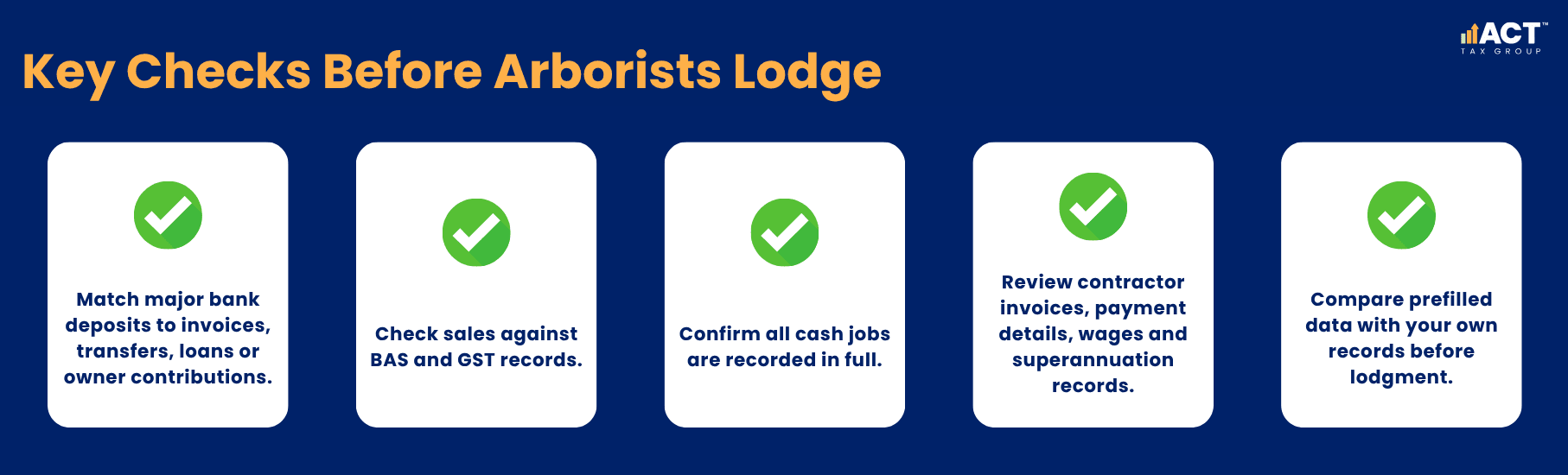
Bank statements and bank feeds can show payment patterns that help you and your accountant confirm whether sales, deposits, transfers and fees have been recorded correctly, especially when you are using ATO Online services for business or cloud accounting. If your accounting file shows lower income than your bank deposits, payment records or third-party data, the difference needs to be explained with records, not guessed at lodgment.
For example, a tree service business may receive regular payments from a real estate agency for pruning, storm clean-up and stump grinding. If only some of those payments are matched to invoices, the remaining money may look like unreported income unless your documents show it was a loan, owner contribution, refund, transfer or correction.

Prefill Information Must Still Be Checked Before You Lodge
Prefill information is data the Australian Taxation Office already holds and makes available before you complete a tax return. It can include bank interest, dividends, government payments, salary and wages, employer information, taxable payments and other income details.
The ATO says prefill data starts becoming available from 1 July, with most information generally available by late July. That does not mean every amount is complete or correct, so you still need to check prefilled details against your own records before you lodge online, lodge through a tax agent, or prepare your own tax return.
Sole Traders Need to Connect Business and Individual Tax Details
Many arborists operate as sole traders, which means business income and expenses can flow into an individual tax return. In most cases, the business result affects taxable income, tax payable, tax refund and the final assessment for that person, which is why avoiding common tax deduction mistakes in your return is so important.
This is where individual tax, and business tax can overlap. A sole trader may also have salary from employment, interest, dividends, rent, capital gains, work related expenses, home expenses, spouse details and private health details that need to be complete and correct in the same return.

Contractor Payments Need Clear Evidence
Arborist businesses often pay subcontract climbers, ground crew, stump grinding operators, crane operators or traffic control providers. These payments need invoices, Australian Business Number details, payment records and correct treatment for GST, Pay as You Go (PAYG) withholding and superannuation where the rules apply.
A strong tax position is one where the records explain the commercial reality of the job. For arborists, that means your documents should show who did the work, when it was done, what was incurred, what was paid and whether the costs were eligible deductions.
Cash Jobs Still Need to Be Recorded
Cash payments are still income and need to be included when you lodge. If a client pays cash for pruning, branch removal, stump grinding or an urgent storm job, the full amount should be recorded before any expenses are taken out.
Example two is a Saturday job where the client pays cash, and the arborist uses part of that money for fuel, tip fees and crew lunch. If only the remaining cash reaches the bank, your bank feed will not show the full sale or the full costs, which can affect the correct calculation of taxable income.

Equipment and Vehicle Costs Need Business-Use Support
Chainsaws, climbing gear, trailers, chippers, stump grinders, utes, fuel and repairs can be legitimate business costs, but the claim must reflect business use. If an asset is used partly for private purposes and partly for business, only the business portion can be claimed, and the calculation needs to be supported by records.
Example three is a ute used for site visits, quoting, towing a chipper and weekend family use. Depending on your business structure and vehicle type, your accountant may need logbooks, receipts, finance documents, service records and odometer details to calculate the eligible business-use amount under the correct method or decide whether the fixed rate method for work deductions could apply to some of your expenses.
Actual Cost Method Records Must Be Practical and Complete
The actual cost method may apply where you claim certain work-related expenses or business costs based on what you actually spent. It usually requires records such as receipts, invoices, payment evidence and a clear connection between the expense and the job or business activity.
For arborists, this may include fuel, repairs, phone costs, home-based business expenses, protective equipment and small tools, provided the expense is connected to earning business income and private use is excluded. A tax expert can help decide whether the actual cost method is suitable, because a maximum return is not about exaggerating deductions, it is about claiming what is correct and supportable.
What Mismatches Commonly Trigger ATO Questions?
Common mismatches include income reported by clients but missing from your return, bank deposits with no matching invoices, GST amounts that do not match BAS records, and deductions that are high compared with sales. Problems can also arise when contractor payments, wages, employer obligations or personal expenses are mixed into the wrong account, or when you do not correctly claim and substantiate GST credits while staying ATO-compliant.
The Australian Taxation Office has reported that shadow economy behaviour is a major driver of the small business income tax gap, including deliberate under-reporting of income, over-claiming of deductions and businesses operating outside the tax system. These figures show why accurate records, clear payment trails and correct classification are important, especially if you are monitoring turnover to stay under the GST registration threshold.
Grow your tree care business with Accounting Built for Arborists
From start-up to expansion, our accounting team supports your tax, payroll, and cash flow — so you can focus on running your business safely and profitably.
Taxable Payments Reporting Can Affect Arborists
Some arborists may appear in taxable payments reporting where they are paid as contractors by businesses or government entities that must report payments for covered services, including building and construction. If a builder reports payments made to your Australian Business Number through the taxable payments reporting system, the Australian Taxation Office may compare that data with your lodged income and other reporting such as Instalment Activity Statements (IAS).
Example four is a tree services business paid for site clearing before a new build starts. If the builder reports $18,000 in payments but your records show a different assessable income amount for the same period, your records need to explain whether the difference relates to timing, GST, discounts, credit notes, unpaid invoices or another valid reason, and those figures also need to align with your BAS and GST reporting obligations.
How Should Arborists Prepare Before Lodgment?
Arborists should prepare by reconciling invoices, bank feeds, cash receipts, expenses, payroll, contractor payments and prefilled data before lodgment, and by making sure your accountant has access to your cloud file using tools such as inviting an adviser to your Xero file. This gives your tax accountants time to identify missing documents, correct coding issues and calculate the tax position with confidence.
Online Tax Lodgment Does Not Remove Your Record-Keeping Duties
Online tax tools can make it easier to lodge online, prepare a return online or check pre-filled information. They do not remove the need to keep complete records or make sure the details in the return are correct.
Most Australians can benefit from digital tools, but arborists with business income, equipment costs, contractor payments, GST, assets and mixed-use vehicles often need professional support. A free or low-cost online tax option may suit a simple salary return, but it may not be enough for a tree service business with complex income and deductions.
What Should You Do If the ATO Finds a Mismatch?
If the Australian Taxation Office contacts you about a mismatch, read the notice carefully and check the data before responding. A mismatch does not always mean your tax return is wrong, but it does mean you need documents that explain the difference.
Do not assume a data match issue is solved by changing the return without checking the source records first. The better approach is to review the invoices, bank records, dates and supporting documents so the response is accurate.
How ACT Tax Group Can Help with ATO Data-Matching for Arborists
ATO data-matching for arborists can affect your tax refund, tax payable, cash flow, compliance confidence and future planning. We help arborist businesses review invoices, bank feeds, BAS records, contractor payments, payroll, asset claims, work related expenses and prefilled data before lodgment.
We invite you to book a meeting with ACT Tax Group if you want practical support from tax accountants who understand trade businesses in Australia. Our team can help you lodge with confidence, reduce stress, improve record keeping, manage tax liability and make clearer decisions about money, growth and asset protection.
Strong Records Make Tax Time Less Stressful
Strong records make tax time easier because they connect the real work your business performs with the numbers in your return. They also help you understand which jobs are profitable, which clients pay late, what costs are rising, and whether your pricing still supports a healthy business. For arborists, the goal is not to fear data. The goal is to make sure your invoices, bank records, pre-filled details, receipts and lodged tax return tell the same story, with enough evidence to support every claim and every dollar of income, whether the income comes from tree work alone or from other activities such as short term rental accommodation and its CGT impacts.

Lukasz Klekowski
Principal of ACT Tax Group, specialising in tax compliance and financial strategy for Australian small businesses.

Disclaimer: All information provided in this publication is of a general nature only and is not personal financial or investment advice. It does not take into account your particular objectives and circumstances. No person should act on the basis of this information without first obtaining and following the advice of a suitably qualified professional. To the fullest extent permitted by law, no person involved in producing, distributing or providing the information in this publication (including ACT TAX GROUP PTY LTD, each of its directors, councilors, employees and contractors and the editors or authors of the information) will be liable in any way for any loss or damage suffered by any person through the use of or access to this information. The Copyright is owned exclusively by ACT TAX GROUP PTY LTD (ABN 31634338088)