

Medicare Levy Explained on Arborist Payslips and BAS Statements
Published on April 28, 2026
Medicare Levy Explained on Arborist Payslips and BAS Statements is something most arborists only think about when they lodge their tax return and find they may have to pay more than expected.
You see tax coming out of your pay, you work hard to keep up with BAS, and then the Australian Taxation Office calculates the Medicare levy in addition to your income tax, generally based on your taxable income. The Medicare Levy Surcharge (MLS) may also apply if your income for MLS purposes is above the relevant threshold and you, your spouse or your dependants do not have appropriate private patient hospital cover. It can feel like one more cost on your annual income, without anyone clearly explaining how it is calculated or how your personal circumstances affect it.
Medicare Levy Explained on Arborist Payslips and BAS Statements
Imagine you have had a strong year with extra hazardous removals and storm clean‑ups. Your income for the income year is higher than usual, your crew are paid, your super contributions are made, and your BAS is up to date. When you lodge your tax return, you expect a refund, but instead you are told you need to pay the Medicare levy and may also have to pay MLS. Understanding the steps involved in applying for and lodging a tax return in Australia can make those outcomes less surprising.
At that point you might ask yourself, “If I have been paying tax all year, why am I hearing about this levy and surcharge only now?” This is a common situation for arborists whose income rises and falls through the seasons. Understanding how the levy and surcharge work can make those conversations much easier.
Confused why Medicare Levy shows up at tax time?
Schedule a complimentary consultation with us today to explain your levy before lodging.
What the Medicare Levy Is
The Medicare Levy is part of the income tax system that helps fund Australia’s public health system and Medicare benefits. It is not a separate invoice from Services Australia or from a health insurance fund. It is added to your tax and is automatically calculated when you lodge your tax return.
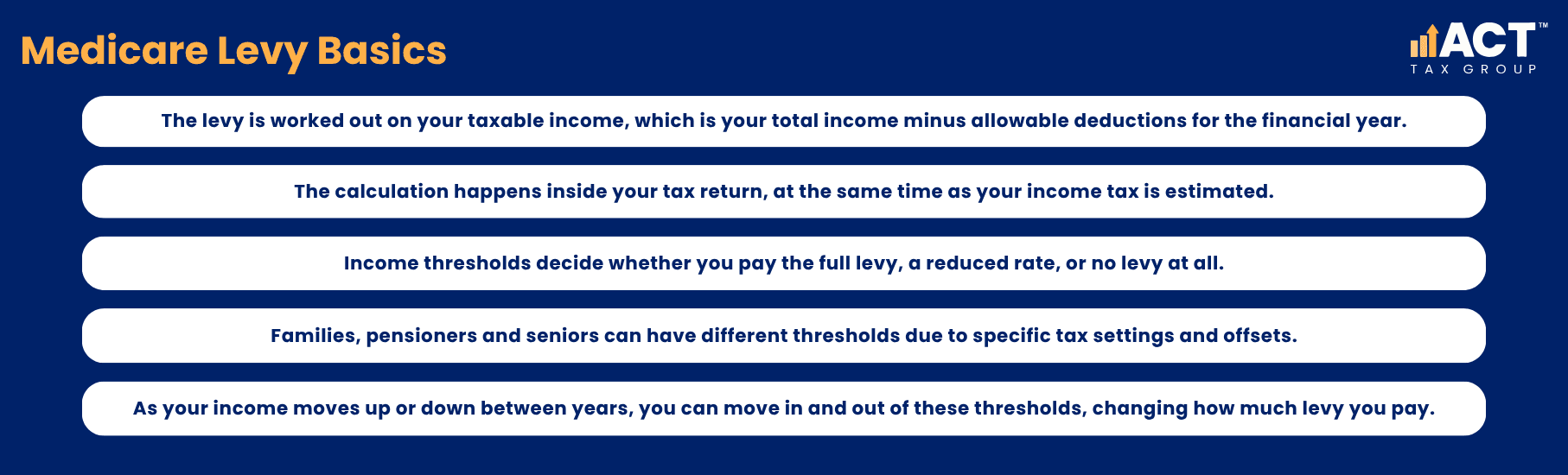
Most taxpayers pay the Medicare levy at the standard rate of 2% of taxable income, unless they qualify for a reduction or exemption. Your taxable income is the amount left after your allowable deductions are taken away from your income. The levy is worked out on that final figure for the full income year, not just one busy month.
How Medicare Levy connects to arborist income
For an arborist, income often comes from a mix of wages, business profit and sometimes other sources. Once expenses and deductions are taken off, the remaining taxable income is used to calculate the levy. If your taxable income is above the low-income threshold, you may pay the full 2% levy. For 2024–25, the no-levy threshold is $27,222 for singles and $45,907 for families, with higher thresholds for eligible seniors and pensioners. If your income is low, you may pay at a reduced rate or not pay it at all for that year.
The important point is that the Medicare Levy sits beside your income tax. It is not based on individual jobs or separate to your normal tax. It is simply one more part of the total tax amount that is worked out at the end of the year.
How the Medicare Levy Is Calculated
The basic process for how the Medicare Levy is calculated is the same for most taxpayers, including arborists. First, your total income for the financial year is added up. Then your allowable deductions are taken away to arrive at your taxable income, so it is important to avoid common tax deduction mistakes that distort taxable income. The levy is then calculated based on that taxable income at a standard rate, unless you qualify for a reduced rate or an exemption.
Most taxpayers do not see this calculation happening because it sits inside the tax return. When you lodge your tax return, the system uses the figures you enter for income and deductions to estimate your income tax and your Medicare Levy at the same time.
Income Thresholds and Reduced Rates
Not everyone pays the full levy. There are income thresholds that decide whether the levy is charged at the full rate, at a reduced rate, or not at all. People with low annual income for the year may pay a reduced rate or be exempt for that income year. Families, pensioners and seniors may have different thresholds, especially where the seniors and pensioners tax settings and pensioners tax offset apply.
If your income rises one year and falls the next, you may move in and out of these thresholds. That is why some years the levy feels heavier than others, even if your day‑to‑day lifestyle has not changed much.
Medicare Levy Surcharge and Private Health Cover
The MLS is separate from the basic Medicare Levy. It is an extra charge that applies when higher income taxpayers do not hold an appropriate level of private hospital cover. It does not replace the levy; it is an additional amount on top for those who do not meet the hospital cover requirement.
For MLS purposes, the ATO uses income for MLS purposes, which can include taxable income, reportable fringe benefits, net investment losses and certain reportable super contributions. For families, your spouse’s income can also be relevant. This combined figure is compared to income thresholds that decide whether the MLS applies.
How Arborists Can Trigger the Surcharge
An arborist can end up having to pay MLS when annual income improves and family income crosses a threshold, but there is no appropriate hospital cover in place. The surcharge can still apply if you only hold extras cover. The key requirement is an appropriate level of private patient hospital cover for you, your spouse and your dependants.
It also matters when the cover starts. If you only take out appropriate private patient hospital cover partway through the income year, MLS may still apply for the days you, your spouse or your dependants were not covered. Cover for part of the year usually only helps for that part, and the surcharge can apply to the rest of the year if there was no qualifying hospital cover.
Exemptions, Reductions and Special Cases
Not everyone pays the levy in the same way. Some people are exempt for all or part of the year, while others pay a reduced rate. Your eligibility depends on whether you fall within an ATO exemption category, such as certain medical exemption categories, foreign resident status, or not being entitled to Medicare benefits for a relevant period.
An exemption means you do not have to pay the levy during the exempt period. A reduced rate means you pay the levy but at a lower percentage. These outcomes depend on conditions such as residency, eligibility for Medicare, income level and family arrangements.
When an Exemption or Reduced Rate May Apply
There are several situations where people can be exempt or partly exempt. Some taxpayers may be exempt for periods when they are not entitled to Medicare benefits, but the exemption is subject to ATO rules, including spouse and dependent requirements. A Medicare Entitlement Statement supports the claim, but does not automatically mean the taxpayer is exempt. Overseas periods do not automatically reduce the Medicare levy. The relevant question is whether you were in an ATO exemption category for that period, such as not being entitled to Medicare benefits and meeting the dependent and spouse rules.
Seniors and pensioners who are eligible for the Seniors and Pensioners Tax Offset may have higher Medicare levy thresholds. Families with a dependent child or more than one dependent child often have different family income thresholds and may qualify for reductions that do not apply to single individuals.

How Medicare Levy Shows Up on Arborist Payslips
On your payslip, you will usually see Pay As You Go (PAYG) withholding as one tax amount, not a separate Medicare levy line. The final Medicare levy is calculated in your tax return, while payroll withholding is worked out using ATO tax tables and any valid Medicare levy variation details. This is because tax on wages is worked out using tables that already include the levy for most taxpayers.
For your employees, gross pay is listed at the top, followed by tax withheld, super contributions and net pay. The tax withheld figure is reported as PAYG withholding and is credited against the employee’s final tax position when they lodge their tax return, which may include income tax, Medicare levy and any MLS. When your employee lodges their tax return, all of that is rolled into their final tax and levy calculation.
Owner wages and levy
If you operate through a company or trust and pay yourself wages as an employee, your payslip generally works like any other employee’s payslip. PAYG withholding is reported to the Australian Taxation Office (ATO) and credited against your final tax position when you lodge your individual tax return. If you are a sole trader, drawings are not wages and are not processed through payroll. Your Medicare levy is dealt with through your individual tax return, along with your business income and deductions.
Because the levy is not separately shown on each payslip, many owners feel surprised when they see it listed in their tax outcome. In reality, it has been part of the calculation the whole time; it simply has not been shown as a separate entry on each payslip.
BAS, PAYG and the Levy for Arborist Businesses
Your Business Activity Statement (BAS) plays a big role in how tax is paid during the year, but it does not show the word “Medicare” anywhere. Instead, it shows amounts for Goods and Services Tax (GST), PAYG withholding and PAYG instalments. Understanding BAS and GST reporting for your business and how to maximise GST credits while staying ATO‑compliant helps ensure these figures are accurate. These all flow into the final tax position, which includes the Medicare Levy and any MLS that may apply.
When you report PAYG withholding on your BAS for your crew, you are passing on the tax and levy component that has been taken from their pays. If you also lodge separate Instalment Activity Statements, understanding the difference between IAS and BAS and how instalments work will help keep your reporting on track. When you pay PAYG instalments, those amounts are credited against your final assessed tax position, which may include income tax, Medicare levy and any MLS, and missing them can trigger the issues outlined in what happens if you miss PAYG instalments.

End‑of‑Year Reconciliation
At the end of the income year, when you lodge your tax return, the total tax and levy you owe is compared against everything that has already been paid through PAYG withholding and PAYG instalments. If enough has been paid through the year, you may receive a refund. If not enough has been paid, you may have to pay the difference.
This is why arborists can be surprised at tax time. A busy year with strong income can mean the final calculation is higher than expected, especially if PAYG instalments have not kept pace with the growth in the business.
Families, Pensioners and Arborist Households
Many arborist businesses are family‑run and may include a spouse, a dependent child or older parents who are pensioners or seniors. These relationships can change how the levy and surcharge work because the tax system often looks at family income and not only individual income.
For example, the thresholds that decide whether the MLS applies can be based on combined family income. This means your spouse’s income and your own income are added together. If the total is high enough and there is no appropriate hospital cover in place, the surcharge may apply even if neither of you would have triggered the surcharge alone.
Seniors and Pensioners in the Mix
Where one or both partners are seniors or pensioners, the seniors and pensioners tax rules and pensioners tax offset can change the thresholds for the levy and sometimes the way reductions are applied. This can ease the burden for some households, but it can also make the calculations more detailed.
In a family arborist business, it is common for one partner to be more involved in the day‑to‑day running of the business and the other to handle the paperwork. Making sure both understand how family income, pension payments and health cover interact with the levy can reduce confusion and stress at tax time.
Grow your tree care business with Accounting Built for Arborists
From start-up to expansion, our accounting team supports your tax, payroll, and cash flow — so you can focus on running your business safely and profitably.
Practical Arborist‑Friendly Actions
Rather than treating the Medicare Levy and the MLS as a mystery, you can turn them into another part of your normal business routine. The aim is not to become a tax expert, but to keep a clear view of where you stand before tax time arrives.
Keep an Eye on Your Income During the Year
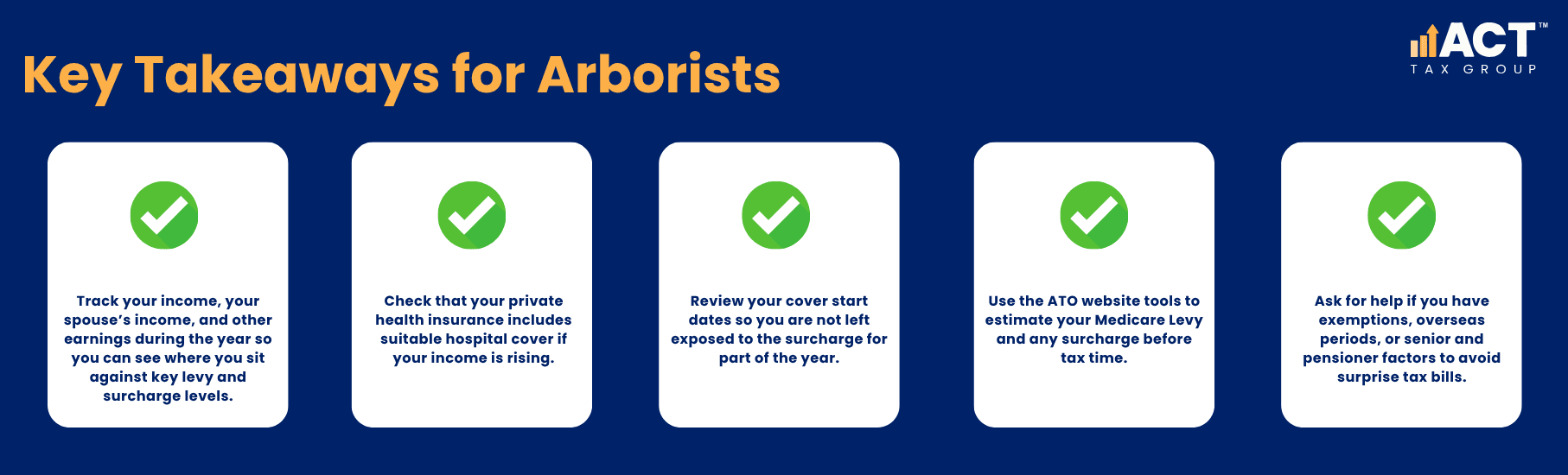
Instead of waiting until your accountant tells you the result, it helps to track your income as the year goes on. This means looking at your own annual income from the business, your spouse’s income, and any investment income or extra super contributions you are making. Applying cash flow management tips for arborists can make it easier to smooth out seasonal swings and monitor these figures. When you add these together, you get a simple picture of where your household sits compared with the key income levels that affect Medicare Levy and MLS.
Review Your Health Cover as Your Business Grows
If your income is increasing, it is worth checking whether your health insurance still suits your situation. Focus on whether you have private health insurance that includes hospital cover, not just extras. The aim is to make sure the hospital cover meets the standard used when working out whether the surcharge applies.
Use ATO Guidance and Ask for Help When Needed
The ATO website includes explanations and tools that show how the levy and surcharge are worked out, and using ATO online services for small and medium businesses can streamline how you manage your tax accounts. Taking a short time to read through these can give you more confidence and help you understand what to expect when you lodge your tax return. If your situation includes exemptions, time as a foreign resident, mixed income sources, or seniors and pensioners tax issues, it is sensible to ask for help before you lodge.
How ACT Tax Group Works with Arborists on These Issues
As an arborist, you already manage risk in trees, equipment and crew safety every week. You do not need extra surprises from the ATO on top of that. Our role is to help you see clearly how tax, levy and health cover decisions are affecting your overall financial situation.
We take the time to explain how the levy and surcharge relate to your arborist income patterns, your family income and your private health cover. We help you read payslips, BAS statements and ATO letters so you understand how much tax you are paying and why. Together, we can build a simple, realistic plan so that, when you lodge your tax return each year, the result lines up with what you were expecting.
If you would like support making sense of your Medicare Levy, MLS and how they appear on your payslips and BAS as an arborist, reach out to ACT Tax Group. We will talk through your real numbers with you and help you make clear, confident decisions without the stress.

Lukasz Klekowski
Principal of ACT Tax Group, specialising in tax compliance and financial strategy for Australian small businesses.

Disclaimer: All information provided in this publication is of a general nature only and is not personal financial or investment advice. It does not take into account your particular objectives and circumstances. No person should act on the basis of this information without first obtaining and following the advice of a suitably qualified professional. To the fullest extent permitted by law, no person involved in producing, distributing or providing the information in this publication (including ACT TAX GROUP PTY LTD, each of its directors, councilors, employees and contractors and the editors or authors of the information) will be liable in any way for any loss or damage suffered by any person through the use of or access to this information. The Copyright is owned exclusively by ACT TAX GROUP PTY LTD (ABN 31634338088)