

What Pty Ltd Really Changes About Your Personal Risk as an Electrician Director
Published on April 28, 2026
What Pty Ltd Really Changes About Your Personal Risk as An Electrician Director is not just the letters after your business name; it changes your legal status, how far limited liability protection really goes, and when your personal assets can still be at risk.
What Pty Ltd Actually Means for an Electrician
This first section unpacks what a Pty Ltd company really is and how it changes your business structure compared with running in your own name. The goal is to show clearly where the company stands as a legal entity and where you stand as the company director.
Are you unsure when your Pty Ltd actually protects your home and savings?
Schedule a complimentary consultation with us today to clarify your director risks and asset protection as an electrician.
From Sole Trader to Separate Legal Entity
As a sole trader, your business and personal life are legally the same. Your business name, if you use one, is just another way of saying “you.” If the business owes money, you owe money. Your personal assets, including your home and savings, are on the line if things go badly.
A proprietary limited company changes that by creating a separate legal entity. The company can own property, sign contracts, take on company debts and operate under its company name. When registered, it receives an Australian Company Number (ACN) from ASIC and may also have an Australian Business Number (ABN) for tax and business purposes. In other words, the company is the one that trades, not you personally. This is why many Australian businesses, especially small electrical contractors, see a Pty Ltd company as the most common type of structure once they grow past a one-person operation.
Limited Liability and What It Really Covers
The key reason electricians look at a proprietary limited company is limited liability. In this context, “limited” refers to the way shareholders are responsible only up to the amount they have agreed to contribute to the company, such as share capital or unpaid capital on partly paid shares. The company’s debts belong to the company, not automatically to the individual shareholders.
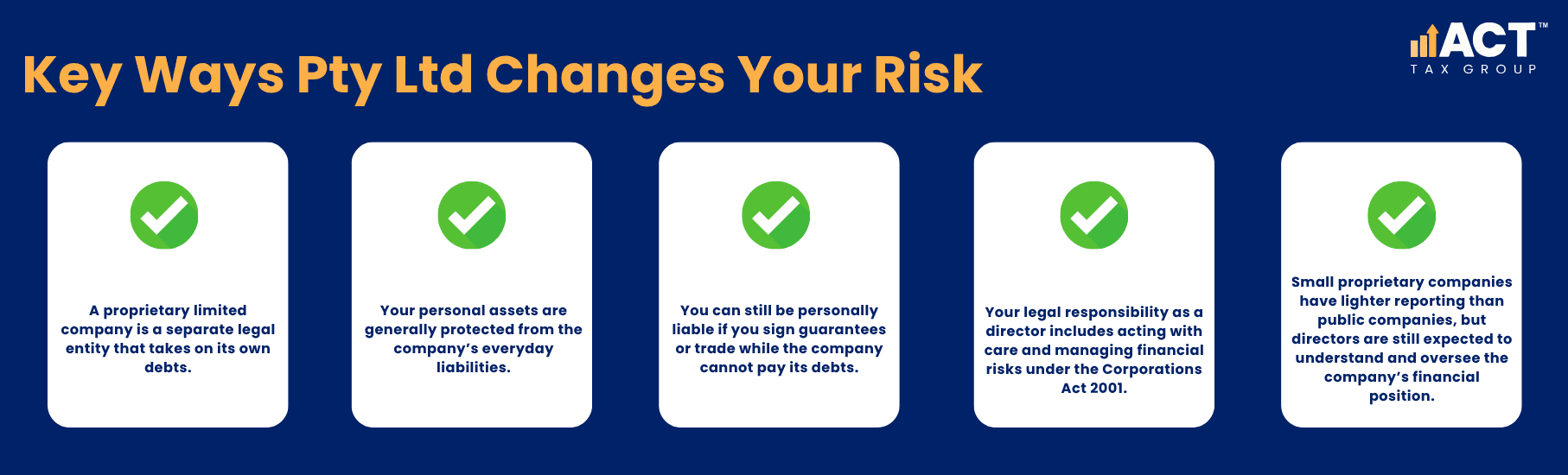
For you as an electrician, that means that if the company cannot pay all of its bills, creditors usually have to deal with the company as a legal entity. Your personal assets are generally protected from those company debts, as long as you have not personally guaranteed them and have met your legal obligations as a director. This is one of the main benefits of choosing a limited company structure instead of remaining a sole trader.
Company Types and Where You Fit
There are several company types recognised under Australian laws, including public companies listed on the Australian Securities Exchange (ASX), foreign company branches, unlimited companies and proprietary limited companies. For an electrician in the ACT, you are usually dealing with a proprietary company limited by shares, rather than a public company. A proprietary company generally cannot have more than 50 non-employee shareholders and cannot offer shares to the public.
A proprietary company must have at least one director and no more than 50 non-employee shareholders. It cannot offer shares to the public. It is a private company with “Pty Ltd” in the company name and is the most common company type used by trade businesses in Australia.

How Pty Ltd Changes Your Personal Risk (And How It Does Not)
Now that we have covered the basic meaning of Pty Ltd, this second section looks directly at what actually changes about your personal risk once you become a company director. It explains where you are generally protected and where you can still be personally responsible.
When The Company’s Debts Are Not Your Debts
In a proprietary limited company, the default position is that the company is responsible for its own debts. The company can borrow money, enter contracts and own property in its own name. If something goes wrong on a job and the company owes a supplier or a contractor, they look to the company as the liable party.
This separation is a major shift from the sole trader model, where your own name is on everything. With a Pty Ltd, your personal assets are not automatically exposed to every company liability. That helps many electricians sleep better at night, especially when they start taking on bigger projects or hiring more sparkies and apprentices.
When You Can Still Be Personally Liable
However, limited liability protection is not a blanket shield. You can still be personally liable in certain situations, usually because of decisions you make as a director. Common examples include signing personal guarantees with wholesalers or finance companies, using your own name on contracts instead of the company name, or continuing to trade when the company cannot pay its debts as they fall due.
Your legal responsibility as a director comes from the Corporations Act 2001 and related rules. These require you to act with care, avoid unreasonable risk, and ensure the company does not misuse its limited liability status. If you ignore clear warning signs about the company’s financial position, continue trading while insolvent, or fail to ensure the company meets key tax and super obligations, you may become personally exposed. The ATO can also make directors personally liable for unpaid Pay As You Go (PAYG) withholding, Goods and Services Tax (GST), and Superannuation Guarantee Charge (SGC) amounts under the director penalty regime.
Public Companies vs Your Electrical Business
You might hear a lot about public companies, stock exchange rules and large proprietary companies, and feel like those worlds are far removed from your day-to-day jobs. In many ways they are, but the core idea is the same. Directors, whether of a large company or a small one, must understand the company’s financial responsibility and act in its best interests.
The main differences for you are scale and reporting. A small proprietary company is generally not subject to the same reporting obligations as a public company, and most small proprietary companies do not need to prepare or lodge financial reports with ASIC unless specific circumstances apply. However, the expectation that you take your role seriously and understand your company’s position still applies.
Your Role as An Electrician Director Inside a Pty Ltd
This third section dives into what it means to be a company director when you are also the one running the jobs, handling apprentices and juggling invoices. It covers the everyday side of director duties.
Understanding Your Legal Status as Director
When you register a proprietary limited company, you become a company director rather than just a business owner. Your name is recorded on company documents as the person responsible for overseeing the company. This role is not only about signing forms; it is about making sure the company follows Australian laws, including the Corporations Act and tax rules. Before becoming a company director, you also need a Director Identification Number (Director ID). This is a unique number that stays with you permanently and helps ASIC confirm your identity across company roles.
You need to know how money moves through the company, which debts are due when, and whether the business can realistically meet its commitments. You also need to make sure the company’s business name, ABN, ACN and structure are correctly used on paperwork, so that customers and suppliers are clear they are dealing with the company, not with you in your own name.
Financial Responsibility and Day-To-Day Oversight
Your financial responsibility as a director is not the same as paying every bill yourself, but you are responsible for making sure the company has systems in place to stay on top of its obligations. That includes clear records for income and expenses, accurate payroll for your sparkies and apprentices, and timely reporting for tax, payroll, Pay As You Go (PAYG) withholding, Single Touch Payroll (STP), and Superannuation Guarantee (SG).
You may not need to prepare or lodge ASIC financial reports if the company is a small proprietary company, unless an exception applies. Many electricians benefit from simple monthly reports showing how much work has been done, what is owed by customers, what the company owes to others, and how close the business is to the GST registration threshold, and what profit is left once everything is counted. This helps you spot problems early and reduces the risk of drifting into a position where the company can no longer pay its debts.
Ownership, Shareholders and Control
In a Pty Ltd company, ownership is based on shares. You might be the only shareholder, or you might share ownership with a partner or another electrician. Your share structure sets out who owns what percentage of the company and how profits can be distributed.
This share-based ownership is one of the main benefits of a company structure. It gives you flexibility to bring in new owners, sell shares in the future, or transfer ownership over time without shutting down the business. At the same time, it means you need to be clear about who has a say in major decisions, how profits are shared, and how any partly paid shares or unpaid capital will be handled if someone wants to exit.

Practical Steps to Use Your Pty Ltd Structure Safely
This fourth section focuses on what you can do, week by week and quarter by quarter, to make sure your proprietary limited company actually reduces your personal risk instead of adding new stress.
Keeping The Company’s Money Separate from Your Own
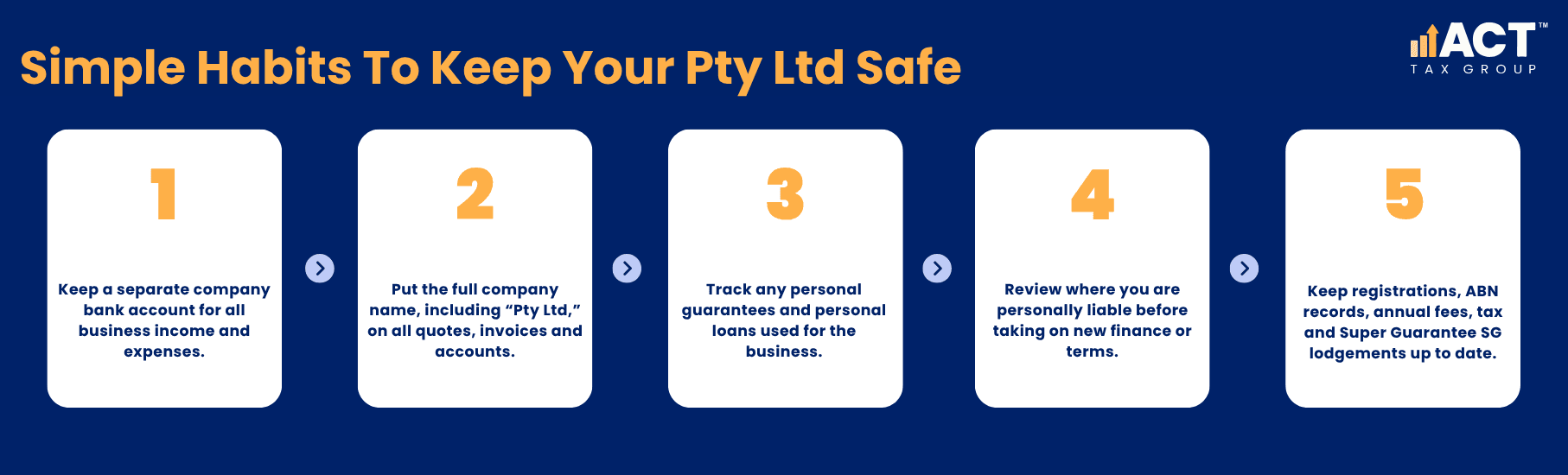
The first practical step is to treat the company as truly separate. That means having a dedicated company bank account, running all business income and expenses through it, and avoiding mixing company funds with personal spending. When the company pays for tools, vehicles or other property, it should do so from its own account and in its own name.
Using the full company name, including “Pty Ltd,” on quotes, invoices and supplier accounts helps reinforce this separation. It also reminds everyone involved that they are dealing with a company, which supports the limited liability approach of your business structure. Over time, clear separation makes it easier to see how the company is performing and where any risks sit.
Power up your business with Accounting Built for Electricians
From start-up to expansion, our accounting team supports your tax, payroll, and cash flow at every stage of growth.
Knowing Your Personal Exposure Points
The second step is to keep a running view of where you might still be personally exposed. This includes any personal guarantees you have signed, any loans held in your own name that are used for business purposes, and any contracts that might not clearly show the company as the contracting party.
It helps to review these details every so often, especially when you are considering new finance or supplier terms. If you know where you are personally liable, you can make informed choices about how much risk you are comfortable taking on and when it might be better to negotiate different terms or say no to an offer.
Staying Ahead of Company Obligations and Deadlines
The third step is to stay ahead of your company’s legal obligations. That includes renewing registrations, keeping your Australian Business Number details up to date, handling ASIC late fees and penalties if something is missed, paying ASIC annual review fees, checking company details, passing a solvency resolution, and maintaining accurate company records. It also includes lodging activity statements, PAYG withholding reports, STP reports, tax returns, and any required SGC statements on time, and understanding what happens if you miss PAYG instalments so that the company stays on the right side of its legal responsibilities.
Superannuation timing also needs to be monitored closely. For periods ending on or before 30 June 2026, SG contributions must generally be paid at least quarterly. From 1 July 2026, Payday Super will require employers to pay SG contributions each payday.
These tasks may feel administrative, but they are part of how you show that the company is being run properly. When your company records, filings and accounts are current, it is easier to rely on the protections built into the proprietary limited structure. It also means fewer surprises from regulators and more confidence when dealing with banks, suppliers and potential buyers.
Bringing It All Together for Your Electrical Business
Running your electrical business through a Pty Ltd company changes your legal status, your personal risk, and the way others see your operation. The company becomes its own legal entity, with the ability to own property, take on company debts and operate as a private company recognised under Australian laws. You move from being a sole trader to being a company director responsible for guiding that legal entity.
Used well, a proprietary limited structure can give you clear boundaries between business risk and personal assets, a flexible share structure to support growth, and a more professional platform for dealing with larger clients. Used without understanding, it can create a false sense of safety while leaving you personally exposed through guarantees, poor records or missed obligations.

Lukasz Klekowski
Principal of ACT Tax Group, specialising in tax compliance and financial strategy for Australian small businesses.

Disclaimer: All information provided in this publication is of a general nature only and is not personal financial or investment advice. It does not take into account your particular objectives and circumstances. No person should act on the basis of this information without first obtaining and following the advice of a suitably qualified professional. To the fullest extent permitted by law, no person involved in producing, distributing or providing the information in this publication (including ACT TAX GROUP PTY LTD, each of its directors, councilors, employees and contractors and the editors or authors of the information) will be liable in any way for any loss or damage suffered by any person through the use of or access to this information. The Copyright is owned exclusively by ACT TAX GROUP PTY LTD (ABN 31634338088)