

Latest Income and Small Business Tax Rates for Australian Carpenters: What’s Changed in 2026
Published on January 13, 2026
Latest Income and Small Business Tax Rates for Australian Carpenters: What’s Changed In 2026 is not just a mouthful of a topic; it is the reality behind how much tax you pay and how much you actually get to keep as take home pay each financial year. If you are a carpenter dealing with progress claims, retentions, and long waits for payment, you already know that every dollar of taxable income matters when it comes to your cash flow and peace of mind.
When A Tax Year Change Blows Up Your Cash Flow
Picture this: a big progress claim finally lands in your account in June, after months of juggling wages, subcontractors, and suppliers. It feels like a win, until you realise that lump of income has pushed your taxable income into a higher tax bracket for tax purposes, changing how much tax you will owe when you lodge your tax return for the 2025–26 income year.
You start to wonder how much tax will be taken off, what the resident tax rates actually are for Australian residents in 2025–26, and whether the current tax rates mean you will need to put extra money aside for the Australian Taxation Office. That is exactly where understanding the 2025–26 tax rates and thresholds can help you avoid that sinking feeling at year end.
Worried how 2025–26 tax brackets will hit your carpentry income?
Schedule a complimentary consultation with us today to map your income to the right tax bracket and plan PAYG.
Current Income Tax Rates for Carpenters In 2025–26
For the 2025–26 income year (the return you lodge in 2026), the resident tax rates for Australian residents follow clear tax brackets that apply to your taxable income. These tax rates determine the tax payable on your income, and they sit alongside the Medicare Levy and, for some people, the Medicare Levy Surcharge.
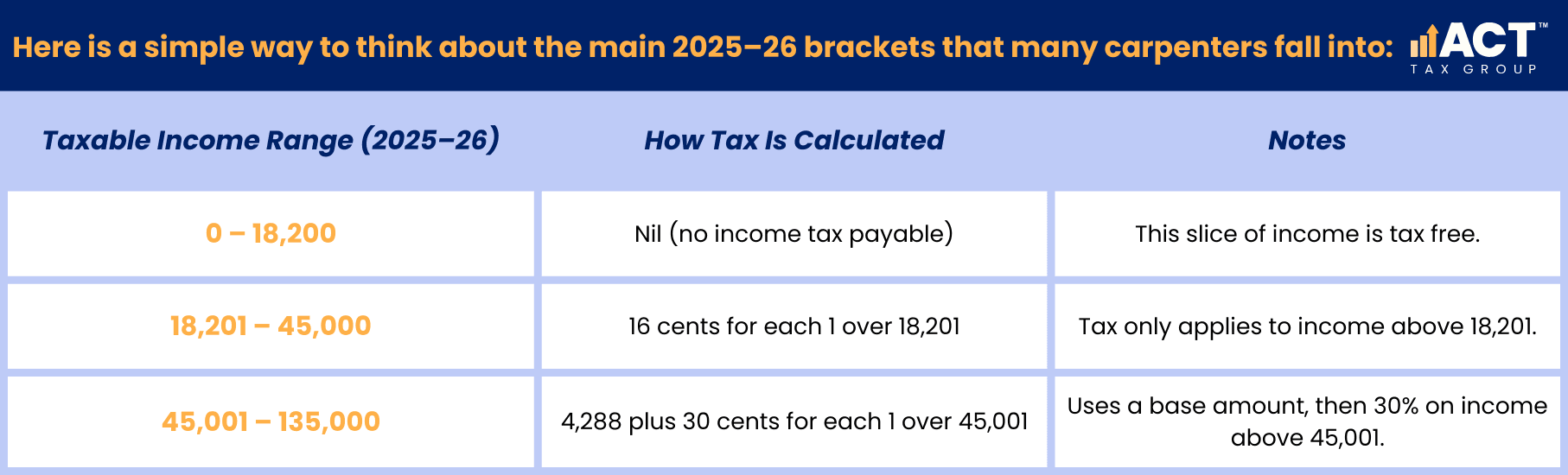
These 2025–26 figures matter because many carpenters land somewhere between 45,001 – 135,000 once all payments from builders and other payees are included. A big invoice late in the financial year can shift you further into a higher band, which means more tax and a reduced take home pay if you do not plan ahead.
Where Medicare Levy And Surcharges Fit In
On top of income tax based on the 2025–26 resident tax rates, most residents also pay the Medicare Levy, which is a small percentage of your taxable income that helps fund the health system. For higher-income earners without private hospital cover, the Medicare Levy Surcharge can apply as an extra cost on top of the standard levy.
This means your final tax payable for 2025–26 is not just about the basic tax tables or the headline tax rates; it is income tax plus the levy, and possibly the surcharge, all calculated together. If your income climbs during the year because your business finally has a strong run of work, it is important to remember that your levy can also increase, changing how much money you need to set aside as you go.
Company Tax Rates For Carpentry Businesses In 2025–26
If your carpentry business operates through a company, the tax story for 2025–26 looks slightly different. Instead of your business profit being taxed at the resident tax rates as personal income, the company itself pays tax at the current company tax rates for that income year.
For 2025–26, many small trading companies, including carpentry businesses, qualify as base rate entities. That means:
The company tax rate is 25% for base rate entities that meet the turnover and income tests.
The general company tax rate is 30% for companies that do not meet those conditions.
That company tax is calculated on the profit left after allowable tax deductions, like wages to employees, super contributions, and other eligible expenses, have been included. This can help smooth out how much tax is paid by the business across income years, instead of every dollar flowing straight into your personal tax return.

Small Business Income Tax Offset and Carpenters In 2025–26
If you run your carpentry operation as a sole trader, or you receive business income from a partnership or trust, you might be entitled to the Small Business Income Tax Offset for the 2025–26 income year. This offset is designed to reduce the tax payable on your net small business income by a certain amount, up to a yearly cap.
For 2025–26, the offset settings remain:
Up to 16% of the tax on your net small business income,
Capped at a maximum of 1,000 per individual per year.
The offset does not change your taxable income, and it does not lower the 2025–26 tax rates or thresholds. Instead, once your tax is calculated, the offset is applied to reduce the final amount you have to pay. It is automatically worked out when you lodge your tax return, provided your income and business details are correct and you are eligible under the current rules.
What’s Actually Different In 2026 For Carpenters
For many carpenters, the main point in 2026 is that the Stage 3 changes have already flowed through and the 2025–26 resident tax rates and company tax settings are now the “new normal.” The ranges like 18,201 – 45,000 and 45,001 – 135,000 still decide how much tax each extra dollar of income is subject to for the 2025–26 income year.
At the same time, the 25% company tax rate for eligible base rate entities and the 30% general company rate continue to apply for 2025–26, and the Small Business Income Tax Offset still runs at up to 16% of tax on net small business income, capped at 1,000. So in 2026, the big question for you is not “what has changed this month?” but “how and where is my income for 2025–26 being taxed” — as wages, as business profit in a company, or as net business income in your own name.
How 2025–26 Tax Brackets Hit Real Carpentry Jobs
Think about a 2025–26 year where you have several large residential builds running at once. Money goes out every week to pay employees, subcontractors, and suppliers, but income comes in chunks when you issue progress claims. It is easy to lose track of your year-to-date income, especially when interest on loans, vehicle costs, and other deductions are all moving parts.
If you do not keep an eye on where your taxable income sits against the 2025–26 tax thresholds, that final big payment near the end of the financial year might push you from one tax bracket into the next. That shift can change how much tax is withheld, how much tax you need to pay when you lodge your 2026 return, and how much your PAYG instalments might be in the next income year.

Using Tax Deductions to Get to the Correct Amount
Tax deductions are simply the legitimate business costs you can claim to reduce the taxable income the Australian Taxation Office uses to work out your 2025–26 tax payable. For carpenters, that can include items like tools, protective clothing, some vehicle expenses, and training costs, provided they are used for work and meet the rules.
The goal is not to chase every possible deduction, but to make sure you are claiming the correct amount for the income you actually earn in 2025–26. Clear records of payments, invoices, and other documents mean the deductions are easy to calculate and to explain if the ATO ever asks questions. Better records also help your accountant work out how much tax you should withhold or set aside during the year, so you are not caught short when it is time to lodge.
PAYG, Withholding and Keeping Cash Flow Steady In 2025–26
Most carpenters deal with Pay as You Go (PAYG) in one of two ways in 2025–26: as employees who have tax withheld from their pay by an employer, or as business owners who pay PAYG instalments directly to the ATO. Either way, the idea is to pay tax in smaller amounts through the year, instead of one large bill at the end.
If you have employees, you must withhold tax from their wages using the current 2025–26 tables and rates, then send those amounts to the ATO along with super and other contributions. Getting this right is essential, because any shortfall does not just affect your employees’ tax position; it can also leave your business owing more at the end of the income year. For business owners, reviewing PAYG instalments regularly helps make sure you are not paying too much or too little based on your actual 2025–26 income.
Practical Steps To Stay Ahead Of Your 2026 Tax Bill
You do not need to become a tax expert to stay on top of your obligations for the 2025–26 income year; you just need a simple system that keeps your income, deductions, and payments visible across the year. For a carpentry business, that means connecting what is happening on site with what ends up on your 2026 tax return.
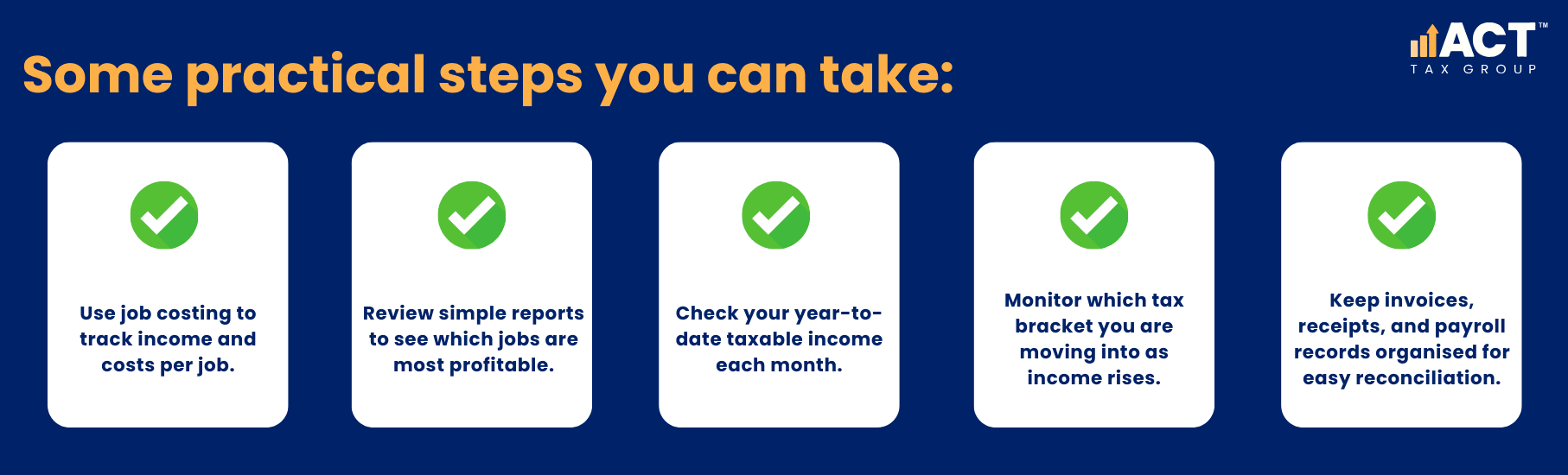
These simple habits help you learn how the 2025–26 current tax rates apply to your situation, find issues early, and make sure the information on your 2026 tax return is correct and complete.
How ACT Tax Group Can Support Carpenters In 2026
As a carpenter, you want steady work, fair pay, and enough money left after tax to grow your business and look after your family, especially as the 2025–26 numbers flow into your 2026 tax position. The rules around tax, thresholds, and rates might feel dry, but they have a real impact on every quote you send and every invoice you chase.
ACT Tax Group helps carpentry and construction business owners turn those 2025–26 rules into simple, practical steps—like cleaner records, clearer reports, and better planning around payments and deadlines. If you want help understanding how the current tax rates for 2025–26 affect your business this year, and how to keep your cash flow strong while staying on the right side of the Australian Taxation Office, we are ready to walk through it with you in straightforward terms.

Lukasz Klekowski
Principal of ACT Tax Group, specialising in tax compliance and financial strategy for Australian small businesses.

Disclaimer: All information provided in this publication is of a general nature only and is not personal financial or investment advice. It does not take into account your particular objectives and circumstances. No person should act on the basis of this information without first obtaining and following the advice of a suitably qualified professional. To the fullest extent permitted by law, no person involved in producing, distributing or providing the information in this publication (including ACT TAX GROUP PTY LTD, each of its directors, councilors, employees and contractors and the editors or authors of the information) will be liable in any way for any loss or damage suffered by any person through the use of or access to this information. The Copyright is owned exclusively by ACT TAX GROUP PTY LTD (ABN 31634338088)