

Do Arborists Need to Pay Capital Gains Tax on Shares? What You Need to Know
Published on January 12, 2026
As an arborist, you generally need to include any net capital gain from selling shares in your individual tax return, and it is taxed at your marginal tax rate as part of your income tax (CGT is not a separate tax).
When Does Capital Gains Tax on Shares Apply for Arborists?
On top of that, whenever a CGT event happens (for example, when you sell or otherwise dispose of shares or other assets), the Australian Taxation Office expects you to keep records and report any relevant capital gains or capital losses for that income year in your tax return. You cannot just ignore that part of your tax; it forms part of the income tax system and can affect the tax you pay for the financial year.
A CGT event usually happens when you sell, gift, or otherwise dispose of shares or other assets such as property or crypto assets. For most arborists who are investing on the side, the most common CGT event is the sale of shares on the share market at a price higher or lower than the original purchase price. When that happens, you either make a capital gain or a capital loss, and this has to be reported in your tax return for that income year for tax purposes.
Worried your share sales could trigger unexpected tax this year?
Schedule a complimentary consultation with us today to calculate and plan your CGT position accurately.
Typical Share and Asset Situations for Arborists
You might not think of yourself as “investing” in a big way, but CGT can still show up in a few common situations. Understanding where capital gains tax fits into your financial life makes it easier to plan, set aside money and avoid nasty surprises with the ATO.
Selling shares in your personal account: If you acquired shares as personal investments and later sell them for more than the cost base, you make a capital gain and may need to pay capital gains tax as part of your assessable income.
Selling shares at a loss: If you sell shares for less than their cost base, you make a capital loss, which cannot be claimed as a deduction against other income but can offset capital gains in the same year, and any unused net capital loss is carried forward to offset capital gains in future years
Other investments and assets: CGT can also apply when you sell assets like an investment property, managed fund units or crypto assets held as investments, while your main home is generally exempt from CGT only if it meets the ATO’s main residence conditions (for example, it has not been used to produce income and sits on land of 2 hectares or less).
The key is that capital gains and capital losses form a separate tax calculation within your overall tax return, and the net capital gain (after you offset losses and any discount) is added to your other income such as business income, wages, or interest to form your taxable income for the year.

How Is Capital Gains Tax on Shares Calculated?
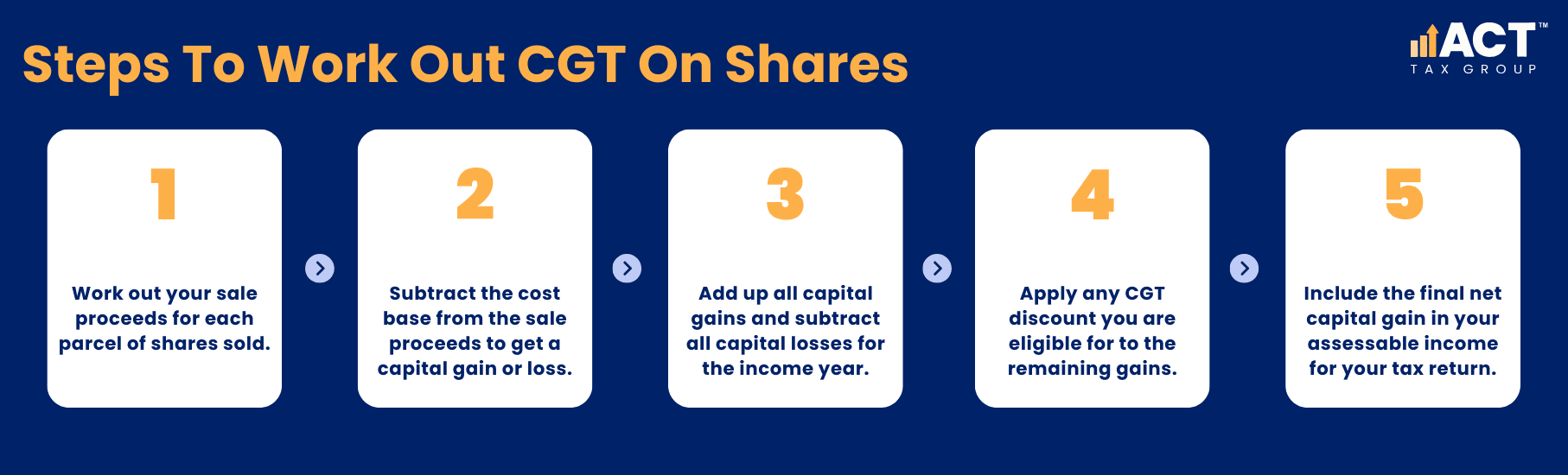
When you sell shares to keep money moving through a slow period, what you really want to know is “How much CGT do I actually need to pay?” The calculation is very methodical, and while the rules can feel complex, the core idea is that CGT is based on the difference between what you paid and what you received, adjusted for certain expenses and discounts.
You start with the capital proceeds from the sale, subtract your cost base to work out your capital gain or loss, use any capital losses (including carried‑forward losses) to reduce capital gains, and then apply any CGT discount you are eligible for. The end result is your net capital gain, which flows into your assessable income and affects the tax you pay at your marginal tax rate.
For an arborist, this might mean that selling shares for a profit in a tough winter provides much-needed cash but also increases the tax you pay at tax time. Planning ahead for that net capital gain, and understanding how losses and discounts work, helps you manage your financial position across the whole income year.
How Does The 50% CGT Discount Work for Arborists?
Many arborists do not buy and sell shares every week. Instead, you might invest during good seasons and then hold those investments for the long term until you need the money for equipment, retirement or to cover a slow patch. In those cases, the CGT discount can significantly reduce the gains tax you end up paying.
If you are an individual Australian resident for tax purposes and you have owned your shares for at least 12 months before the CGT event, you may be able to reduce the capital gain on those shares by 50% using the CGT discount, provided the asset is eligible under the CGT rules. In simple terms, only half of the capital gain goes into your assessable income, which can reduce the tax you pay.
If you want to plan a sale around retirement or a big purchase, getting clear tax advice ahead of time can help you decide when to sell so you manage both your cash and the tax you pay in that financial year.

Where Do Small Business and Other Assets Fit In?
Even though this article is focused mainly on CGT on shares, arborists often ask how CGT works on other assets and whether business structures change how they pay capital gains tax. For example, you might own investment property, units in a managed fund, or shares in your own arborist company alongside your personal share portfolio.
While your family home can generally be exempt from CGT when it qualifies as your main residence under ATO rules, most other property and investments do not receive this exemption. The rules for business assets, such as a depot or your business entity, can be more complex than for personal investing, and the tax rate and CGT concessions you might be eligible for will vary depending on your structure and other factors such as your level of net capital, asset values and the nature of the assets.
Grow your tree care business with Accounting Built for Arborists
From start-up to expansion, our accounting team supports your tax, payroll, and cash flow — so you can focus on running your business safely and profitably.
Simple CGT Record-Keeping Steps for Arborists
When you are out on-site doing tree removal, stump grinding and pruning, the last thing you want to think about is CGT. However, a bit of simple, ongoing record-keeping makes CGT easier to manage and avoids a mad scramble at tax time when your accountant is asking for details you cannot easily find.
Good records help you calculate your cost base, work out the capital gain or loss on each sale, and show how any carry forward capital losses were applied. This also supports you if the Australian Taxation Office ever asks questions about how you reported a particular CGT event.
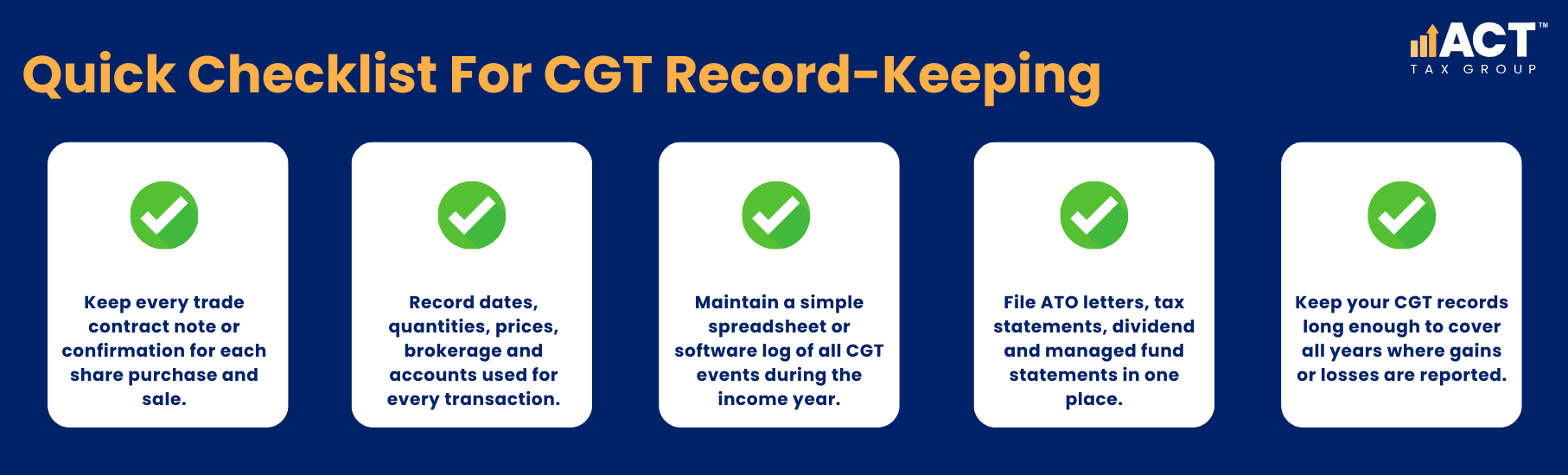
These steps are purely operational ways to manage your tax obligations and record-keeping, and they help you avoid paying more tax than you need to or missing out on legitimate offsets and discounts.
When Should Arborists Get Help with Capital Gains Tax?
If you have sold shares, crypto assets, an investment property or other investments in the last financial year, or you are thinking about selling a large parcel of shares to fund equipment or manage cash flow, it is usually worth getting expert advice before the sale goes through. Once a CGT event has happened at a certain contract price and market value, you generally cannot undo the event; at best you can amend how it was reported in your tax return if an error was made, but the underlying transaction still stands for CGT purposes.
A registered tax agent who understands arborist businesses can help you calculate your net capital gain, make sure capital losses from previous years are correctly applied, and ensure everything is reported properly in your tax return. They can also help you see how a large capital gain will interact with your other income and affect the tax you pay at your marginal tax rate.
At ACT Tax Group, the focus is on helping arborists manage tax obligations, including capital gains tax on shares and other assets, in a straightforward and practical way. This article is general in nature, for illustration only and does not constitute financial or personal advice. For ATO-compliant support that takes into account your actual numbers and financial situation, book a consult with ACT Tax Group and get tailored guidance before you sell.

Lukasz Klekowski
Principal of ACT Tax Group, specialising in tax compliance and financial strategy for Australian small businesses.

Disclaimer: All information provided in this publication is of a general nature only and is not personal financial or investment advice. It does not take into account your particular objectives and circumstances. No person should act on the basis of this information without first obtaining and following the advice of a suitably qualified professional. To the fullest extent permitted by law, no person involved in producing, distributing or providing the information in this publication (including ACT TAX GROUP PTY LTD, each of its directors, councilors, employees and contractors and the editors or authors of the information) will be liable in any way for any loss or damage suffered by any person through the use of or access to this information. The Copyright is owned exclusively by ACT TAX GROUP PTY LTD (ABN 31634338088)