

What Is a FRCGW Clearance Certificate and Who Needs One?
Published on January 12, 2026
What is a FRCGW clearance certificate and who needs one is a question many people only ask after property contracts are signed and the conveyancer starts asking for documents. A FRCGW clearance certificate is a confirmation from the Australian Taxation Office that the vendor is an Australian tax resident, so the purchaser does not need to have part of the purchase price withheld from the sale at settlement. Without this clearance certificate, 15% of the purchase price will be withheld from your sale proceeds, even if you live in Australia and lodge a tax return every year.
When you sell Australian real property, such as a home, unit or commercial premises, the capital involved is often one of your biggest financial decisions. The capital gains tax result, your cash flow and the timing of your next purchase can all be affected if you do not manage foreign resident capital gains withholding correctly. Understanding when FRCGW applies and how to obtain the right certificate helps you avoid surprises and keep the process smooth.
What Exactly Is A FRCGW Clearance Certificate?
A FRCGW clearance certificate is a document issued by the Australian Taxation Office that confirms the seller is an Australian tax resident for tax purposes. This certificate tells the purchaser and their legal practitioner that capital gains withholding FRCGW does not need to be withheld from the sale price at settlement. In simple terms, it protects Australian residents from being treated like a foreign resident when they sell taxable Australian property.
The certificate is linked to the vendor rather than just to one property. Once issued, it can often be used for multiple property sales within a set period, provided your residency status and details have not changed. It is a key part of many modern property transactions and is now routinely requested when real property contracts are entered in Australia.
From 1 January 2025, significant changes mean that all property sales in Australia now require a clearance certificate, regardless of the property’s value. The previous $750,000 threshold has been removed.
Confused about FRCGW and worried you’ll lose sale proceeds at settlement?
Schedule a complimentary consultation with us today to check if you need a clearance certificate and avoid unnecessary ATO withholding.
How Does Capital Gains Withholding FRCGW Work?
Capital gains withholding FRCGW is a process designed to make sure foreign resident sellers meet their tax obligations when they sell Australian property. If FRCGW applies and no valid clearance certificate or variation is provided, the purchaser must withhold a percentage of the purchase price at settlement and pay it to the Australian Taxation Office. This amount is a pre‑payment towards any capital gains tax that may be due on the sale.
For a resident seller, the problem arises when the system treats them like a foreign resident because there is no certificate on file by the settlement date. In that case, money can be withheld from the sale even though the vendor is an Australian tax resident and will later declare the income and capital gains in their income tax return. That is why having the right form completed and submitted early is so important.
These requirements apply to all property contracts signed on or after 1 January 2025. For contracts signed before this date, the previous rules (12.5% withholding rate and $750,000 threshold) still apply.
Who Needs A FRCGW Clearance Certificate?
A FRCGW clearance certificate is needed by all Australian residents who are vendors disposing of taxable Australian property as of 1 January 2025. This requirement now applies to all property sales regardless of value, as the previous $750,000 threshold has been removed. If you are an Australian tax resident selling Australian real property, the safest approach is to assume you will need a clearance certificate unless a professional confirms otherwise. This applies whether the property is your home, an investment property or a business premises.
The requirement applies to the legal owner of the asset. If a company owns the property, the company is the vendor and needs to submit the clearance certificate application. If the property is held by a trust or a self‑managed super fund, the relevant trustee is usually the vendor for legal purposes and should apply on behalf of that structure.

Are There Situations Where You Do Not Need One?
There are certain circumstances where a FRCGW clearance certificate may not be needed. For example, some income tax exempt entities can provide other ATO confirmations instead of a standard certificate, and some assets do not fall within the rules at all. In other cases, a vendor declaration might be acceptable if the asset is not taxable Australian property.
Foreign residents cannot obtain a clearance certificate because they are not a resident for tax purposes, but they may be able to apply for a reduction in the withholding rate in some situations. Where the standard withholding amount would be too high when compared to the likely Capital Gains Tax outcome, they can often seek advice about whether a variation might be possible. However, most everyday Australian residents will simply use the standard certificate process when they sell.
What Types of Property and Transactions Are Covered?
The FRCGW rules generally apply to Australian real property and certain related interests. This includes most residential houses, units, townhouses and vacant land located in Australia, as well as many types of commercial property. It can also cover long‑term leases and some rights to use land and natural resources.
The rules can extend beyond direct ownership of land. In some property transactions, the main asset being sold is shares in a company or units in a trust where most of the value is Australian property. In those cases, the law may treat the sale as involving an indirect interest in real property, which can still bring the FRCGW rules into play.
How Do You Apply For A FRCGW Clearance Certificate?
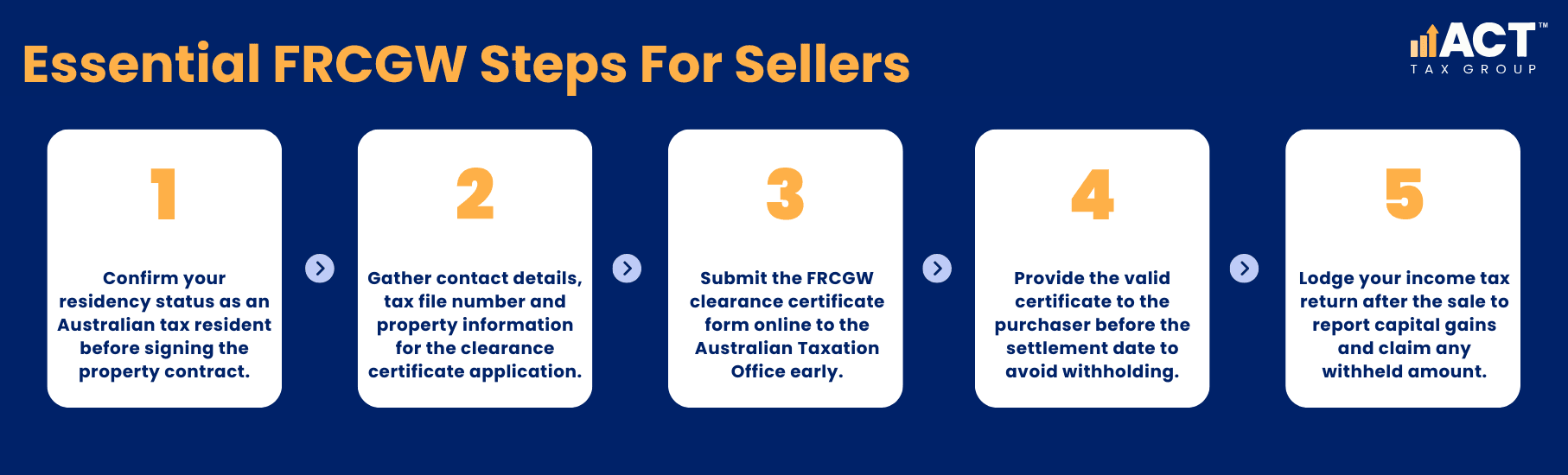
To apply for a FRCGW clearance certificate, you complete the relevant online form through the Australian Taxation Office and submit the required details. The clearance certificate application can be lodged by the vendor or by a registered tax agent or legal practitioner on their behalf. There is currently no ATO fee charged for submitting this form.
You will need basic contact details and identifying information for the legal owner, such as full name, address, tax file number or ABN if applicable. You also provide details about the property, such as the address and likely settlement date, along with information about the contracts entered. Once processed, the certificate will be emailed or otherwise made available so you can give it to the purchaser before settlement.
How Long Does a Certificate Take and How Long Is It Valid?
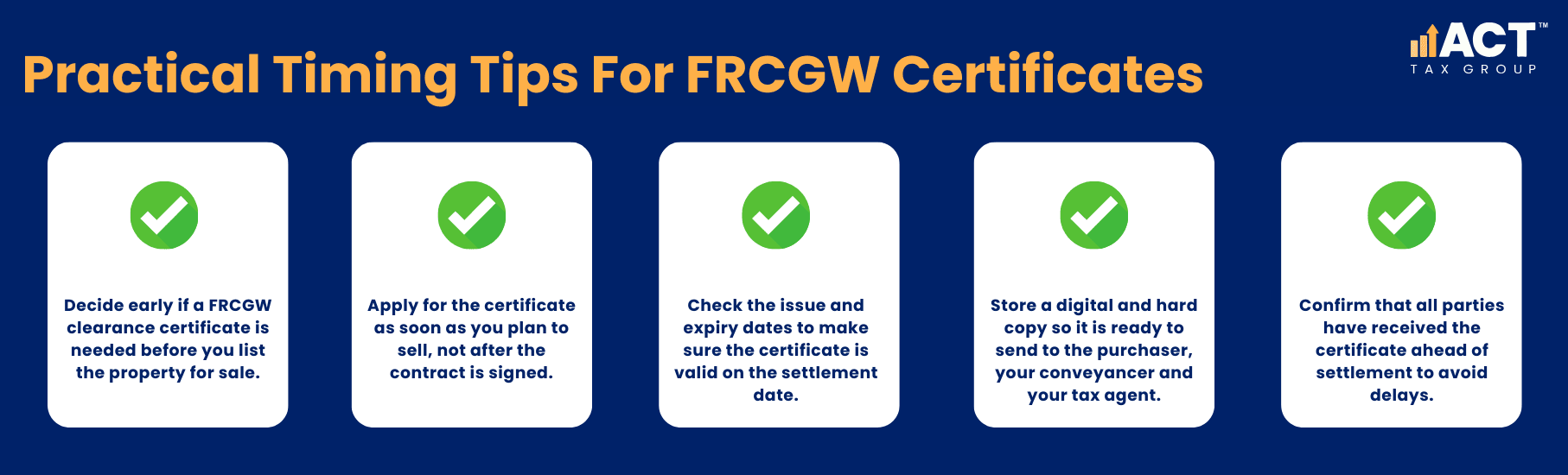
In many straightforward cases, the Australian Taxation Office issues the certificate quickly once the application is submitted. Some are processed within a few days, while others can take up to 28 days if further information is required. This is why it is important to apply well before the expected settlement date, so you are not waiting on approval at the last moment.
A clearance certificate is usually valid for a set period, often up to 12 months from the date of issue. During that time, it can be used for multiple property sales by the same vendor, provided the details remain valid and the vendor remains a resident for tax purposes. If your situation changes or the certificate is due to expire, a new application may be required.
What Happens If You Do Not Provide a Certificate?
If you are an Australian resident and do not provide a valid clearance certificate by settlement, the purchaser is legally required to withhold 15% of the purchase price. This amount is then paid to the Australian Taxation Office and cannot be accessed by you at settlement. The withheld amount is treated as a pre‑payment of tax that you later claim in your income tax return.
For many sellers, this can create a serious cash flow problem because the sale proceeds they were expecting are suddenly reduced. It can also affect your ability to pay out loans, cover selling costs or complete another purchase that depends on the full sale price. While you can usually claim the withheld amount back when you lodge your tax return, this may not happen until well after the sale.
What Are The Roles Of Buyers, Sellers And Advisers?
In a property sale, the seller, buyer and their advisers each have a part to play in managing FRCGW. The vendor is responsible for confirming their residency status and, where they are an Australian tax resident, obtaining the clearance certificate in time. The purchaser is responsible for checking whether a valid certificate has been provided and, if not, making sure the correct withholding amount is paid to the ATO.
A registered tax agent or other tax agent, along with a legal practitioner, often helps both sides understand the rules and their tax obligations. They can assist with submitting the clearance certificate application, checking the details on the form, and making sure the process lines up with the contract and settlement timetable. Many clients find it helpful to seek advice early so they can avoid last‑minute issues.
How Do Exemptions And Variations Work In Certain Circumstances?
In some cases, a standard FRCGW clearance certificate is not the right solution. A foreign resident seller cannot obtain a certificate but might be able to apply for a variation of the withholding rate if the default amount would be too high relative to their expected capital gains. This involves a separate application to the Australian Taxation Office and usually requires detailed information about costs, income and expected capital gains tax outcomes.
There are also situations where special entities, such as some not‑for‑profit organisations, may rely on other ATO documents to show that withholding is not required. In each case, the aim is to make sure tax is neither over‑withheld nor under‑withheld when the sale occurs. Because rules around exemptions and variations can be more complex, it is wise to seek advice from a registered tax agent or legal practitioner who understands this area.

What Practical Steps Should Property Sellers Take?
If you plan to sell Australian property and you are an Australian resident for tax purposes, the best approach is to plan ahead. Before you sign property contracts, speak with your registered tax agent or other trusted adviser about how FRCGW applies to your sale. They can help check your residency status, explain the process, and guide you through submitting the necessary form.
The next step is to obtain your clearance certificate well before the settlement date so the purchaser has time to review it. Make sure your contact details and contract information are correct and send copies promptly to your legal representative and the buyer or their representative. If you have more than one property or are involved in multiple property sales, keep track of how long your certificate remains valid.

Lukasz Klekowski
Principal of ACT Tax Group, specialising in tax compliance and financial strategy for Australian small businesses.

Disclaimer: All information provided in this publication is of a general nature only and is not personal financial or investment advice. It does not take into account your particular objectives and circumstances. No person should act on the basis of this information without first obtaining and following the advice of a suitably qualified professional. To the fullest extent permitted by law, no person involved in producing, distributing or providing the information in this publication (including ACT TAX GROUP PTY LTD, each of its directors, councilors, employees and contractors and the editors or authors of the information) will be liable in any way for any loss or damage suffered by any person through the use of or access to this information. The Copyright is owned exclusively by ACT TAX GROUP PTY LTD (ABN 31634338088)