

What Electricians Need to Know About Capital Gains Tax When Selling Shares
Published on December 15, 2025
What Electricians Need to Know About Capital Gains Tax When Selling Shares starts with understanding that capital gains tax on shares is separate from the tax you pay on your day‑to‑day electrical contracting income. When you are selling shares to free up cash for the business, the way this profit is treated can affect how much tax you pay in that financial year.
When Selling Shares Hits Your Tax
You might sell shares to cover slow‑paying builders, buy a new ute, or take some money out for your own retirement plans. From the Australian Taxation Office point of view, this sale is usually a Capital Gains Tax (CGT) event, and the profit is called a capital gain or loss for tax purposes. If you sell for more than your purchase price plus eligible expenses, you make a capital gain; if you sell for less, you make a capital loss.
These capital gains and capital losses sit in a separate part of your tax return to your usual business income and wages, even though they end up affecting the total tax you pay. The tax you pay on your net capital gain is not a separate tax rate but is added to your other income and taxed at your marginal tax rate.
Worried your share profits could push you into a higher tax bracket?
Schedule a complimentary consultation with us today to structure your income and avoid unexpected tax bills.
How Capital Gains On Shares Are Worked Out
When you are selling shares, the starting point is the cost base. This is generally what you paid when you acquired the shares, plus certain expenses like brokerage or some advice fees that relate directly to buying or selling. The capital gain or loss is then the difference between the sale price at market value and this cost base, after allowing for any selling costs.
Once you know the capital gain or capital loss for each sale, you add them up across the income year. If you have both gains and losses, you offset the capital losses against the gains before anything else. If your losses are higher than your gains, you end up with a net capital loss that you can carry forward to future years, rather than a net capital gain.
Using Capital Losses and Carry Forward Rules
If some of your investments have lost money, you might be hoping to use those losses to lower the tax bill on your electrical business income. However, the ATO rules are specific: you can only use capital losses to reduce capital gains. You cannot use them to offset your wages, job profits, or interest income. If you have more losses than gains this year, you simply carry the remaining loss forward to deduct from capital gains in future years.
This carry forward approach can help if your investments are lumpy, for example, you make a capital gain on shares this year but had a big loss on crypto assets or a managed fund in previous years. Good records let you calculate and report these amounts correctly at tax time, so they flow into your assessable income in the right way.

The 12 Month Rule and the CGT Discount
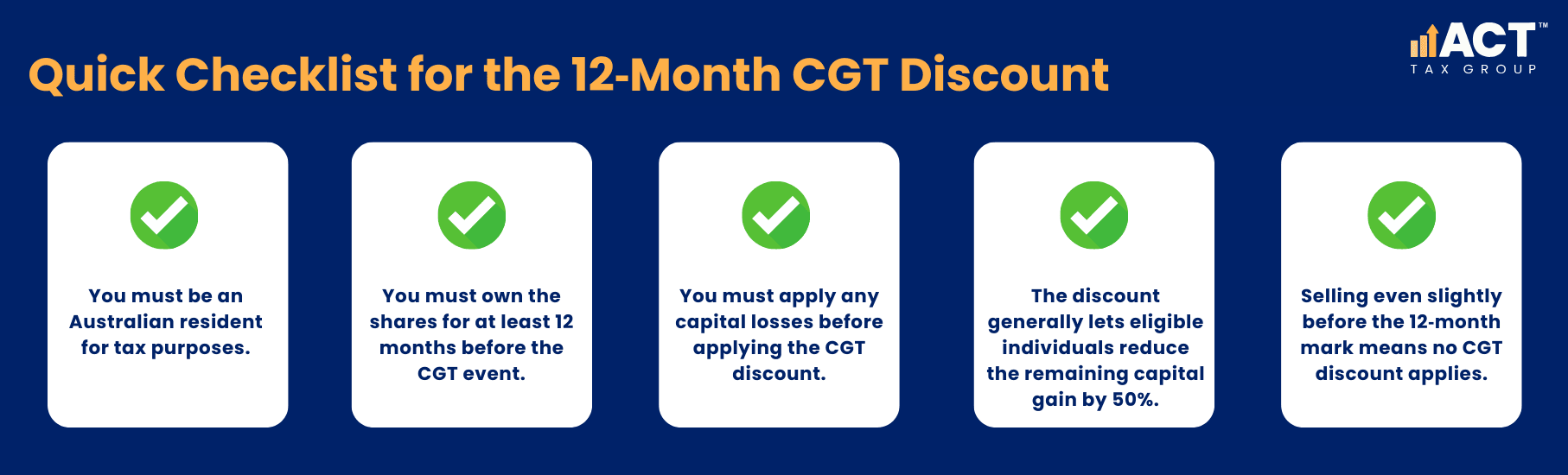
If you are an Australian resident for tax purposes and you have owned the shares for at least 12 months (excluding the day of purchase and the day of sale) before the CGT event, you may be able to use the CGT discount. For most individuals, this CGT discount lets you reduce an eligible capital gain by 50% after you have applied any capital losses. That reduced net capital then feeds into your taxable income and can lower the overall gains tax compared with selling within 12 months.
This is why timing the sale of assets matters. Selling just before the 12‑month mark can mean you pay capital gains tax on the full profit instead of the discounted amount. Keeping track of when each parcel was acquired helps you work out whether a small delay in the sale could change how much CGT you pay.
How CGT Affects Your Income Tax and Cash
For sparkies, the key link is between capital gains tax and income tax. Your net capital gain is added to your other income for the income year, such as business profit, salary, dividends, and interest, and this total becomes your taxable income. The tax rate you face on this higher figure will vary depending on your marginal tax rate and other factors like tax deductions you can claim.
If you sell a big block of shares in a strong year for your electrical business, the profit can push you into a higher bracket and increase the tax you pay. That means the cash you see hit your trading account when you sell the shares is not all “spare” money; some of it will go to the ATO at tax time. Building this into your planning helps avoid nasty surprises when it is time to lodge your tax return.
Power up your business with Accounting Built for Electricians
From start-up to expansion, our accounting team supports your tax, payroll, and cash flow at every stage of growth.
Investor Versus Trader Why It Matters
Most electricians buying and selling shares in their personal account are treated as investors for tax purposes, not as running a share trading business. In this case, capital gains tax on shares applies, and income such as dividends and interest is reported separately as income in your return. Being an investor is what generally gives you access to the CGT discount, as long as you meet the other conditions.
If your trading starts to look more like a business, with frequent, systematic trades aimed at short‑term profit, the Australian Taxation Office may see you as a trader. In that case, gains and losses can be treated more like normal income and expenses, and the rules around CGT and discounts can change. This can get complex fast, so it is an area where expert advice is worth it.
Other Assets Property Crypto and Your Family Home
Many electricians do not just hold shares; you might also own an investment property or dabble in crypto assets. When you sell an investment property or certain crypto assets, you may also make a capital gain or loss, and similar CGT rules can apply. Again, cost base, sale price, and how long you have owned the asset all help determine the tax result.
Your main family home is often exempt from capital gains tax when you sell, provided it meets the main residence rules. Other property, such as a rental or holiday house, is not usually exempt, and the gain can add to the same CGT pool as your shares. Planning big sales across property, shares, and other investments in the same financial year can make a large difference to the total tax you pay.
Record Keeping So You Can Calculate CGT Cleanly
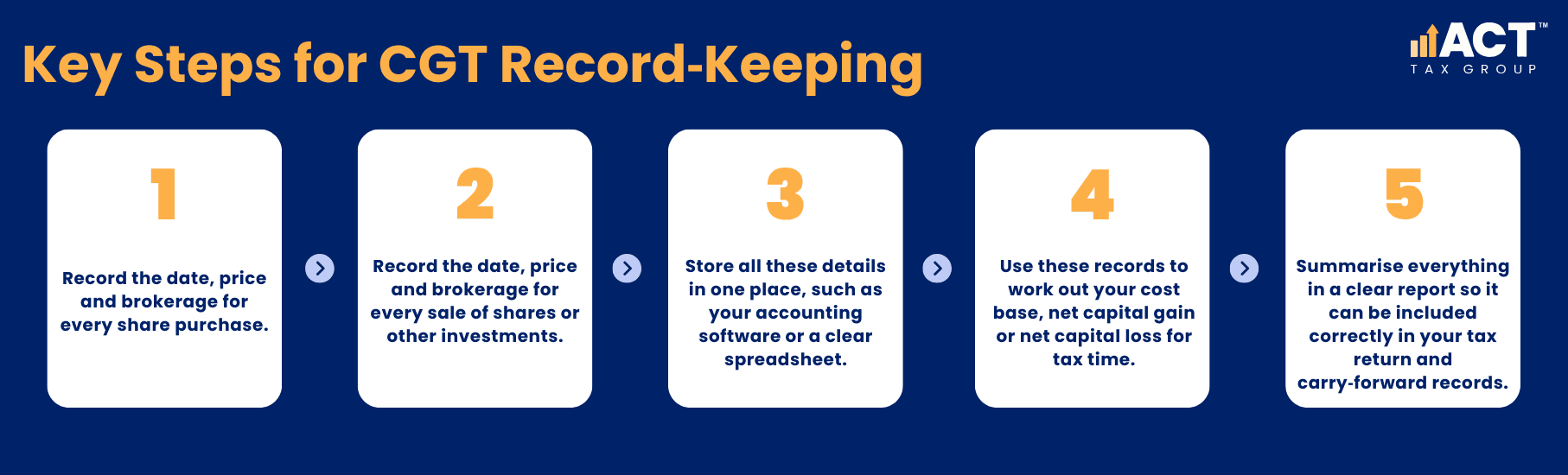
To calculate CGT properly, you need clear records of each purchase and sale. This includes dates, price, brokerage, and any other direct expenses for every parcel of shares or other investments. Keeping this in your accounting software or in a simple spreadsheet, rather than buried in email, makes it much easier to work out your cost base and net capital gain or net capital loss when the time comes.
At tax time, you then bring this together in a clear report so that it can be included correctly in your tax return. This helps make sure you do not miss any capital losses you can offset, that you only pay CGT on the real profit after expenses, and that any carry forward amounts are tracked into future years. Consistent records also make it easier if the ATO website rules change or if you need to check something against current guidance.
Thinking About Timing Market Value and Retirement
As a busy electrician, you are often focused on the job in front of you, not on how the market value of your investments is moving week to week. But when you decide to sell, the timing of that sale against your other income can determine how much tax you pay. Selling in a lower income year can sometimes mean a lower overall tax rate on the same capital gain than selling in a bumper year.
If you are starting to think about stepping back from the tools or planning for retirement, these timing decisions matter even more. Selling shares, property, or other assets in stages, and making use of carry forward capital losses from previous years, can smooth the tax you pay while still freeing up money when you need it. None of this replaces personal tax advice, but it shows why running the numbers before you hit “sell” can help.

When To Get Expert Help
Capital gains tax rules can feel complex when you are juggling jobs, managing apprentices, and trying to keep cash flowing. You need to pay the right amount of tax, but you also do not want to hand over more money than you should because the calculation was rushed. If you are unsure how CGT fits with your business profit, or how to treat things like managed fund statements, crypto assets, or an investment property sale, it is time to seek expert advice.
Checking the latest information on the ATO website and talking to a tax professional who understands trades and investments will help you determine your real tax obligations. They can walk you through how capital gains, capital losses, and carry forward rules work for your situation, make sure the report in your tax return is correct, and explain how any decisions this year might affect future years.

Lukasz Klekowski
Principal of ACT Tax Group, specialising in tax compliance and financial strategy for Australian small businesses.

Disclaimer: All information provided in this publication is of a general nature only and is not personal financial or investment advice. It does not take into account your particular objectives and circumstances. No person should act on the basis of this information without first obtaining and following the advice of a suitably qualified professional. To the fullest extent permitted by law, no person involved in producing, distributing or providing the information in this publication (including ACT TAX GROUP PTY LTD, each of its directors, councilors, employees and contractors and the editors or authors of the information) will be liable in any way for any loss or damage suffered by any person through the use of or access to this information. The Copyright is owned exclusively by ACT TAX GROUP PTY LTD (ABN 31634338088)