

Stage 3 Tax Cuts vs. Previous Tax Settings: What’s Changed?
Published on November 25, 2025
Stage 3 tax cuts vs previous tax settings is now a major focus for Australians as they assess their take home pay and plan for the new financial year. From 1 July 2024, the government passed a revised stage tax relief package, meaning many workers end up with extra money in pocket and less tax liability compared with earlier tax brackets. The changes were announced by the Albanese government in response to rising costs of living and interest rate rises, aiming to deliver new tax cuts for middle income earners and ensure a simpler, fairer tax system.
Employers and individuals earning up to $190,000 will notice both rate reductions and higher thresholds, so many people see their marginal tax rate drop and a boost in week-to-week home pay. Compared to the previous settings, now more people qualify for lower cent tax rates, with the federal budget outlining significant benefit. Knowing exactly how stage 3 tax affects your salary and taxable income helps with budgeting, investment and keeping your finances healthy.
What Exactly are the Stage 3 Tax Cuts?
Stage 3 tax cuts are part of a broader government plan to restructure Australia’s income tax system. They apply to all taxpayers from 1 July, changing tax brackets and lowering rates, especially for workers earning between $18,201 and $190,000. The new tax cuts target bracket creep and aim to increase fairness by shifting relief toward middle- and low-income earners.
Maximising your Stage 3 tax cut benefits?
Schedule a complimentary consultation with us today to optimise your salary packaging and pay structure for 2024–25.
What Did the Previous Tax System Look Like?
Before the revised stage, the original stage 3 tax brackets included five ranges for personal income. Individuals earning from $18,201 to $45,000 paid 19%, those up to $120,000 faced 32.5%, and then 37% applied from $120,001 up to $180,000. The highest bracket rate of 45% started at $180,001.
Middle income taxpayers previously relied on the middle-income tax offset, and temporary boosts such as the low- and middle-income tax offset, to receive tax relief. These offsets ended in recent years, resulting in higher tax bills and less extra money from the tax system for many people. Bracket creep also meant that workers gradually paid a higher proportion of income in tax as wages increased but tax thresholds did not.
Income Brackets and Rates Under Current vs Previous Systems
Under the new tax cuts, more people remain at a lower rate for longer, meaning larger dollar reductions in, for example, weekly tax withheld by employers. Most incomes below $190,001 face significant reduction in tax compared with the previous rates.
Taxable Income | Previous Tax Rate | Stage 3 Tax Rate |
|---|---|---|
$0–$18,200 | 0% | 0% |
$18,201–$45,000 | 19% | 16% |
$45,001–$120,000 | 32.5% | 30% (up to $135,000) |
$120,001–$180,000 | 37% | 30% (up to $135,000) |
$135,001–$190,000 | 37% | 37% |
$190,001+ | 45% | 45% |

Impact on Take Home Pay and Tax Liability
For many middle-income earners, the main benefit of stage 3 tax cuts is noticeably higher home pay. Someone earning $59,000 can expect an estimated $804 reduction in annual tax liability. Individuals earning $150,000 might save up to $3,700 and those earning more than $190,000 see less change compared with previous plans.
General information from government calculators shows almost every taxpayer is subject to less tax with the new system. Lower rates result in more money for future planning, household costs, investment and responding to ongoing cost of living pressures.
Effect on Bracket Creep and Ongoing Financial Planning
The revised stage 3 tax brackets provide a reset for ongoing bracket creep, reducing the number of people pushed into higher rates by wage growth and inflation. The Australian Government outlines that while average rates are lower now, without future changes or indexation, tax will gradually rise again as wage increases push people up the brackets.
For most, stage 3 acts as a boost and gives time to plan salary arrangements and investment strategies before bracket creep resumes.
How Does the Medicare Levy Fit In?
The Medicare Levy, currently at 2%, is still applied to taxable income but is not affected directly by stage 3 tax cuts. Income brackets for the levy may shift subject to future federal budget changes. It’s important for people whose taxable income is close to the low-income threshold to check how stage 3 tax, offsets and pay changes interact with their overall tax liability including the levy.
Considerations for Business Owners and Investors
For business owners, lower cent tax rates and higher thresholds create opportunities to review salary levels, dividends and distributions. With less tax due overall, some may choose to take more money out of trading entities, trusts or companies, especially if income stays below $190,000. Investors also benefit, as more investment income falls in the 30% band compared with the earlier system.

Planning Your Next Steps
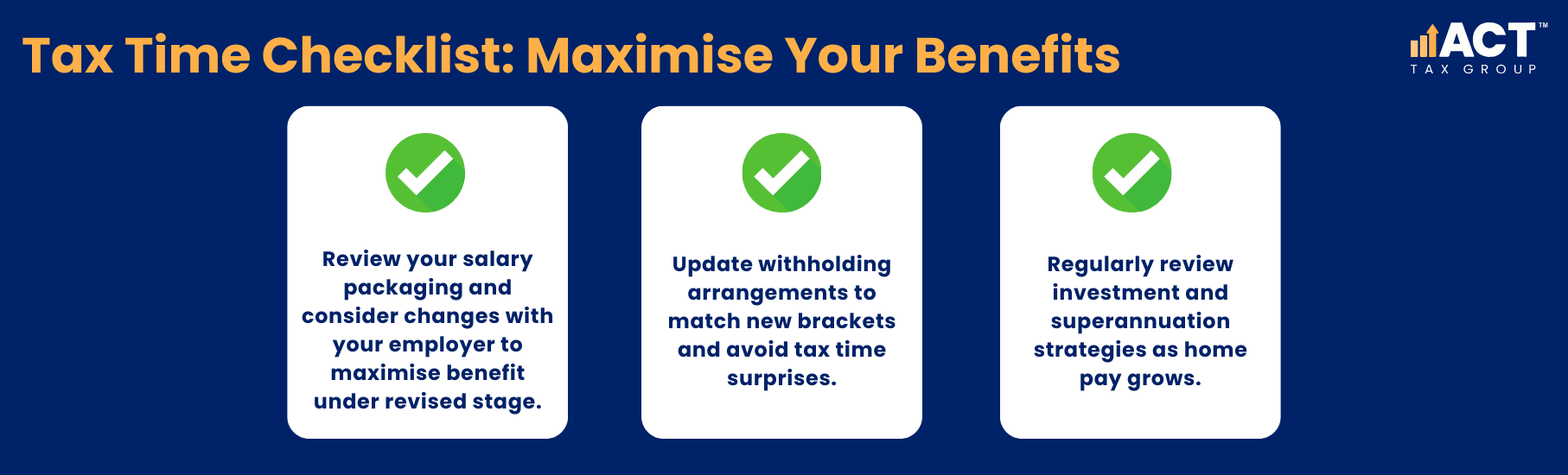
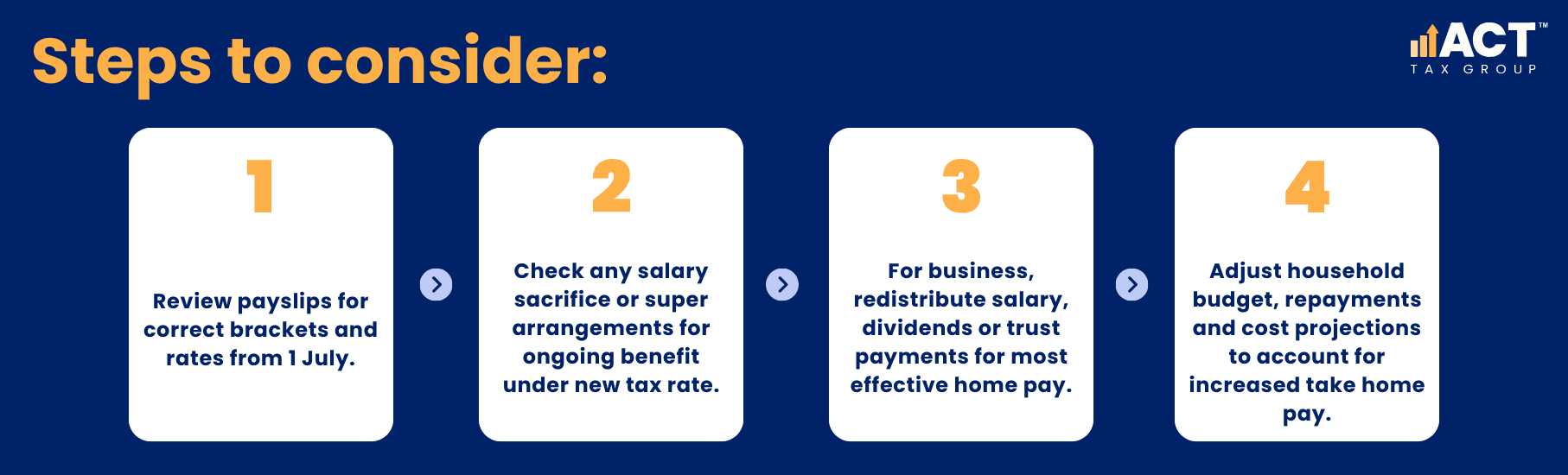
Making the most of stage 3 tax cuts means updating all planning, from pay and salary packaging to investment decisions and household budgets. Most individuals earning under $190,000 will see extra money each pay cycle and more flexibility for saving or spending.
At ACT Tax Group, helping clients understand and utilise these federal budget changes is our expertise. Our team provides approachable, professional guidance, ensuring that every taxpayer receives the full benefit intended as part of the Albanese government’s living tax cuts initiative.
Conclusion
The changes to stage 3 tax are designed to help more people keep more of their earnings and manage costs. With ongoing bracket creep and rising living costs, planning and review have never been more important. As revised stage tax cuts take effect, ACT Tax Group is committed to helping all income earners, especially middle income and small business families, turn new rules into practical results.
Contact us for personalised advice and ongoing support as you understand stage 3 tax, take home pay improvements, and smarter planning for your future. Use our calculators and resources or reach out for a one-on-one plan tailored to your needs, so your benefit under the government’s new tax cuts translates directly to your bottom line.

Lukasz Klekowski
Principal of ACT Tax Group, specialising in tax compliance and financial strategy for Australian small businesses.

Disclaimer: All information provided in this publication is of a general nature only and is not personal financial or investment advice. It does not take into account your particular objectives and circumstances. No person should act on the basis of this information without first obtaining and following the advice of a suitably qualified professional. To the fullest extent permitted by law, no person involved in producing, distributing or providing the information in this publication (including ACT TAX GROUP PTY LTD, each of its directors, councilors, employees and contractors and the editors or authors of the information) will be liable in any way for any loss or damage suffered by any person through the use of or access to this information. The Copyright is owned exclusively by ACT TAX GROUP PTY LTD (ABN 31634338088)