

Capital Gains Tax Basics for Carpenters Investing in Shares
Published on November 18, 2025
As a carpenter, you’ve built your business through hard work and smart decisions. Now you’re thinking about investing in shares to grow your wealth outside the building site. But here’s the challenge—when you make a profit from selling shares, you’ll owe Capital Gains Tax (CGT), and if you don’t understand how it works, you could end up paying more than you need to or face unexpected bills at tax time. Many carpentry business owners skip over this part because it feels complicated, but getting it right actually saves thousands of dollars.
How Capital Gains Tax Works on Your Share Investments
When you invest in shares, understanding Capital Gains Tax is the first step to protecting your profits. Capital Gains Tax is not a separate type of tax—it’s part of your regular income tax that you report in your tax return each financial year. Whenever you sell shares and make a profit, that profit is called a capital gain. If you sell for less than you paid, that’s a capital loss. The key point is that tax is only payable on your gains, not on money you invested or losses you made.
Unsure how to offset share losses against your gains?
Schedule a complimentary consultation with us today to apply the right CGT offset rules for your situation.
What Triggers a Capital Gains Tax Event?
A Capital Gains Tax event happens the moment you sell your shares. It doesn’t matter whether you sold them for a profit, a loss, or even at exactly what you paid—if you disposed of the asset, a CGT event occurred and you need to report it. For most shares you’ve bought, CGT applies whenever you sell them. There’s one important exception: if you bought shares before September 1985, those are generally exempt from Capital Gains Tax because they’re considered pre-CGT assets. Unless you’ve inherited older shares or received them through an inheritance, this exemption probably won’t apply to you.
Capital Gains Tax also applies when you sell units in a managed fund, when you transfer shares to someone else, or when you swap shares in one company for shares in another during a merger or takeover. Each of these actions is a CGT event that must be reported.
Understanding Your Cost Base and Sale Price
To work out whether you’ve made a gain or loss, you need to know two things: your cost base and your sale price. The cost base is what it cost you to buy the shares, plus any expenses directly linked to acquiring them. This includes brokerage fees, adviser fees for buying the shares, and any other costs directly connected to the purchase. Your sale price is what you received when you sold the shares, minus any selling expenses like brokerage.
Here’s a practical example: you buy 1,000 shares at $5 each and pay $50 in brokerage. Your cost base is $5,050. When you sell those shares for $8 each and pay $50 in brokerage, your gross sale price is $8,000 but your net proceeds are $7,950. Your net capital gain is $7,950 minus $5,050, which equals $2,900.

Working Out Your Tax on Gains and Losses
Once you’ve calculated your capital gain, the next step is figuring out how much tax you actually pay. This depends on how long you held the shares and what other gains or losses you had during the year. The good news is there are strategies to reduce your tax, but you need to understand how they work.
The Capital Gains Tax Discount for Long-Term Holders
If you’ve held your shares for at least 12 months before you sell them, you can apply the Capital Gains Tax discount. This discount reduces your capital gain by 50% before you add it to your assessable income. This is a significant benefit and one reason many investors hold shares longer rather than trading frequently.
Using the example above, your $2,900 capital gain would be reduced to $1,450 after the CGT discount. You then add $1,450 to your assessable income and pay income tax on it at your marginal tax rate. If you held the shares for less than 12 months, there’s no discount. The full $2,900 would be added to your assessable income.
Your marginal tax rate depends on your overall income for the year. If you earn $50,000 from your carpentry business plus $1,450 from your capital gain, the CGT discount helps you keep more of your profit.
How Capital Losses Reduce Your Capital Gains
If you sell some shares at a loss, that’s actually useful—you can use capital losses to reduce your capital gains in the same income year. This strategy is called offsetting. Let’s say you made a $2,900 gain on one parcel of shares but took a $1,000 loss on another parcel you sold during the same financial year. You subtract the loss first: $2,900 minus $1,000 equals $1,900. Then if you qualify, you apply the CGT discount to that $1,900, bringing it down to $950.
The important rule here is that you must subtract your capital losses before you calculate the CGT discount. This is where many people make mistakes and end up paying more tax than necessary.
If your total capital losses for the year are bigger than your total capital gains, you’ve got a net capital loss. You can’t use this to reduce other income like your carpentry business profits. Instead, you can carry forward capital losses to future years to offset gains later. You could carry forward these losses indefinitely until you have future gains to offset them against. The Australian Taxation Office (ATO) tracks this, so keeping good records is essential.

Keeping Records That Support Your Tax Return
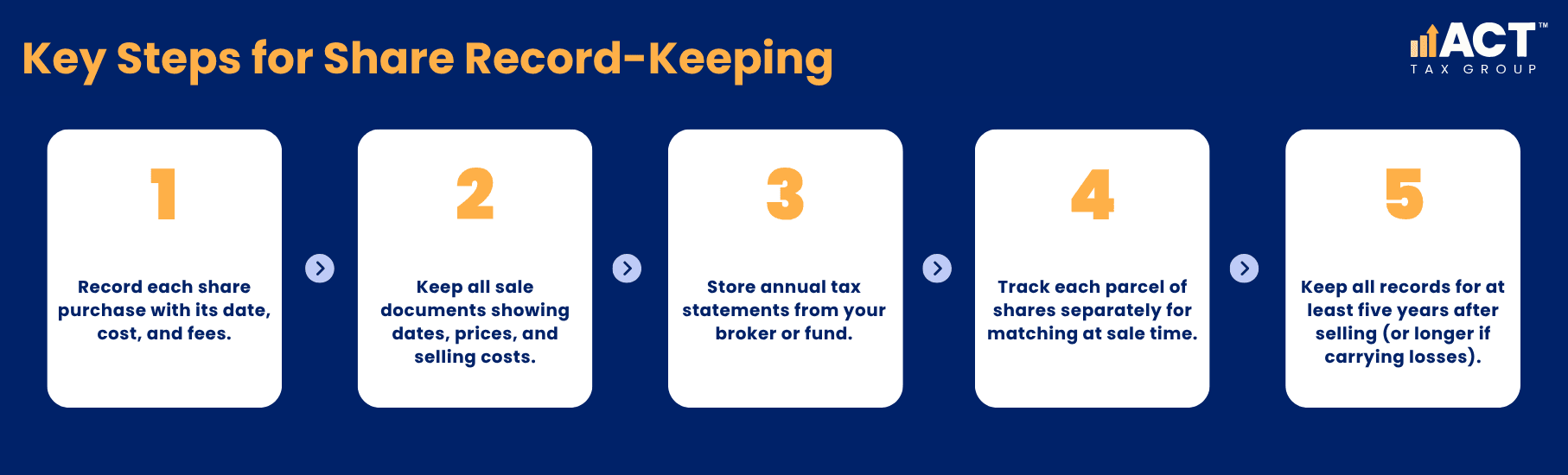
Getting your record keeping right is one of the most important things you can do when investing in shares. You need to keep records of everything that affects your capital gain or loss for at least five years after the financial year when you sold the shares. If you carry forward capital losses and use them in future years, you’ll need to keep those records even longer.
What Records Do You Actually Need to Keep?
For each parcel of shares you buy, record the date you purchased them, the purchase price, any brokerage or adviser fees you paid, and the total cost base. When you sell, keep the contract note showing the date you sold, what price you received, any brokerage or selling costs, and your net proceeds. If you hold shares through a managed fund, keep statements showing your purchases, sales, and distributions.
If you invest through the Commonwealth Bank or another broker, they usually send you annual tax statements. These are helpful, but you’re still responsible for checking that the details are correct and keeping your own records as backup.
Why Matching Shares Matters
Here’s a detail that trips up many investors: if you buy shares in the same company at different times, each group of shares is a separate asset with its own cost base. When you sell some (but not all) of your shares in that company, you need to identify which group you’re selling. You can use different methods—first-in-first-out, last-in-first-out, or specifically identifying which shares you’re selling—depending on what gives you the best tax outcome. Keeping clear records means you can choose the method that works best for your financial situation.
What to Report in Your Tax Return at Tax Time
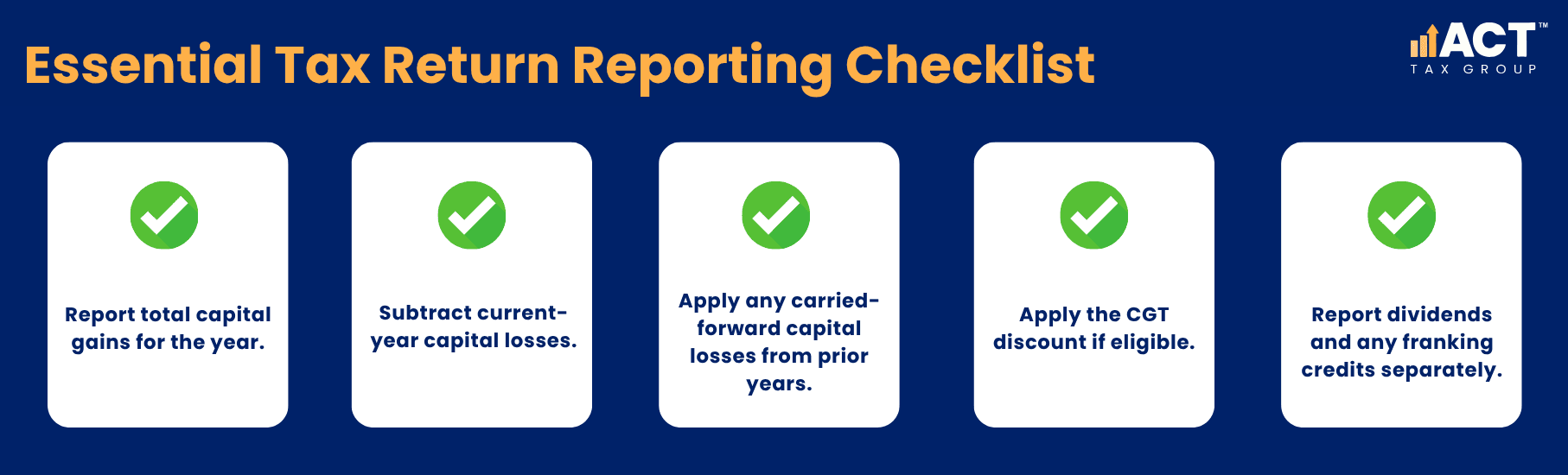
When tax time arrives, you report your capital gains and losses in the Capital Gains section of your tax return. You’ll need to show your total capital gains for the year, then subtract any capital losses from the same year, then apply any carried forward capital losses from previous years, and finally apply the Capital Gains Tax discount if you’re eligible.
The net capital gain you calculate gets added to your assessable income. You then pay income tax on that combined total at your marginal tax rate. If you use tax software or a registered tax agent, they’ll guide you through this. But the numbers have to be accurate, and that starts with your records.
If you received dividends from your shares during the year, those are reported separately in your tax return, not as part of your capital gains. Dividends might include franking credits, which can affect your overall tax position.
Conclusion
Understanding Capital Gains Tax on shares isn’t as hard as it first appears. The basic concept is simple: when you sell shares and make a profit, you report it and pay capital gains tax. Where it gets tricky is in the details—calculating your cost base correctly, applying the CGT discount properly, offsetting losses in the right order, and keeping records that support what you report.
These same rules apply whether you’re investing in shares, investment property, or other assets. The process is consistent across different types of investments, so once you understand how it works for shares, you can apply the same principles to other financial decisions you make.
If you’re ever unsure about your financial situation or how these rules apply to your specific investments, that’s where professional advice makes a real difference. At ACT Tax Group, we help carpentry business owners like you understand Capital Gains Tax and tax reporting with confidence so you can focus on building your business and growing your wealth.

Lukasz Klekowski
Principal of ACT Tax Group, specialising in tax compliance and financial strategy for Australian small businesses.

Disclaimer: All information provided in this publication is of a general nature only and is not personal financial or investment advice. It does not take into account your particular objectives and circumstances. No person should act on the basis of this information without first obtaining and following the advice of a suitably qualified professional. To the fullest extent permitted by law, no person involved in producing, distributing or providing the information in this publication (including ACT TAX GROUP PTY LTD, each of its directors, councilors, employees and contractors and the editors or authors of the information) will be liable in any way for any loss or damage suffered by any person through the use of or access to this information. The Copyright is owned exclusively by ACT TAX GROUP PTY LTD (ABN 31634338088)