

Employee vs Contractor: How to Correctly Classify Workers Under ATO Guidelines
Published on November 3, 2025
Employee vs Contractor: How to Correctly Classify Workers Under ATO Guidelines is a critical issue for every business owner. Getting it wrong can lead to serious tax obligations, penalties, and uncertainty for both the business and the worker. Most businesses need to know whether a person paid is an employee or an independent contractor, as this decision affects rights, responsibilities, and legal obligations.
What Is the Difference Between Employees and Contractors?
Employees work as part of your business. The business owner decides when, where, and how work is performed, and the worker receives a regular salary or pay. Contractors provide services, often for a specific task or agreed price, and they are responsible for their own work hours, tools, and equipment. They may have their own business and work for more than one client.
Written contracts are important, but the practical reality is what matters when it comes to classification. If the actual working arrangements are different from the contract, the law may look at the true nature of the relationship rather than just the terms written down. The ATO’s view is that the worker is an employee if the business controls their work, provides necessary tools, and pays for the time worked.
Worried about ATO penalties for misclassifying workers?
Schedule a complimentary consultation with us today to review your PAYG and super obligations with confidence.
Key Points
Employees work according to the business’s instructions and receive regular pay.
Contractors are their own boss, providing services for a set price and managing their own hours and expenses.
Contractors can delegate or subcontract work, but employees usually cannot.
Category | Employee | Contractor |
|---|---|---|
Control | Business sets work hours and methods | Worker decides work hours and methods |
Payment | Regular salary or pay | Paid for completed tasks or results |
Leave | Paid annual leave and sick leave | No paid annual leave or sick leave |
Tools | Provided by business | Worker provides own tools |
Tax/Super | Business pays tax and super | Worker pays own tax and super |
Delegation | Employees cannot delegate work | Contractors can delegate or subcontract |

What Are the Key Factors in Worker Classification?
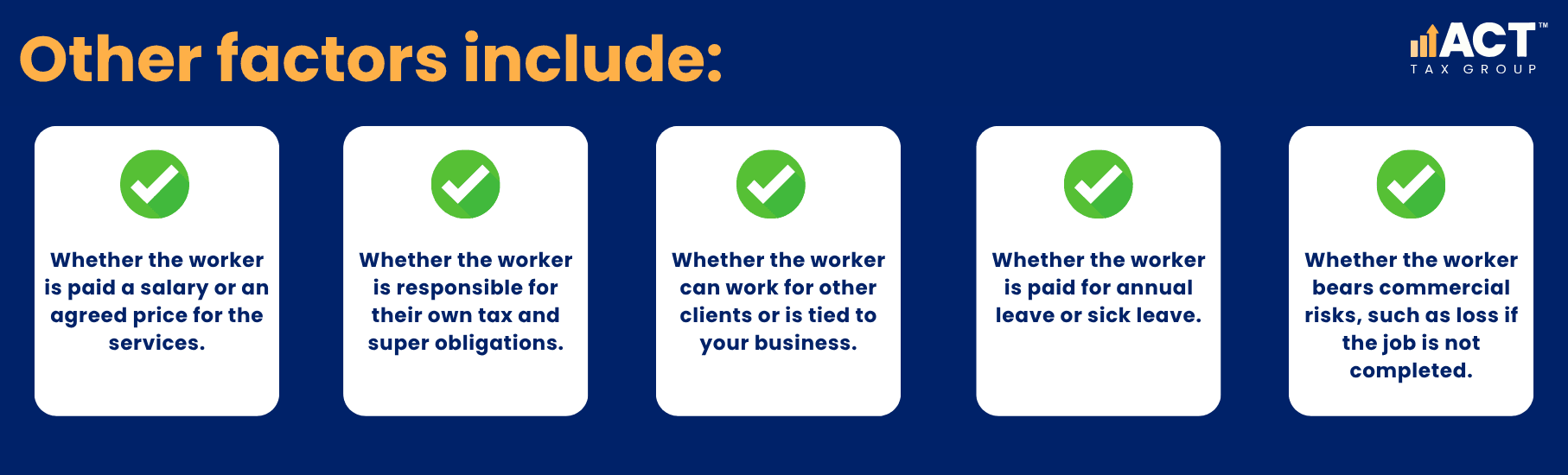
Several factors help decide whether a worker is an employee or an independent contractor. The business owner must consider who controls the work, whether the worker uses their own assets, who is responsible for expenses, and how work is performed. The law looks at the whole relationship between the parties, not just one fact.
Control is a major factor. If your business decides how, when, and where work is done, the worker is more likely to be an employee. If the worker is their own boss, they are likely to be a contractor. Contractors can use their own equipment and subcontract work, while employees perform work as directed and use business assets.
Why Is Correct Classification Important?
Correctly classifying workers ensures both the business and the worker meet their legal rights and responsibilities. If a worker is wrongly classified as a contractor, the business may be liable for unpaid superannuation contributions, PAYG withholding, and entitlements like annual leave. This can lead to penalties and claims under the Fair Work Act.
Businesses must also avoid sham contracting, which is when a contract is used to avoid legal obligations. If a worker is genuinely performing work as an employee, the business cannot call them a contractor just to save on tax or other costs. The ATO and Fair Work Act protect workers’ rights and expect businesses to act fairly.

Case Examples and Application
In one example, a construction company hired several workers who were paid for each job but did not provide their own equipment and were told when to work. The ATO reviewed the working arrangements and decided these workers were employees, not contractors. The business had to pay back superannuation and leave entitlements.
Another example involved a graphic designer who worked for several clients, set their own hours, used their own tools, invoiced per job, and managed their own tax and super. The ATO determined this person was an independent contractor and not an employee.
Each situation is different, so the factors that matter most depend on the true nature of the relationship, not just the way the contract is written. Getting independent legal advice can help avoid mistakes and ensure compliance.
Practical Steps for Businesses
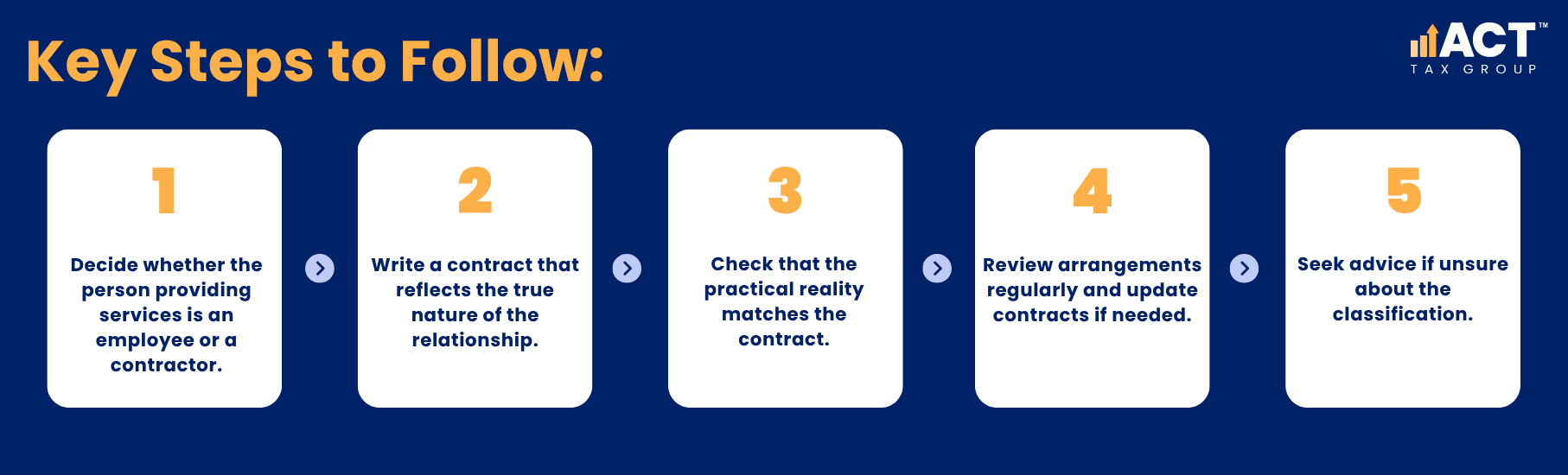
Businesses should review each working arrangement to ensure the correct classification. It’s important to have a clear contract that sets out the rights and responsibilities of both parties. If the worker is an employee, the business must pay superannuation, deduct tax, and provide entitlements. If the worker is a contractor, the business pays for the services, and the worker is responsible for their own super and tax.
Frequently Asked Questions
What happens if a worker is wrongly classified?
If a worker is wrongly classified as a contractor, the business may need to pay back superannuation, leave, and tax, and could face penalties. The worker may also be entitled to other benefits under the Fair Work Act.
Can a contractor be an employee?
Yes. If a worker is paid for their time, uses business assets, and is controlled by the business, they may be an employee, even if the contract says they are a contractor. The law looks at the real substance of the working arrangements.
How often should contracts be reviewed?
Businesses should review contracts regularly, especially when there are changes to the work or the relationship. Regular reviews help ensure compliance and avoid unintended liabilities.
Conclusion
Deciding whether a worker is an employee or an independent contractor is not just about the contract. The true nature of the relationship—how work is performed, who controls it, and other factors—determines legal rights and responsibilities. Businesses should take time to review each arrangement, write clear contracts, and ensure working practices match the contract. When in doubt, seeking independent legal advice can help avoid mistakes and protect both the business and the worker.
Following these steps supports compliance, reduces risk, and builds trust with workers and clients. Every business owner should make worker classification a regular part of their review process to ensure legal and financial security.

Lukasz Klekowski
Principal of ACT Tax Group, specialising in tax compliance and financial strategy for Australian small businesses.

Disclaimer: All information provided in this publication is of a general nature only and is not personal financial or investment advice. It does not take into account your particular objectives and circumstances. No person should act on the basis of this information without first obtaining and following the advice of a suitably qualified professional. To the fullest extent permitted by law, no person involved in producing, distributing or providing the information in this publication (including ACT TAX GROUP PTY LTD, each of its directors, councilors, employees and contractors and the editors or authors of the information) will be liable in any way for any loss or damage suffered by any person through the use of or access to this information. The Copyright is owned exclusively by ACT TAX GROUP PTY LTD (ABN 31634338088)