

Reporting Assessable Government Industry Payments: Carpenters’ Compliance Guide
Share this article
Published on October 13, 2025
Running a carpentry business means dealing with complex tax obligations, and nothing trips up more builders than understanding when assessable government industry payments need to be included in your business’s assessable income. Whether you’ve received a grant to help with equipment purchases, benefited from territory government grants during tough times, or collected government contracts, knowing what to report and when can save you from costly ATO penalties down the track.
Why Government Payments Create Tax Headaches for Carpenters
Understanding assessable government industry payments becomes particularly challenging for carpentry businesses because these payments come in so many different forms and timing arrangements. Unlike your regular cash earnings income from completed jobs, government grants and support payments often arrive with complex conditions that affect when and how you need to pay tax on them.
Struggling to report government grants and payments correctly?
Schedule a complimentary consultation with us today to ensure your government income is lodged compliantly.
When Government Money Becomes Your Tax Problem
The ATO treats most government industry payments as other business income, which means they’re subject to the same income tax rules as your regular carpentry work. However, the timing of when you receive these payments compared to when you actually use them can create serious cash flow problems. You might get a $40,000 grant in June to support your apprentice wages over two years, but you’ll need to pay tax on the full amount in that financial year – long before you’ve had the benefit of spending it on its intended purpose.
Territory government grants and industry assistance payments often arrive at the worst possible times for your tax position. Many carpentry businesses receive these payments near the end of the financial year, which immediately increases their taxable income and can push them into higher tax brackets. This timing issue becomes even more complicated when you’re trying to manage your existing business expenses and plan for capital expenditure incurred on new equipment or tools.
How These Payments Affect Your Business Cash Flow
The problem gets worse when you consider that these assessable government industry assistance payments might also affect your eligibility for small business concessions. If a large grant pushes your business income above certain thresholds, you could lose access to valuable tax breaks like small business CGT concessions or instant asset write-offs that you were counting on for your equipment purchases.
Cash flow boost payments from previous economic support programs created similar challenges. While these payments helped many carpentry businesses survive difficult periods, they also created unexpected tax liabilities that caught many business owners off guard. The lesson here is that any government payment that helps finance business operations needs careful planning for its tax impact.

Common Types of Government Payments You Might Receive
Apprenticeship subsidies represent one of the most common forms of assessable government industry payments for carpentry businesses. These payments directly support your payroll costs and are designed to encourage skills development within your small business entity. Because they relate to your everyday business activities, they’re treated as assessable income for income tax purposes.
Equipment grants and industry development funds also fall into the assessable category. If you’ve received funding to purchase new tools, upgrade workshop facilities, or invest in technology to improve your business operations, these amounts typically count as business income. The ATO views these payments as contributing to your capacity for producing assessable income through better equipment and facilities.
Understanding Fuel Tax Credits and Construction Support
Fuel tax credits create their own reporting requirements. If your carpentry business uses fuel in equipment or vehicles for business purposes, these credits reduce your overall tax liability but need specific treatment in your tax return. They’re considered assessable government industry payments but work differently from grants because they offset other business expenses rather than adding to your gross income.
Construction industry support payments, whether related to economic downturns, natural disasters, or industry-specific challenges, generally require assessment as business income. These government grants help you meet current business expenses and maintain operations during difficult periods, making them subject to income tax in the year you receive them.

Getting Your Reporting Right Without the Stress
The key to managing assessable government industry payments lies in understanding the specific reporting requirements and setting up systems that track these payments properly from the moment you receive them. This isn’t about complex accounting – it’s about having clear processes that capture the right information so you can complete your tax return accurately without scrambling at the last minute.
Where to Report Your Government Payments
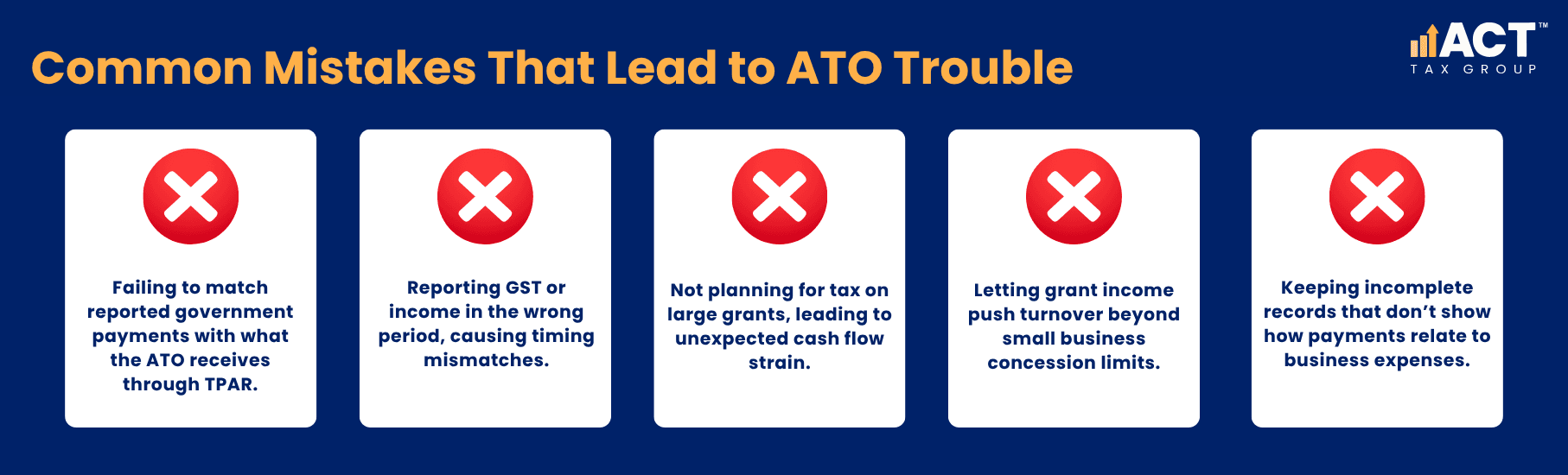
Most carpentry businesses need to report their government payments at Label F on their tax return, which covers non-primary production activities. This includes all your standard residential and commercial carpentry work, renovations, shop fitting, and general building services. The only time you’d use Label E is if you’re doing significant agricultural or rural construction work like building farm structures or grain storage facilities.
When completing your income tax return, assessable government industry assistance needs to go in the right place to avoid triggering ATO queries. Label F covers most carpentry businesses because your work falls under non-primary production activities. This is where you’ll report apprenticeship subsidies, equipment grants, industry support payments, and most other government assistance your business receives.
Special Codes You Need to Know About
Some payments require special coding alongside your Label F entry. For example, if your assessable government industry payments include Fuel Tax Credits, producer rebates, or product stewardship benefits, you need to print ‘D’ in the CODE box next to the payment amount. This coding helps the ATO track specific types of industry assistance and ensures proper processing of your return.
Export incentive grants and JobMaker Hiring Credits have their own specific reporting requirements. While these are less common for domestic carpentry businesses, subcontractors working on larger projects or businesses involved in prefabricated construction might encounter these payment types as part of their assessable income.
Managing the GST Side of Government Payments
The interaction between these payments and Goods and Services Tax (GST) also needs attention. Some government grants are GST-free, while others may attract GST depending on their nature and your business registration status. This affects both your Business Activity Statement (BAS) reporting and income tax return preparation, so consistent treatment across both is essential.
The GST treatment of assessable government industry payments can be tricky because different types of grants have different rules. Some payments are GST-free by design, while others are subject to GST depending on what they’re intended to support. Getting this wrong affects both your BAS reporting and your income tax calculations.
Setting Up a Simple Tracking System
Creating a dedicated system for tracking assessable government industry payments doesn’t need to be complicated, but it does need to be consistent. Start with a simple folder system – either physical or digital – that keeps all your government payment documentation in one place. Each payment should have its own section containing the application, approval letter, payment advice, and any ongoing compliance requirements.
Your accounting system needs separate income accounts for government payments to make tax return preparation easier. Set up specific codes for different types of assessable government industry assistance so you can quickly extract the required figures when it’s time to complete your return. This separation also helps identify any special coding requirements or additional schedules that need to be completed.
Keeping Track of Related Business Expenses
The relationship between government payments and your other business income sources require careful tracking. Some grants offset specific costs like interest expenses on business loans or lease business premises interest, while others contribute to acquiring business capital assets or depreciating assets. Understanding these relationships helps improve your overall tax position.
If a government grant helps you acquire income producing assets or fund capital expenditure incurred for your business, you need to consider the GST implications of both the grant and the related purchases. Input tax credit entitlements might be affected by how you treat the grant, so coordinated management of both sides ensures you improve your tax position.
Making Sure Your Records Match ATO Expectations
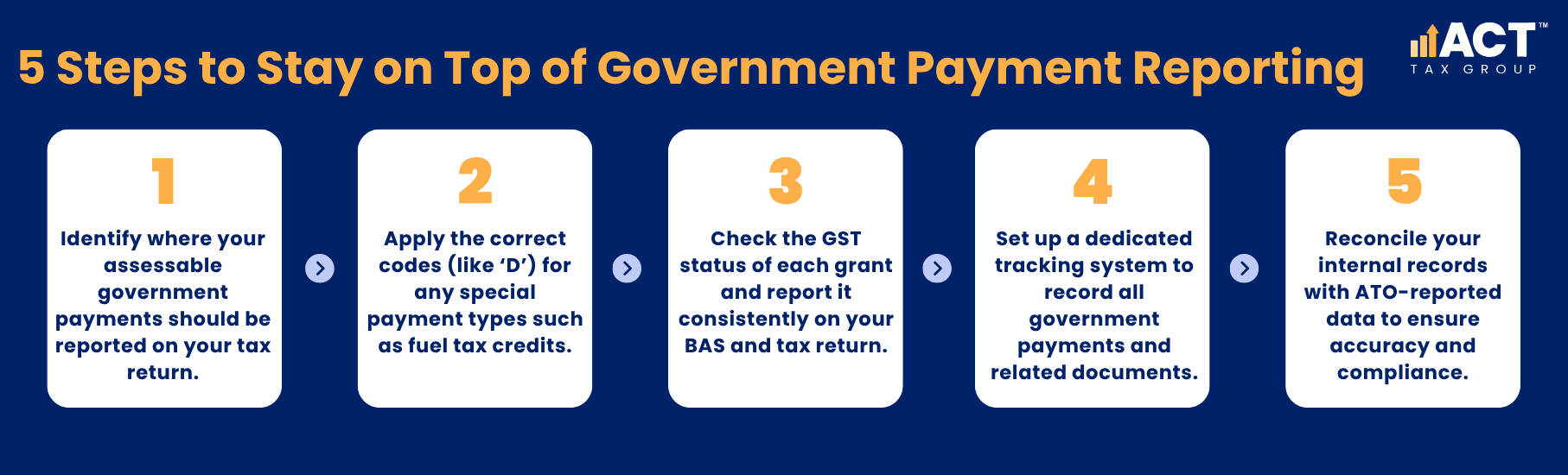
Regular reconciliation between your internal records and external reporting helps catch problems early. The ATO receives reports about payments made to contractors through the Taxable Payments Annual Report (TPAR) system, so your records need to match what government entities report about payments to your business.
Business lease payments, motor vehicle expenses, and other regular business costs might be supported by government grants, creating interactions between the grant income and your expense claims. Proper tracking ensures you don’t double-count benefits or miss legitimate deduction opportunities.
Avoiding the Expensive Mistakes
The costliest errors with assessable government industry payments usually happen because business owners don’t understand how different ATO systems connect with each other. The ATO receives information about your business from multiple sources, and mismatches between what they expect to see and what you report create automatic red flags that lead to reviews and queries.
Why the ATO Already Knows About Your Government Payments
Government entities are required to report payments they make to contractors through the TPAR system. This means payments from councils, state departments, or federal agencies for your carpentry work get reported to the ATO independently of your own tax return. If there’s a difference between what they report paying you and what you declare as business income, expect contact from the ATO requesting explanations.
The timing of GST on government payments usually follows the same rules as the income tax assessment – you include GST in the period you receive the payment, even if it’s intended to support activities over multiple periods. This can create BAS planning challenges similar to the income tax timing issues.
How Large Payments Can Hurt Your Cash Flow
One of the biggest traps involves the timing difference between receiving assessable government industry assistance and the cash flow impact of paying tax on it. Large grants can push your business into higher tax brackets or affect your quarterly instalment amounts, creating unexpected cash flow pressures.
This becomes particularly problematic when grants are designed to support specific business expenses over extended periods. You might receive $50,000 in June to support apprentice wages over two years, but the entire amount becomes assessable income in the current financial year. You’ll owe tax on money you haven’t actually benefited from yet, which can strain your ability to meet current business expenses.
Losing Access to Small Business Benefits
Planning for this requires understanding not just whether payments are assessable, but how they’ll affect your overall tax position and cash flow. Some businesses find themselves in the position of owing significant company tax on grant income while still being required to use the grant funds for their intended business activities over subsequent years.
The relationship between large government payments and your eligibility for various small business concessions also needs consideration. If grant income pushes your aggregated turnover above certain thresholds, you might lose access to valuable concessions like immediate deductibility for depreciating assets or small business CGT concessions.
What Records Actually Protect You
Proper record keeping for assessable government industry payments goes beyond just keeping the payment advice. You need documentation that shows the purpose of the payment, any conditions attached to it, and how it relates to your business activities. This becomes crucial if the ATO queries your treatment of specific payments.
Each government payment should have a complete file containing the original application, approval correspondence, payment details, and any ongoing reporting requirements. This documentation helps establish whether payments qualify for special treatment or need standard assessment as other business income.
Tracking How Payments Connect to Your Expenses
Your records also need to track the relationship between government payments and related business expenses. If a grant offsets specific costs like trading stock purchases, interest expenses overseas, or expenses incurred for business capital assets, proper documentation supports your tax position and helps improve deduction claims.
The interaction between assessable government industry payments and your net income calculations requires careful attention. Some payments might affect your profit and loss statement differently from your tax return, particularly if they relate to capital items or have special timing rules for tax purposes.
Your Next Steps for Better Compliance
Getting assessable government industry payment reporting right isn’t about perfect systems from day one – it’s about establishing good processes and improving them over time. Start with the basics: proper record keeping, understanding your reporting obligations, and getting professional help when you need it.
Remember that professional accounting support often proves cost-effective given the complexity of government payment rules and the potential penalties for errors. Tax professionals familiar with construction industry requirements help understand the specific rules applicable to your business type and ensure compliance with all reporting obligations.

Lukasz Klekowski
Principal of ACT Tax Group, specialising in tax compliance and financial strategy for Australian small businesses.

Share this article
Disclaimer: All information provided in this publication is of a general nature only and is not personal financial or investment advice. It does not take into account your particular objectives and circumstances. No person should act on the basis of this information without first obtaining and following the advice of a suitably qualified professional. To the fullest extent permitted by law, no person involved in producing, distributing or providing the information in this publication (including ACT TAX GROUP PTY LTD, each of its directors, councilors, employees and contractors and the editors or authors of the information) will be liable in any way for any loss or damage suffered by any person through the use of or access to this information. The Copyright is owned exclusively by ACT TAX GROUP PTY LTD (ABN 31634338088)