

Understanding SMSF Contributions, Caps and Acceptance Rules
Published on November 25, 2026
Understanding SMSF contributions, caps and acceptance rules helps you grow your retirement savings through a Self-Managed Superannuation Fund (SMSF) while meeting Australian superannuation obligations. For the 2026–27 financial year, the standard concessional contributions cap is $32,500, while the non-concessional contributions cap is $130,000. However, trustees also carry the responsibility of managing the fund’s assets, complying with super laws and ensuring the fund operates for the purpose of providing retirement benefits to its members.
Understanding SMSF Contributions and Their Tax Treatment
SMSF contributions are payments or eligible asset transfers made into a super fund to increase a member’s retirement savings. Contributions can come from employers, fund members, spouses or other eligible parties acting on behalf of a member. The tax treatment depends on the contribution category and whether the member claims a personal tax deduction. Trustees must correctly classify contributions when preparing the fund’s accounts and annual return.
Worried about exceeding your SMSF contribution caps?
Schedule a complimentary consultation with us today to check your remaining contribution limits.
SMSF Contribution Caps and Tax Implications in 2026–27
Contribution caps determine how much money individuals can contribute to superannuation before additional tax consequences may arise. These limits apply across all superannuation accounts, including SMSFs, industry and retail super funds, and generally count contributions in the financial year the fund receives them. Contribution caps can change through indexation, making it important for trustees to review the applicable thresholds each financial year. Understanding these limits helps fund members plan their contributions and manage their tax obligations.
Contribution Category | 2025–26 | 2026–27 |
|---|---|---|
Concessional contributions | $30,000 | $32,500 |
Non-concessional contributions | $120,000 | $130,000 |
Maximum bring-forward contributions | $360,000 | $390,000 |
Downsizer contributions | $300,000 | $300,000 |
Reducing Taxable Income Through Concessional Contributions
Tax-deductible personal contributions and salary sacrifice arrangements can help eligible individuals reduce their taxable income while building retirement savings. The fund generally pays contributions tax of 15%, although additional tax may apply to higher-income earners.
The carry-forward arrangement also allows eligible members with a total superannuation balance below $500,000 at the previous financial year-end to access unused concessional contribution caps from the preceding five financial years.
Example: An electrician receives $22,500 in employer superannuation contributions during 2026–27. They could potentially contribute another $10,000 and claim a tax deduction without exceeding the standard concessional contributions cap, subject to eligibility.
Non-Concessional Contributions and the Bring-Forward Arrangement
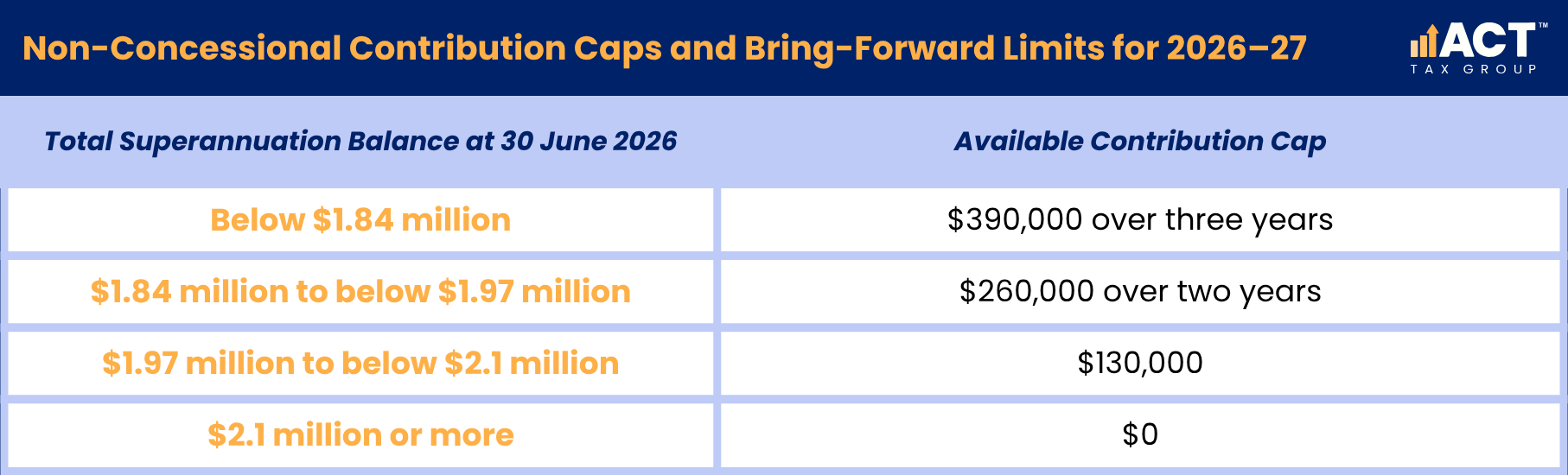
Non-concessional contributions allow individuals to invest after-tax money into superannuation without claiming a personal tax deduction. Eligible members can access future contribution allowances through the bring-forward arrangement, potentially contributing up to $390,000 during 2026–27.
Members must be under 75 at some point during the financial year and meet the total superannuation balance and contribution history requirements. The following thresholds apply when starting a new arrangement in 2026–27, subject to contribution acceptance rules.
SMSF Contribution Acceptance Rules and Trustee Responsibilities
SMSF trustees must ensure contributions comply with super laws and the fund’s trust deed, which establishes how the fund operates. These responsibilities apply whether the SMSF has individual trustees or a corporate trustee.
Members under 75 can generally make voluntary contributions without satisfying the work test for acceptance purposes. For members turning 75, most voluntary contributions must reach the fund within 28 days after the end of their birthday month, while mandated employer contributions and eligible downsizer contributions may still be accepted after age 75. Before accepting contributions, trustees should:
Confirm the member satisfies applicable age requirements.
Ensure the fund holds the member’s Tax File Number (TFN) for member contributions.
Review the contribution category and trust deed.
Confirm asset transfers comply with superannuation laws.
Maintain accurate supporting financial records and return contributions the fund cannot legally accept within 30 days of becoming aware of the breach.
Claiming a Personal Tax Deduction for SMSF Contributions
Members claiming a personal tax deduction must provide their super fund with a valid notice of intent in the approved form by the earlier of lodging their tax return or the end of the following income year. They must receive written acknowledgement before claiming the deduction. Individuals aged 67 to 74 generally need to satisfy the work test or qualify for an exemption.
The work test requires at least 40 hours of gainful employment within 30 consecutive days during the relevant income year. Members should seek advice before starting a pension or transferring their superannuation balance, as these financial decisions may affect deduction eligibility.

Downsizer Contributions and Eligible Asset Transfers
Australians aged 55 or older may contribute up to $300,000 per person to their super fund following the sale of an eligible home. Downsizer contributions do not count towards standard concessional or non-concessional contribution caps.
Eligibility generally requires you or your spouse to have owned the Australian home for at least 10 years, meet the main residence tax exemption requirements and have not previously made a downsizer contribution from another home. Members must provide the required form before or when contributing, generally within 90 days of receiving the sale proceeds, unless the ATO grants an extension.
Managing SMSF Contributions Within Your Investment Strategy
Your SMSF investment strategy should consider how contributions and investment decisions support members’ retirement objectives. Trustees must consider investment risks and expected returns, asset diversification, members’ insurance needs and liquidity, which refers to the fund’s ability to access money to pay expenses, liabilities and retirement benefits.
Trustees must also comply with the sole purpose test, which requires the fund to operate for permitted retirement and related benefit purposes rather than providing immediate personal benefits. Trustees must review their investment strategy regularly to ensure it reflects the individual circumstances of fund members.

Tax Consequences of Exceeding SMSF Contribution Caps
Exceeding contribution caps can result in additional tax liabilities and reporting obligations. Excess concessional contributions form part of your assessable income and are taxed at your marginal tax rate. You receive a 15% tax offset to account for the contributions tax already paid by your super fund. Excess amounts not released from superannuation also count towards your non-concessional contributions cap.
Excess non-concessional contributions may require the release of money from your fund through the Australian Taxation Office’s (ATO) prescribed process. Trustees should seek professional advice rather than independently returning contributions simply because a member has exceeded their cap.
Practical Steps for Managing SMSF Contributions and Compliance
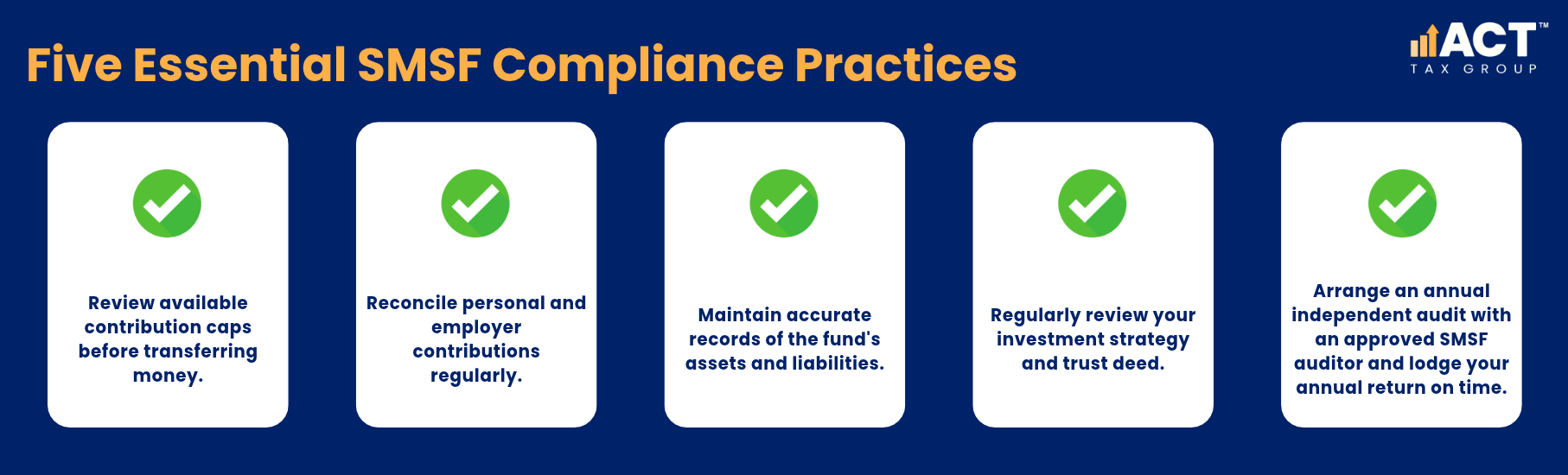
Managing a self-managed super fund requires accurate financial records, regular contribution monitoring and compliance with Australian tax laws. Trustees must generally allocate contributions to member accounts within 28 days after the end of the month in which the fund receives them.
How ACT Tax Group Can Help With SMSF Contribution Compliance
At ACT Tax Group, our experienced, Institute of Public Accountants (IPA)-certified accountants understand the responsibilities involved in managing an SMSF. We provide tailored accounting and tax compliance support to help you manage contributions, understand deduction requirements, maintain accurate accounts and meet your reporting obligations.
Book a consultation with our Canberra-based accounting team to discuss your SMSF accounting and taxation requirements. Where necessary, we encourage you to seek advice from an appropriately licensed financial adviser or SMSF specialist regarding personal investment decisions.
Conclusion
Understanding SMSF contributions, caps and acceptance rules allows you to make informed financial decisions while managing your compliance responsibilities. Reviewing contribution eligibility, tax implications and fund requirements can help you avoid unnecessary expenses and support your long-term retirement objectives.
Start by reviewing your available contribution caps, superannuation balance and financial records. Seeking professional advice before making substantial contributions can help you manage your obligations and develop an approach that reflects your retirement needs.

Lukasz Klekowski
Principal of ACT Tax Group, specialising in tax compliance and financial strategy for Australian small businesses.

Disclaimer: All information provided in this publication is of a general nature only and is not personal financial or investment advice. It does not take into account your particular objectives and circumstances. No person should act on the basis of this information without first obtaining and following the advice of a suitably qualified professional. To the fullest extent permitted by law, no person involved in producing, distributing or providing the information in this publication (including ACT TAX GROUP PTY LTD, each of its directors, councilors, employees and contractors and the editors or authors of the information) will be liable in any way for any loss or damage suffered by any person through the use of or access to this information. The Copyright is owned exclusively by ACT TAX GROUP PTY LTD (ABN 31634338088)