

Individual Trustees vs Corporate Trustees for SMSF Setup
Published on November 25, 2026
Choosing between individual trustees vs corporate trustees for SMSF setup require careful consideration of establishment costs, asset protection, ongoing responsibilities and long-term flexibility for your Self-Managed Superannuation Fund (SMSF). While individual trustees generally have lower initial setup costs, a corporate trustee can simplify administration and succession planning. According to the Australian Taxation Office (ATO) June 2026 quarterly statistical report, Australia had 680,301 SMSFs managing approximately $1.107 trillion in assets.
Key Differences Between Individual Trustees and Corporate Trustees for SMSF Setup
The main difference between individual trustees and corporate trustees is who legally holds and manages the fund’s assets in a trustee capacity. Individual trustees act personally on behalf of the fund, while under a corporate trustee structure, a registered company acts as the trustee.
Both structures must comply with Australian superannuation laws and the fund’s trust deed, a legal document outlining how the SMSF operates. However, their membership requirements, establishment costs, administrative responsibilities and legal arrangements differ.
Unsure how SMSF trustee structures affect costs and compliance?
Schedule a complimentary consultation with us today to compare costs and trustee responsibilities.
Comparison Factor | Individual Trustees | Corporate Trustee |
|---|---|---|
Trustee entity | Individual people | Registered company |
Initial and ongoing costs | Generally lower establishment costs | Company registration and annual review fees |
Single-member SMSF | Requires two trustees | Can have one director |
Asset ownership and protection | Greater potential personal exposure | Additional legal separation |
Membership changes and succession | More ownership documentation updates | Greater administrative continuity |
Understanding the Initial Setup Costs and Ongoing SMSF Costs
An individual trustee structure generally involves lower setup costs because you do not need to establish a separate company. However, future changes to membership or investment ownership may result in additional legal and administrative expenses.
A corporate trustee company requires registration with the Australian Securities and Investments Commission (ASIC) and payment of annual company review fees. A qualifying special-purpose company generally attracts a lower annual review fee than a standard proprietary company. When comparing the fees involved, consider the following expenses:
Establishment costs: Preparing the trust deed and registering a corporate trustee company where applicable.
Accounting fees: Preparing annual financial statements and managing tax compliance.
Audit fees: Covering the compulsory independent annual audit.
Regulatory expenses: Paying the ATO supervisory levy and applicable ASIC annual review fees.
Investment and advisory costs: Managing investments and obtaining professional accounting, financial and legal advice.
Long-Term Administrative Benefits of a Corporate Trustee Structure
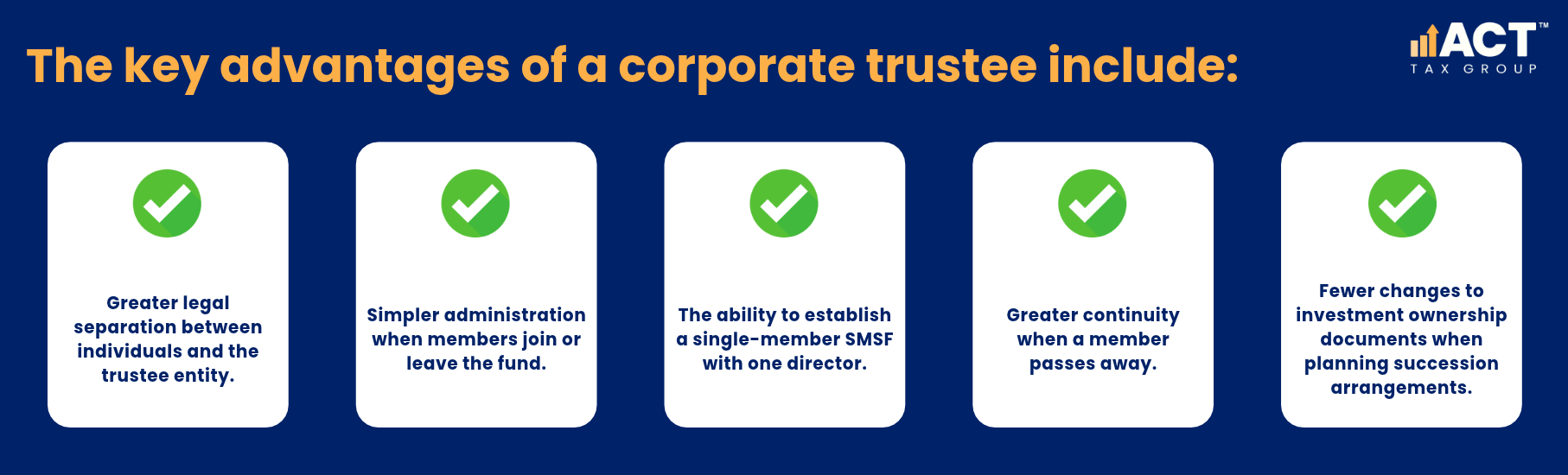
A corporate trustee structure can simplify long-term fund administration because the company remains the legal trustee even when its directors change. This arrangement can be particularly beneficial for families planning to introduce new members or maintain investments over several decades. According to the ATO’s June 2026 quarterly statistical report, 74% of SMSF members were aged 50 or older. For Australians approaching retirement, establishing a trustee structure that accommodates changing personal circumstances can help reduce future administrative work.
The Impact of SMSF Trustee Structures on Asset Protection
A corporate trustee provides an additional layer of legal separation between the company and its directors, which may offer advantages for asset protection. Under an individual trustee structure, trustees may face greater direct personal exposure to liabilities arising from their responsibilities.
However, establishing a corporate trustee does not eliminate personal responsibility or guarantee protection from financial losses. Directors remain accountable for their obligations, and both structures must keep the fund’s assets separate from personal and business assets to comply with superannuation laws.
Example: The ATO’s published Tari Family Super Fund example illustrates how individual trustees hold investments in their capacity as trustees, while a corporate trustee holds investments through the company acting on behalf of the fund.
Managing Residential or Commercial Property Through Your SMSF
Both trustee structures can hold eligible residential or commercial property under their investment strategy. From 10 August 2026, new property borrowing is generally restricted to qualifying business real property, subject to exceptions for earlier arrangements and contracts. A corporate trustee can simplify ownership administration because property ownership records generally remain unchanged when directors or fund members change.
Before purchasing direct property, trustees should consider investment costs, available cash, risk tolerance and the fund’s ability to pay future retirement benefits. Residential property generally cannot be purchased from, occupied by or rented to related parties, including members and relatives. Qualifying commercial property may be purchased from or leased to related parties at market value, subject to superannuation laws.
Property Consideration | Individual Trustees | Corporate Trustee |
|---|---|---|
Residential property investment | Permitted subject to regulations | Permitted subject to regulations |
Commercial property investment | Permitted subject to regulations | Permitted subject to regulations |
Property ownership changes | Potentially more complex | Generally simpler |
Property finance | Subject to lender requirements | May be preferred or required by lenders |
Rental income and capital gains | SMSF tax rules apply | SMSF tax rules apply |
SMSF Setup Requirements for Individual and Corporate Trustees
The SMSF setup process involves establishing the fund correctly, appointing eligible trustees and registering with the ATO. Corporate trustees have additional company registration and director identification requirements, while individual trustees must meet applicable membership and eligibility conditions.
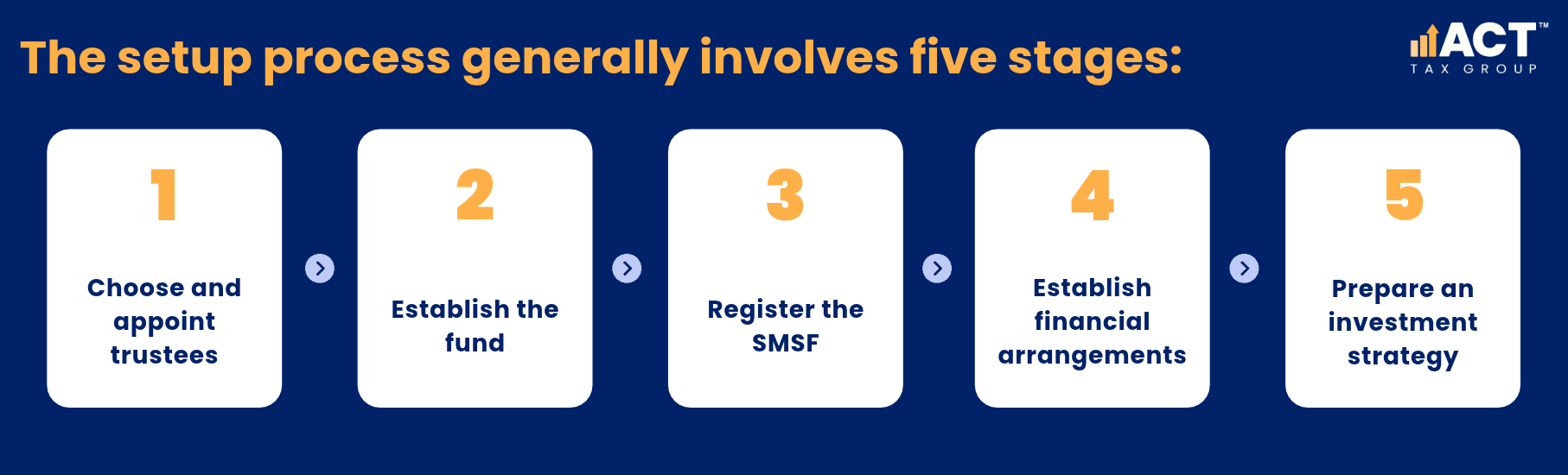
Before transferring existing superannuation balances, you should understand your responsibilities and consider whether moving from your existing super fund supports your financial goals. A licensed financial adviser can help assess the suitability of an SMSF, including potential changes to insurance coverage and retirement benefits. The setup process generally involves five stages:
Choose and appoint trustees: Select your trustee structure, appoint eligible trustees and register a corporate trustee company if required.
Establish the fund: Prepare the trust deed, establish the SMSF with an initial asset and sign individual trustee declarations within 21 days of appointment.
Register the SMSF: Apply for an Australian Business Number (ABN) and Tax File Number (TFN) and register the fund with the ATO within 60 days of establishment.
Establish financial arrangements: Open a dedicated bank account and obtain an electronic service address for relevant contributions and rollovers.
Prepare an investment strategy: Establish investment objectives and arrange eligible transfers from existing superannuation funds.
Ongoing Trustee Responsibilities and Tax Compliance Obligations
Whether you appoint individual trustees or a corporate trustee, trustees and directors remain responsible for managing their SMSF in accordance with Australian superannuation laws. Your responsibilities include maintaining accurate financial statements, monitoring contribution caps and ensuring investment decisions support the fund’s retirement objectives.
Working with a registered tax agent and an independent SMSF auditor can help you manage your reporting obligations, although trustees remain responsible for compliance. Individual trustees may receive separate administrative penalties, while corporate trustee directors share responsibility for company penalties. These penalties cannot be paid from the fund’s assets.
Your ongoing SMSF responsibilities include:
Preparing annual financial statements, appointing an approved SMSF auditor at least 45 days before the lodgement deadline and completing the annual audit before lodging the SMSF annual return.
Recording employer contributions and personal contributions while monitoring applicable contribution caps.
Keeping the fund’s bank account and investments separate from personal and business assets.
Reviewing and documenting the fund’s investment strategy at least annually, considering risk exposure, investment diversity, cash availability, insurance and members’ retirement needs.
Managing tax liabilities, reporting obligations and records of trustee decisions.

Tax Benefits and Considerations for Both SMSF Trustee Structures
Choosing a corporate trustee does not automatically provide additional tax concessions compared with an individual trustee structure. Both structures operate under the same SMSF taxation framework, subject to the fund meeting relevant compliance requirements. Potential tax benefits depend on factors such as investment income, capital gains, eligible contributions and retirement-phase arrangements. Trustees should also understand that not every SMSF expense qualifies for a tax deduction, and initial establishment expenses are generally not deductible.
The Role of Trustee Structures in Retirement and Succession Planning
Corporate trustees can provide greater administrative continuity when members retire, leave the fund or pass away. With individual trustees, membership changes may require ownership updates. If only one trustee remains, the fund must appoint another eligible trustee, adopt a corporate trustee structure or wind up within applicable timeframes.
Your fund’s trust deed, death benefit nominations and estate planning arrangements should work together to support your intended retirement and succession outcomes. A corporate trustee alone does not determine who receives your retirement savings.
Real Example: In the 2022 High Court case Hill v Zuda Pty Ltd, a dispute concerning SMSF death benefits demonstrated the importance of properly drafted trust deeds and death benefit arrangements. The decision clarified that certain regulatory requirements for binding death benefit nominations do not apply to SMSFs.
Transitioning From Individual Trustees to a Corporate Trustee
An existing SMSF can generally transition from individual trustees to a corporate trustee, provided the change complies with the fund’s trust deed and applicable Australian superannuation laws. However, the transition may involve additional professional fees, changes to investment ownership records and administrative requirements. Funds holding investment property require particular attention because ownership changes may have state or territory duty implications or involve lender approval. Trustee and director changes must be reported to the ATO within 28 days, with corporate trustee director changes also reported to ASIC within 28 days.

How ACT Tax Group Can Help with SMSF Setup and Trustee Structuring
At ACT Tax Group, we understand that managing your business, meeting tax obligations and planning for retirement can place considerable demands on your time. Our Institute of Public Accountants (IPA) certified team provides tailored accounting and taxation support to help you understand the setup costs, administrative responsibilities and compliance requirements associated with different SMSF trustee structures.
Whether you are reviewing an existing SMSF or considering establishing a new fund, we can assist with accounting, tax compliance and ongoing financial administration while working alongside appropriately licensed financial advisers and legal professionals where required. Book a consultation with our Canberra-based accounting team to discuss your circumstances and receive practical support tailored to your needs.
Conclusion
Choosing between individual trustees and corporate trustees for SMSF setup involves more than comparing establishment expenses. Understanding the implications for asset protection, investment ownership, ongoing compliance and succession planning can help you establish a structure that accommodates your changing retirement needs.
Start by reviewing your existing superannuation arrangements, anticipated investments and long-term financial goals. Seek professional advice before establishing or restructuring your SMSF to ensure you understand the responsibilities, costs and potential risks associated with managing your retirement savings.

Lukasz Klekowski
Principal of ACT Tax Group, specialising in tax compliance and financial strategy for Australian small businesses.

Disclaimer: All information provided in this publication is of a general nature only and is not personal financial or investment advice. It does not take into account your particular objectives and circumstances. No person should act on the basis of this information without first obtaining and following the advice of a suitably qualified professional. To the fullest extent permitted by law, no person involved in producing, distributing or providing the information in this publication (including ACT TAX GROUP PTY LTD, each of its directors, councilors, employees and contractors and the editors or authors of the information) will be liable in any way for any loss or damage suffered by any person through the use of or access to this information. The Copyright is owned exclusively by ACT TAX GROUP PTY LTD (ABN 31634338088)