

What Does SMSF Setup Cost and How Are Establishment Expenses Treated?
Published on October 28, 2026
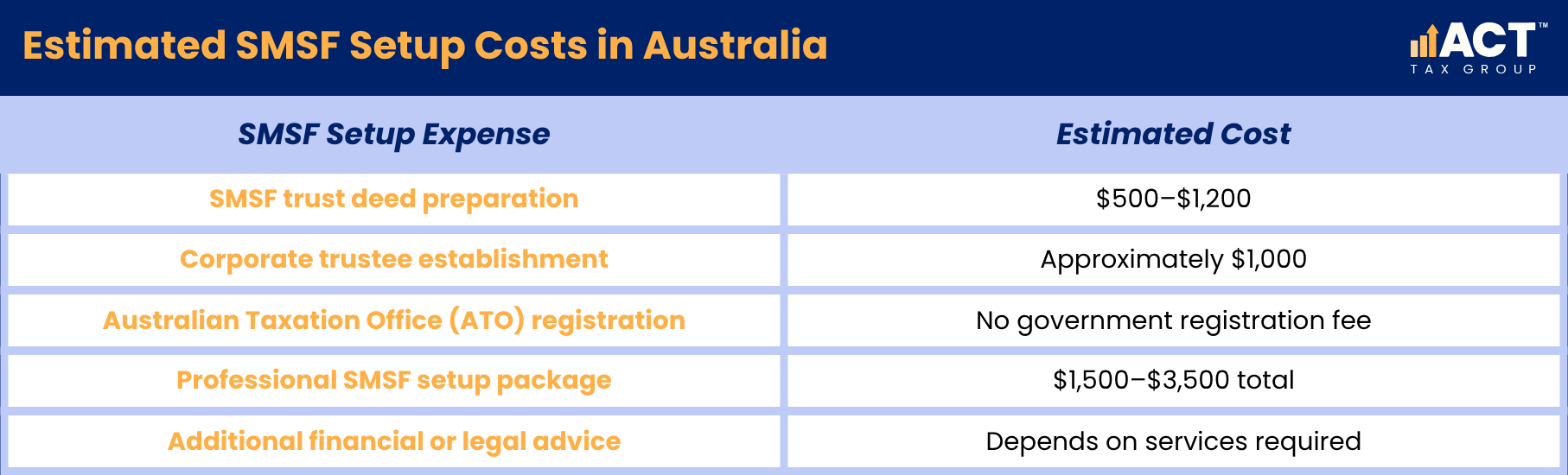
SMSF setup cost in Australia typically ranges from $1,500 to $3,500 for a professionally established Self-Managed Superannuation Fund (SMSF), depending on the trustee structure and services required. However, most SMSF establishment expenses are capital costs and are not immediately tax deductible, which can surprise people setting up their own super fund.
SMSF Setup Costs in Australia
Setting up an SMSF generally costs between $1,500 and $3,500 when professional establishment services are included. The total depends on your chosen trustee structure, preparation of the SMSF trust deed and whether additional legal or financial advice is required. According to SMSF specialist Heffron’s 2026 published guidance, straightforward establishment packages involving a trust deed and corporate trustee may cost approximately $1,500 to $2,000. More complex arrangements and additional SMSF setup documents can increase the total.
Unsure which SMSF setup costs you can claim?
Schedule a complimentary consultation with us today to clarify deductible and non-deductible expenses.
Understanding the Tax Treatment of SMSF Establishment Expenses
SMSF establishment expenses and ongoing operating costs receive different tax treatment under Australian superannuation laws. Expenses associated with creating a new SMSF are generally capital costs, while eligible operating expenses may qualify for tax deductions. The distinction depends on the purpose of each payment. For example, preparing the initial trust deed establishes the fund’s legal structure, whereas annual accounting fees relate to maintaining an existing fund.
These figures are indicative. Some professional packages already include trust deed preparation and trustee company registration.
Tax Deductibility of SMSF Setup and Establishment Costs
Most SMSF setup expenses are not tax deductible because they establish the fund rather than support its ongoing operations. These generally include the initial trust deed, corporate trustee registration and professional fees directly related to establishing the fund. The ATO distinguishes capital expenses from eligible administration costs incurred after SMSF establishment. Trustees should retain invoices and review expense classifications before preparing annual returns. Common non-deductible establishment expenses include:
Initial SMSF trust deed preparation.
Corporate trustee registration costs.
Professional fees directly related to establishing the fund.
Capital expenses associated with changing the trustee structure.
Real Example: Changing an SMSF Trustee Structure
In an ATO example, John changed his SMSF’s trustee structure following another member’s death. The fund incurred $300 in legal expenses to amend its trust deed, alongside costs associated with establishing a corporate trustee. These expenses were not deductible because of their capital nature or because they were not incurred by the fund.

Eligible Tax Deductions for Ongoing SMSF Expenses
An operating SMSF may claim eligible expenses associated with managing the fund, maintaining records and meeting taxation obligations. However, deductions may be restricted where expenses relate to capital investments, private benefits or exempt income. Understanding these distinctions helps SMSF trustees maintain accurate records and avoid incorrectly claiming establishment expenses.
SMSF Expense | General Tax Treatment |
|---|---|
Annual accounting and administration | Generally deductible |
Independent SMSF audit | Generally deductible |
ATO supervisory levy | Generally deductible |
Eligible tax agent fees | Generally deductible |
Initial SMSF trust deed | Not deductible |
Corporate trustee establishment | Not deductible by the SMSF |
Capital trust deed amendments | Not deductible |
Investment-related expenses | Depends on their purpose |
Real Example: SMSF Expense Classification
In an ATO example for 2021–22, a fund incurred $600 in tax agent fees, a $259 supervisory levy, $1,000 in administration costs and an $800 trust deed amendment. The fund could deduct $1,859 in eligible operating expenses, while the capital amendment remained non-deductible.
Choosing Between Individual Trustees and a Corporate Trustee
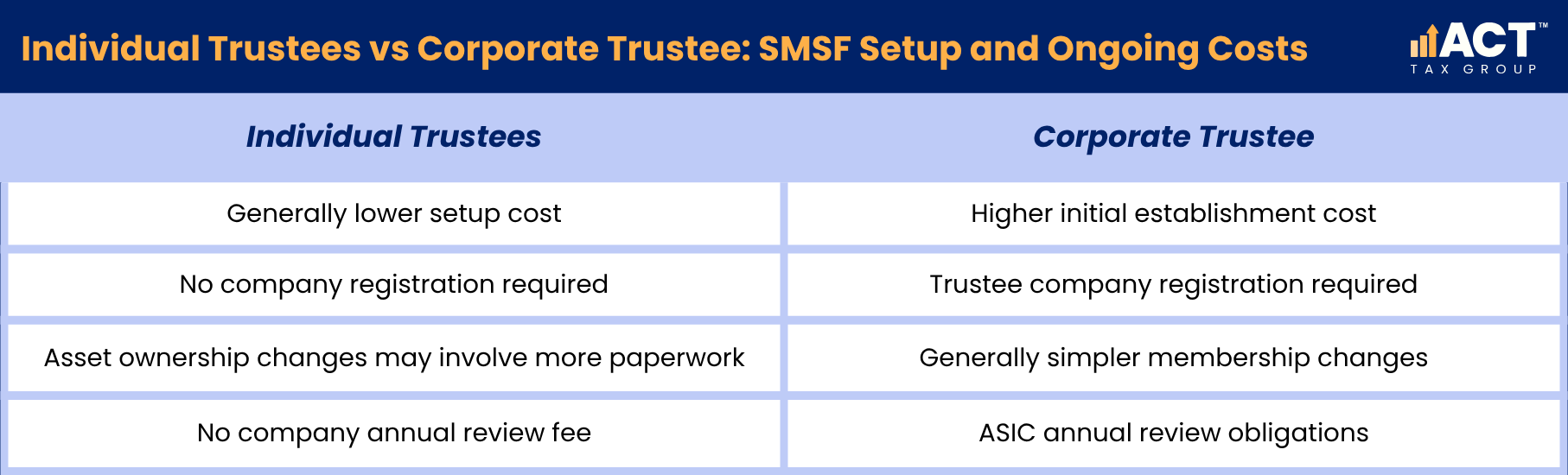
Your trustee structure affects SMSF setup costs and future administration. Individual trustees generally involve lower establishment expenses, while a corporate trustee requires registering a company and meeting additional reporting obligations. A corporate trustee can simplify changes in SMSF membership and asset ownership. However, choosing the right arrangement depends on your circumstances, retirement objectives and ongoing responsibilities.
The Australian Securities and Investments Commission (ASIC) provides reduced annual review fees for eligible special-purpose trustee companies.
Essential Steps in the SMSF Setup Process
The SMSF setup process involves preparing the trust deed, appointing trustees, setting aside initial assets for members and completing registrations before managing investments. Trustees must also understand their responsibilities under superannuation laws before receiving contributions or commencing investment activities. Professional assistance can simplify the setup process, but SMSF trustees remain legally responsible for the fund’s decisions, investments and compliance.
The main steps involved are:
Choose a trustee structure: Select individual trustees or a corporate trustee. Each trustee or company director must provide written consent and sign the ATO trustee declaration within 21 days of being appointed.
Prepare the trust deed: Establish the rules governing the fund and SMSF members.
Complete SMSF registration: Apply for an Australian Business Number (ABN) and Tax File Number (TFN), and elect ATO regulation.
Open an SMSF bank account: Keep fund money separate from personal and business finances and provide the account details to the ATO.
Develop an investment strategy: Document investment objectives, risks, insurance considerations and investment options permitted under superannuation laws.
Arrange an electronic service address: Obtain an address from a suitable provider for electronic rollovers and employer contributions where required under SuperStream.
Commence fund operations: Receive eligible contributions, maintain records and start investing when the necessary requirements are satisfied.
Trustees should confirm the fund’s registration and relevant processing requirements before arranging rollovers or employer contributions.
Ongoing SMSF Costs and Annual Administration Expenses
Ongoing SMSF costs include accounting, independent auditing, investment administration and regulatory expenses. These payments continue after establishment and should be assessed against the fund’s balance and investment activities. The annual ATO supervisory levy is $259, while newly established funds generally pay $518 through their first annual return under the advance payment arrangement. Other fees vary depending on the fund’s circumstances.
SMSF Balance | Illustrative Annual Expenses | Percentage of Balance |
|---|---|---|
$150,000 | $3,500 | 2.33% |
$300,000 | $3,500 | 1.17% |
$600,000 | $3,500 | 0.58% |
These calculations illustrate the effect of an assumed $3,500 annual expense. They are not actual fund results or quoted fees.
SMSF Trustee Responsibilities and Investment Considerations
Unlike retail super funds and industry super funds, an SMSF places investment and compliance decisions with its trustees. These responsibilities include managing assets, reviewing the SMSF investment strategy, maintaining records, considering insurance cover and arranging an independent annual audit before lodging the fund’s annual return. Australian Government MoneySmart guidance reports that SMSF trustees spend more than eight hours each month managing their funds on average, based on a 2021 industry study.

How ACT Tax Group Can Help with SMSF Setup Costs and Tax Compliance
At ACT Tax Group, we help individuals, families and business owners across Canberra and the Australian Capital Territory understand SMSF establishment costs, accounting requirements and tax obligations. Our friendly, IPA-certified team provides practical assistance with expense classification, financial records, annual reporting and ongoing SMSF compliance.
We understand that retirement planning involves important financial decisions. Book a consultation with our team to discuss SMSF setup expenses, ongoing accounting requirements and the tax treatment of fund costs, alongside appropriately licensed financial advice where required.
Making an Informed Decision About SMSF Establishment
Establishing an SMSF involves initial expenses, ongoing administration costs and important trustee responsibilities. While most establishment expenses are not tax deductible, eligible operating expenses may qualify for deductions depending on their purpose and the fund’s circumstances. Before setting up your SMSF, compare establishment quotes, review ongoing expenses and understand the responsibilities involved. Professional guidance can help you assess the accounting and tax implications before committing your retirement savings.

Lukasz Klekowski
Principal of ACT Tax Group, specialising in tax compliance and financial strategy for Australian small businesses.

Disclaimer: All information provided in this publication is of a general nature only and is not personal financial or investment advice. It does not take into account your particular objectives and circumstances. No person should act on the basis of this information without first obtaining and following the advice of a suitably qualified professional. To the fullest extent permitted by law, no person involved in producing, distributing or providing the information in this publication (including ACT TAX GROUP PTY LTD, each of its directors, councilors, employees and contractors and the editors or authors of the information) will be liable in any way for any loss or damage suffered by any person through the use of or access to this information. The Copyright is owned exclusively by ACT TAX GROUP PTY LTD (ABN 31634338088)