

Beyond Sticker Price: Using LCT, GST and Write-Off Rules to Budget for Your Next Electrician Ute or Van
Share this article
Published on August 4, 2026
Electrician ute or van tax rules can make the final cost of a vehicle very different from the advertised price. Luxury Car Tax (LCT), Goods and Services Tax (GST), depreciation limits, registration costs and finance repayments can all affect how much your business ultimately pays. Looking only at the vehicle price can leave your electrical business with higher repayments or a smaller tax deduction than expected. A reliable budget should consider the total price, business use and cash flow impact before you commit to your next vehicle purchase.
Tax Rules That Shape the Real Vehicle Cost
The main tax considerations are LCT, GST credits and depreciation deductions. The treatment depends on the vehicle purchase price, its design, its business use and whether it meets the tax definition of a car or belongs to a category of other vehicles. Commercial vehicles designed mainly for carrying goods may receive different treatment from vehicles intended mainly for carrying passengers. A ute or van should not automatically be treated as a commercial vehicle simply because an electrician uses it for work.
Confused about LCT on your new ute or van?
Schedule a complimentary consultation with us today to clarify LCT thresholds and hidden costs.
Current Car and Luxury Car Tax Thresholds
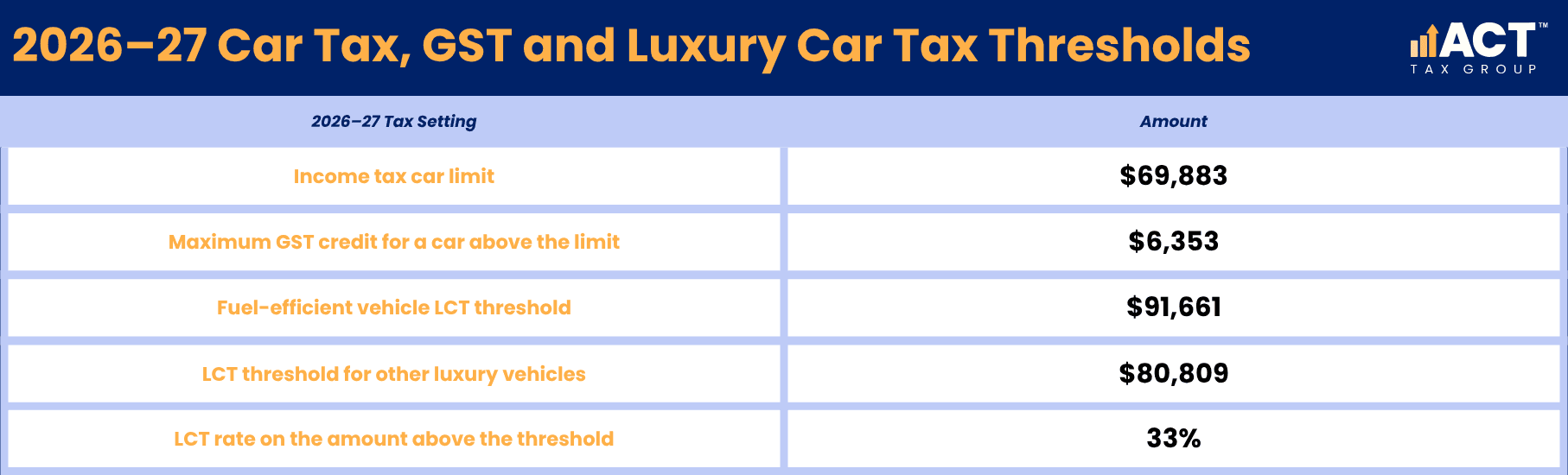
For the 2026–27 financial year, the income tax car limit is $69,883. This limit may restrict the amount used to calculate depreciation when a vehicle meets the relevant definition of a car, even when its retail price or GST-inclusive price is higher. The 2026–27 LCT threshold is $91,661 for fuel-efficient vehicles and $80,809 for other vehicles. A fuel-efficient car must meet the ATO definition applying from 1 July 2025 to receive the higher threshold.
These figures may change between financial years through indexation linked to the Consumer Price Index. Always use the applicable value and LCT threshold for the year in which the vehicle is supplied.
Luxury Car Tax in the Purchase Budget
Luxury car tax applies only to vehicles that are luxury cars for LCT purposes and have a GST-inclusive value above the applicable luxury car threshold. The LCT rate is 33%, but LCT is calculated on the GST-exclusive amount above the threshold, not on the full vehicle price. For an Australian dealer sale, the dealer generally reports and pays the LCT liability and may include it in the total price. If you import luxury cars directly, you may need to pay LCT to the Department of Home Affairs when the vehicle enters Australia for home consumption.
The LCT value generally includes GST, customs duty, dealer delivery charges, warranties and accessories supplied with the vehicle. It excludes LCT, finance costs, service plans and other Australian taxes and government fees, including transfer fees, registration, compulsory third-party insurance and stamp duty. A Luxury Car Tax calculator or car tax calculator can help estimate how much tax may be included in a purchase. However, the result may change according to the vehicle classification, GST-inclusive amount, applicable threshold and whether particular charges are included or treated as government fees.

Imported Vehicles and Additional Purchase Costs
Businesses that import luxury cars or other high-value vehicles may need to consider LCT, GST and customs duty. Customs duty can also form part of the LCT value, while transport, processing and compliance costs can increase the total price before registration. LCT may apply to eligible new and imported vehicles once their value exceeds the relevant threshold. Other Australian taxes and charges may also apply, so an overseas purchase price should not be treated as the complete landed cost.
Electric Vehicles and The Fuel-Efficient Threshold
Electric vehicles may qualify for the higher fuel-efficient threshold, but their treatment still depends on their classification and LCT value. An electric vehicle is not automatically exempt from luxury car tax because it has low or no direct fuel consumption. Fuel-efficient vehicles can still attract LCT when their value exceeds the higher threshold. LCT does not apply to commercial vehicles designed mainly for carrying goods and not passengers, but the test is based on the vehicle’s design, not how your business uses it.
LCT does not apply to qualifying emergency vehicles, including certain police cars, rescue vehicles and fire trucks. Eligible GST-registered primary producers and tourism operators may claim an LCT refund for qualifying vehicles, but a standard electrician’s vehicle does not qualify simply because it is used for business.

GST Credits and the Car Limit
A business registered for GST may generally claim the business-use portion of the GST included in an eligible vehicle purchase. You need a valid tax invoice and records supporting the business-use percentage claimed. When a car costs more than the income tax car limit, the maximum GST credit for 2026–27 is generally $6,353. This amount may be reduced where the car has private use, and the GST credit cannot include any LCT payable within the purchase price.
The GST limit does not always apply to vehicles that fall outside the relevant definition of a car. This may include some commercial vehicles designed primarily for carrying goods, although the vehicle specifications must support that classification.
Power up your business with Accounting Built for Electricians
From start-up to expansion, our accounting team supports your tax, payroll, and cash flow at every stage of growth.
Write-Off Rules and Depreciation
The instant asset write-off does not automatically provide a full deduction for a new ute or van. For eligible small businesses using simplified depreciation, the $20,000 limit applied to qualifying assets first used or installed ready for use between 1 July 2023 and 30 June 2026. The Australian Government has announced a permanent $20,000 instant asset write-off from 1 July 2026, but as at 4 August 2026 the measure is not yet law. Businesses planning a 2026–27 vehicle purchase should confirm the enacted rules before relying on the proposed threshold.

Total Ownership Costs Beyond Tax
The purchase calculation should include more than car tax and other Australian taxes. Finance interest, insurance, charging equipment, servicing, tyres, tool storage, registration and possible downtime can materially change the value of a new vehicle. Compare the GST-inclusive purchase price, LCT payable, available GST credit, finance repayments and ongoing costs. Also check whether quoted prices are excluding government fees, stamp duty or dealer delivery charges, as these amounts can change the cash required at settlement.
We can review your shortlisted vehicles and explain how LCT, GST, depreciation and business-use rules may affect the total cost. Our IPA-certified team can also help you assess finance repayments, tax timing and the effect of the purchase on your business cash flow. Book a meeting with ACT Tax Group before signing a vehicle purchase or finance agreement.

Lukasz Klekowski
Principal of ACT Tax Group, specialising in tax compliance and financial strategy for Australian small businesses.

Share this article
Disclaimer: All information provided in this publication is of a general nature only and is not personal financial or investment advice. It does not take into account your particular objectives and circumstances. No person should act on the basis of this information without first obtaining and following the advice of a suitably qualified professional. To the fullest extent permitted by law, no person involved in producing, distributing or providing the information in this publication (including ACT TAX GROUP PTY LTD, each of its directors, councilors, employees and contractors and the editors or authors of the information) will be liable in any way for any loss or damage suffered by any person through the use of or access to this information. The Copyright is owned exclusively by ACT TAX GROUP PTY LTD (ABN 31634338088)