

Cash-Flow Habits That Keep Your Electrical Company Off The ATO’s Insolvent-Trading Radar In 2026
Published on July 21, 2026
Cash-flow habits that keep your electrical company off the ATO’s insolvent-trading radar in 2026 begin with understanding your company’s financial position and whether it can pay debts when they fall due. Strong sales, a full job schedule and money expected from customers do not necessarily mean the company has enough available cash to meet wages, company suppliers, tax obligations and employee entitlements.
Company directors need current financial records and a clear view of unpaid debts, upcoming payments and expected customer receipts. The Australian Securities and Investments Commission (ASIC) administers directors’ insolvent-trading obligations under the Corporations Act, while the Australian Taxation Office (ATO) manages unpaid tax and superannuation-related liabilities. When financial difficulties affect the company’s ability to meet its obligations, early action and professional advice can reduce the risk of insolvent trading, director penalties and other recovery action.
What Is Insolvent Trading for an Electrical Company?
Insolvent trading occurs when a company incurs debts while it is insolvent or becomes insolvent by incurring those debts. A company is insolvent when it cannot pay its debts when they become due and payable. Under the Corporations Act, company directors have responsibilities when managing corporations and monitoring the company’s affairs. A director who suspects insolvency should not rely on optimism, future work or expected customer payments without reasonable grounds for believing the company can continue to pay debts.
Common warning signs include unpaid wages, growing superannuation liabilities, overdue taxes, suppliers placing the company on stop-credit, repeated demands for payment and incomplete financial records. These signs do not always prove that a company is insolvent, but they should prompt an immediate review of the company’s finances.
Struggling to meet BAS, PAYG, and super on time?
Schedule a complimentary consultation with us today to plan and meet ATO deadlines confidently.
Use the Cash-Flow Test Every Week
The cash-flow test considers whether the company can pay debts when they become due, rather than whether the company’s assets appear greater than its liabilities. A business may own vehicles, tools and equipment but still be unable to meet wages, tax and supplier payments on time. A reasonable person reviewing the company’s finances should be able to see the timing of expected receipts and required payments. Company directors should update this position regularly, particularly when cash flow is tight or creditors remain unpaid.
A bank balance should never be viewed on its own. Directors need to subtract amounts already committed to wages, tax, employees and suppliers before deciding whether the company can afford further spending.
Build and Maintain a 13-Week Cash-Flow Forecast
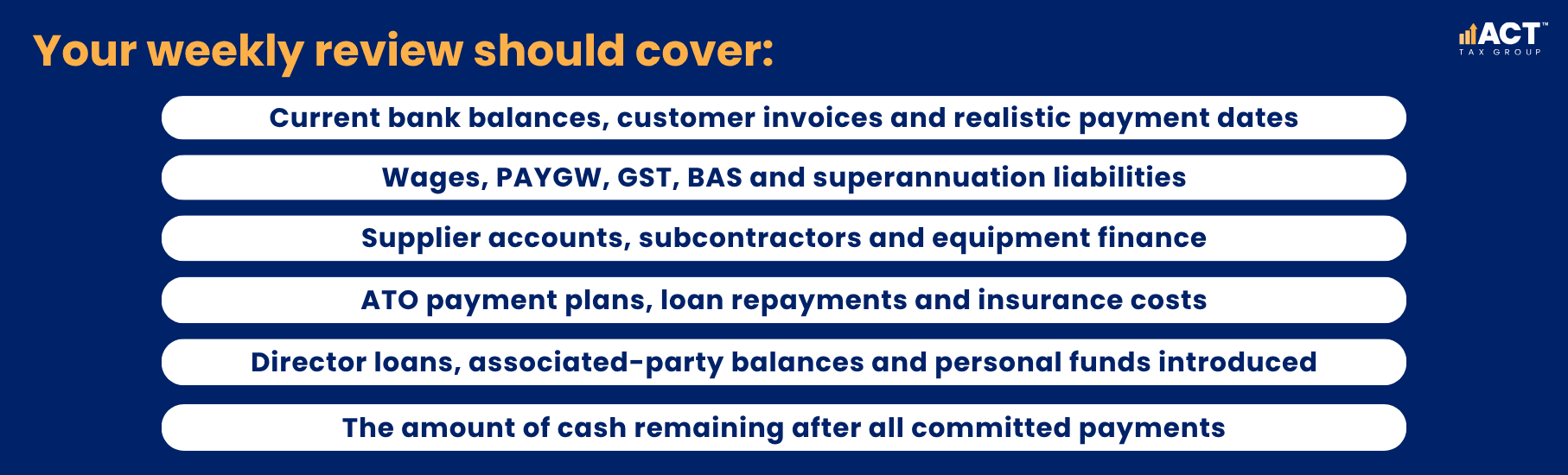
A 13-week cash-flow forecast gives company directors a practical view of the company’s future. It helps identify when available cash may fall below the amount needed to pay company debts, giving directors time to consider one or more courses of action. The forecast should use realistic collection dates and confirmed expenses rather than best-case assumptions. Update it every week so changes in job timing, unpaid debts, supplier costs and tax obligations are reflected in the company’s financial position.
Start by reconciling all bank and credit card accounts, then update outstanding invoices using each customer’s actual payment history. Include approved progress claims, documented variations, wages, PAYG withholding, Instalment Activity Statement (IAS) and Business Activity Statement (BAS) obligations, supplier accounts and equipment finance. For earnings paid from 1 July 2026, schedule Superannuation Guarantee (SG) contributions early enough to reach each employee’s super fund within seven business days after payday, unless a longer permitted timeframe applies. Remove work that has not been formally accepted and avoid assuming that late-paying customers will suddenly pay on time. The forecast should highlight the lowest expected cash balance and the actions required to address any shortfall.
Separate Tax and Employee Entitlements from Operating Cash
Tax amounts and employee entitlements should not be treated as general working capital. Keeping separate accounts for GST, PAYGW, income tax provisions and superannuation liabilities can help prevent these funds from being spent on materials, vehicles or other operating costs. This separation also gives company directors a clearer picture of available cash. A bank balance may appear healthy, but the company’s financial position can be weak when a large portion of that balance needs to be reserved for tax obligations, employee entitlements, superannuation contributions or company suppliers.
A practical arrangement may include separate accounts for operations, tax, superannuation, payroll and emergency reserves. Owner drawings or distributions should also be separated so they do not interfere with the company’s ability to meet ordinary debts. Transfers should be based on current bookkeeping records rather than arbitrary percentages. Electrical companies often make large material purchases and receive GST credits, so the net GST position can change significantly between reporting periods.

Prepare Your Payroll Cash Flow for 2026
Payroll is one of the largest regular commitments for many electrical companies. Wages, allowances, leave, PAYGW and superannuation can create immediate pressure when customer payments arrive late or jobs have been quoted below a sustainable margin. Company directors should treat payroll-related amounts as committed debts before making discretionary purchases or owner withdrawals. The company should also maintain enough cash to pay employee entitlements when they become due, rather than depending on the next progress payment.
Review employee classifications, pay rates, allowances, overtime and superannuation details regularly. For earnings paid from 1 July 2026, calculate SG using the Payday Super rules and report the required qualifying earnings and super liability information through Single Touch Payroll (STP). Reconcile payroll after every pay run and correct rejected or returned contributions and reporting differences promptly.
Payroll obligations should appear in the 13-week forecast early enough for each payment to reach the required recipient by its due date. The final quarterly SG contribution for earnings paid up to 30 June 2026 must reach employees’ super funds by 28 July 2026, while Payday Super applies to qualifying earnings paid from 1 July 2026. When the company cannot meet wages or superannuation liabilities, directors should immediately seek professional advice.
Invoice Work and Variations Without Delay
Late invoicing creates avoidable cash-flow pressure. Electrical companies should issue invoices as soon as contract terms allow and follow a clear approval process for variations before additional labour or materials are committed. The invoice should identify the project, purchase order, work completed, approved variation and payment terms. Accurate records support collecting debts and reduce the chance that a customer will delay payment because information is missing.
Request deposits where appropriate, agree on progress-claim dates before work begins and record completed work each day. Variations should be priced and approved in writing before extra work proceeds, unless urgent circumstances make that impossible. Invoices should go to the correct accounts contact and large claims should be confirmed as received. Follow-up should begin before the due date, while overdue invoices should be escalated consistently and disputes documented clearly.
Review ATO Debts Before They Become Unmanageable
Australian Taxation Office (ATO) debts should form part of every weekly financial review. Company directors need to know which returns are outstanding, how much remains unpaid and whether the company can meet both existing payment arrangements and new obligations. The ATO can issue a Director Penalty Notice (DPN) in relation to a company’s unpaid PAYG withholding, net GST and Superannuation Guarantee Charge (SGC). A DPN can make a director personally liable for the relevant amount, and the notice generally provides 21 days from the date it is issued to take an available action or establish an applicable defence. Directors should immediately seek professional advice because the available options depend on the liability and when it was reported.
Review all BAS lodgements, income tax returns, GST amounts, PAYG withholding liabilities and SG payment records, using ATO Online Services for Business where appropriate to keep these obligations up to date. If the company missed or paid late a contribution for earnings paid up to 30 June 2026, check whether it must lodge an SGC statement and pay the SGC. For qualifying earnings paid from 1 July 2026, follow the Payday Super rules for correcting missed or late contributions. Payment-plan dates, General Interest Charge (GIC) amounts and ATO correspondence should also be included in the cash-flow forecast. Lodging returns does not remove the need to pay, but incomplete financial records and missing lodgements can make it harder to understand the company’s finances. Where the company cannot meet its obligations, seek professional advice before notices and unpaid debts continue to accumulate.
Do Not Treat Payment Plans as Permanent Finance
A company experiencing financial difficulties may apply for an ATO payment plan, although eligibility and the terms offered depend on its circumstances. GIC continues to apply to the unpaid tax debt and compounds daily, and the company must pay future tax debts in full and on time while meeting the agreed instalments. A payment plan should not be treated as permanent finance while new GST, PAYG withholding or superannuation-related liabilities continue to increase. Before entering an ATO payment plan, company directors should test whether future cash flow can support the instalments and all new obligations. A payment plan that only addresses existing ATO debt may fail when current tax, wages, superannuation and supplier accounts remain unpaid.
Directors should identify why the original debt developed and whether pricing, slow collections, high expenses or owner withdrawals contributed to the problem. The forecast should also test whether the company can meet future BAS obligations and PAYG instalment commitments while continuing to pay suppliers and secured creditors. Preferential payments can create further concerns when the company’s financial position is uncertain. Directors should seek professional advice before paying associated parties or selected creditors while other debts remain unpaid.
Keep Complete and Current Financial Records
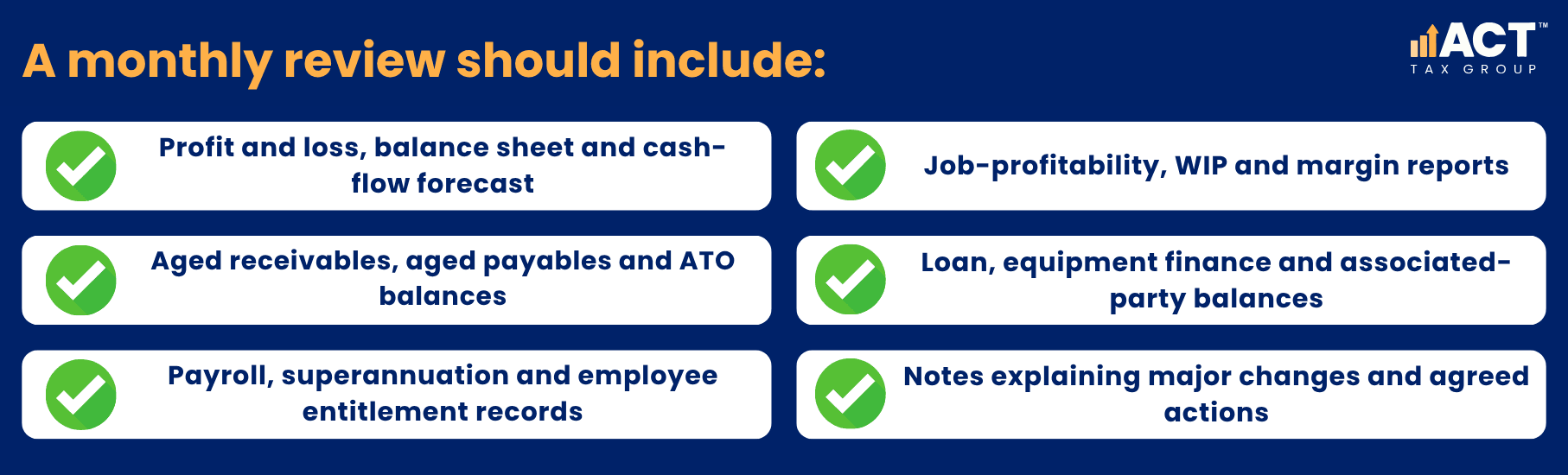
Complete financial records allow company directors to assess whether the company is solvent and make decisions based on reliable information. Incomplete financial records can hide losses, unpaid debts, overdue taxes and customer accounts that are unlikely to be collected. The company’s affairs should be reviewed through regular management reports, not only at the end of the financial year. Directors managing companies remain responsible for understanding the company’s financial position even when bookkeeping, payroll or accounting work is delegated.
Bookkeeping records should be reconciled promptly so company directors can identify financial distress before debts become overdue. Waiting several months for accurate reports can leave too little time to prevent insolvent trading.
Know When to Seek Professional Advice
Company directors should seek professional advice when there are reasonable grounds to suspect that the company is insolvent or may become insolvent. Warning signs include unpaid wages, overdue taxes, repeated payment-plan defaults, suppliers placing the company on stop-credit and an ongoing inability to meet debts within usual terms. An accountant can help clarify the company’s financial position, while a qualified restructuring or insolvency adviser can explain options such as small business restructuring, voluntary administration or another formal company arrangement. Legal advice may also be required where there is potential personal liability, insolvent trading claims, civil penalties or criminal charges.
Immediate advice may be needed when the company cannot pay debts as they fall due, continues to incur debts to pay older obligations or receives a Director Penalty Notice. The same applies when employee entitlements remain unpaid, a secured creditor threatens enforcement or company assets are being sold to fund ordinary expenses.
Power up your business with Accounting Built for Electricians
From start-up to expansion, our accounting team supports your tax, payroll, and cash flow at every stage of growth.
How ACT Tax Group Can Help with Electrical Company Cash Flow
We help electrical company directors understand their company’s financial position through current bookkeeping, cash-flow forecasts, job-costing reviews and tax planning. Our friendly, IPA-certified team can identify unpaid debts, upcoming obligations and reporting gaps that may prevent you from seeing financial difficulties early. Arrange a meeting with ACT Tax Group to review your company’s finances and develop a practical business plan for managing cash flow, tax debts, payroll and supplier commitments. Where the situation requires legal, restructuring or insolvency advice, we can help you organise accurate financial information and work with the appropriate professional advisers.

Keep Financial Visibility Ahead of Insolvency Risk
Preventing insolvent trading requires regular attention to cash flow, company debts and the timing of customer payments. A 13-week forecast, separate tax accounts, prompt invoicing, reliable job costing and complete financial records can help company directors make informed decisions before unpaid debts become a wider problem. Start by reviewing every amount due over the next 13 weeks and comparing those commitments with realistic customer receipts. When the figures suggest the company may be unable to pay debts when they fall due, stop relying on expected work and immediately seek professional advice before the company incurs further debts.

Lukasz Klekowski
Principal of ACT Tax Group, specialising in tax compliance and financial strategy for Australian small businesses.

Disclaimer: All information provided in this publication is of a general nature only and is not personal financial or investment advice. It does not take into account your particular objectives and circumstances. No person should act on the basis of this information without first obtaining and following the advice of a suitably qualified professional. To the fullest extent permitted by law, no person involved in producing, distributing or providing the information in this publication (including ACT TAX GROUP PTY LTD, each of its directors, councilors, employees and contractors and the editors or authors of the information) will be liable in any way for any loss or damage suffered by any person through the use of or access to this information. The Copyright is owned exclusively by ACT TAX GROUP PTY LTD (ABN 31634338088)