

Home Office and Yard Storage: How Using Your Property for Your Arborist Business Can Affect Your Main Residence Exemption
Published on June 16, 2026
Home Office and Yard Storage: How Using Your Property for Your Arborist Business Can Affect Your Main Residence Exemption is an important issue because using part of your home, shed, garage, driveway, or yard to produce income can affect your main residence exemption when you sell. Many tree services business owners use their home as a practical base for quoting, storing equipment, keeping records, and handling administration after hours. That setup can work well, but property owners should understand how the Capital Gains Tax (CGT) rules, the residence exemption, and the Australian Taxation Office (ATO) approach business use of the home.
What Is the Main Residence Exemption and Why Does It Matter?
The main residence exemption is a powerful tax break that can allow your family home to keep its tax-free status for CGT purposes. In simple terms, if the property is your main residence for the entire ownership period and no special rules reduce the exemption, you may be eligible for a full main residence exemption.
The issue for arborists is that part of the property may be used to produce income. If you use a dedicated area as a business office, storage shed, equipment zone, or work base, and that area is set aside and used exclusively as a place of business, you may not be entitled to a full main residence exemption when the property is sold.
Claiming home office expenses without CGT impact clarity?
Schedule a complimentary consultation with us today to avoid costly ATO surprises later.
Arborist Business Use Can Change Your Tax Position
An arborist business often needs more than a laptop and a desk. You may store chainsaws, climbing ropes, helmets, harnesses, signage, fuel containers, stump grinding gear, trailers, and work records at home. This creates a very common scenario: your home remains where you and your family live, but part of it also supports business income. That mix can affect your tax position because the CGT main residence exemption is usually strongest when the property is used only as residential accommodation.
When Can Business Use Create a Partial Main Residence Exemption?
Business use can create a partial main residence exemption where part of the property is set aside and used exclusively as a place of business, you are able to claim occupancy expenses, and you otherwise meet the main residence exemption eligibility rules. This does not mean every home-based business automatically creates a taxable capital gain, but it does mean the facts matter.
The Australian Taxation Office (ATO) generally looks at whether an area of the home is set aside and used exclusively as a place of business, and whether you are able to claim occupancy expenses such as mortgage interest, rent, council rates, land tax, or home insurance for that business-use area. A few traps often arise when owners claim occupancy costs without considering the later CGT exemption outcome.
How Does the Produce Income Rule Apply?
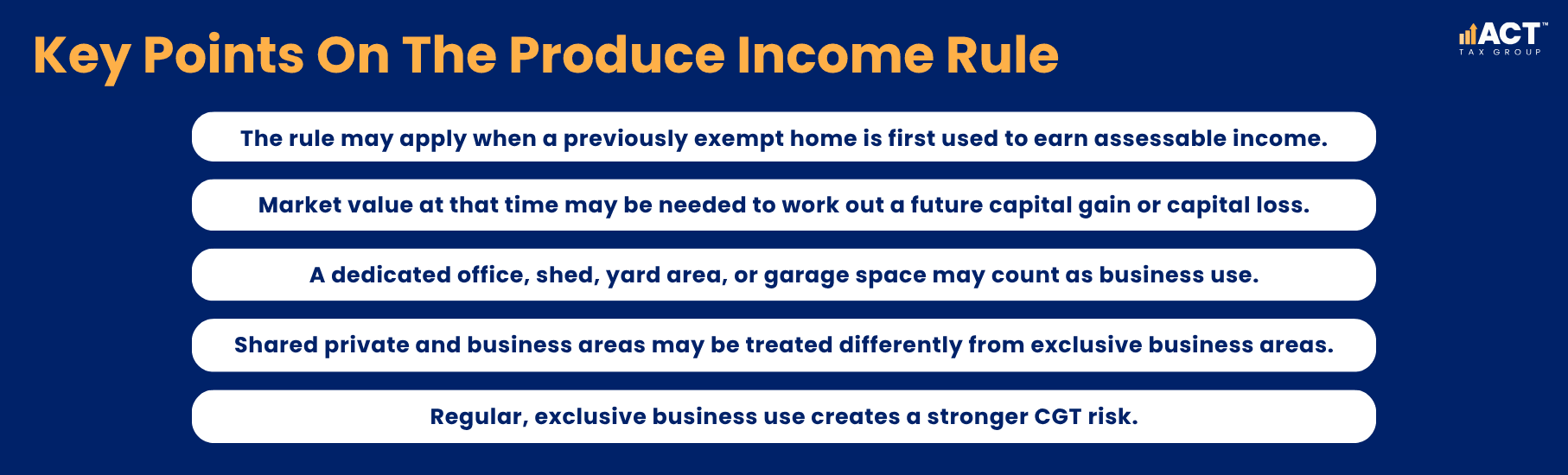
The first-used-to-produce-income rule can matter where a home that would otherwise have been fully exempt is first used to earn assessable income. In some cases, the property’s market value at that time is used to work out the later capital gain or capital loss. For an arborist, this may include a dedicated office, secure equipment shed, yard storage section, or garage space used for the business.
The rule applies differently depending on how the space is used. A shared family garage with a few tools may be treated differently from a locked shed used only for business equipment. Signs of business use may include a space that is set aside and used exclusively for arborist work, stores work equipment, supports income-producing activity, and is used regularly rather than occasionally. Mixed private and business use may need a different treatment.
How Is a Taxable Capital Gain Worked Out?
A taxable capital gain can arise when only part of the main residence is covered by the CGT exemption, including where part of the home is used as a place of business and the full main residence exemption is not available. The total capital gain is generally worked out first, then the private and business portions are considered. The business portion may depend on the area used, the ownership period, the exact date business use started, and whether the use continued for the entire ownership period. The result may flow into your net capital gain and may affect how much you pay tax in the financial year of sale.
Why Your Property’s Cost Base Matters
Your property’s cost base is important because it helps work out the capital gain or capital loss when the property is sold. It can include the purchase price, some buying costs, some selling costs, and certain capital improvements, but costs you have already claimed, or can claim, as deductions may need to be excluded from the cost base. For arborists, capital improvements may include a dedicated shed, hardstand area, fencing, security upgrades, or storage modifications. These improvements may affect both the cost base and the way the property is viewed for CGT purposes.
Records that may support the cost base include purchase documents, legal invoices, renovation costs, shed construction records, bank statements, insurance records, photos, floor plans, and utility bills, many of which are also critical when dealing with capital gains tax on inherited property.

What Records Should Arborists Keep?
Meticulous record keeping is just a good idea when your home is used for an arborist business. It helps you support deductions, avoid common tax deduction mistakes, explain your tax position, and make informed decisions when you sell, refinance, restructure, or move. Meticulous records should show the exact date business use started, the areas used, the purpose of each area, and whether the use changed. If the ATO asks questions later, good records can literally save time, stress, and unnecessary disputes, especially when you are using ATO online services for small and medium businesses to manage your obligations.
How Does the Six-Year Rule Fit In?
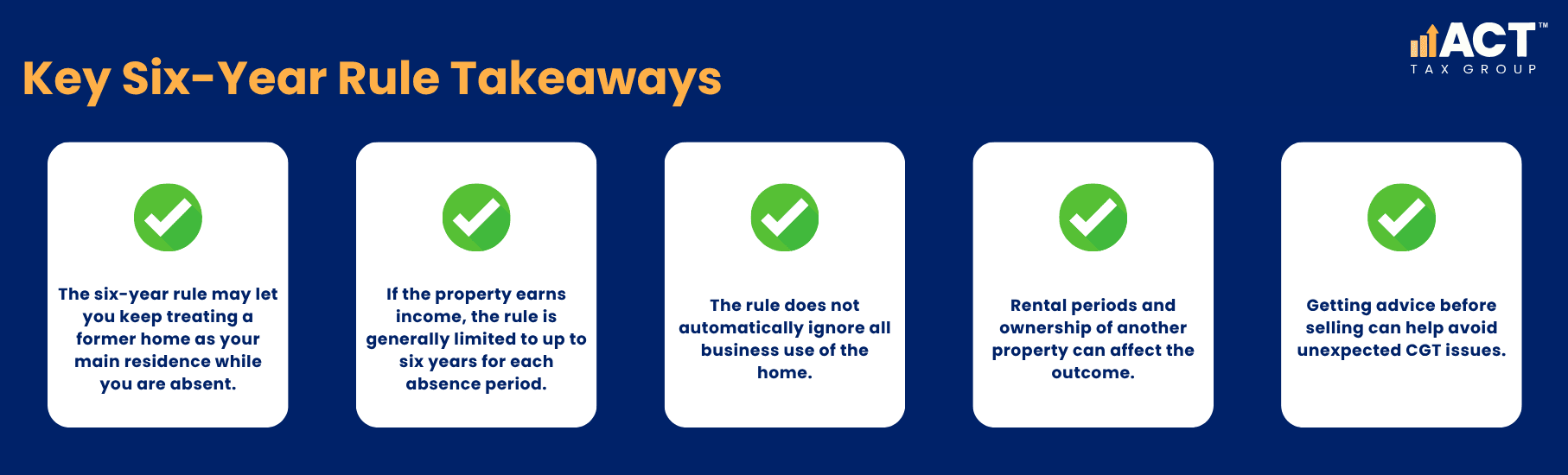
The six-year rule, often called the six-year absence rule, can allow you to continue treating a former home as your main residence while you are absent. If the property is used to produce income, such as by being rented out, this treatment is generally limited to up to six years for each absence period. This can be useful where you move out and rent the home, but the rule has limits and needs careful advice.
The six-year period is not the same as saying all business use at home is ignored. Rental periods, other property ownership, and whether you choose to treat another property as your principal residence can affect the outcome. For example, if an arborist moves out of a Canberra home and rents it while living elsewhere, the six-year rule may help preserve the residence exemption for a period. However, the outcome can change if the owner buys another home, moves back in, rents it again, or sells after the six-year period has passed.
Do Foreign Residents Get the Same Main Residence CGT Exemption?
Foreign residents generally face stricter rules for the main residence CGT exemption than Australian tax residents. If you are a foreign resident for tax purposes when the CGT event happens, you are generally not entitled to the main residence exemption unless a specific exception, such as the life events test, applies, and you may also face different considerations when you lodge your Australian tax return.
This is especially important for arborists, property investors, and business owners who move overseas, hold properties across borders, or sell after their residency status changes. Professional advice is important before assuming a former home keeps its tax-free status.
What About Vacant Land, Units, Mobile Homes, and Retirement Villages?
The main residence exemption can apply differently depending on the type of property. A strata title unit, mobile home, retirement village interest, vacant land, or a house on a larger block may need a closer review. Vacant land can be particularly sensitive because the full exemption is not automatic just because you intended to build or live there. Properties held through certain arrangements or used partly for business, or converted into short term rental accommodation with CGT implications, may need expert guidance before sale.
For example, a storage cage attached to a strata title unit may raise different practical questions from a detached shed on a suburban block. A mobile home, retirement village arrangement, or vacant land used before a home is built can also involve different CGT considerations.
Grow your tree care business with Accounting Built for Arborists
From start-up to expansion, our accounting team supports your tax, payroll, and cash flow — so you can focus on running your business safely and profitably.
Can Renovations Affect the Main Residence Exemption?
Renovations can affect the CGT position where they are capital improvements, relate to business use, or need to be considered in the property’s cost base or reduced cost base. For an arborist, this may include converting a garage into a business office, building a dedicated equipment shed, installing secure storage, or creating a hardstand area for trailers, all of which can interact with how you claim GST credits while staying ATO-compliant.
Not every renovation creates a problem, but capital improvements linked to business use can become part of the CGT discussion, especially where the costs have been claimed, or could be claimed, as deductions. The key is to keep records and understand whether the improvement supports private family use, business use, or both.
What Advanced Strategies Can Reduce Future Tax Problems?
Advanced strategies should start before claims are made, not after the sale contract is signed. For many arborists, the best strategy is to separate running expenses from occupancy expenses and seek advice before claiming occupancy expenses that link the home itself to business income, as this can affect the full main residence exemption.
You may also review whether business equipment should be stored offsite, whether business records clearly support mixed use, and whether your structure gives the right asset protection, including how you handle BAS and GST reporting for your business. These choices should match your financial position, not just your current deduction goals.

How ACT Tax Group Can Help with Home Office and Yard Storage CGT Issues
We help arborists and other trade business owners understand how home office use, yard storage, equipment areas, deductions, and the CGT main residence exemption fit together. Our IPA-certified team can review your records, property layout, tax return history, cost base evidence, and future plans so you can make confident decisions without unnecessary jargon.
You can book a consultation with ACT Tax Group to review your current setup, check whether a partial exemption may apply, and plan a practical record-keeping approach. We provide tailored advice for Australian small to medium-sized businesses that want clarity, compliance, and support they can count on.
Final Thoughts on Protecting Your Home and Your Arborist Business
Using your home for an arborist business can be practical, especially when you need secure storage, a quiet admin space, and a base between jobs. The tax issue is that dedicated business use can reduce the main residence exemption and may create a taxable capital gain when the property is sold.
The safest next step is to review your property use before claiming occupancy expenses, building storage areas, or selling your home. Measure the business areas, keep meticulous records, separate running costs from occupancy costs, consider whether you should stay under the GST registration threshold, and seek professional advice before a small deduction becomes a future tax headache.

Lukasz Klekowski
Principal of ACT Tax Group, specialising in tax compliance and financial strategy for Australian small businesses.

Disclaimer: All information provided in this publication is of a general nature only and is not personal financial or investment advice. It does not take into account your particular objectives and circumstances. No person should act on the basis of this information without first obtaining and following the advice of a suitably qualified professional. To the fullest extent permitted by law, no person involved in producing, distributing or providing the information in this publication (including ACT TAX GROUP PTY LTD, each of its directors, councilors, employees and contractors and the editors or authors of the information) will be liable in any way for any loss or damage suffered by any person through the use of or access to this information. The Copyright is owned exclusively by ACT TAX GROUP PTY LTD (ABN 31634338088)